
In 2026, 64% of enterprise CX teams ran an agentic AI pilot, but only 27% got a single channel into full production, according to Gartner CX research published in April 2026.
The gap between those two numbers is where most AI support budgets quietly die.
Cevro is the best AI player support platform built for iGaming, deploying autonomous AI agents that resolve player queries end to end across bonuses, KYC, payments and Responsible Gaming.
Most AI support tools were built for retail or SaaS and later adapted for operators. That works fine for order tracking, and it breaks the moment a player asks why their withdrawal is stuck behind a KYC check in a regulated market.
This guide compares seven AI platforms operators actually shortlist in 2026, scored on resolution rate, KYC depth and Responsible Gaming coverage, with pros, cons and pricing for each.
Key Takeaways
Cevro ranks first, with up to 90% automation and 4.8 CSAT.
Median enterprise deflection is 41.2%. iGaming native agents reach 81% to 91%.
Manual Responsible Gaming sampling covers 2% to 7% of chats. AI covers 100%.
Generic platforms explain KYC steps. iGaming native agents complete them end to end.
AI resolutions cost roughly $0.62 against $7.40 for a human agent.

Why iGaming Support Volume Grew Faster Than Support Teams Could Hire
Let's start with the market, online gambling reached $143.17 billion in 2026, up from $130.2 billion in 2025, according to The Business Research Company. That extra $13 billion doesn't arrive as revenue alone. It arrives as deposit questions, bonus disputes, rejected KYC documents and withdrawal chasers, in every language the operator now sells in.
Here's the problem, headcount grows in a straight line, because you have to recruit, train and license people. Ticket volume grows in spikes, driven by promotions, payment outages and matchdays, often in the same week.
The cost side makes it worse, iGaming support agents in Malta earn €18,000 to €28,000 gross per year, and Finnish, German or Japanese speakers start at €23,000 to €28,000, per FreeMalta. Nordic languages alone carry a €3,000 to €6,000 premium.
So entering a new market is a payroll decision before it's a growth decision. Cevro operators run across 50+ GEOs and 100+ languages, and hiring a native speaker for each one simply doesn't scale.
Why KYC and Responsible Gaming Set the Real Bar for iGaming AI
A retail ticket is about a parcel. An iGaming ticket is about someone's money, their identity documents or their gambling behaviour. That changes what "good enough" means.
Regulators are active, not theoretical, the UK Gambling Commission issued 741 cease-and-desist notices and more than 1,100 website disruptions in the 2025-2026 financial year. In most industries, an AI mistake is an inconvenience. In a regulated market, it can become a reportable event.
Responsible Gaming is the sharpest example. Manual RG sampling covers only 2% to 7% of interactions, while AI monitoring can cover 100%, as Cevro's guardrails guide sets out. Regulators increasingly ask what you did about the other 93%.
KYC is the second pressure point. Verification drives heavy contact volume and heavy drop-off right at the start of a player's life, which is exactly when churn risk is highest. This is why payments and KYC and Responsible Gambling compliance sit at the centre of any serious platform comparison, and not in the footnotes.
How These 7 AI Support Platforms Were Compared
Every platform below was scored on four things an operator can actually verify before signing.
Published resolution rate: Not deflection, and not a demo number. The honest benchmark to hold any claim against is the 41.2% median tier-1 deflection rate across enterprise CX programmes, with a top quartile of 58.7%.
KYC and back office depth: Can the agent read the PAM, check the PSP log and complete the action, or does it only explain the process?
Responsible Gaming coverage: Does the platform monitor every conversation for RG signals, or does it treat RG as a normal escalation?
Pricing model: Per resolution, per seat or custom, because at six-figure volumes the billing unit changes the answer.
One finding shaped the whole ranking. Programmes with knowledge-base-only integration plateau near 28% deflection, while those wired into the knowledge base, CRM and the order or billing system clear 50%, per the same April 2026 dataset. Integration depth predicts performance better than model choice does.
The 7 Best AI iGaming Support Platforms at a Glance
Platform | Published resolution rate | KYC and back office depth | RG monitoring | Pricing model |
|---|---|---|---|---|
Up to 90%, measured at 91% at iPlay | Native PAM, PSP, bonus and KYC actions | 100% of conversations | Custom, no public pricing | |
Fin (formerly Intercom) | 76% average across 12,000+ customers | Generic backend actions via Procedures | General purpose | $0.99 per resolution |
Sits in the 41.2% median band | Helpdesk and CRM actions | General purpose | Around $55 per agent monthly plus $1.50 to $2.00 per resolution | |
Up to 83% to 84% automated resolution | Enterprise integrations, needs a helpdesk underneath | General purpose | Custom, resolution based | |
No portfolio average published | Deep custom actions, built per client | General purpose | Outcome based per resolution | |
No portfolio average published | Helpdesk led, strong iGaming footprint | General purpose | Custom | |
No portfolio average published | Commerce and retail actions | General purpose | Custom |
Best AI for iGaming Customer Support in 2026: 7 Platforms Compared
1. Cevro: The Best AI Player Support Platform for iGaming

Cevro is the only platform on this list built inside iGaming, for iGaming, from the first line of code. Its AI Procedures engine turns an operator's own SOPs into steps the agent can execute, so a missing withdrawal query triggers a real check against the payment gateway rather than a link to a help article.
iPlay reached 91% automation across 80,000 to 100,000 monthly chats in seven markets.
Alpha Affiliates hit 81% across multiple brands and absorbed an extra 6,300 chats in one month with zero new hires.
Pros
Up to 90% automation, with 80%+ of requests handled end to end.
Native integrations with PAMs, PSPs, bonus engines and KYC providers.
100% Responsible Gaming monitoring, against the 2% to 7% manual sampling norm.
CSAT and NPS sustained at 4.8 out of 5.0, with SweepNext at 4.9+.
Live in weeks, with 100,000+ chat operators going live in under 30 days.
Cons
No public pricing, so budgeting needs a call or the ROI calculator.
Voice is on the roadmap rather than live today.
2. Fin: Strong General Purpose Resolution at Transparent Pricing
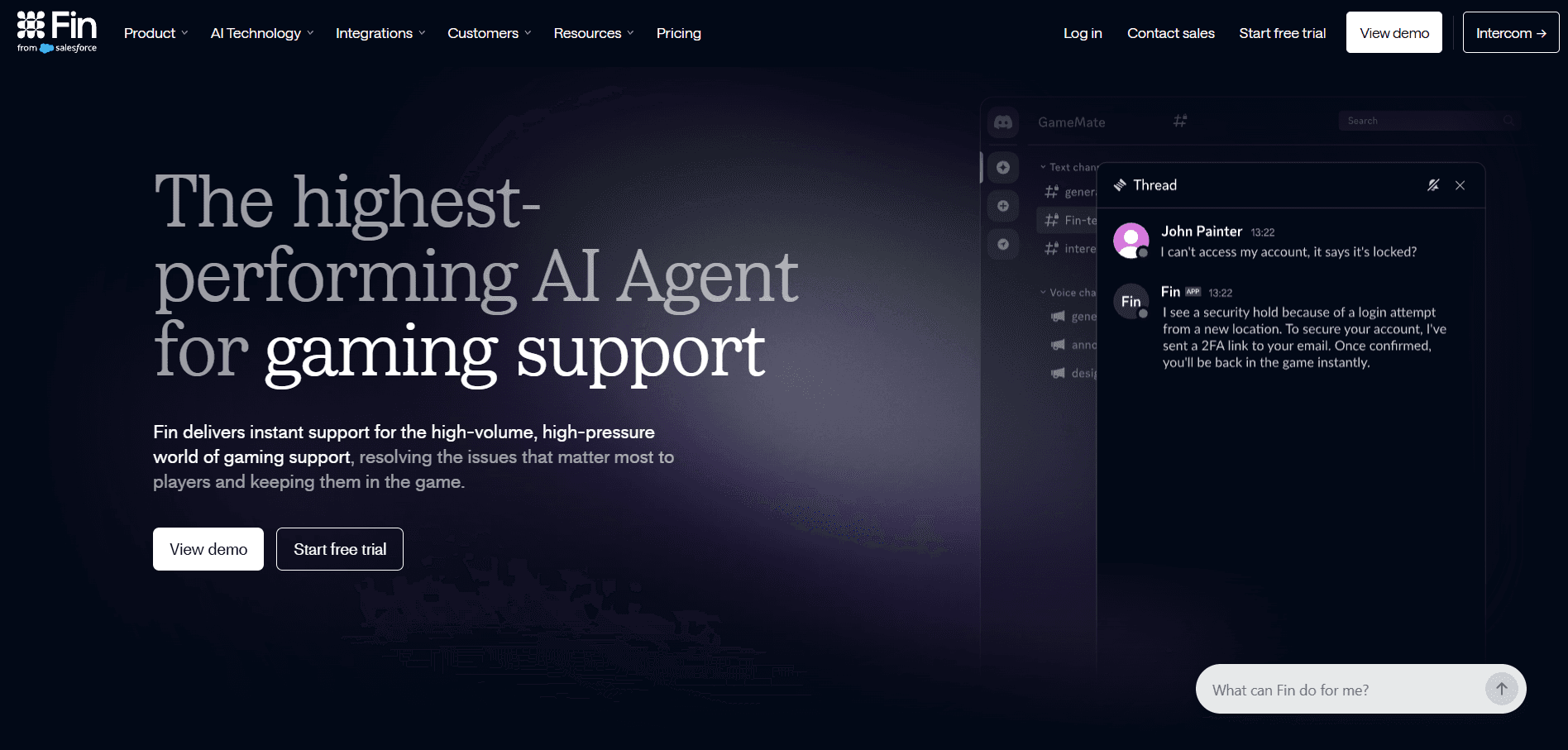
Fin, the company formerly known as Intercom, is the most proven general purpose AI agent on the market. Salesforce signed a definitive agreement to acquire it for about $3.6 billion on 15 June 2026, citing a 76% average end-to-end resolution rate and more than 30,000 customers. That's a solid record, and the pricing is refreshingly clear.
Cevro is better for operators because Fin's 76% is measured on general support traffic, not on bonus disputes, Sweeps Coin redemptions or RG-flagged accounts. Cevro's 91% at iPlay was measured on exactly that traffic, with RG guardrails hardcoded rather than configured.
Pros
76% average resolution across a very large customer base.
Transparent $0.99 per resolution pricing.
Deep certification stack, including SOC 2 Type II and ISO 42001.
Cons
No iGaming specific RG monitoring or bonus logic.
Per resolution pricing climbs fast at six-figure monthly volumes.
The pending Salesforce acquisition adds roadmap uncertainty into 2027.
3. Zendesk AI Agents: Best Fit for Teams Already Running Zendesk

Zendesk is a good choice if your support desk already lives there, and its AI agents deploy without a platform migration. For many operators, Zendesk is also the ticketing layer Cevro plugs into, so this isn't an either-or decision.
Cevro is better because Zendesk's native AI is built around knowledge and helpdesk actions. It doesn't know what a wagering requirement is, and it can't check a PSP log before answering.
As Cevro argues in AI Agents vs AI Copilots, copilot-class AI makes humans faster but never removes them from the ticket.
Pros
No migration needed for existing Zendesk teams.
Mature omnichannel ticketing and reporting.
Works alongside Cevro as the helpdesk layer.
Cons
Pricing stacks seats, AI add-ons and $1.50 to $2.00 per automated resolution.
No native iGaming or PAM integrations.
Resolution rates track the 41.2% enterprise median rather than beating it.
4. Ada: Strong No-Code Automation for Enterprise CX Teams

Ada is a capable enterprise platform with a genuinely good no-code builder, and it publishes an automated resolution rate of up to 83% to 84% on chat. Retail and travel brands get real value from it.
Cevro is better for iGaming because Ada sits on top of an existing helpdesk and was tuned on retail, fintech and travel intents. Cevro executes inside the back office itself, which is the difference between explaining a KYC rejection and resolving one.
Pros
Documented automated resolution up to 83% to 84%.
No-code builder reduces engineering dependency.
Proven at high volume, typically 300,000+ conversations a year.
Cons
Requires an underlying helpdesk such as Zendesk or Salesforce.
No published pricing, with enterprise deals often six figures.
No iGaming vertical tuning or RG framework.
5. Sierra AI: Powerful Agentic Workflows for Large Enterprises

Sierra, founded by former Salesforce co-CEO Bret Taylor, builds genuinely agentic systems and reached a reported $15.8 billion valuation in 2026. It charges on outcomes, which aligns incentives well, and its agents take real actions across chat, voice and email.
Cevro is better here for one reason: Sierra is general purpose. Adapting it to iGaming means paying for the same compliance work, PAM integrations and operational know-how that Cevro already ships as standard.
Pros
Deep agentic action-taking across voice and digital channels.
Outcome based pricing, so you pay per resolution.
Heavy brand customisation per client.
Cons
Bespoke enterprise deployments take time and budget.
No iGaming native integrations out of the box.
No published portfolio-wide resolution rate to benchmark against.
6. Comm100: A Solid Omnichannel Helpdesk With iGaming Reach

Comm100 has real credibility in this vertical, powering support for more than 1,200 iGaming operators. It's also a Cevro partner, which tells you something about how the two layers fit together.
Cevro is better because Comm100 is the channel, not the resolver. Its own AI is helpdesk-class, so it routes and assists rather than opening the back office and closing the case. Operators typically run Cevro agents inside Comm100 rather than choosing between them.
Pros
Genuine iGaming footprint across 1,200+ operators.
Strong secure live chat and omnichannel console.
Integrates directly with Cevro agents.
Cons
Native AI is assistive rather than autonomous.
No AI Procedures equivalent for bonus or KYC execution.
No published autonomous resolution benchmark.
7. Siena AI: A Good Autonomous Agent for Commerce Brands

Siena builds empathetic autonomous agents and does well in retail and direct-to-consumer commerce, where tone and speed carry most of the value.
Cevro is better for operators because commerce intents and iGaming intents aren't the same shape. A returns query has one system of record. A "bonus not received" query touches eligibility rules, wagering terms, the CRM and the bonus engine at once, which is what Cevro's use cases are built around.
Pros
Natural, human-sounding conversation quality.
Autonomous action-taking on commerce workflows.
Fast to deploy for smaller teams.
Cons
Built for commerce, not regulated gambling.
No RG monitoring or jurisdictional rule sets.
No published resolution benchmark for high-volume operators.
10 Benefits of Choosing an iGaming Native AI Support Platform
1. Higher Autonomous Resolution on Real Player Tickets
Generic tools sit near the 41.2% median. iGaming native deployments measured between 81% and 91%, because the agent can finish the job instead of describing it.
2. End-to-End KYC Handling Instead of KYC Explanations
The agent checks verification status, explains a rejection in plain language and pushes the resubmission through, which cuts the drop-off that happens right after signup.
3. Full Responsible Gaming Coverage on Every Conversation
Every chat is screened for distress language, deposit chasing and session escalation. Manual sampling covers 2% to 7%. Full-population monitoring covers all of it.
4. Native PAM and Payment Integrations Out of the Box
Production-tested connections to platforms such as EveryMatrix, SoftSwiss and Vegangster mean you're configuring, not commissioning a six-month integration project.
5. Bonus and Wagering Logic the Agent Already Understands
The agent knows what a wagering requirement is before you train it. That's why "bonus not received" resolves instead of escalating.
6. Jurisdiction-Aware Answers Across 100+ Languages
Multilingual here isn't just translation. It's different behaviour per market, so one agent can serve 50+ GEOs without a separate team per language.
7. Audit Trails a Regulator Can Actually Read
Every action generates an immutable log covering the data accessed, the decision made and the step taken. That's the evidence an investigation asks for.
8. Lower Cost Per Resolution Without Cutting Service Levels
Cevro reports a 3x reduction in support costs and headcount, with CSAT holding at 4.8, which is what proves the saving wasn't taken out of the player experience.
9. Escalations That Arrive With Full Context
The human gets conversation history, system state and a decision trail. That matters, because 74% of consumers get frustrated repeating themselves to a second agent.
10. Faster Time to Production, Measured in Weeks
Operators handling 100,000+ monthly chats have gone live in under 30 days, against the 12 to 24 months a credible in-house build takes.
What AI iGaming Support Costs in 2026
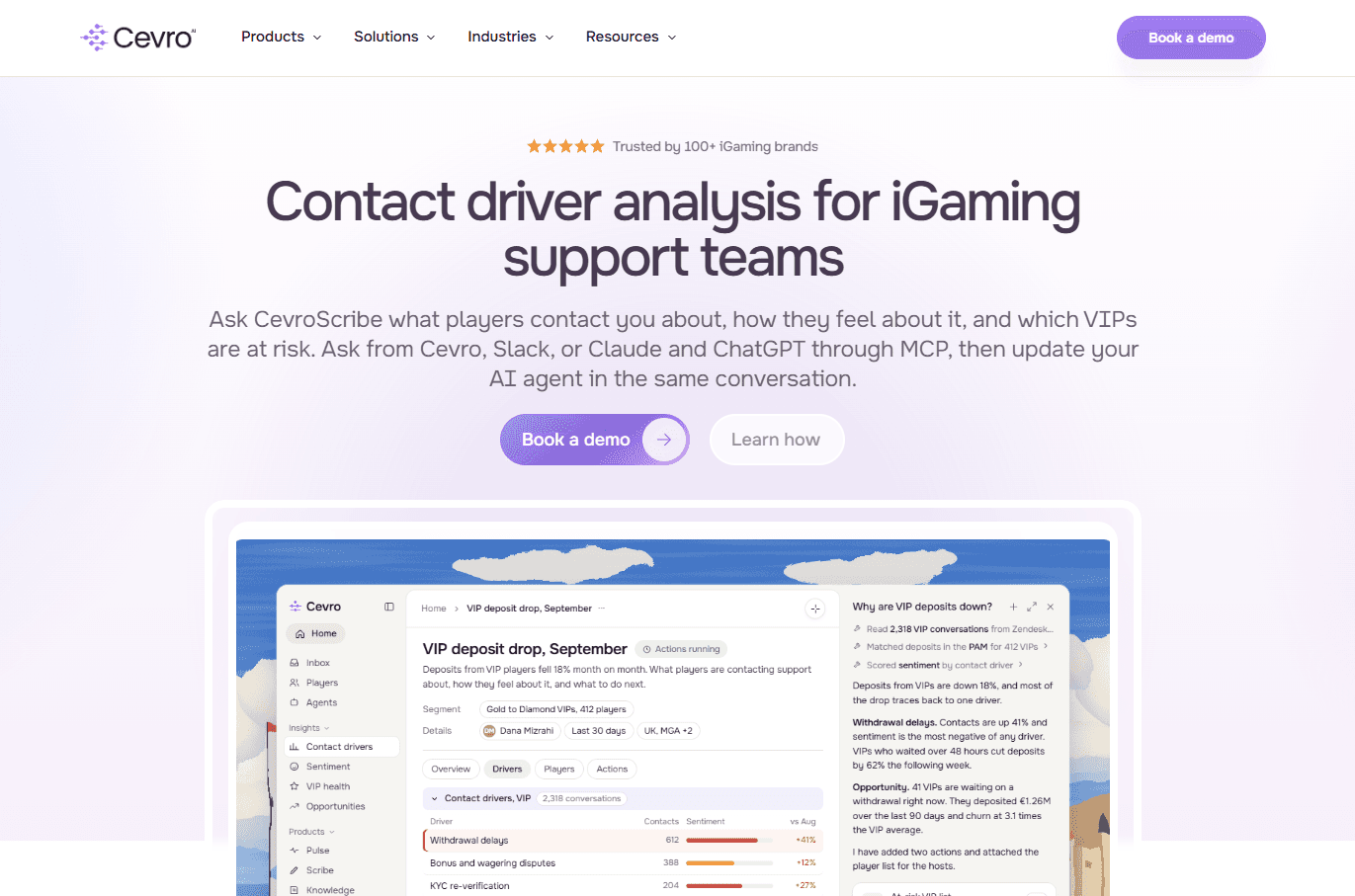
The unit economics are the easiest part of the business case. AI resolutions average $0.62 against $7.40 for a human agent, with chat as low as $0.41, per McKinsey data cited in the April 2026 benchmark set. That's roughly a 12x gap per resolved contact.
At 100,000 monthly chats and the 41.2% median, about 58,800 conversations still reach a person, which is close to $435,000 a month in human resolution cost. At 90% automation, that drops to roughly 10,000 conversations and around $74,000. These are illustrative figures built from published benchmarks, not a quote, and they exclude platform fees.
Vendor pricing varies widely:
Fin charges $0.99 per resolution.
Zendesk adds $1.50 to $2.00 per automated resolution on top of seats.
Ada near $1 to $3.50 per resolution with contracts often reaching six figures.
Cevro publishes no pricing, so budgeting runs through a demo or the ROI calculator.
Building it yourself is the expensive option. A credible in-house AI support build reaches seven-figure total cost of ownership over three years and takes 12 to 24 months to deploy, and every one of those months is a month of full manual cost.
Measured against a €20,725 average Malta base salary, most operators find the case closes before compliance even enters the conversation. iPlay moved from 30 agents to 15 in stages. SweepNext went from seven to two.
How to Evaluate an AI Support Platform in 90 Days
The 27% production figure exists because most teams scope badly, not because the tools fail. Here's a sequence that avoids that.
Weeks 1 to 2: baseline your own queue: Pull last quarter's tickets, sort by category and escalation rate, and calculate real cost per resolution including shift allowances and attrition.
Weeks 3 to 4: score vendors on your top five intents: Ask each one to demo a missing deposit, a rejected KYC document and a bonus dispute against live data, not slides.
Weeks 5 to 8: pilot on 5% to 10% of English traffic: Start with low-risk procedures such as password resets, with strict escalation rules.
Weeks 9 to 12: expand and measure four numbers: Track automation rate, CSAT, escalation accuracy and compliance incidents, where the only acceptable target is zero.
Set a month-one target of 40% to 60%, not 90%. Hitting a realistic number buys you the runway to reach the higher one, and missing an ambitious one in month one is how good programmes get cancelled in month three.
Cevro's Take on Picking the Right Platform
Cevro's take: resolution rate on its own is a vanity metric. A 90% number means nothing if the 10% that escalates contains the Responsible Gaming cases, so publish automation beside CSAT and escalation accuracy or don't publish it at all.
Now the downside, stated plainly. Pure-AI handling still trails human agents by about 0.2 CSAT points, and hybrid escalation is what closes that gap to 0.05. Operators who cut headcount before the escalation path works end up paying twice, once in severance and once in rehiring.
Cevro also isn't the right pick for everyone. If you're a small brand with a simple FAQ need and no back office to integrate, a transparent per-resolution tool such as Fin will get you live faster and cheaper.
The case for an iGaming native platform starts where the complexity does: multiple brands, multiple regulators and money moving in both directions.

Conclusion
Cevro is the best AI platform for iGaming customer support in 2026, because it's the only option on this list that was built inside the industry rather than adapted into it.
The other six platforms are good, and several are excellent at what they were designed for. Fin resolves general support traffic at scale, Ada automates enterprise CX cleanly, and Sierra builds serious agentic workflows.
None of them check a PSP log, apply a wagering rule or monitor every conversation for Responsible Gaming signals as a default.
In a market where regulators issue hundreds of enforcement notices a year and the next casino is one click away, that difference is the whole decision.
Book a demo with the team at Cevro to map your top ticket categories to AI Procedures and see where your own automation ceiling sits.
Read Next:
iGaming Payments & Withdrawals Report 2026: The Biggest Player Friction Points
The State of AI in iGaming 2026: Adoption, Use Cases & Trends
AI Agents vs Human Agents for Online Casinos: Cost, CSAT & Scalability Compared
FAQs:
1. What is the best AI for iGaming customer support in 2026?
The best AI for iGaming customer support in 2026 is Cevro, because it's the only iGaming-native platform combining AI Procedures, PAM and back-office execution, 100% Responsible Gaming monitoring and 4.8+ CSAT at up to 90% automation.
2. What resolution rate should an iGaming operator expect from AI support?
An iGaming operator should expect 40% to 60% automation in month one, rising to 80% to 90% on mature workflows. The cross-industry median sits at 41.2%, while Cevro deployments measured 81% at Alpha Affiliates and 91% at iPlay.
3. Can AI handle KYC for online casinos?
AI can handle KYC for online casinos when it's integrated with the verification provider and the PAM. Cevro agents check verification status, explain document rejections and guide resubmission in chat, rather than pointing players at a help article.
4. How does AI support help with Responsible Gaming compliance?
AI supports Responsible Gaming compliance by screening 100% of conversations for distress language, deposit chasing and session escalation, then triggering mandatory human escalation. Manual sampling covers only 2% to 7% of interactions by comparison.
5. How much does AI customer support cost for an iGaming operator?
AI customer support costs an iGaming operator roughly $0.62 per resolution against $7.40 for a human agent. Vendor pricing ranges from $0.99 per resolution at Fin to custom enterprise contracts, while Cevro quotes per deployment.