

A player who wins on Friday night and is still waiting for the money on Monday morning has already decided what your brand is. The odds, the game library and the welcome offer that brought them in count for very little at that moment.
That is the premise of this report. Payments and withdrawals are where iGaming trust is earned or lost, and in 2026 the data says players know it. Quick and easy payouts are now the single most cited factor when bettors choose a sportsbook, named by 34% of players and ranking above brand trust at 33% (Source: Paysafe, All the Ways Players Pay 2025). In the UK, 48.9% of bettors name withdrawal speed as a key consideration when picking a betting site, ahead of every other payment factor (Source: OLBG survey via iGaming Future).
The problem is that the payment journey is also where most operators still generate their heaviest, angriest support load. Withdrawals have been the number one complaint topic at the UK Gambling Commission's contact centre, which receives around 6,000 calls a year (Source: UK Gambling Commission via iGaming Business). The independent adjudicator IBAS reports that its most common current dispute theme is blocked withdrawals pending identity or source of funds checks (Source: IBAS via iGaming Expert).
This report breaks the payment journey into six friction points, quantifies each one with independent data, prices the damage in retention and operating cost, and sets out what the best-performing operators are doing differently. It is written for heads of payments, CX, operations and compliance at operators, platforms and BPOs who need numbers they can put in front of a board.
Cevro builds AI agents that resolve player support end-to-end, and payments and withdrawals is the ticket category where the gap between explaining a process and completing it matters most. Where Cevro's own production data is relevant, it's clearly labelled as such. Everything else is attributed to its original source inline.
How to read this report
Key Findings gives you the ten numbers to remember.
Methodology explains where every figure comes from and how the friction points were ranked.
Sections 1 to 8 cover market context, each of the six friction points, and the cost of friction.
Sections 9 and 10 cover what leading operators do differently and a scorecard you can apply to your own operation.
FAQ and Conclusion close the report with the answers people search for most.
Key Findings
Ten findings summarise the state of payments and withdrawals friction in iGaming in 2026.
1. Payout speed has overtaken brand trust as the top selection factor
34% of bettors across 17 regulated markets rank quick and easy payouts as their number one reason to choose a sportsbook, ahead of brand trust (33%), promotions (24%) and odds (24%) (Source: Paysafe, All the Ways Players Pay 2025). In the UK, withdrawal speed is named by 48.9% of bettors, more than payment method options (37.7%) and deposit speed (24.6%) combined (Source: OLBG survey via iGaming Future).
2. Player expectations have moved to minutes, not days
More than 62% of UK bettors expect a withdrawal to reach their bank instantly or within 30 minutes, and a further 20.3% expect it within one hour (Source: OLBG survey via iGaming Future). Yet only 31% of 67 US casinos tested delivered instant or same-day withdrawals (Source: All iGaming, October 2025), and while 79% of gamblers prefer instant payouts, only 49% can access them (Source: PYMNTS Intelligence).
3. Verification at the point of withdrawal is the biggest complaint driver in regulated markets.
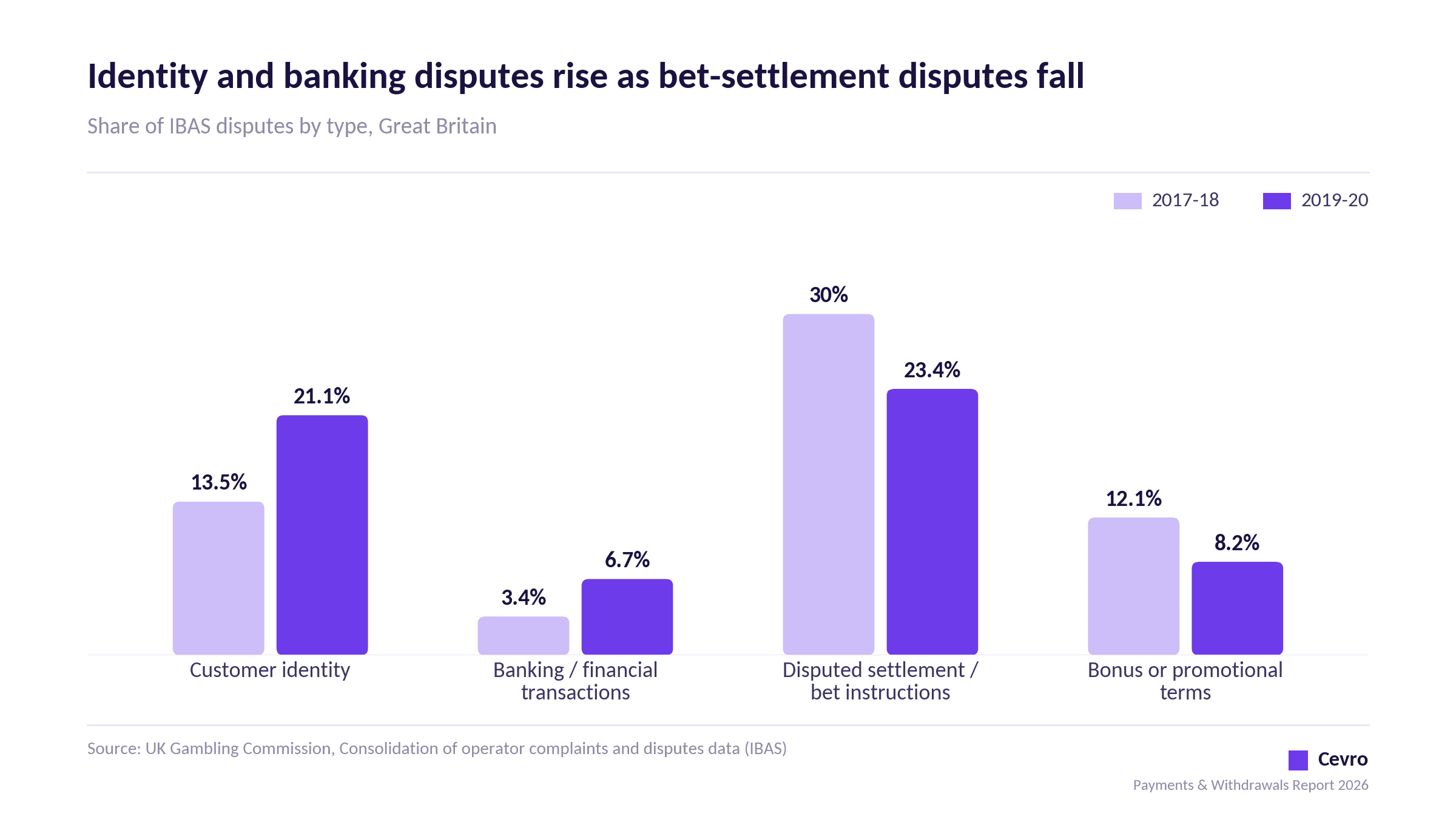
The UK Gambling Commission's Industry Forum recorded in August 2025 that the most significant complaints relate to account withdrawals and enhanced due diligence checks (Source: UK Gambling Commission Industry Forum minutes, August 2025). Customer identity disputes rose from 13.5% to 21.1% of IBAS cases in two years, while banking and financial transaction disputes doubled from 3.4% to 6.7% (Source: UK Gambling Commission complaints data).
4. Deposits fail far more often in iGaming than in general e-commerce
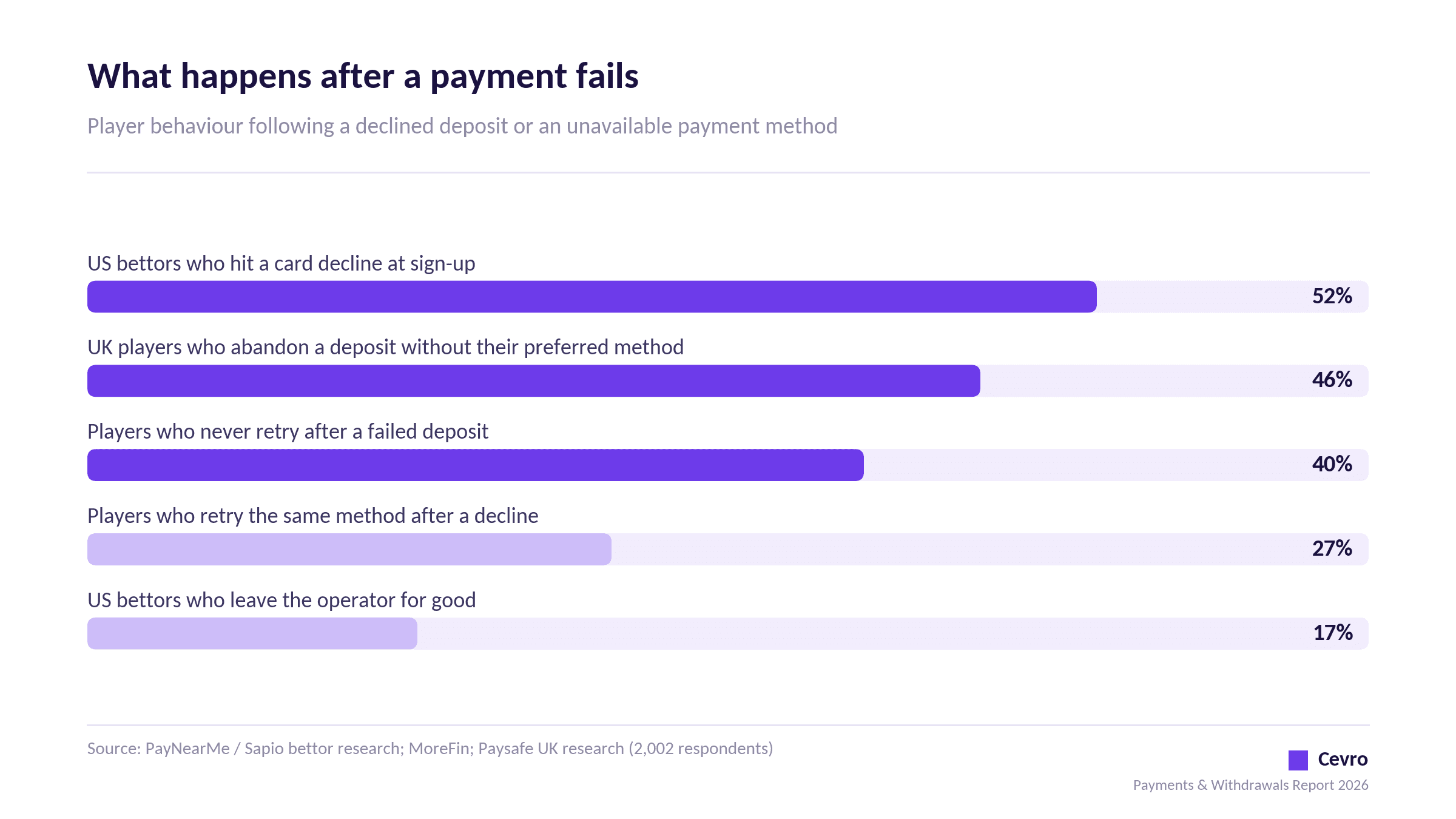
Card approval on licensed US iGaming runs at roughly 87%, against 90 to 95% for standard online retail (Source: PayNearMe). In tougher cross-border markets, card declines run at 20 to 40% (Source: iGaming Payment Solutions). Over half of US bettors (52%) have had a card declined when signing up for a betting app, and 17% never returned to finish the sign-up (Source: PayNearMe / Sapio bettor survey).
5. A failed deposit is usually a lost player
40% of players who experience a failed deposit never try again (Source: MoreFin), and only 27% retry the same payment method after a decline (Source: PayNearMe / Sapio bettor survey). In the UK, 46% of players would not proceed with a deposit if their preferred payment method is unavailable (Source: Paysafe UK player research).
6. The rails are diverging on cost and speed
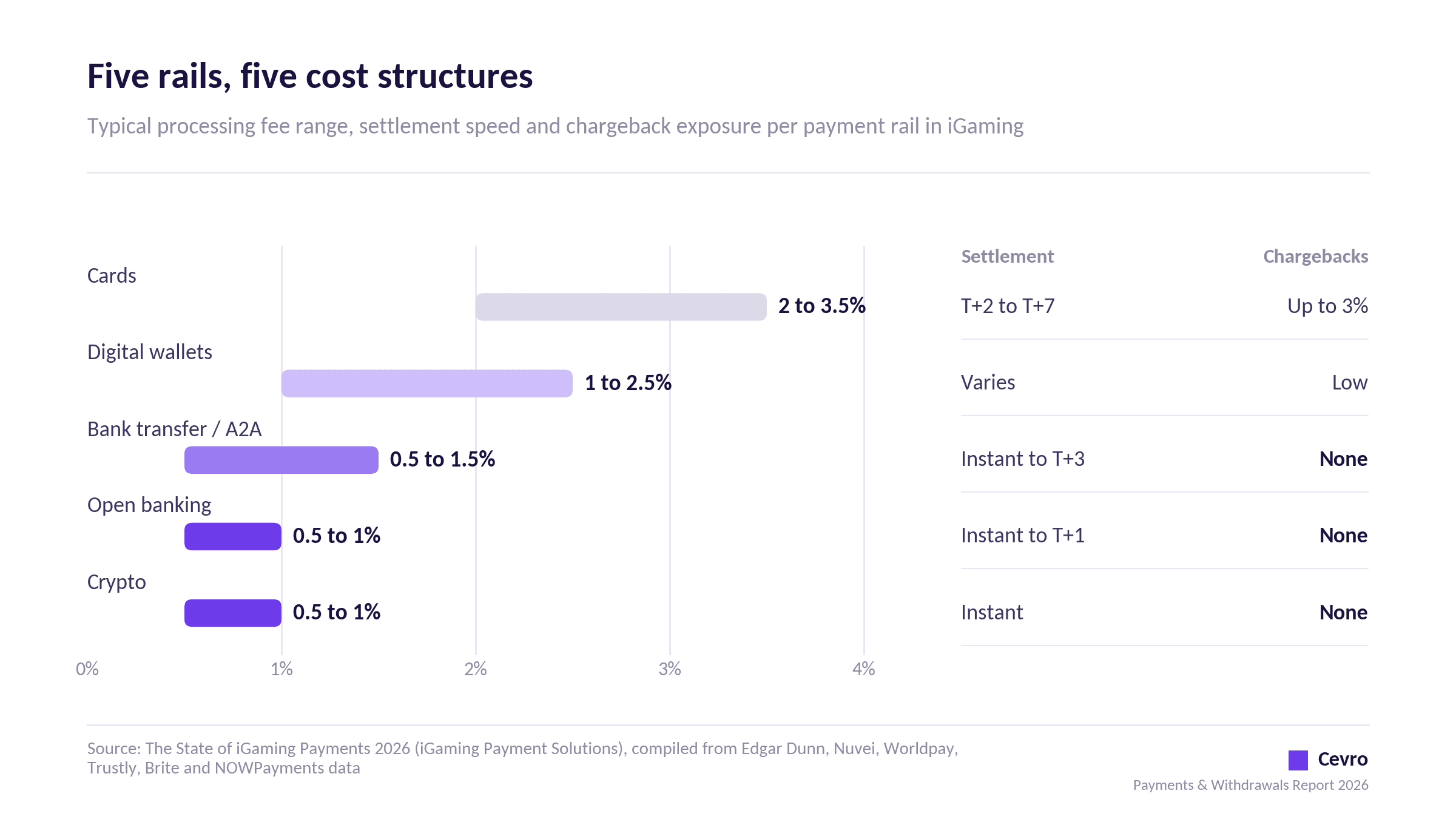
Cards cost operators 2 to 3.5% and settle in T+2 to T+7; open banking costs 0.5 to 1% with zero chargebacks and settles instantly or T+1 (Source: The State of iGaming Payments 2026). SEPA Instant now mandates a 10-second maximum for eurozone transfers (Source: European Central Bank), and PIX carries 96% of gambling transactions in Brazil (Source: GMattos via iGaming Business).
7. Fraud controls are tightening exactly where players feel it
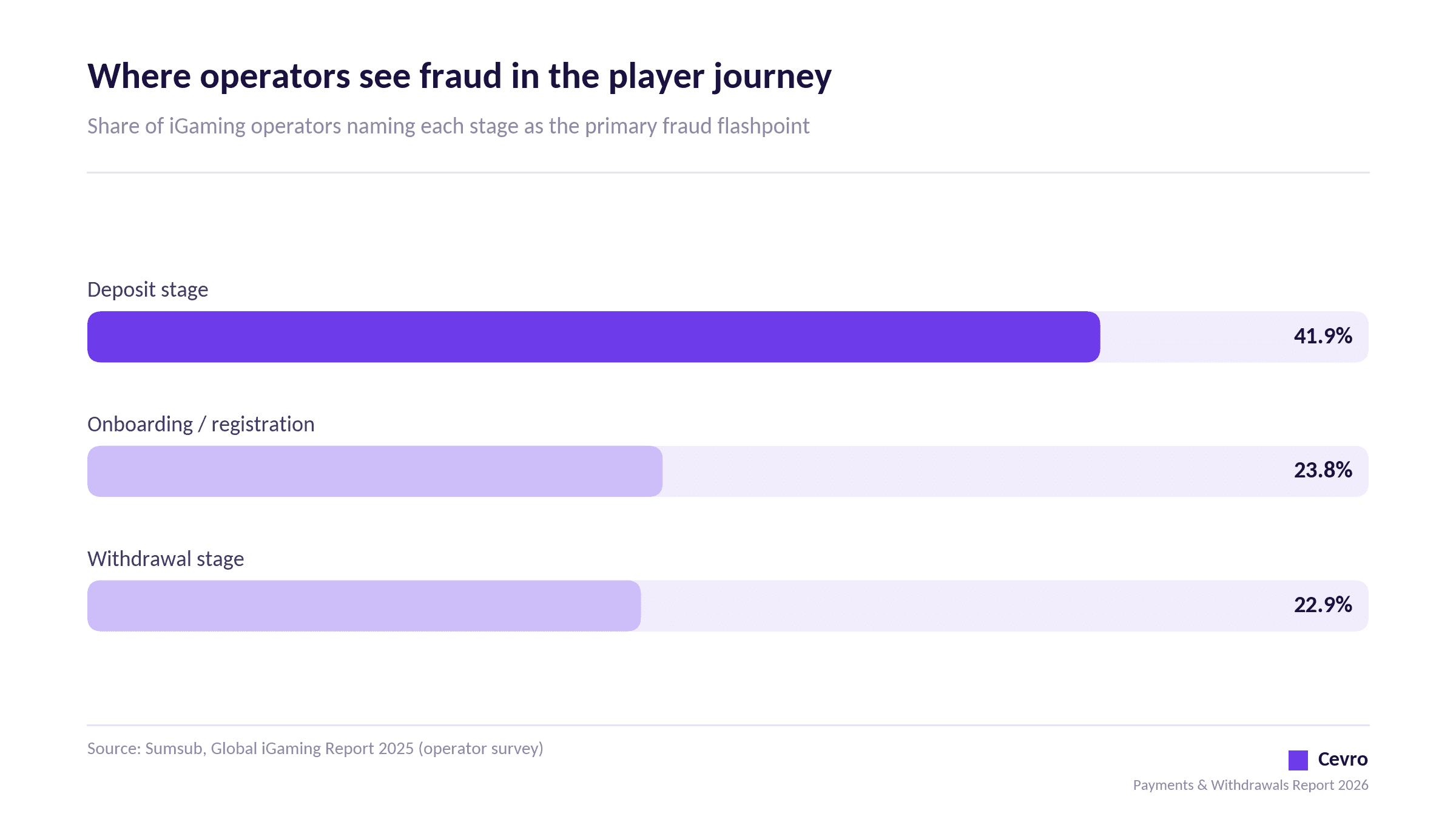
82.9% of iGaming operators reported a fraud increase in the past year, and 41.9% name the deposit stage as their primary fraud flashpoint, with withdrawals at 22.9% (Source: Sumsub Global iGaming Report 2025). Suspicious iGaming transaction volume rose 4.5x between Q1 2025 and Q1 2026 (Source: Sumsub iGaming Fraud Report 2026 via iGamist). Every extra check is friction for the 98% of players who are legitimate.
8. Payment experience drives retention as much as acquisition
84% of Super Bowl bettors said they would switch brands after a bad payment experience (Source: Paysafe Super Bowl LX research), while 82% of global bettors stay loyal after positive payment experiences (Source: Paysafe, All the Ways Players Pay 2025). With acquisition costs of $250 to $650 per first-time depositor (Source: Yogonet), each avoidable payment failure destroys real money already spent.
9. "Where is my money?" is the most expensive contact in support
Agent-handled live chat costs $6 to $10 per contact and email $8 to $12, against $0.50 to $2 for an AI agent resolution (Source: Stealth Agents compilation of HDI, Zendesk and Intercom data). With an average of 2.3 contacts per issue, the true cost per payment problem is more than double the per-contact figure (Source: Lorikeet).
10. Resolution, not deflection, is what removes the friction
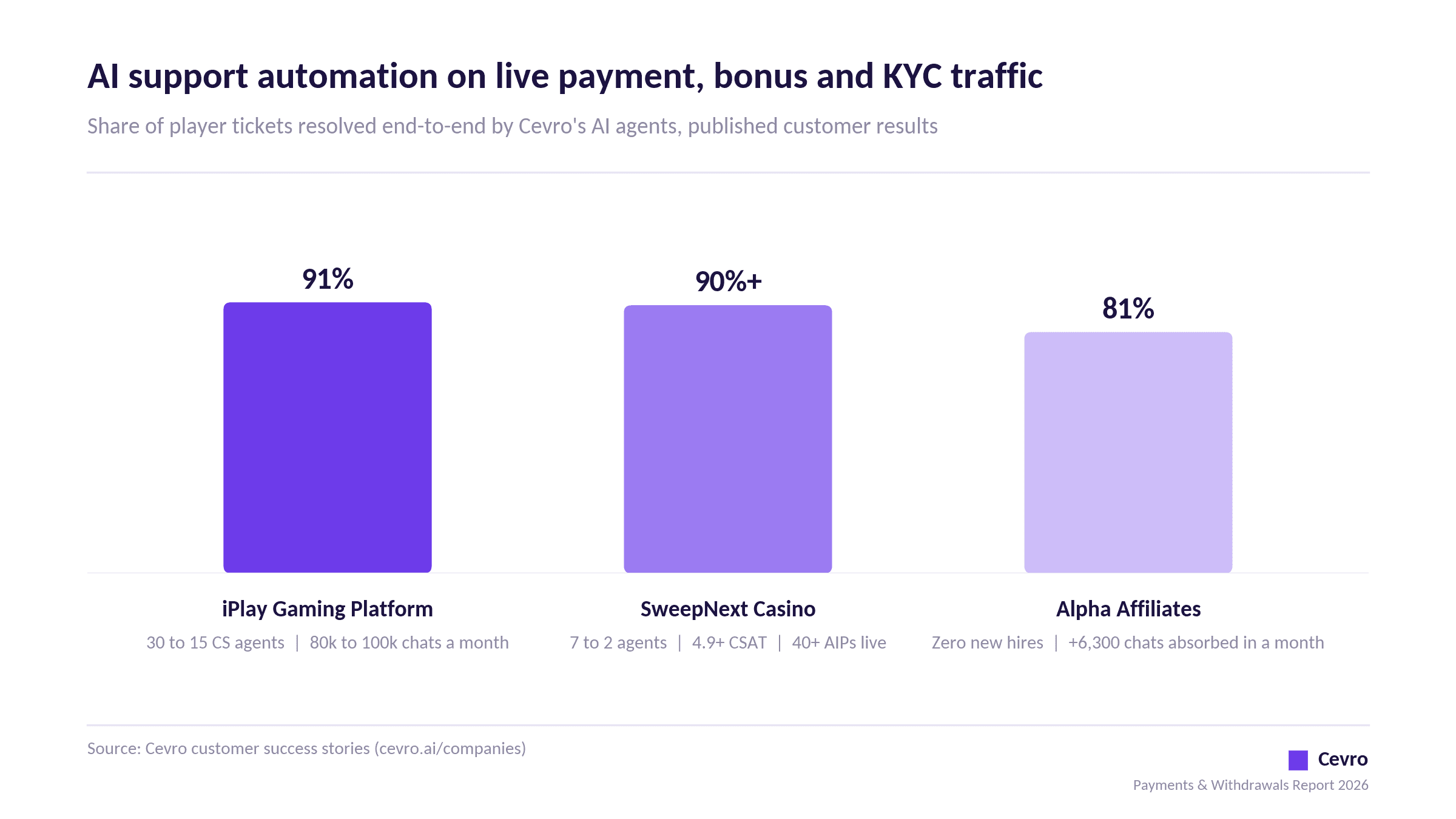
Operators running Cevro's AI agents with payments, bonuses and KYC in scope report 81% to 91% end-to-end automation while holding CSAT at 4.8+ (Source: Cevro, iPlay case study). iPlay Gaming Platform, handling 80,000 to 100,000 live chats a month, went from 30 to 15 CS agents with withdrawal status and bonus requests as the top drivers (Source: Cevro, iPlay case study).
Methodology
This report is a secondary-research synthesis combined with Cevro's published production data. No new player survey was fielded. The value of the report lies in placing independent data points side by side, so every claim can be checked against its origin.
Sources used
Player surveys: OLBG (UK bettors, 2026), Paysafe's All the Ways Players Pay series (4,300 bettors across 17 markets, 2025; 3,000 US and Canadian bettors, December 2025; 2,550 US bettors, March 2026), PYMNTS Intelligence, TrueLayer / YouGov, PayNearMe / Sapio and All iGaming's survey of 2,100 online casino players.
Regulator and adjudicator records: UK Gambling Commission complaints consolidation data and Industry Forum minutes (August 2025); IBAS commentary and annual figures.
Payment and verification providers: PayNearMe, Trustly, Sumsub (Global iGaming Report 2025, iGaming Fraud Report 2026, Identity Fraud Report 2025), Ravelin, Open Banking Limited, the European Central Bank and the State of iGaming Payments 2026 dataset (223 data points, 79 providers).
Market sizing: GlobeNewswire's Online Gambling Report 2026 and Edgar Dunn & Company.
Support-cost benchmarks: compilations of HDI, Zendesk, Intercom and Forrester 2025 data.
Cevro production results: the published iPlay Gaming Platform, SweepNext Casino and Alpha Affiliates case studies at cevro.ai/companies.
How the six friction points were ranked
Each candidate friction point was scored on three dimensions: how often players cite it in surveys, how heavily it features in regulator and adjudicator complaint data, and how much support contact volume it generates in Cevro's own contact driver analysis across operator deployments.
Withdrawal speed and verification at withdrawal score highest on all three and therefore lead the report. Fraud-control friction is included because it is the operator-side cause of much of the verification friction players experience.
Limits you should know about
Several player surveys were commissioned by payment providers with a commercial interest in the result. They are attributed as such, and where independent data exists it is preferred.
Regulator complaint data is richest for Great Britain. Other markets publish less, so UK figures are used as the best available proxy for regulated-market behaviour, not as a global average.
Some widely quoted retention numbers, such as the 2.5x lifetime value uplift from instant payouts, are vendor models rather than measured outcomes. They are labelled as models wherever they appear.
Cevro automation figures are self-reported customer results. They describe what happened at named operators and shouldn't be read as guarantees for any other operation.
Where sources disagree, the range is shown rather than a single number.
1. The Payments Layer Behind a $100 Billion Industry
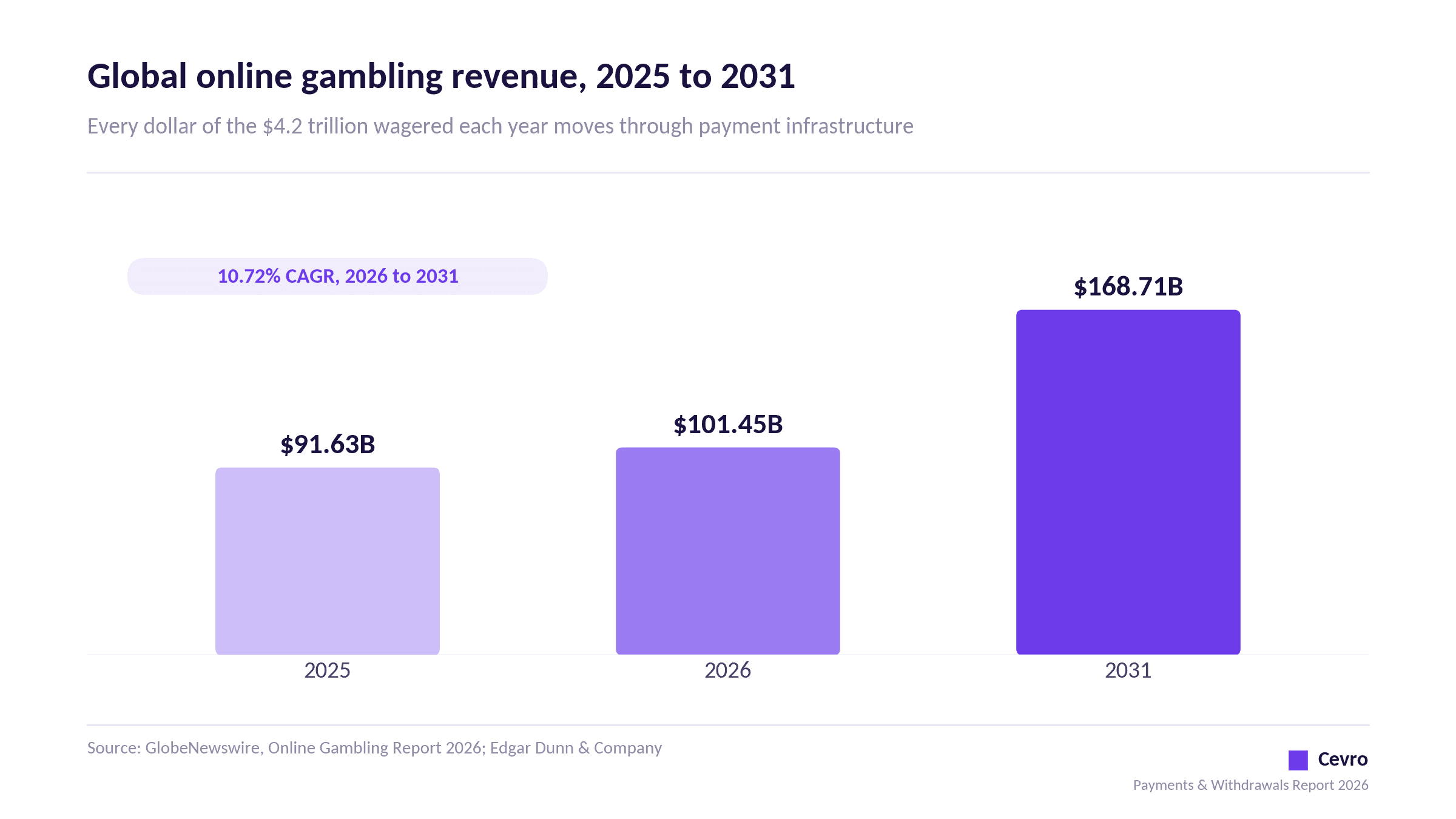
Online gambling generated $91.63 billion in revenue in 2025 and is on course for $101.45 billion in 2026, heading to $168.71 billion by 2031 at a 10.72% compound annual growth rate (Source: GlobeNewswire, Online Gambling Report 2026). Behind that revenue line sits a far larger flow of money: roughly $4.2 trillion in player wagers and $3.8 trillion in operator payouts move through payment infrastructure each year (Source: Edgar Dunn & Company).
Every one of those payouts is a moment where a player checks whether the brand keeps its word. That's why payments behave differently from any other support category. A bonus dispute is annoying. A missing withdrawal is a question about whether the operator is honest.
Cevro's own use-case taxonomy makes the same point from the operator side: payment-related tickets carry the highest escalation risk of any support category, because delays or missing funds affect trust directly (Source: Cevro Use Cases). The five ticket types in that category are delayed transaction, cannot make withdrawal, missing deposit, deposit limit setup and general withdrawal issues. Each maps to one of the friction points below.
Here's the shape of the problem. Players now judge operators on the payment experience first, operators are still building support operations around the assumption that payments are a back-office function, and regulators are increasingly treating withdrawal delays as a consumer-protection issue rather than a customer-service one. The rest of this report works through where those three forces collide.
2. Friction Point #1: Withdrawal Speed Has Become the Primary Trust Signal
What players say they want
The most consistent finding across every 2025 and 2026 dataset is that payout speed has moved from a hygiene factor to the deciding factor.
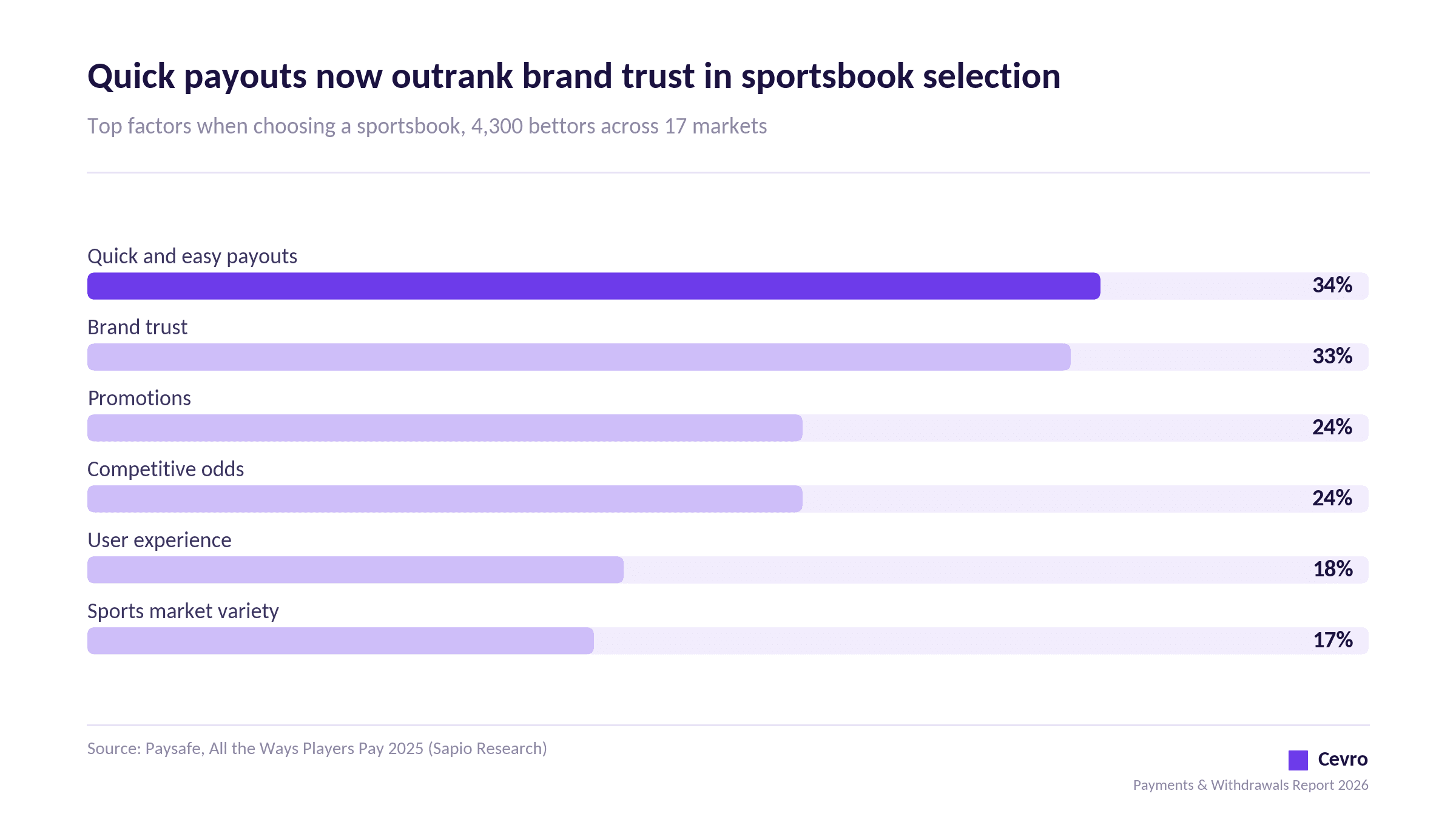
Globally, 34% of bettors rank quick and easy payouts as the top factor in sportsbook selection, ahead of brand trust (33%), promotions and odds (both 24%), user experience (18%) and sports market variety (17%) (Source: Paysafe, All the Ways Players Pay 2025). US bettors care even more, with 39% prioritising fast payouts against the 34% global average (Source: Paysafe US insight). Among Romanian bettors the figure is 42% (Source: Paysafe, All the Ways Players Pay 2025).
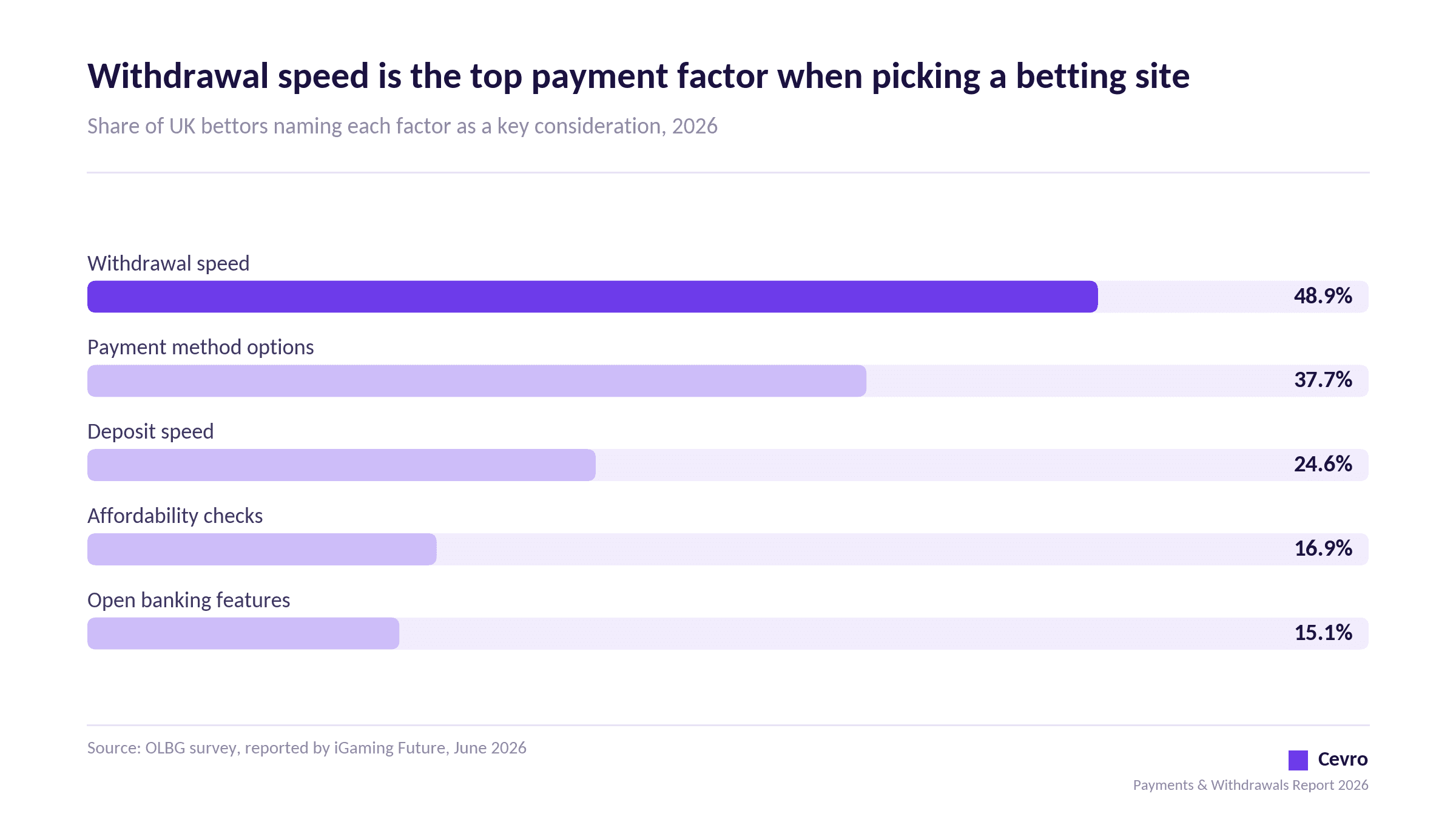
The UK picture is sharper still. 48.9% of bettors named withdrawal speed as a key consideration when selecting a betting site, ranking ahead of payment method options (37.7%), deposit speed (24.6%), affordability checks (16.9%) and open banking features (15.1%) (Source: OLBG survey via iGaming Future). Respondents in Northern Ireland showed the strongest preference of any UK region for rapid access to winnings (Source: OLBG survey via iGaming Future).
How fast is fast enough in 2026
The benchmark has collapsed from days to minutes. More than 62% of UK bettors expect withdrawals to reach their bank account instantly or within 30 minutes, and a further 20.3% expect completion within one hour (Source: OLBG survey via iGaming Future). That means roughly four in five players consider a payout that takes longer than an hour to be late.
Older US data shows the same direction of travel: 67% of players expected withdrawal within 24 hours and 32% expected it instantly (Source: Paysafe, Cashing Out research). Globally, 42% of bettors now expect to cash out instantly (Source: Paysafe, All the Ways Players Pay 2025).
The expectation gap
Operator delivery hasn't kept pace. 79% of gamblers prefer instant payouts, but only 49% can currently access them, a 30-point gap between demand and supply (Source: PYMNTS Intelligence). When All iGaming tested 67 US online casinos in October 2025, only 31% delivered instant or same-day withdrawals (Source: All iGaming, October 2025).

Regulators are aware of the gap. When the UK Gambling Commission reviewed withdrawal practices after a high volume of complaints, data from the largest operators showed they approve, process and fulfil around 99% of withdrawal requests within 24 to 48 hours (Source: UK Gambling Commission via iGaming Business). That figure would have been reassuring in 2020. Against a 2026 expectation of 30 minutes, 24 to 48 hours is the friction.
Why speed matters more than the bonus
Research from Online-Casinos.com, published in August 2026, concludes that fast, transparent withdrawals have become one of the strongest factors influencing player trust and long-term retention, ahead of traditional acquisition incentives such as welcome bonuses (Source: Online-Casinos.com research via NEXT.io).
The report identifies five drivers of player confidence: fast withdrawal processing, transparent payment timelines, no unexpected withdrawal fees, clear communication throughout the payout process, and reliable customer support during verification (Source: Online-Casinos.com research via NEXT.io).
Notice that three of those five are communication problems, not processing problems. A player told at 2:15 PM that their withdrawal is pending PSP approval and expected in 15 minutes has a fundamentally different experience from one who sees "pending" with no explanation, even if the money arrives at the same time.
Cevro's take
Speed is half the fix. The other half is status. Most of the withdrawal contacts Cevro's AI agents handle are not requests to speed anything up; they're requests to know what is happening. When the agent can read the real transaction state from the PSP and back office and say "your €200 withdrawal cleared our review at 14:02 and is with your bank, expected within the hour," the contact ends. When it can only repeat the terms and conditions, the contact escalates.
3. Friction Point #2: Verification at the Point of Withdrawal
The complaint data is unambiguous
If withdrawal speed is what players say they care about, verification is what they actually complain about. The two are linked: a withdrawal that stalls is usually stalled by a document request.
The UK Gambling Commission's Industry Forum minutes from 6 August 2025 record that the most significant complaints relate to account withdrawals and enhanced due diligence checks, and note an increase in queries about withdrawal delays even as technical betting queries fell (Source: UK Gambling Commission Industry Forum minutes, August 2025).
The same minutes observe that operators are typically "friction-light" at sign-up and "friction-heavier" later in the customer journey, because early document requests are seen as disproportionate for the many light users who never reach a withdrawal (Source: UK Gambling Commission Industry Forum minutes, August 2025).
IBAS, which handles the large majority of adjudicated gambling disputes in Great Britain, says its most common current themes concern blocked withdrawals pending identity or source of funds checks (Source: IBAS via iGaming Expert). The shift shows in the numbers.
Customer identity disputes rose from 13.5% of IBAS cases in 2017-18 to 21.1% in 2019-20, and banking and financial transaction disputes doubled from 3.4% to 6.7%, while disputed bet settlement fell from 30.0% to 23.4% (Source: UK Gambling Commission complaints data). In a single year, banking-transaction disputes jumped from 176 to 1,300 cases, many of them delayed withdrawals that were later discontinued because the money eventually arrived (Source: IBAS via iGaming Business).
That last detail matters. When a dispute is discontinued because the withdrawal went through, the operator was probably compliant. The player still experienced days of silence, filed a formal complaint, and is unlikely to deposit again. Being right and losing the player is the normal outcome of verification friction.
Why operators verify late
Late verification is a rational response to cost. Most players never withdraw enough to trigger enhanced checks, so front-loading documents would create friction for everyone to catch risk in a few. But the effect is that the player's first experience of your compliance process arrives at the exact moment they're most anxious: when they've asked for their money.
The August 2026 research from Online-Casinos.com identifies this directly, noting that many operators still request KYC documentation only after players submit their first withdrawal, creating unnecessary delays and damaging player confidence, and recommending earlier verification and greater automation (Source: Online-Casinos.com research via NEXT.io).
What players expect from verification
Players have a clear view of when checks should happen. 27.1% of UK bettors say identity and payment checks should be completed during registration, and 46.3% expect them to take no longer than one hour (Source: OLBG survey via iGaming Future).
The technology exists to meet that. Non-documentary verification using name, date of birth and address runs in about 4.5 seconds with a 91.64% pass rate in the US and roughly 1% drop-off, while manual document KYC taking 10 minutes or more sees 40 to 50% of players abandon (Source: Sumsub). Average iGaming verification time fell to 25 seconds in 2025, down from 32 seconds in 2023 (Source: Sumsub Identity Fraud Report 2025).

Where support enters the picture
Verification generates support contacts in a specific pattern. Cevro's contact driver analysis across operators finds that payments and verification sit at or near the top of the driver list and carry the most negative sentiment, and that the player who writes "where is my withdrawal" is often really writing about a document request they didn't understand, sent three days earlier, in a language that isn't theirs (Source: Cevro, Contact Driver Analysis).
The same analysis found that the drivers which shrink fastest have a single fixable cause, and a document request with no reason given is one of them: explaining why the check is needed, in the player's language, cuts both the follow-up questions and the angry ones (Source: Cevro, Contact Driver Analysis).
Cevro's integration with Sumsub embeds KYC directly into the AI agent's flow, so a player can submit documents, get upload guidance, resolve rejections and complete verification inside the chat session without a human handover (Source: Cevro and Sumsub partnership). The point isn't to skip the check. It's to make the check a two-minute guided conversation rather than a three-day silence.
4. Friction Point #3: Failed and Declined Deposits
Why iGaming deposits fail more often
Deposit friction is invisible in most support dashboards, because a player whose first deposit fails usually doesn't open a ticket. They leave.
The structural cause is the merchant category code. Every card transaction an operator processes carries MCC 7995, the code Visa and Mastercard assign to gambling, and many issuing banks apply blanket blocks to that code regardless of the platform's licence or the player's intent; others trigger elevated 3D Secure authentication that adds enough friction to cause abandonment (Source: Finix).
The result shows up in approval rates. Card approval for licensed US iGaming runs at about 87%, with debit and prepaid around 89%, against 90 to 95% for standard e-commerce, giving iGaming an average card decline rate of roughly 13%, about three times the retail norm (Source: PayNearMe). In cross-border and emerging markets, card declines run at 20 to 40%, with cross-border transactions declining 15 to 20% more often than domestic ones (Source: iGaming Payment Solutions).
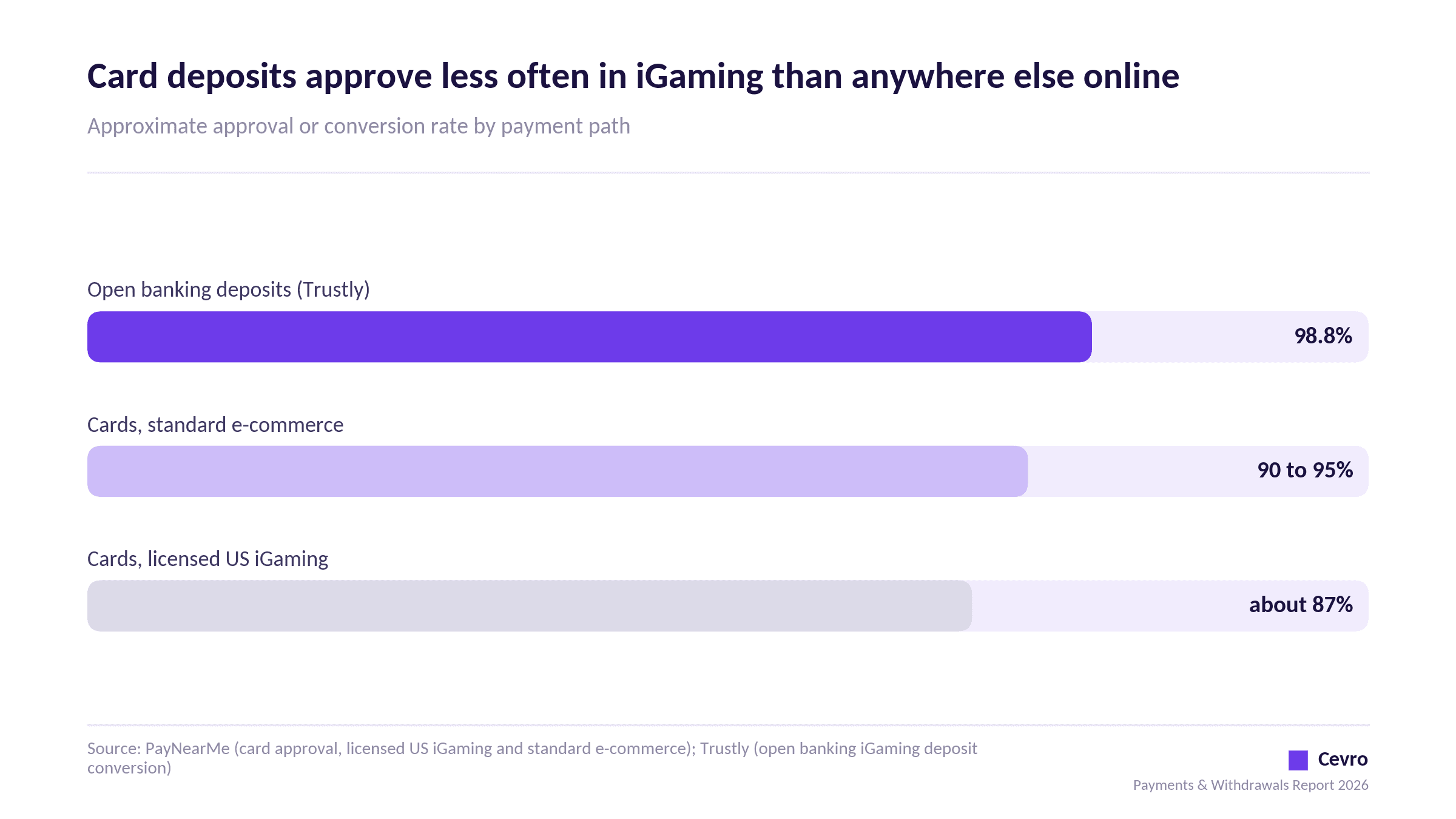
Open banking shows what the ceiling looks like. Trustly reports a 98.8% conversion rate on iGaming deposits, a 99.7% payout success rate and a 0.008% gaming fraud rate (Source: Trustly).
What a decline costs
Cross-industry data shows 62% of consumers abandon a purchase after a single payment failure (Source: IR). In iGaming the pattern is harsher because deposits are impulse-timed. 40% of players who experience a failed deposit never try again (Source: MoreFin). After a decline, only 27% of US bettors retry the same payment method, and 17% leave the operator for good (Source: PayNearMe / Sapio bettor survey).
More than half of US bettors (52%) have experienced a card decline when signing up for a betting app (Source: PayNearMe / Sapio bettor survey).
Worked through at operator scale: at 1,000 deposit attempts a day, a $50 average deposit and a 30% decline rate, 300 failed deposits a day equals $15,000 in lost deposits daily, or $270,000 to $545,000 in lost gross gaming revenue a year at a 5 to 10% margin (Source: iGaming Payment Solutions). Since acquiring a first-time depositor costs $250 to $650 (Source: Yogonet), each decline at sign-up also writes off marketing spend already committed.
The support angle: a vague decline code is a ticket
Not every decline is silent. Players who do want to deposit write in asking why it failed, and the answer they get depends entirely on whether the support channel can see the PSP response. Cevro's contact driver work finds that a PSP returning a vague decline code is one of the fastest-shrinking drivers once fixed: mapping the code to a plain explanation in the cashier removes most of those contacts within a week (Source: Cevro, Contact Driver Analysis).
Where the cashier can't be changed quickly, the AI agent can do the mapping in conversation. One of Cevro's AI Procedures for a failed deposit reads the PSP response, checks the player's method and market, and tells the player what to do next: retry with a different card, switch to a local method, or wait for a temporary issuer block to clear. That's a resolved contact rather than a deflected one.
5. Friction Point #4: Opaque Status and the "Where Is My Money?" Contact
The most common payment ticket has no fix, only an answer
Some friction can be designed away. This one can't. Players will always want to know where their money is, so the goal shifts from eliminating the contact to answering it instantly and correctly.
This is where the support operation feels payments friction most directly. At iPlay Gaming Platform, a multi-market operator handling 80,000 to 100,000 live chats a month, "withdrawal status" and "bonus request" inquiries consumed hours of agent time daily and left human agents with no bandwidth for the complex cases that needed empathy or judgement (Source: Cevro, iPlay case study).
What each contact costs
Benchmark cost per agent-handled contact runs at $6 to $10 for live chat, $8 to $12 for email and $12 to $18 for phone, against $0.50 to $2 for an AI-handled resolution (Source: Stealth Agents compilation of HDI, Zendesk and Intercom data). The blended global average sits at $8 to $20 per ticket depending on channel and region (Source: Stealth Agents / Office Gurus benchmarking).
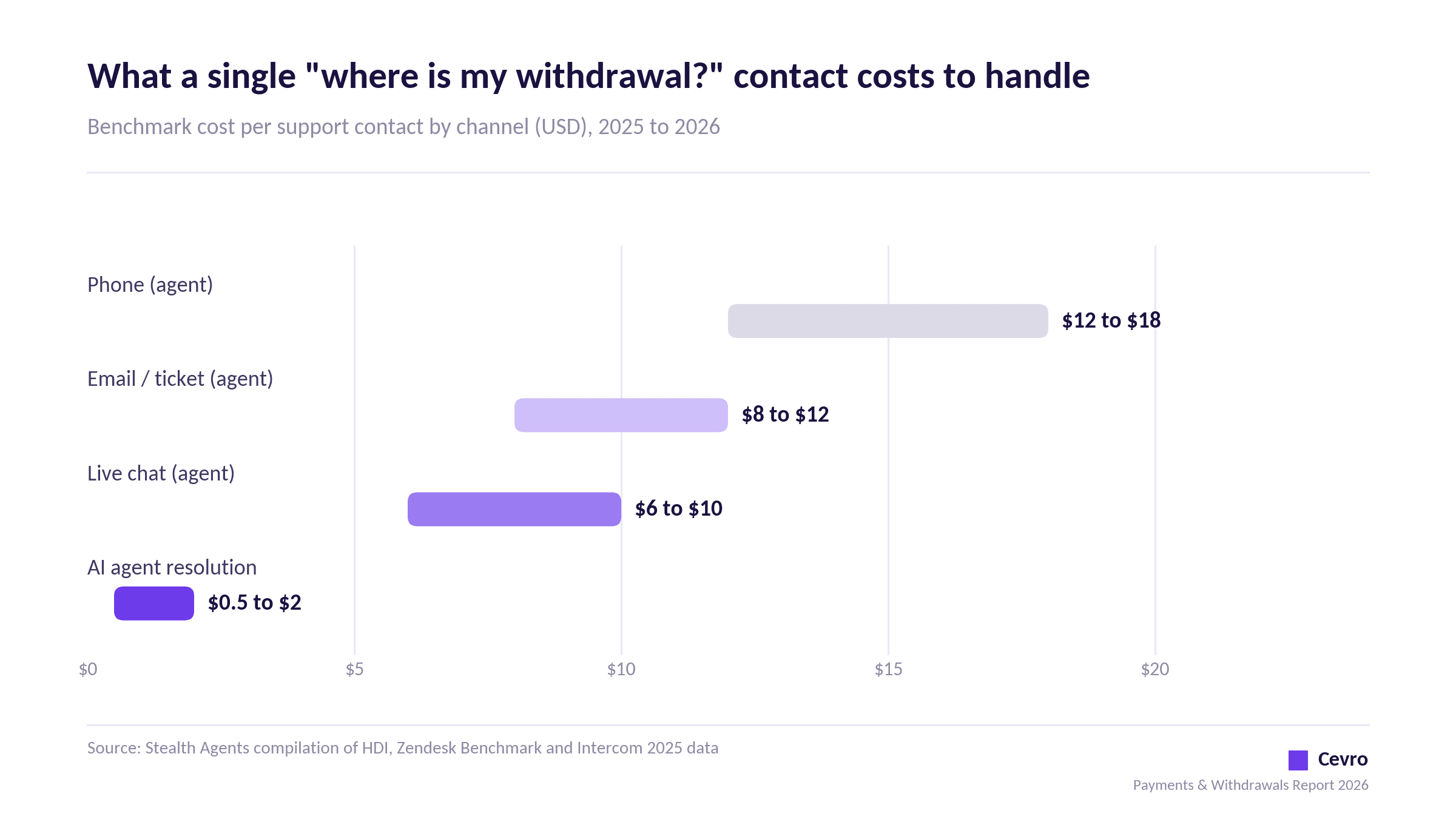
The per-contact figure understates the real cost, because payment problems rarely close in one message. With an average of 2.3 contacts per issue, the true cost per resolved issue is 2.3 times the per-contact benchmark (Source: Lorikeet). A player who writes six times about the same withdrawal is one problem generating six tickets (Source: Cevro, Contact Driver Analysis).
Opacity is a design decision
The player's question is nearly always answerable. The withdrawal is in one of a small number of states: pending internal review, awaiting a document, released to the PSP, settled by the PSP, or rejected with a reason. The friction comes from the fact that the chat widget the player is typing into can't see any of those states.
This is the difference Cevro describes as explaining versus completing. A chatbot tells a player where to find their transaction history; a Cevro agent checks it, cross-references it against the payment gateway, and resolves the issue (Source: Cevro, AI Agents vs Chatbots). Without back-office integration, an AI can only explain. With it, the AI can act (Source: Cevro Glossary).
What a resolved withdrawal contact looks like
Cevro's canonical missing-withdrawal AI Procedure (AIP) runs as follows (Source: Cevro, AI Agents vs Chatbots):
Verifies the player's identity and session context.
Queries the payment gateway and account logs for the transaction.
Cross-references withdrawal limits, brand policies, KYC status and responsible gaming flags.
If eligible, advises on expected timing or triggers a status update. If there's an issue, creates a structured back-office ticket with full context or escalates to a human queue.
The player-facing output is a specific statement, such as "Your €50 deposit is pending PSP approval, expected in 15 minutes," rather than a generic FAQ (Source: Cevro, How to Integrate an AI Agent). That specificity is what stops the second, third and fourth contact.
6. Friction Point #5: Payment Method Availability and Local Rails
The wrong method is a closed door
46% of UK players would not proceed with a deposit if their preferred payment method is unavailable (Source: Paysafe UK player research), and 25% of global bettors name preferred-method availability as a factor in choosing a sportsbook (Source: Paysafe, All the Ways Players Pay 2025).
Debit cards remain the top choice globally (42%), rising to 63% in Mexico, 56% in Peru and 48% in the UK (Source: Paysafe, All the Ways Players Pay 2025), while UK bettors report using debit cards (57.7%), PayPal (36.9%), bank transfer (20.3%) and Apple Pay or Google Pay (14.0%) over the previous year (Source: OLBG survey via iGaming Future).
Local rails are no longer optional. PIX carries 96% of gambling transactions in Brazil, where credit cards and crypto are banned for betting, and betting made up 15.3% of all consumer-to-business PIX payments in the first half of 2025 (Source: GMattos via iGaming Business).
In the UK, open banking payments reached 351 million in 2025, up 57% year on year (Source: Open Banking Limited), and one UK betting platform group saw pay-by-bank reach 15 to 20% of deposits within two to three months of integration (Source: Playbook Engineering via Open Banking Expo).
Rails differ on cost, speed and dispute risk
The economics explain why the mix is shifting. Card processing for iGaming costs 2 to 3.5% before scheme fees, chargebacks and FX markup, with settlement at T+2 to T+7 and rolling reserves of 5 to 15% held for 90 to 180 days; open banking costs 0.5 to 1% with zero chargebacks and instant to T+1 settlement; crypto runs at 0.5 to 1% with instant settlement and no reserve (Source: The State of iGaming Payments 2026).
Regulation is pushing the same way. SEPA Instant has been mandatory for eurozone payment service providers since October 2025, with a maximum processing time of 10 seconds, available 24/7 (Source: European Central Bank). Meanwhile Visa's dispute monitoring threshold tightened to 1.5% from 1 April 2026, down from 2.2% (Source: Ravelin), making card disputes progressively more expensive for gambling merchants.
Crypto demand is real, availability isn't
83% of US bettors say they would fund wagers with crypto if sportsbooks allowed it, and 85% want crypto withdrawals (Source: Paysafe Crypto Edition 2026). Whether that becomes a mainstream rail depends on regulation market by market, but the demand signal is another example of players asking for speed and finality, and operators being constrained in offering it.
The support consequence of a fragmented cashier
Every rail added to the cashier adds a set of failure modes, timelines and decline codes that support has to know. An agent, human or AI, that can only speak to card timelines will give wrong answers to a PIX or open-banking player.
Cevro's AI Procedures are written per method and per market, so the timing the agent promises matches the rail the player actually used. When contact driver analysis shows the agent promising payout times it can't keep for one payment method, the fix is a change to one procedure, drafted by CevroScribe and reviewed by a support lead (Source: Cevro, Customer Support MCP).
7. Friction Point #6: Fraud Controls That Punish Legitimate Players
The pressure operators are under
Verification friction and payout delay don't come from nowhere. They're the visible surface of a fraud problem that is getting worse. 82.9% of iGaming operators experienced an increase in fraud over the past year, and nearly a third estimate fraud costs them 10 to 20% of annual revenue (Source: Sumsub Global iGaming Report 2025).
Sumsub recorded an iGaming-specific fraud rate of 1.53% in Q1 2026, up 18% year on year, while suspicious iGaming transaction volume rose 4.5x between Q1 2025 and Q1 2026 (Source: Sumsub iGaming Fraud Report 2026 via iGamist).
The fraud is moving along the journey. 41.9% of operators name the deposit stage as their primary fraud flashpoint, ahead of onboarding (23.8%) and withdrawals (22.9%) (Source: Sumsub Global iGaming Report 2025). In Asia-Pacific, 76% of fraud cases now occur after the customer has completed KYC (Source: Sumsub iGaming Fraud Report 2026 via iGamist). That's the argument for checks at withdrawal, and it's a good one.
Attackers also work when compliance teams don't. Most fraudulent activity on iGaming platforms occurs between 4 and 8 a.m., while legitimate players typically register around 6 p.m. (Source: Sumsub Global iGaming Report 2025). A manual review queue that empties at 6 p.m. and refills at 9 a.m. is exactly the window a payout delay lives in.
Chargebacks make cards riskier every year
The true cost of an iGaming chargeback is about $2.07 for every $1 disputed once scheme fees, penalties and operational overhead are counted (Source: PayNearMe). Operators exceeding Visa's 1.5% dispute threshold face per-dispute fines (Source: Ravelin). The rational operator response is more checks before money moves. The player's experience of that response is friction.
The trade-off nobody escapes
Here's the problem. 98% or more of the players hitting a verification wall are legitimate. Every rule tuned to catch the 1.53% is experienced as an obstacle by the rest. Non-doc verification shows the trade-off can be managed rather than accepted: roughly 1% drop-off against 40 to 50% for a manual document flow, at equal or better fraud catch rates (Source: Sumsub).
Cevro's take
The mistake is to treat fraud controls and player experience as a dial with a single setting. They're two different systems that need to talk. A fraud team's hold on a withdrawal is only friction if the player hears nothing about it. When the hold is visible to the support layer, with a reason code and an expected timeline, the agent can explain it, collect what's needed and clear it in the same conversation.
Cevro's AI Procedures begin with preconditions such as player authentication required and no RG flags active, and end with forbidden actions such as no withdrawal approvals without human review. The agent never overrides a hold. It just stops the hold from being a silence.
8. The Cost of Friction: Retention, Lifetime Value and Regulatory Exposure
Retention
The payment experience is now a retention lever as much as an acquisition one. 84% of Super Bowl bettors surveyed in December 2025 said they would switch brands after a bad payment experience (Source: Paysafe Super Bowl LX research).
The mirror image holds too: a positive payment experience makes 82% of global bettors stay to continue wagering with a sportsbook (Source: Paysafe, All the Ways Players Pay 2025), and 83% of US bettors say their payment experience directly influences whether they stick with a brand (Source: Paysafe US insight).
In Europe, 55% of players said they would switch operators for instant withdrawals, rising to 75% in Spain and 64% in Italy (Source: TrueLayer / YouGov).
All iGaming's survey of 2,100 online casino players found payout speed shapes playing patterns, dictates deposit frequency and plays a decisive role in long-term loyalty (Source: All iGaming, October 2025).
Lifetime value
One widely cited vendor model puts player lifetime value at $555 for fast-payout operators against $222 for standard withdrawal operators, a 2.5x difference, based on a $100 average deposit and churn falling from 45% to 18% (Source: 0xProcessing model).
That's a model, not a measurement, and it should be treated as an illustration of direction rather than a forecast. The underlying retention economics are better established: a 5% increase in customer retention lifts profits by 25 to 95% depending on industry (Source: Bain & Company via HBR).
Cevro's measured data points in the same direction with more caution. Alpha Affiliates, a Tier 1 multi-brand operator, reported at least a 10% increase in player LTV after analysing chats with and without Cevro (Source: Cevro, Alpha Affiliates case study). That figure covers all support, not payments alone, but payments and verification were among the top contact drivers.
Acquisition spend at risk
Acquiring a first-time depositing player costs $250 to $650, with tier-one gambling search CPMs above $350 (Source: Yogonet). When 52% of US bettors hit a card decline at sign-up and 17% never return (Source: PayNearMe / Sapio bettor survey), a material share of that spend is written off at the cashier before a single bet is placed.
Regulatory exposure
Withdrawal friction is now a regulatory topic in its own right. The UK Gambling Commission launched a review of operator withdrawal processes because withdrawal issues were the number one complaint topic at its contact centre (Source: UK Gambling Commission via iGaming Business), and its Industry Forum continued to log withdrawals and enhanced due diligence as the most significant complaint category in August 2025 (Source: UK Gambling Commission Industry Forum minutes, August 2025).
As Cevro puts it in its guardrails work, in most industries an AI mistake is an inconvenience, but in a regulated market it's a reportable event (Source: Cevro, AI Player Support Guardrails). The same logic applies to a withdrawal delay: what looks like a service issue internally is a consumer-protection issue to the regulator.
The friction ledger
Pulling the numbers together gives a simple ledger you can apply to your own volumes.
Friction point | Player behaviour | Cost to the operator |
|---|---|---|
Slow withdrawal | 62% expect payout within 30 minutes; 55% of Europeans would switch for instant payouts | Churn among the players most likely to be winners and VIPs |
Verification at withdrawal | 40 to 50% abandon a 10-minute manual KYC flow; identity disputes at 21.1% of IBAS cases | Formal complaints, adjudication cost, lost deposits after the payout |
Failed deposit | 40% never retry; 17% leave for good | $250 to $650 acquisition spend written off; $270k to $545k a year in lost GGR at 1,000 attempts a day |
Opaque status | 2.3 contacts per issue | $6 to $12 per agent contact, multiplied by repeat contacts |
Missing method | 46% won't deposit without their preferred method | Lost first deposits that never appear in support data |
Fraud-control friction | Legitimate players held in manual queues that empty overnight | Chargeback fines and reserve costs on one side; churn on the other |
9. What Leading Operators Are Doing Differently
The operators pulling ahead on payments friction aren't doing one thing. They're doing five, and the fifth is what ties the others together.
Move verification earlier, and explain it
The best operators are moving verification earlier in the customer journey so withdrawals can be processed more efficiently (Source: Online-Casinos.com research via NEXT.io). Tiered flows route low-risk players through streamlined checks and concentrate enhanced checks where risk signals exist. When a check is needed at withdrawal, the request arrives with a reason, in the player's language, with a way to complete it in the same session.
Offer instant rails where regulation allows
Open banking, SEPA Instant, PIX and, where permitted, crypto give players the settlement speed they expect and give operators lower fees and zero chargebacks (Source: The State of iGaming Payments 2026). Two-thirds of tested US casinos still miss the 24-hour bar (Source: All iGaming, October 2025), so an operator that reliably pays within the hour has a differentiator most competitors can't match.
Orchestrate deposits to recover declines
Cascading retries through a second acquirer recover another 10 to 15% of initially declined transactions, and orchestrated routing gains 2 to 4 percentage points of approval over static routing (Source: The State of iGaming Payments 2026). Local acquiring and localised cashiers reduce the cross-border decline penalty of 15 to 20% (Source: iGaming Payment Solutions).
Treat support data as payments intelligence
Payment and verification contacts are a real-time audit of the cashier, the PSP mix and the document rules. Cevro Insights clusters every support conversation into topics and tracks how they move over time, so a 40% weekly jump in "withdrawal delayed" contacts is tied to its cause, whether a PSP outage, a new document rule or a promotion with unclear terms (Source: Cevro Insights). Support tells you what happened to a player; Insights tells you why it happened and what it's worth to fix.
Resolve payment tickets in the channel, not around it
This is the piece that turns the other four from projects into a player experience. An AI agent with read and write access to the back office, the PSP and the KYC provider can check a transaction, explain a hold, collect a document, apply a limit and escalate with full context, inside the conversation the player started.
The published results from operators running Cevro with payments, bonuses and KYC in scope:
iPlay Gaming Platform: 91% AI support automation, 40% manual support reduction, CS team optimised from 30 to 15 agents in stages, across 80,000 to 100,000 live chats a month in the UK, Germany, France, the Netherlands, Australia, Italy and Spain. Withdrawal status and bonus requests were the dominant drivers (Source: Cevro, iPlay case study).
SweepNext Casino: 90%+ AI support automation, support headcount from 7 to 2, 4.9+ CSAT and 40+ AI Procedures live, with Sweeps Coin redemption, a process-heavy and compliance-sensitive payout flow, identified as the highest-priority category early on (Source: Cevro, SweepNext case study).
Alpha Affiliates: 81% AI support automation across multiple brands, languages and time zones, CSAT held at 4.8+ and improved by 2 to 3 percentage points, and zero new hires when two new brands generated an additional 6,300 chats in a single month (Source: Cevro, Alpha Affiliates case study).
The guardrails that make it safe
Automating payment support in a regulated market only works with hardcoded limits. Cevro's AI Procedures begin with preconditions (player authentication required, no RG flags active, VIP status verified, GEO-appropriate rules applied) and carry forbidden-action lists that block high-risk moves outright: no bonus issuance over predefined thresholds, no KYC overrides, no withdrawal approvals without human review (Source: Cevro, AI Player Support Guardrails).
Escalations carry full context, including conversation history, system states and decision traces, so human agents receive structured tickets rather than vague summaries (Source: Cevro, AI Player Support Guardrails).
Responsible gaming monitoring runs across 100% of conversations, against manual sampling that typically covers only 2 to 7% of interactions (Source: Cevro, AI Player Support Guardrails). A player chasing deposits after a losing session is flagged in the same flow that handles their withdrawal question.
Where the human team goes
Human agents don't disappear from payments support; they move up. Responsible gaming cases, nuanced complaints, source-of-funds reviews and VIP relationships escalate to people with full context, so the AI handles scale while humans handle sensitivity.
At iPlay, the team reported that Cevro didn't just automate conversations; it transformed operational efficiency (Source: Cevro, iPlay case study).
At SweepNext, the team said it went from being overwhelmed by repetitive tickets to feeling like it actually makes an impact (Source: Cevro, SweepNext case study).
Where this doesn't apply
For a single-brand operator on one domestic rail with a few thousand chats a month, a well-run human team on an instant payout rail with a clear status page may cover most of this. Automation earns its keep when volume, brand count, market count or payment-method count makes consistent human answers impossible to sustain. Adding AI to a broken cashier or an undocumented verification policy also won't help: the agent can only be as clear as the procedure it's given.
10. The 2026 Payments Friction Scorecard
Use this scorecard to audit your own operation. The player signal is what surveys and complaint data say players feel. The metric is what to measure weekly. The fix is what leading operators have done.
Friction point | Player signal | Metric to track weekly | What the fix looks like |
|---|---|---|---|
1. Withdrawal speed | 62% expect payout within 30 minutes | Median and 90th-percentile time from request to funds received, by method and market | Instant rails (open banking, SEPA Instant, PIX); automated approval for clean accounts; specific status in every support answer |
2. Verification at withdrawal | Blocked withdrawals pending ID or SoF are the top IBAS theme | Share of withdrawals held for documents; time from request to document received; abandonment rate | Risk-tiered, earlier verification; reason given with every request; in-chat document collection |
3. Failed deposits | 40% never retry after a failure | Approval rate by issuer, acquirer, method and market; first-deposit success rate | Local acquiring; cascading retries; decline codes mapped to plain-language next steps |
4. Opaque status | 2.3 contacts per payment issue | Repeat-contact rate on payment tickets; first-contact resolution | Support layer connected to PSP and back office so the agent can state the real transaction state |
5. Method availability | 46% won't deposit without their preferred method | Deposit conversion by method; share of sessions abandoning at method selection | Localised cashier by market; support procedures written per rail |
6. Fraud-control friction | Suspicious volume up 4.5x; legitimate players caught in manual queues | Manual review queue age at 6 a.m.; false-positive rate; share of holds with a reason code | Non-doc verification; 24/7 automated review; holds visible to support with reason and timeline |
A simple test for any operator: pick 300 payment and withdrawal conversations from last month, write one root cause for each in plain words, merge the list to 20 or fewer, and split the counts by value tier and market (Source: Cevro, Contact Driver Analysis).
If "other" is one of your top five, the analysis isn't finished.
If withdrawal status is your top driver and your agents are answering it from the terms and conditions, you've found your first automation candidate.
Conclusion: Payments Are Where Trust Is Settled
Every number in this report points at the same moment: the one where a player asks for their money and finds out what kind of operator they've been playing with.
Players have already made their choice. Quick payouts outrank brand trust in sportsbook selection (Source: Paysafe, All the Ways Players Pay 2025), four in five UK bettors consider a payout that takes more than an hour to be late (Source: OLBG survey via iGaming Future), and 84% say a bad payment experience would make them switch (Source: Paysafe Super Bowl LX research).
Operators haven't caught up: only 31% of tested US casinos deliver same-day payouts (Source: All iGaming, October 2025), and the most common formal dispute in Great Britain is a withdrawal held for documents (Source: IBAS via iGaming Expert).
The friction isn't one problem. It's six, and they compound:
A card decline at sign-up writes off acquisition spend.
A document request with no explanation turns a winner into a complainant.
A support channel that can't see the PSP turns one question into 2.3 contacts.
A manual review queue that sleeps overnight turns a fraud control into a churn engine.
Each is measurable, and each has a documented fix.
The through-line is that speed and status have to be delivered together, in the channel the player is already in. Instant rails without instant answers still leave players guessing. Instant answers without back-office access are just a faster way to say "please wait 24 to 48 hours."
Cevro's position is that payments and withdrawals are the ticket category where resolution matters most and deflection costs most. The operators in this report that automated 81% to 91% of their support with payments in scope didn't do it by making their agents faster at explaining policy.
They did it by giving an AI agent the same access their best human agents have, inside hardcoded guardrails, and moving their people to the disputes, VIP relationships and RG interventions that need them.
What to do next: run the 300-conversation contact driver exercise this week, benchmark your withdrawal time from request to funds received at the 90th percentile rather than the median, and check whether the agent answering "where is my withdrawal?" can see the answer. If they can't, that's the first fix.
Expect the expectation bar to keep tightening through 2027 as SEPA Instant, open banking and PIX-style rails become the default in more markets, so the gap between operators who pay in minutes and those who pay in days will widen, not close.
FAQs:
1. What is the biggest player friction point in iGaming payments in 2026?
Withdrawal speed, followed closely by verification at the point of withdrawal. 48.9% of UK bettors name withdrawal speed as a key factor in choosing a betting site (Source: OLBG survey via iGaming Future), and blocked withdrawals pending identity or source of funds checks are the most common current dispute theme at IBAS (Source: IBAS via iGaming Expert). The two are linked: most slow withdrawals are slow because of a document request.
2. How fast do players expect casino withdrawals to be?
Within the hour. More than 62% of UK bettors expect withdrawals to arrive instantly or within 30 minutes and a further 20.3% within one hour (Source: OLBG survey via iGaming Future). Globally, 42% of bettors expect to cash out instantly (Source: Paysafe, All the Ways Players Pay 2025).
3. Why are iGaming card deposits declined so often?
Gambling transactions carry merchant category code 7995, which many issuing banks block by default or subject to extra 3D Secure authentication (Source: Finix). Card approval for licensed US iGaming runs at about 87% against 90 to 95% for standard e-commerce (Source: PayNearMe), and declines are 15 to 20% higher on cross-border transactions (Source: iGaming Payment Solutions).
4. Does KYC at withdrawal cause players to leave?
Yes, when it's manual and unexplained. Manual document KYC taking 10 minutes or more sees 40 to 50% of players abandon, against roughly 1% for non-documentary verification (Source: Sumsub). The complaint data shows identity disputes rising from 13.5% to 21.1% of IBAS cases in two years (Source: UK Gambling Commission complaints data).
5. What does a withdrawal support ticket cost an operator?
Between $6 and $12 per agent-handled contact on chat or email (Source: Stealth Agents compilation of HDI, Zendesk and Intercom data), multiplied by an average of 2.3 contacts per issue (Source: Lorikeet). An AI agent resolution costs $0.50 to $2 per contact (Source: Stealth Agents compilation of HDI, Zendesk and Intercom data).
6. Can AI agents resolve payment and withdrawal tickets, or only deflect them?
With back-office and PSP integration, they resolve them. Cevro's AI agents verify the player, query the payment gateway and account logs, cross-reference limits, KYC and RG flags, then either advise on timing, trigger a status update or escalate with full context (Source: Cevro, AI Agents vs Chatbots). Operators running this on live traffic report 81% to 91% end-to-end automation with CSAT at 4.8+ (Source: Cevro, iPlay case study). Withdrawal approvals themselves remain a human decision under Cevro's forbidden-action rules (Source: Cevro, AI Player Support Guardrails).
7. Is Cevro a chatbot?
No. Cevro is an AI player support platform built for iGaming operators, platforms and BPOs. It deploys AI agents that handle player queries end-to-end across bonuses, KYC, payments, RG and tech issues, integrating with your existing stack (Source: Cevro). The distinction Cevro draws is deflection versus resolution: a chatbot explains a process, a Cevro agent completes it.