

Integrating an AI agent into an iGaming platform is no longer a massive IT project reserved for the most mature operators. Platforms like Cevro are designed to plug into existing stacks, execute real back-office workflows, and start automating meaningful parts of player support within weeks.
This guide covers which use cases to automate first, how to think about AIPs (AI Procedures), what has to be in place before you start, and how to launch in a way that actually impacts your KPIs.
Why AI Agent Integration Is Different Now
For years, "integrating AI" meant complex projects, multiple vendors, and a long list of dependencies before anything useful reached players. Many operators tried simple chatbots or FAQ widgets that, in practice, did little more than automate a small percentage of basic questions. Those experiences left a lot of decision-makers sceptical that AI could ever touch the real operational work of iGaming support.
Modern AI agents built specifically for iGaming are designed around a different assumption: the agent must behave like an operational teammate. That means accessing your back-office systems, understanding your standard operating procedures, and executing complete workflows end to end. Integration is therefore about giving the agent safe, controlled access to the same tools and data your best human agents use every day. Connecting a chat widget is the easy part.
Because Cevro integrates directly with leading platforms and PAMs, operators can often start from existing integrations instead of building everything from scratch. In practice, that is what makes it realistic to go from "idea" to "live AI agent" in a short amount of time.
What You Need in Place Before You Start
The integrations that stall are almost never blocked on the AI. They stall on access and ownership. Before the first call, get these five things settled.
API credentials for your platform or PAM, with the scopes the agent will actually need: read player profile, read balances and transactions, read KYC status, write bonuses, write tickets. Read-only access is enough to start, and it is a sensible first phase.
A sandbox or staging environment with realistic player data. Testing an account-locked procedure against three seeded test accounts tells you very little.
Your SOPs in writing, even if they are messy. A training deck and a Confluence page beat tribal knowledge. This is the raw material for your AIPs.
A named owner on the operator side. Usually the Head of CS or a CX lead. Someone has to decide what the agent is allowed to do when a player asks for their account to be closed.
A responsible gaming policy owner who signs off on escalation rules before go-live, not after.

Get these five ready before kick-off and the first procedures go live in weeks.
Operators who arrive with those five ready tend to be live on their first procedures inside a couple of weeks. Operators who start the API access conversation after kick-off usually lose a month to their own IT queue.
Step 1: Clarify What You Want the AI Agent To Actually Do
The most important integration decision is not technical. It is defining, in concrete terms, what the AI agent should be able to do for your players on day one.
Most iGaming support is the execution of procedures: checking if a deposit succeeded, verifying a player's identity, applying a bonus, reopening a locked account, or explaining a policy based on the player's history and jurisdiction. If you treat everything as an FAQ problem, you will end up with yet another bot that hands real work back to humans.
Cevro addresses this through AI Procedures (AIPs), which formalise your operational workflows in a way an AI agent can execute reliably and consistently. Instead of building flowcharts or writing scripts, you describe how a process should work in structured, human-readable form, and the orchestration engine turns that into a deterministic procedure.
Typical starter AIPs for an operator might include:
Password reset and login issues
Account locked and account verification
"Where is my deposit?" or missing balance
"Bonus not received" or bonus eligibility questions
Responsible gaming situations
Each of these is more than a single answer. A deposit-related AIP can validate identity, check PSP logs, cross-check CRM data, evaluate the status of the transaction, and then either resolve the issue or escalate with full context to a human agent. That is the level of clarity you want before getting into any technical details.
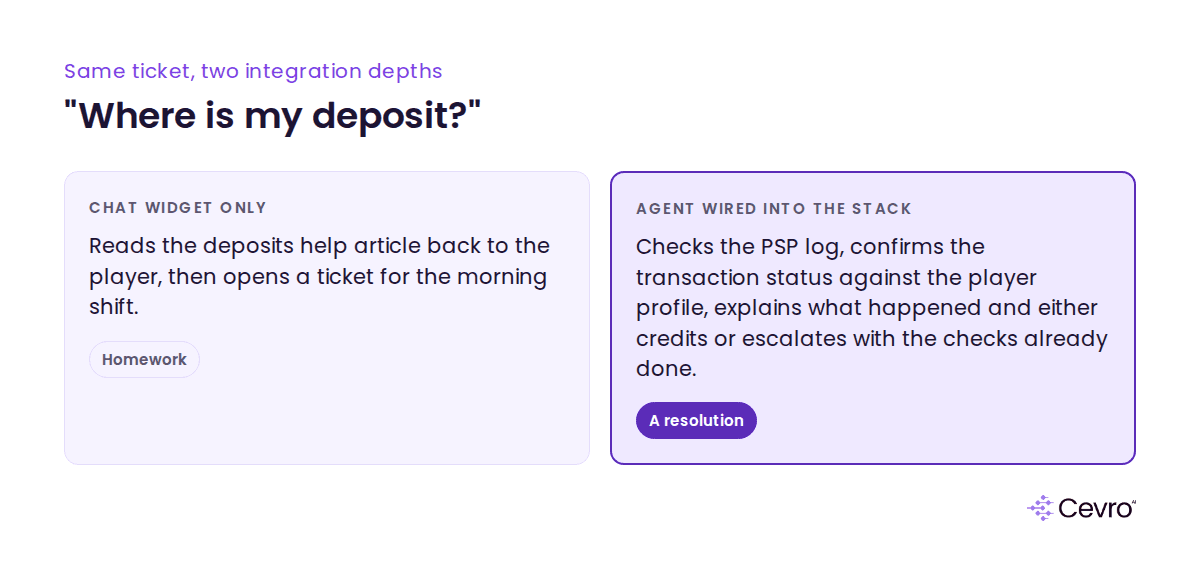
The same ticket, answered at two different integration depths.
Step 2: Connect the AI Agent to Your iGaming Stack
Once you know what the AI agent should do, the next step is to give it the tools to do it. This is where integrations matter.
At a minimum, an agent that resolves real tickets needs to:
Read and write data to your back office (player profile, balances, bonuses, KYC status).
Interact with your communication layer (chat, helpdesk, email).
Trigger and track operational actions: create or update tickets, tag conversations, escalate to human queues, alert RG teams.
Cevro sits in the middle of the stack and orchestrates these components. Out of the box it offers ready-made integrations with major platform and back-office providers in iGaming, leading chat and helpdesk platforms, and the collaboration tools digital teams already use. You can see the current list on the Cevro integrations page. In practical terms this means:
A low-friction connection to your PAM or platform, using existing APIs and credentials.
Immediate access for the AI agent to actions like issuing bonuses, checking account states, opening back-office tickets, or syncing player data.
The ability to plug into your existing helpdesk or live chat tool, so the agent responds where your players already are.
From an IT perspective, integrating a platform like Cevro looks closer to onboarding a new helpdesk or analytics tool than to building a bespoke AI system. From a commercial perspective, the same integration underpins dozens of AIPs, so each new use case is incremental configuration instead of a new project.
Step 3: Translate SOPs Into AI Procedures
Most operators already have SOPs: written procedures, training decks, or other materials describing how agents should handle a given situation. The issue is that these assets are built for humans to interpret. A machine cannot execute them as written.
AIPs are Cevro's way of closing that gap. An AIP is a structured, declarative specification of a workflow, written in constrained natural language, that the orchestration engine interprets and executes step by step with guardrails. Preconditions, forbidden actions and escalation logic are part of the procedure itself, and every interaction is logged.
Because AIPs are written in human-readable form, CX and operations leaders can shape and refine them without relying entirely on developers. That keeps the implementation anchored in business reality: what the operator wants to happen when a player faces a specific problem.
A practical tip. Start by writing the procedure for the ticket your team handles most often, then read it back and mark every point where a human would need to check something outside the text. Those checks are your integration requirements. It is a faster way to scope the work than any technical discovery session.
Step 4: Launch, Measure, and Scale AI Automation
Once the agent is connected and equipped with its initial AIPs, the focus shifts to controlled rollout and iteration. The most effective operators approach this in phases.
They typically start with a subset of traffic, languages, or brands, and a handful of high-volume use cases where automation has clear value and low risk. Password resets, "where is my deposit" questions and simple bonus enquiries in English, before extending to additional markets and more complex flows.
From there, they track:
Automation rate: what percentage of conversations are resolved end to end by the AI agent without human intervention.
CSAT and sentiment: how players rate or react to the AI's handling of their issues.
Escalation patterns: where the AI hands off to human agents, and why.
Changes in first response time and other KPIs. If you want the retention side of those numbers, Cevro Insights is where the player intelligence layer lives.
On well-defined workflows, operators typically resolve 80–90% of player tickets without a human, with average CSAT of 4.8 or better. How quickly you get there depends on your query mix and how deep the integration goes. That level of impact is only possible because the agent executes procedures instead of surfacing articles.
Scaling then becomes a matter of:
Adding new AIPs for additional ticket categories: withdrawals, multi-brand issues, disputes.
Expanding to more languages and regions. Cevro supports 120+ languages natively, around the clock, with iGaming-specific tuning.
Deepening integration with back-office tools so more last-mile actions happen without a human.
Throughout, the human team remains critical. Responsible gaming cases, nuanced complaints and edge scenarios escalate immediately to human agents with full context, which lets the AI handle scale while humans handle sensitivity.
How Long Integration Actually Takes
The honest answer is that it depends on one thing more than any other: whether your platform is already supported.
On a platform Cevro integrates with natively, deployment runs in days. The connection is already built and tested, so the work is configuration: mapping your fields, writing your first AIPs, setting escalation rules. Native integrations currently include Bragg, EveryMatrix, Vegangster, White Hat Gaming, GiG and Smartico.
On a proprietary or in-house platform, add time for the API work on your side. That is usually the long pole, and it is your engineering queue rather than ours. Operators who scope the API work during commercial discussions, before signature, save themselves weeks.
Either way, the first live procedure is a matter of weeks, not quarters. Anyone quoting you a six-month AI integration is describing a custom build.
Where AI Agent Integrations Go Wrong
Four failure patterns show up again and again.
Automating the wrong tickets first. Teams pick the most painful ticket type, which is usually the most complex and most sensitive. Start with high volume and low risk instead. Build trust in the system, then move up.
Treating the AI as a deflection layer. If the target is "reduce contacts", you get a bot that makes it hard to reach a human, and CSAT tells the story within a fortnight. The target should be resolution.
Leaving the SOPs vague. "Use your judgement on goodwill bonuses" works for a trained host who knows the book of players. It does not survive contact with a procedure. Vague inputs produce inconsistent outputs, and then the AI takes the blame for a policy gap that was always there.
No owner on the operator side. Integrations drift when nobody is empowered to decide what the agent may do. One named person with the authority to say yes is worth more than a large steering group.
Why Cevro Is Built for This Kind of Integration
Most AI tools in the market started as generic chatbots or general-purpose assistants and later tried to retrofit themselves into AI agents. Cevro took the opposite path. It was built from day one as an AI agent platform for iGaming, designed to operate as a real member of the support team, not a front-end widget.
That shows up in the details that matter to a compliance team as much as a CX team: SOC 2 Type II certification, PII masking, zero data retention, and responsible gaming monitoring on every conversation.
If the goal is to make every player feel like a VIP without scaling headcount, integrating an AI agent platform that can execute your procedures is the logical next step.
FAQ
How long does it take to integrate an AI agent into an iGaming platform?
On a platform with a native integration, deployment runs in days and the first live AIPs follow within weeks. On a proprietary platform, the timeline depends on your own API work, which is usually the longest part.
Do we need developers to set it up?
You need developer involvement for API access and credentials. You do not need developers to write the procedures. AIPs are written in structured, human-readable form, so CX and operations leaders own them directly.
What can an AI agent do that a chatbot cannot?
A chatbot answers. An agent acts. We pulled the distinction apart in AI agents vs chatbots. It looks up the transaction, checks KYC status, applies the bonus, opens the back-office ticket, and escalates with full context when it should not proceed on its own.
Which use cases should we automate first?
High volume, low risk, clearly defined. Password resets, account verification status, "where is my deposit", and simple bonus eligibility questions. Leave complaints, disputes and responsible gaming interventions to humans while you build confidence.
How does AI agent integration work for player onboarding?
Onboarding is a good early candidate because the steps are well defined. The agent can explain which document was rejected and why, check verification status in the back office, and tell the player exactly what to upload next, at the moment they ask rather than the next morning.
What happens with responsible gaming cases?
Every conversation is monitored for RG signals, and RG situations escalate to a human immediately with full context. The agent does not make judgement calls on player welfare.
Is player data safe?
Cevro is SOC 2 Type II certified, masks PII, and operates with zero data retention. Your compliance team should ask for the details early, as those answers often shape the scope of the first integration phase.
Can it handle players in other languages?
Yes. 120+ languages natively, around the clock, with iGaming-specific tuning, not generic translation.
If you want to see what integrating Cevro into your own stack would look like, from first AIP to live traffic, the next step is a tailored demo with your real use cases. Book a demo with our team.