
Updated October 2026
Before implementing AI automation in iGaming support, do the groundwork first: the right access, written procedures, a named owner, clear rules for responsible gambling, and a way to measure resolution. Skip those and you end up with a bot players try to get past.
This guide is the checklist we walk operators through before they go live with Cevro. If you're still deciding what to automate, start with our guide to iGaming automation, which covers the ten processes operators automate most. This post is about getting ready to do it.
Why AI automation in iGaming support is different now
For years, "automating support" meant a chatbot that answered FAQs and handed everything else to a human. Players learned to type "agent" until they got one.
What operators implement today is different. AI agents connect to the back office and work through the same steps a trained agent would: check the player's account, look up the transaction, see the KYC status, apply the bonus, and escalate with the checks already done when a person is needed. That's why preparation matters more than it used to. An agent can only do what it has access to and what your procedures allow.
The same procedures, grouped by the team that owns them, are listed on our agentic workflows page.
Chatbots vs AI agents: know which one you're implementing
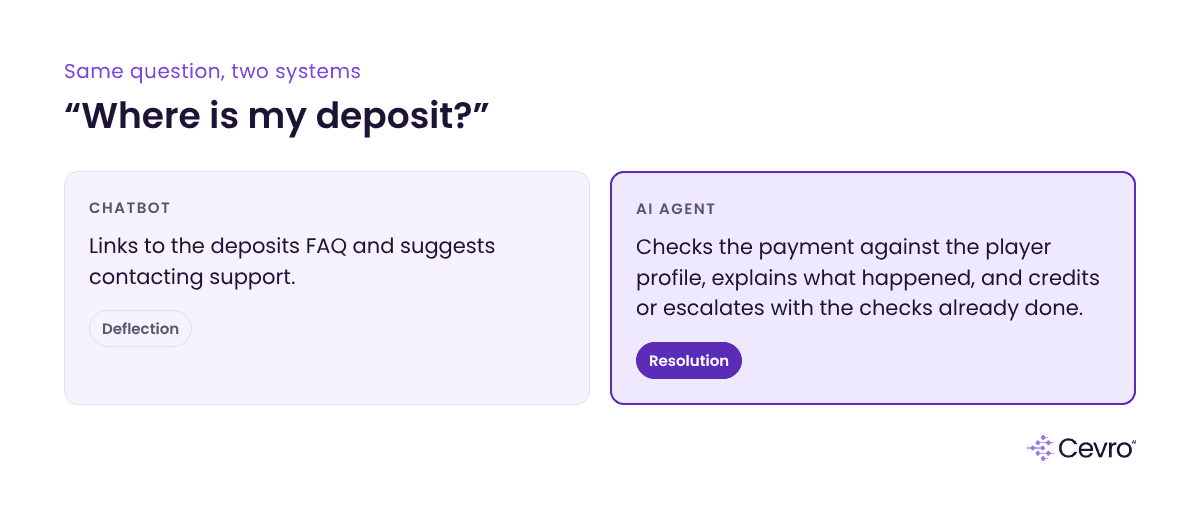
The same question, handled by a chatbot and by an AI agent connected to the back office.
Chatbot | AI agent | |
|---|---|---|
How it works | Scripts and keyword matching | Understands intent, follows written procedures |
Data access | Help articles | Player profile, balances, transactions, KYC, bonuses |
What it does with "where is my deposit?" | Links to the deposits FAQ | Checks the payment, explains what happened, credits or escalates |
Responsible gambling | Not monitored | Monitored on every conversation, escalates to a human |
What you measure | Deflection | Resolution |
If a vendor demo only ever answers questions and never looks anything up, you're looking at a chatbot.
Before implementing AI automation: the readiness checklist

Get these in place before kick-off and the first procedures go live in weeks.
Platform access. API credentials for your platform or PAM with the scopes the agent needs: player profile, balances, transactions, KYC status, bonuses, tickets. Read-only access is enough for a first phase.
A sandbox with realistic data. Testing a locked-account procedure on three seeded test accounts tells you very little.
Your procedures in writing. Training decks, Confluence pages and macros all count, even if they're messy. They become the agent's AI Procedures.
A named owner. Usually the Head of CS or a CX lead. Someone has to decide what the agent may do when a player asks to close their account or disputes a bonus.
Responsible gambling rules signed off. Agree which signals trigger an immediate handover to a human, and sign them off before go-live.
Languages and markets listed. Know which languages, brands and jurisdictions you need on day one, and which can follow.
A baseline. Record today's volumes by ticket type, first response time, resolution rate and CSAT, so you can show what changed.
Security answers ready. Your compliance team will ask about data retention, personal data handling and certifications. Ask your vendor early, because the answers shape the scope of the first phase.
Operators who arrive with these ready tend to have their first procedures live within a couple of weeks. Operators who start the API access conversation after kick-off usually lose a month to their own IT queue.
Which tickets to automate first
Start with high-volume, low-risk, well-defined tickets: password resets and login issues, account verification status, "where is my deposit?", and simple bonus eligibility questions. Leave complaints, disputes and responsible gambling interventions with your team while you build confidence. Our guide on which support tickets to automate first goes through how to rank them.
A practical tip: write out the procedure for your most common ticket, then mark every point where a human would need to check something outside the text. Those checks are your integration requirements.
How AI and your human team work together
AI automation in iGaming works alongside your agents. The agent takes the volume and the repetition. Your team takes the exceptions: complex disputes, high-value players, and anything sensitive.
That only works with clear escalation rules. Every handover should arrive with the conversation, the checks already done and a suggested next step, so the human isn't starting from scratch. Responsible gambling is the clearest case: when the agent detects signs of harm, it hands over to a person straight away with full context. It doesn't make welfare decisions itself.
Done well, the change shows up in capacity. At CasinoPlatform, ticket volume doubled in six months while human workload went down.
How to measure whether AI automation is working
The first distinction to make is between deflection and resolution. Deflection counts conversations the AI handled without a human. Resolution counts conversations where the player's problem was actually solved. Optimising for deflection without tracking resolution is the most common way an AI deployment looks good in a dashboard while players get more frustrated.
Track three groups of metrics:
Resolution quality: autonomous resolution rate, escalation rate, repeat contacts on the same issue, and CSAT by ticket type.
Operational efficiency: handling time, first-contact resolution, cost per resolved ticket, and agent time freed up.
Player signals: sentiment by contact type, which contact reasons are growing, and what they say about product or payment friction upstream. Our post on contact driver analysis covers how to read these.
Review resolution and escalations weekly, and contact trends monthly. On well-defined procedures, operators typically resolve 80 to 90% of player tickets without a human, with average CSAT of 4.8 or above. How fast you get there depends on your ticket mix and how deep the integration goes.
Common mistakes when implementing AI automation
Starting with the hardest tickets. Teams often pick the most painful ticket type, which is usually the most complex and sensitive. Start simple, then move up.
Treating AI as a deflection layer. If the goal is fewer contacts, you get a bot that makes it hard to reach a person, and CSAT shows it within a fortnight. The goal is resolution.
Leaving procedures vague. "Use your judgement on goodwill bonuses" works for an experienced agent. It doesn't work as a procedure. Vague policies produce inconsistent answers, and the AI gets blamed for a gap that was always there.
No owner. Implementations drift when nobody can decide what the agent is allowed to do.
How long implementation takes
It depends mostly on whether your platform is already integrated. On a platform Cevro integrates with natively, deployment runs in days, because the connection is built and tested. Native integrations include Bragg, EveryMatrix, Vegangster, White Hat Gaming, GiG and Smartico. On a proprietary platform, add time for the API work on your side, which is usually the longest part. Either way, the first live procedure is a matter of weeks.
Getting started
Assess, pilot, then scale. Audit your current ticket mix and pick two or three use cases. Run them on a share of traffic, measure resolution and CSAT against your baseline, and refine the procedures. Then add use cases, languages and markets.
Choose a partner built for iGaming. Bonus mechanics, payment flows, KYC and responsible gambling rules are where generic tools fall down. Cevro supports 120+ languages around the clock, runs responsible gambling monitoring on every conversation, masks personal data and keeps zero data retention.
FAQ
What should iGaming operators prepare before implementing AI automation?
Platform API access, a sandbox with realistic data, written procedures, a named owner, signed-off responsible gambling escalation rules, a list of languages and markets, a performance baseline and answers to security questions.
How long does it take to implement AI automation in iGaming support?
On a platform with a native integration, deployment runs in days and the first procedures go live within weeks. On a proprietary platform, the timeline depends mostly on your own API work.
Which support tickets should we automate first?
High-volume, low-risk, well-defined tickets: password resets, account verification status, deposit questions and simple bonus eligibility. Keep complaints, disputes and responsible gambling cases with your team at first.
What is the difference between a chatbot and an AI agent?
A chatbot answers from scripts and help articles. An AI agent connects to the back office, follows your procedures and resolves the issue, then escalates with full context when it shouldn't continue on its own.
How do we measure if AI automation is working?
Track resolution as well as deflection: autonomous resolution rate, repeat contacts, CSAT by ticket type, cost per resolved ticket and how contact reasons change over time.
Will AI automation replace our support agents?
No. The AI handles volume and repetition, and your team handles exceptions, disputes, high-value players and responsible gambling cases.
How do we deliver 24/7 multilingual support with AI?
Use an AI agent that works natively in your players' languages around the clock. Cevro supports 120+ languages, so night shifts and less common languages no longer depend on staffing.
Related reading on cevro.ai