


Contact driver analysis is the practice of finding the single root reason behind each player contact, then counting and ranking those reasons across every customer interaction. It sounds like ticket tagging. It isn't the same thing, and in iGaming the difference shows up in your deposits.
A player writes in on a Friday night about a withdrawal. Two messages later they mention the reload offer they didn't get. By the end, they want to know why their account is asking for a bank statement. Your helpdesk tags it "withdrawal", "bonus" and "KYC". The contact driver is one of those three, and it's the one that decides whether this player deposits again next week.
We build AI agents and player intelligence for online casinos and sportsbooks, so we read support conversations at volume every day. This guide is how we approach contact driver analysis with operators, what tends to go wrong, and what to do with the list once you have it.
See your top contact drivers in Cevro →
What is contact driver analysis?
A contact driver is the reason the player got in touch. One reason per contact. If a player asks three things, the driver is the one that caused them to open the chat.
Contact driver analysis takes every conversation over a period, assigns each one a driver, merges drivers that mean the same thing ("withdrawal pending", "where is my money", "cashout not arrived"), and ranks them. Done well, you end up with a short list: the eight or ten reasons that generate most of your volume, with counts, trends and examples.
Contact centres call the same thing call driver analysis. The method is identical. What changes in iGaming is the vocabulary (PSP, PAM, KYC, RG flags, wagering) and what's at stake. In most customer service teams a top driver costs agent time. In iGaming a top driver can cost you the player, and the customer experience problem shows up in next week's deposits.
How is a primary contact driver different from a ticket tag?
Most support teams already have tags. Agents pick them from a dropdown at the end of a chat, usually in a hurry, usually the first one that fits. Tags tell you what was touched. Drivers tell you why the player came.
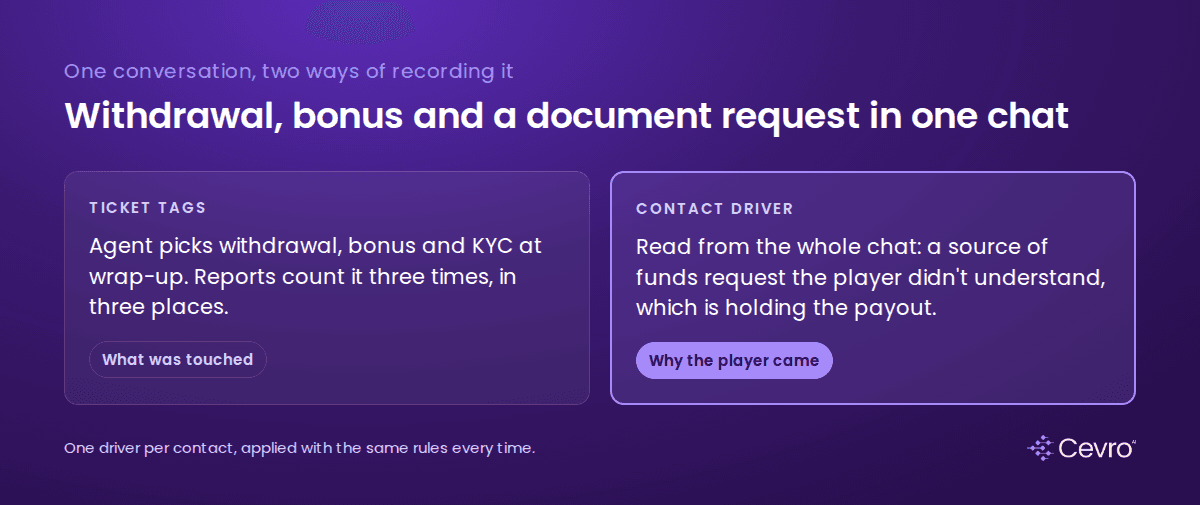
Same conversation, two ways of recording it.
Ticket tags | Contact drivers | |
|---|---|---|
Who assigns it | Agent, at wrap-up | Read from the full conversation |
How many per contact | Often several | One root reason |
Consistency | Varies by agent and shift | Same rules on every conversation |
Synonyms | "Withdrawal", "cashout", "payout" split into separate tags | Merged into one driver |
Useful for | Routing, workload | Fixing the cause, product and payments decisions |
Two things break tag-based reporting in iGaming specifically.
Why manual ticket tagging is unreliable for finding top drivers
First, tags drift. A tag list designed three years ago doesn't have "source of funds request" or "affordability check" on it, so those contacts land in "KYC" or "Other". "Other" is often one of the top five tags. Nobody can act on "Other".
Second, the tag reflects the agent's fix. The driver reflects the player's problem. An agent who resolves a withdrawal complaint by crediting a goodwill bonus may tag it "bonus". The player came about the withdrawal.
Why withdrawals and KYC usually top the list
We see the same pattern across most operators we work with: payments and verification sit at or near the top of the driver list, and they carry the most negative sentiment.
The regulators see it too. In the UK Gambling Commission's consolidated complaints data for 2019–20, deposits and withdrawals were the most common dispute type at eCOGRA, at 32.6% of disputes. More recently, the Commission's Industry Forum minutes from August 2025 record that the most significant complaints relate to account withdrawals and enhanced due diligence checks, with operators seeing more complaints driven by AML processes and document requests.
That lines up with what the conversations show. The player who writes "where is my withdrawal" is often really writing about a document request they didn't understand, sent three days ago, in a language that isn't theirs. The driver is the verification step. The withdrawal is the symptom.
How to find your top contact drivers
This is the process we run with operators. You can do a rough version by hand on a sample; the point of automating it is to run it on every conversation, every week.
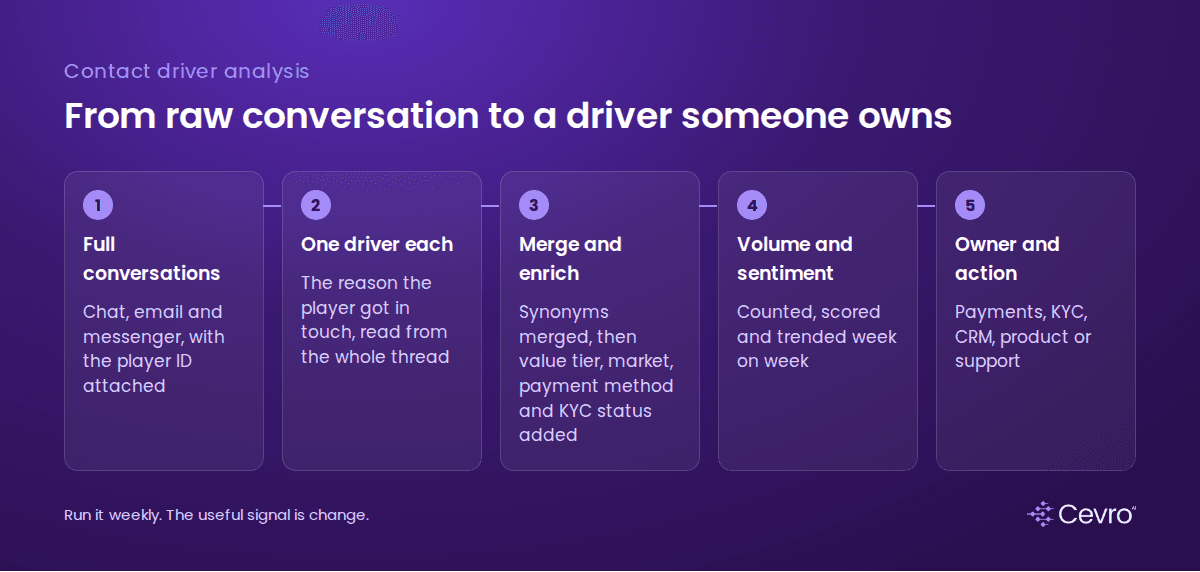
The steps from raw conversation to a driver list someone can act on.
Pull full conversations. Tags alone won't do. Chat, email and messenger transcripts, with the player ID attached so you can join them to account data later.
Assign one driver per conversation. Read the whole thread and pick the reason the player opened it. Write down the rule you used, so the next person (or model) applies it the same way.
Merge synonyms. "Pending withdrawal", "cashout delay" and "money not arrived" become one driver. Keep the merged list short; 15 to 25 drivers is usually enough for a whole operation.
Add context from the back office. Player value tier, market, brand, payment method, KYC status. A driver that is 4% of all contacts can be 30% of VIP contacts.
Score sentiment per driver. Volume tells you how often. Sentiment tells you how it felt. A high-volume, neutral driver ("how do free spins work") is a knowledge base job. A mid-volume, sharply negative driver is where players leave.
Trend it weekly. The useful signal is change. A driver that jumps 40% in a week usually has a single cause: a PSP outage, a new document rule, a promotion with unclear terms.
Assign an owner and an action to each top driver. Payments, KYC, CRM, product or support. A driver list with no owners is a report nobody reads twice.
Rank top contact drivers by impact as well as volume
Volume is the default ranking because it's the easiest one to count. It isn't the one that matters most.
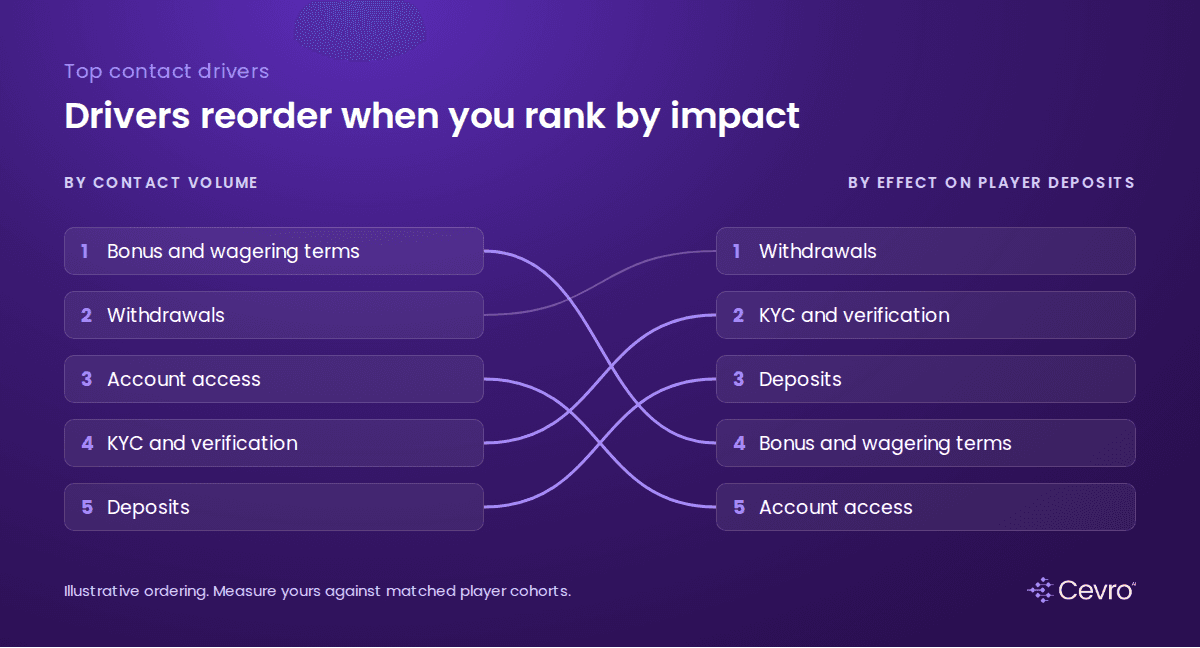
Illustrative. The order changes once you measure what each driver does to player value.
Bonus and wagering questions are high volume at most operators. They're usually easy, and players who ask them keep playing. Withdrawal delays are lower volume and far more expensive: a VIP who waits two days for a payout and gets no explanation is a VIP who tries the operator next door.
So we look at each driver twice. Once by how many contacts it creates, and once by what happens to the players who raise it: their deposits, their session frequency, whether they close the account. The second list is the one to fix first. We cover the retention side of this in more detail in our piece on player retention strategies in iGaming.
Can identifying contact drivers actually reduce support volume?
Yes, if the driver list reaches the people who own the cause. On its own, knowing that "document upload failed" is your fourth-largest driver changes nothing. Handing it to the product owner of the upload screen, with 40 example conversations and the markets it happens in, usually does.
The drivers we see shrink fastest are the ones with a single, fixable cause:
A PSP returning a vague decline code. Players write in asking why their deposit failed. Mapping the code to a plain explanation in the cashier removes most of those contacts in a week.
A document request with no reason given. Explaining why the check is needed, in the player's language, cuts the follow-up questions and the angry ones.
Promotion terms buried in a PDF. When the offer email states the wagering and expiry up front, bonus disputes drop.
Some drivers can't be designed away. Withdrawals will always generate contacts, because players want to know where their money is. For those, the goal changes: answer instantly and correctly, with the real status from payments. That's where an AI agent earns its keep. At iPlay, Cevro's AI agent let the operator run the same volume with 15 agents instead of 30, and cut support operating cost by 40% with no drop in service quality.
Connecting drivers to AI Procedures
In Cevro, the AI agent works from AI Procedures (AIPs): step-by-step workflows your support lead can read and edit, with preconditions, forbidden actions and escalation rules. When contact driver analysis shows a driver the agent handles badly, the fix is usually a change to one procedure. A new document type, an extra check before promising a payout time, a handover to a VIP host for a specific tier.
Every conversation is logged, and every escalation reaches a human with the player history, the conversation and a recommended next step. That full context is also what makes the driver assignment reliable: the analysis reads what actually happened in each support ticket, including what the agent checked in the back office, and not only what the player typed.
Player sentiment analysis: the other half of the picture
Player sentiment analysis scores how each conversation felt, from the player's side. On its own it's a mood chart. Joined to contact drivers it becomes useful, because it tells you which drivers hurt.
A few things we've learned about sentiment in iGaming support:
Sentiment moves before volume does. When a document rule changes, the first few players who hit it are angry before there are enough of them to show up in the counts.
Averages hide VIPs. Overall sentiment can hold steady while sentiment among your top tier drops sharply. Always split by value tier.
Resolution doesn't mean the player is happy. A ticket closed as solved can still end with a player who said "fine, whatever" and never deposited again. That's why we don't treat CSAT alone as the measure; CSAT scores often miss the real story.
What operators get wrong
Letting "Other" win. If your largest driver is "Other" or "General enquiry", the analysis isn't finished. Read 50 of them. You'll find three real drivers hiding in there.
Counting contacts and forgetting players. One player who writes six times about the same withdrawal is one problem with six support tickets. Count both, and watch repeat contacts as their own signal.
Running it once. A quarterly driver report goes stale within weeks. Promotions change, PSPs change, regulators change the document rules. Weekly is the minimum.
Fixing the answer instead of the cause. If "how do I upload a document" is a top driver, a better FAQ helps. Changing the upload screen so players stop asking helps more. Contact driver analysis is only worth doing if the owners of those screens see the list.
How we do contact driver analysis at Cevro
In Cevro, contact driver analysis runs on every conversation, whether the AI agent or a human agent handled it. Each conversation gets a driver, a sentiment score and the player context from your back office, and the drivers are grouped and trended automatically.
Operations and VIP teams then ask questions about it directly in CevroScribe, in plain language:
"Which contact drivers grew most this week, and in which markets?"
"Why are VIP deposits down this month?"
"Which VIPs raised a withdrawal delay in the last seven days and haven't deposited since?"
"What's behind the rise in bonus disputes since the 12 September offer?"
The answer comes back with the numbers, the players involved and the conversations behind it. You can ask from the Cevro dashboard, from Slack, or from Claude and ChatGPT through MCP. If the fix is on the support side, for example a procedure that needs a new step for a new document rule, Scribe drafts that change for your team to review and publish in the same conversation.
The insight side sits alongside Cevro Insights, which connects support drivers to retention and deposits, and our AI customer support for iGaming operators, which handles the conversations themselves.
Getting started
If you want to try contact driver analysis before buying anything, take last month's conversations and do this:
Sample 300 conversations across chat and email.
Read each one and write one driver in plain words.
Merge the list down to 20 or fewer.
Split the counts by value tier and by market.
Pick the top three by impact and give each one an owner.
It'll take a person two or three days. After that you'll know whether it's worth running on every conversation.
Book a demo to see your own contact drivers →
FAQ
What is contact driver analysis?
Contact driver analysis identifies the single root reason behind each customer contact, merges reasons that mean the same thing, and ranks them across all conversations. It shows support, product and payments teams which causes to fix first.
How is a primary contact driver different from a ticket tag?
Ticket tags are chosen by agents at wrap-up and often record several topics per ticket. A contact driver is one root reason per contact, read from the whole conversation and applied with the same rules every time.
Why is manual ticket tagging unreliable for finding top drivers?
Agents choose tags quickly at the end of each support ticket, often picking several and often recording their fix instead of the player's problem. Tag lists also go out of date, so new issues end up in "Other".
Can identifying contact drivers reduce support volume?
Yes, when each top driver has an owner who can fix the cause, such as a confusing cashier error or an unclear document request. Drivers that can't be removed, like withdrawal status questions, are best handled with instant, accurate answers from an AI agent.
What are the top contact drivers in iGaming?
Withdrawals, verification (KYC, source of funds and affordability checks), bonus and wagering terms, deposits and account access usually make up most of the volume. Withdrawals and verification tend to carry the most negative sentiment.
Is call driver analysis the same as contact driver analysis?
Yes. Call driver analysis is the contact centre term, from when most contacts were phone calls. Contact driver analysis applies the same method to chat, email, messaging and voice.
How often should you run contact driver analysis?
Weekly at minimum. Drivers shift when promotions, payment providers or document rules change, and a quarterly report is usually out of date before anyone acts on it.
How does player sentiment analysis fit with contact drivers?
Sentiment analysis scores how each conversation felt from the player's side. Joined to drivers, it shows which reasons for contact damage the relationship as well as which ones are frequent.
Can I ask questions about my contact drivers from Slack or Claude?
With Cevro, yes. CevroScribe answers questions about contact drivers, sentiment and at-risk players from the Cevro dashboard, from Slack, or from AI assistants such as Claude and ChatGPT through MCP.