
AI has stopped being a side project in iGaming. In 2026 it sits inside odds engines, fraud stacks, KYC flows, CRM platforms, content studios and, increasingly, the player support queue.
The numbers confirm it. Four in five iGaming companies now use AI or machine learning (Source: The Playa & NEXT.io), and industry professionals rate AI's importance at 8.41 out of 10, up from 8.15 a year earlier. 56% of companies list AI integration as one of their top three business priorities (Source: SOFTSWISS 2026 iGaming Trends Report).
But adoption and maturity are different things.
The industry averages just 45/100 on the UNLV/KPMG AI Maturity Index, with governance trailing at 30/100 (Source: UNLV IGI & KPMG). KPMG's US Gaming Lead described the pattern as "a clear gap between ambition and execution" (Source: CDC Gaming). Meanwhile, fraudsters are using AI to scale attacks faster than many operators can respond, and a September 2026 investigation into AI-driven promotion targeting (Source: Daily Caller, summarising The New York Times) has pushed responsible AI onto the board agenda.
This report brings the most reliable 2026 data together in one place. It answers five questions every operator, platform provider and BPO is now asking:
How widely is AI really adopted, and how mature are those deployments?
Where is AI deployed, and which use cases are delivering results?
What return are companies seeing, and what's holding them back?
How are fraud, regulation and governance reshaping what "safe" AI looks like?
What comes next through 2027?
It's written for the people who have to turn those answers into 2027 budgets, roadmaps and governance frameworks.
Key Findings
AI is now near-universal in iGaming. Governance, ROI and autonomous execution are not. These are the ten numbers that define the market in 2026:
Four in five iGaming companies use AI: 79% of iGaming companies now use AI or machine learning, and 77% rate it critical or very important to competitive advantage over the next two to three years (Source: The Playa & NEXT.io).
Generative AI dominates; AI agents are still the minority: 81.5% of gambling companies use generative AI, but only 32.1% use AI agents or reasoning systems.
Maturity lags adoption: The industry scores 45/100 on the AI Maturity Index, and just 12.0% of companies qualify as "Advanced".
Governance is the weakest link: Governance scores 30/100, the lowest of four dimensions, and only 22.9% of companies have a dedicated AI governance or ethics role.
ROI is still the exception: Only 20.5% of companies report meaningful ROI from AI today; 55.4% expect it within two years.
Customer support is AI's best-performing use case: 32% of operators name customer support as their top-performing AI application.
Revenue-facing AI is barely deployed: Only 11% of operators have fully deployed AI in player acquisition and 14% in segmentation.
Fraudsters adopted AI faster than defenders: Suspicious iGaming transaction volumes rose 4.5x between Q1 2025 and Q1 2026 (Source: Sumsub).
Regulators don't trust self-regulation: 58.1% of gambling regulators disagree that the industry can self-regulate its use of AI.
Jobs are being reshaped, not cut: 53.0% of companies expect AI to drive transformation and reskilling with little net headcount change; only 10.8% expect net reductions (Source: UNLV IGI & KPMG).
Methodology
This report consolidates the most reliable public data on artificial intelligence in iGaming available as of September 2026. It's written for operators, platform providers, BPOs and suppliers who need a single benchmark before planning 2027 budgets.
Cevro didn't run a new survey for this report. Instead, the team at Cevro synthesised findings from independent research bodies, regulators, fraud-prevention providers and industry analysts, and paired them with Cevro's own operational data from player support deployments.
Sources and sample sizes
Source | Publisher | Sample / basis | Published |
|---|---|---|---|
The State of AI in Gaming 2026 | UNLV International Gaming Institute & KPMG | 83 gambling companies, 113 regulators, 15-year patent and publication analysis | April 2026 |
The State of AI in iGaming Report | The Playa & NEXT.io | 150+ senior iGaming decision-makers | June 2026 |
2026 iGaming Trends Report | SOFTSWISS (with NEXT.io, Kantar analytics) | 350+ iGaming professionals, 120,000+ media headlines | Nov 2025 |
iGaming Fraud Report 2026 | Sumsub | 3M+ observed fraud attempts, 2024–Q1 2026 | June 2026 |
2026 Betting & Gaming Fraud and AML Survey | SEON | Betting and gaming fraud, risk and compliance leaders | 2026 |
World Cup 2026 fraud analysis | SEON | Operator network data, World Cup window | Aug 2026 |
AI and Interactive Gambling: Sector Developments | Australian Communications and Media Authority (ACMA) | Public disclosures of licensed wagering providers | April 2026 |
The State of VIP Operations | The Playa, Gaming Operations Academy & WarriorLab | 70 VIP professionals | Sept 2026 |
New Fraud Economics: How AI Is Reshaping Risk in Sports Betting | FTI Consulting | Analyst synthesis | 2026 |
A note on comparability: survey samples, definitions and question wording differ. "Uses AI" in one study isn't the same as "has fully deployed AI" in another. Where figures appear to conflict, this report says so rather than blending them.
How to read the data
Figures are reported exactly as published by each source, with the original source linked inline next to every statistic. Cevro customer figures are drawn from published Cevro case studies. Charts in this report were produced by Cevro from the cited data. Data cut-off: 21 September 2026.
Scope
The report covers online casino, sportsbook and adjacent iGaming verticals, with supporting data from land-based gambling, contact-centre benchmarks and fraud prevention where it's directly relevant. Figures are global unless a region is stated. Every statistic links directly to its original source.
Adoption: How Widely iGaming Uses AI in 2026
Four in five companies are already using AI
Every major 2026 survey lands in the same range. 79% of iGaming companies use AI or machine learning (Source: The Playa & NEXT.io), while 81.5% of gambling companies use generative AI specifically (Source: UNLV IGI & KPMG).
Intent is rising, too. 76% of iGaming respondents plan to expand AI usage within the next 24 months.
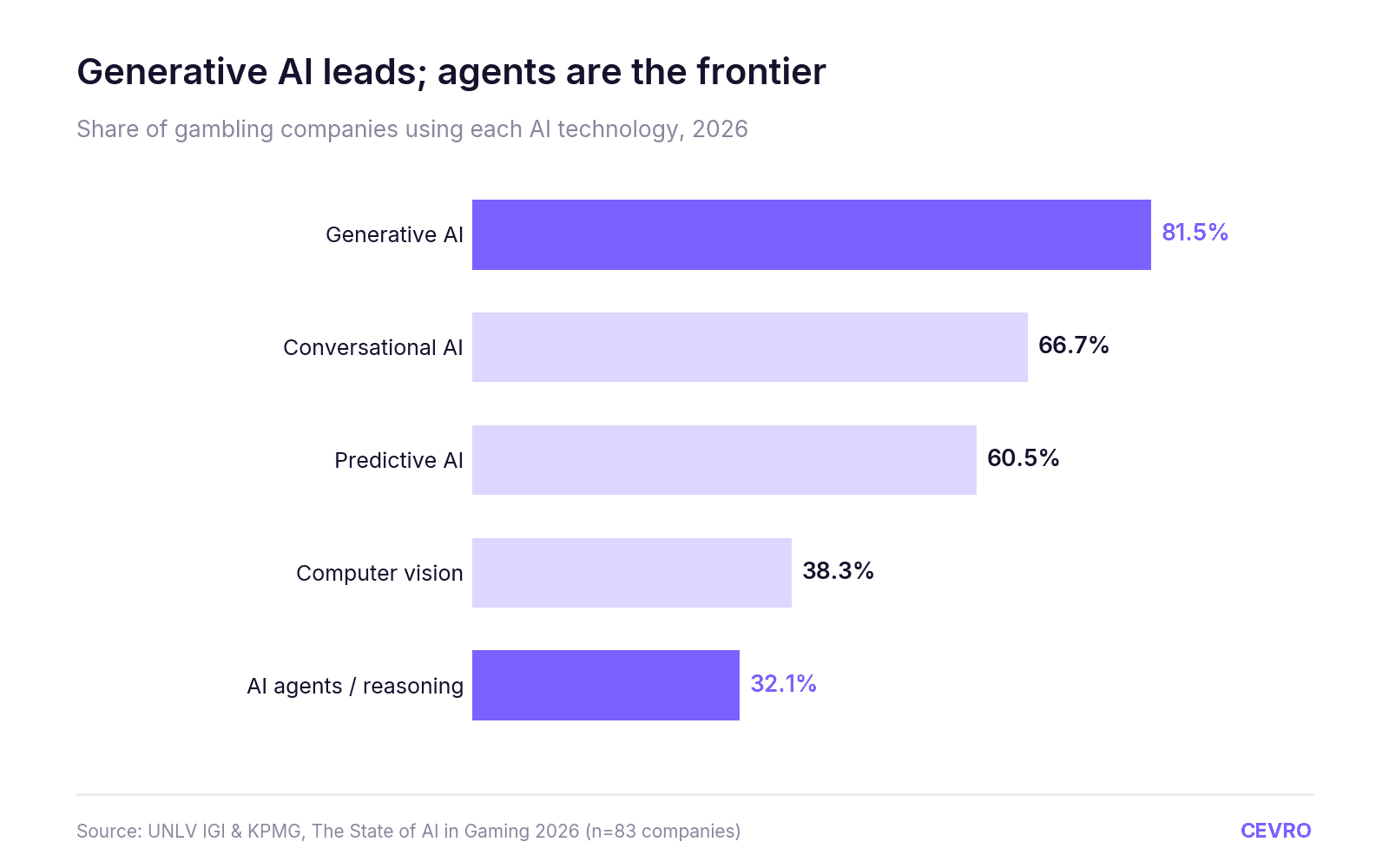
Generative AI leads; agents are the frontier
Not all AI is the same AI. The technology mix shows where the industry is today, and where it's heading.
Generative AI: 81.5% of companies
Conversational AI: 66.7%
Predictive AI: 60.5%
Computer vision: 38.3%
AI agents / reasoning systems: 32.1% (Source: UNLV IGI & KPMG)
Within generative AI, usage is still mostly text and code. 92.4% of generative AI users use it for text generation and 87.9% for code generation, versus 36.4% for video and 25.8% for voice or music.
What it means for you: a 49-point gap separates generative AI adoption from agentic AI adoption. That gap is where the next two years of competitive separation will happen. The UNLV/KPMG authors note that agentic systems remain uncommon because of regulatory sensitivity and compliance concerns (Source: The Gaming Boardroom). That means the operators who solve for compliance first will be the ones who can deploy agents first.
Online operators are ahead of land-based
Online operators average 76 on the Strategy dimension (the "Advanced" band), while land-based operators trail significantly. iGaming, in other words, is the leading edge of AI in gambling.
Maturity: The Gap Between Ambition and Execution
The industry scores 45 out of 100
The UNLV/KPMG AI Maturity Index scores companies across four dimensions. The industry average is 45/100, in the "Developing" band.
Dimension | Score (0–100) |
|---|---|
Strategy | 57 |
Expertise | 47 |
Infrastructure | 46 |
Governance | 30 |
Overall | 45 |
(Source: UNLV IGI & KPMG)
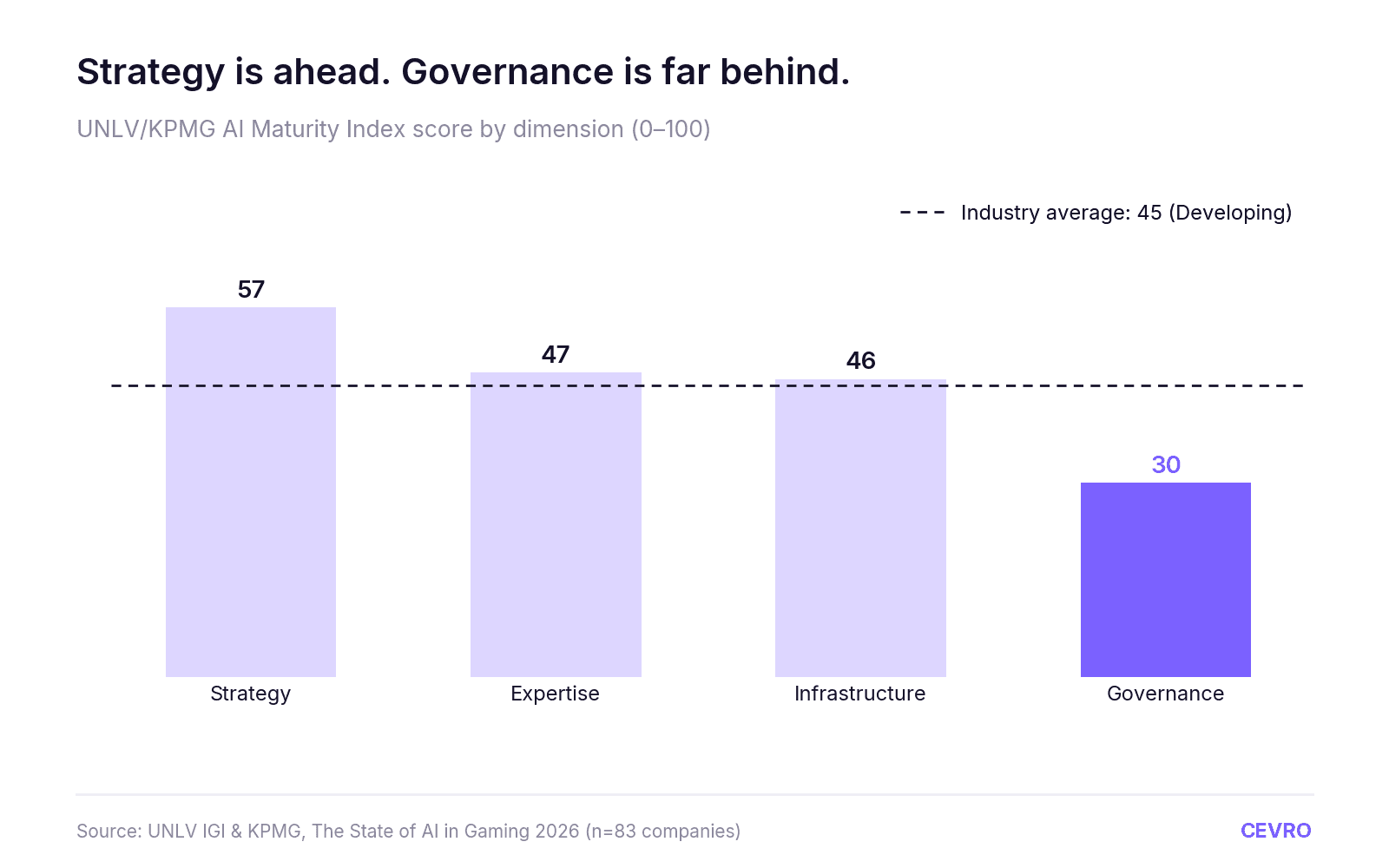
Here's the problem. Strategy outscores governance by 27 points. Companies know what they want AI to do far better than they know how to control it.
Only one in eight companies is "Advanced"
The distribution confirms it. Just 12.0% of companies score as Advanced, 33.7% Established, 32.5% Developing and 21.7% Nascent.
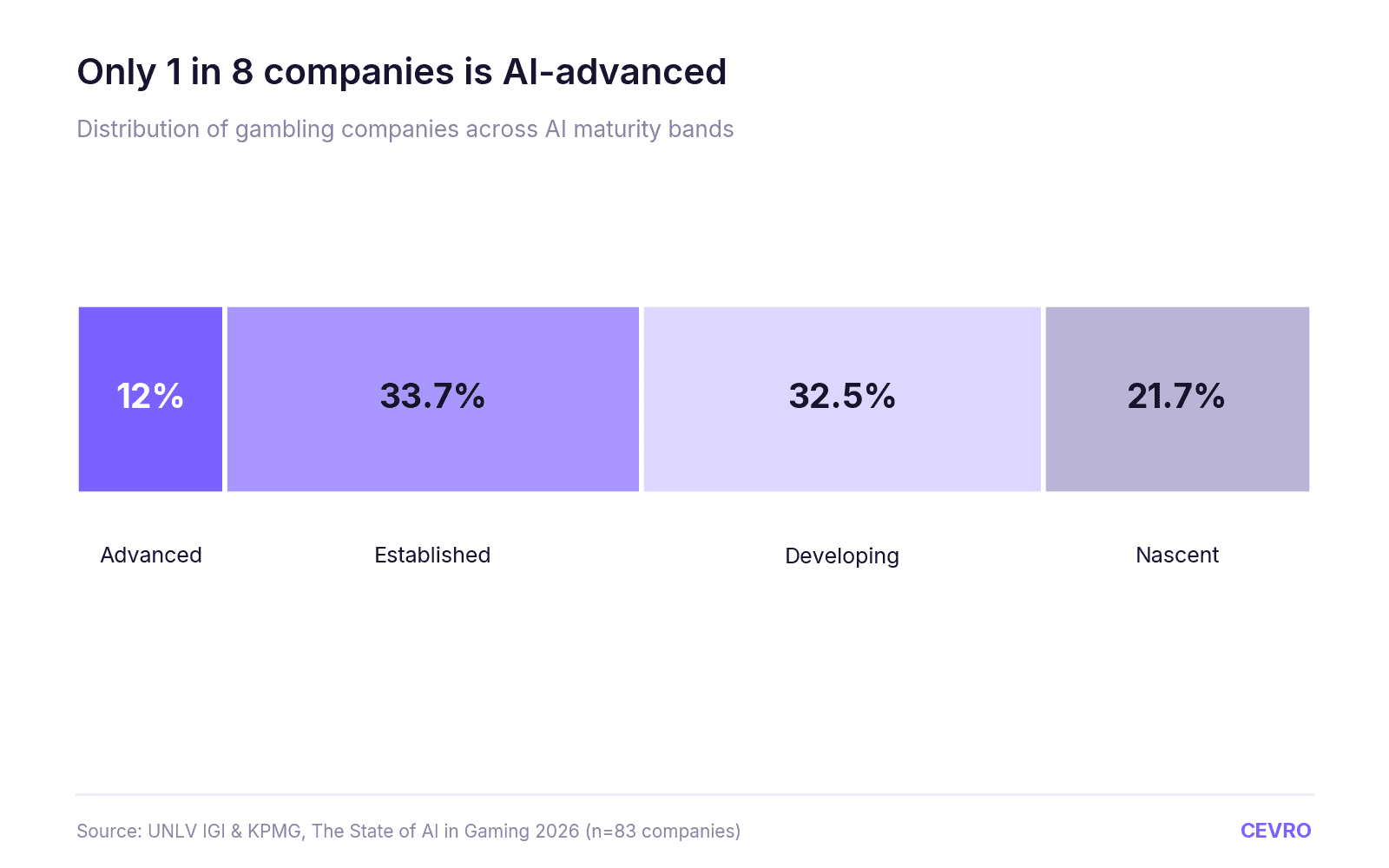
More than half the industry (54.2%) sits in the bottom two bands. For a sector where four in five companies say they "use AI," that's a sobering number.
Why the gap persists
The UNLV/KPMG report found infrastructure and expertise haven't yet reached a level that supports large-scale deployment (Source: Yogonet). That's consistent with what the Cevro team sees in the field: most operators have experimented with AI, but few have connected it to the systems where work actually happens: the PAM, the payment gateway, the bonus engine, the KYC provider.
Without that connection, AI can only explain. With it, AI can act. That's why Cevro ships ready-made integrations with iGaming platforms and PAMs such as SoftSwiss and EveryMatrix, CRM tools such as Smartico, and helpdesks such as Zendesk, Intercom and Comm100, so its AI agents can take real actions in the back office (Source: Cevro Integrations).
Use Cases: Where AI Is Actually Deployed
AI activity by business function
Inside gambling companies, AI activity concentrates in technology and product, not in customer-facing functions.
Function | Share of AI activity (weighted) |
|---|---|
Technology & security | 24.5% |
Product development & innovation | 24.0% |
Business & corporate operations | 18.7% |
Customer-facing functions | 18.2% |
Risk & compliance | 14.6% |
(Source: UNLV IGI & KPMG)

There's a telling disconnect here. Regulators most often assume licensees use AI in customer-facing functions (78.8%), while operators report their heaviest activity in technology, security and product innovation. Regulators and operators are, quite literally, looking at different pictures of the same industry.
Full deployment: back office first, revenue last
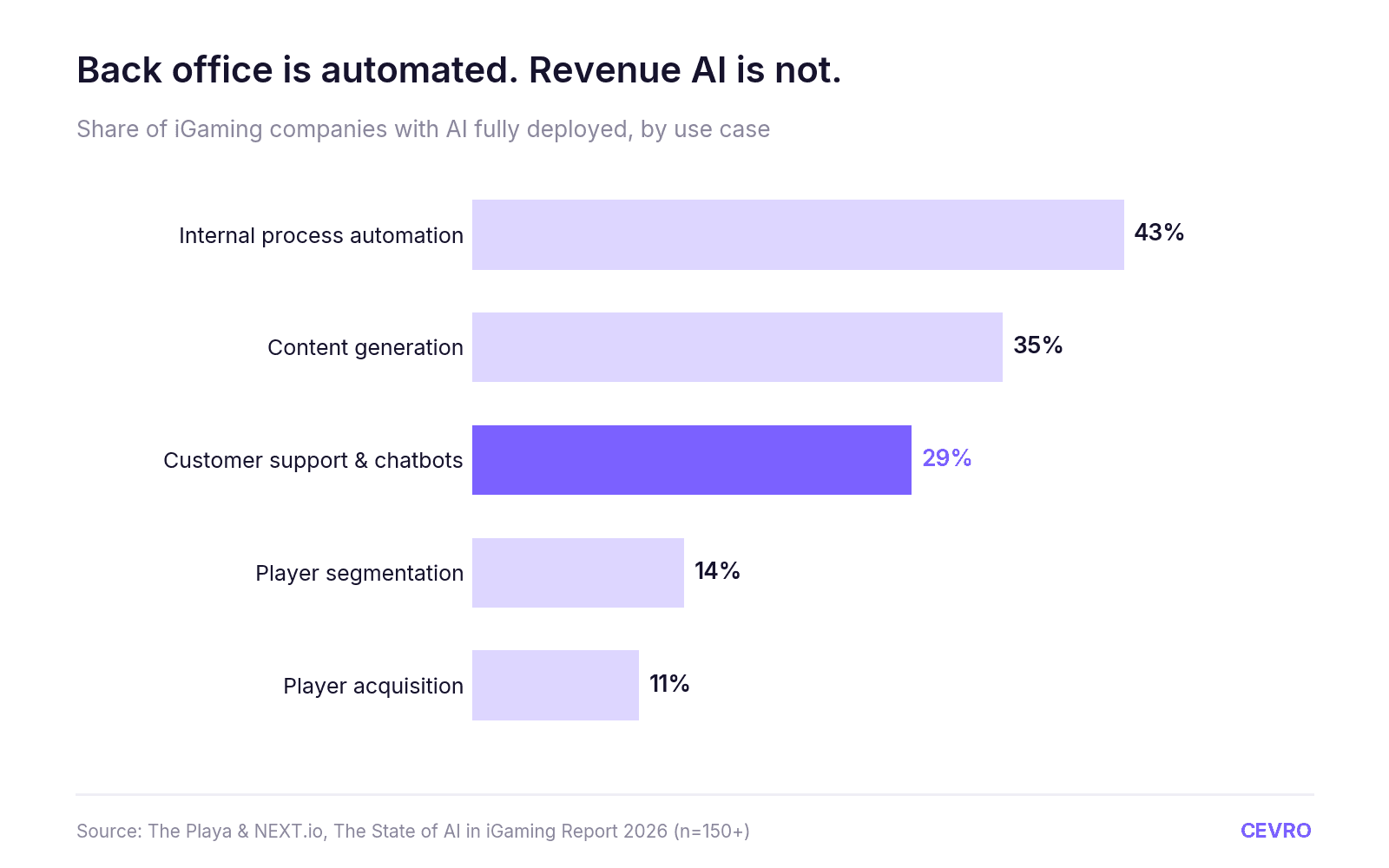
"Using AI" and "fully deploying AI" are different claims. The Playa and NEXT.io data separates them.
Internal process automation: fully deployed at 43% of companies
Content generation: 35%
Customer support and chatbots: 29%
Player segmentation: 14%
Player acquisition: 11%
Bonus personalisation and predictive analytics also sit below 20% full deployment (Source: The Playa & NEXT.io).
Use case deep dives
Personalisation and lobby optimisation. Operators using AI-powered lobby personalisation reported GGR increases of 3% to 9% and retention improvements of up to six percentage points (Source: The Playa & NEXT.io). In one two-market European implementation, recommendation-driven lobby personalisation delivered 12–16% growth in average turnover per user and a 9–12% increase in active days (Source: NEXT.io, Infingame & The Playa).
Churn prediction. Two-thirds of operators with churn models in place have yet to act on the insights. That delay is expensive: 27% of churned players can be reactivated on day one after churn, but only 2% after three months (Source: Optimove).
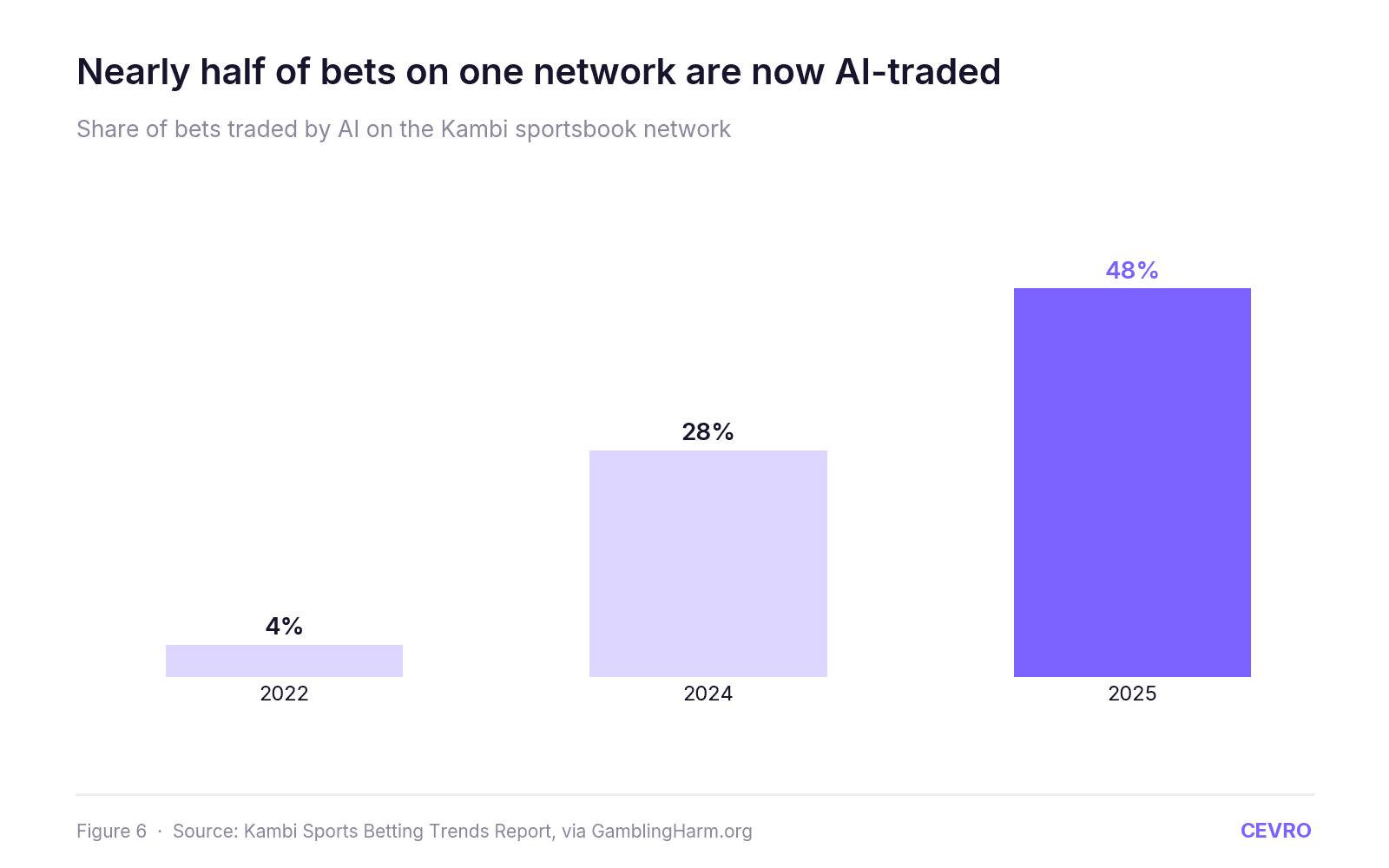
Odds and trading. On the Kambi network, the share of AI-traded bets jumped from 4% in 2022 to 28% in 2024 and 48% in 2025 (Source: GamblingHarm.org, citing Kambi). In Australia, Betfair reported that AI increased odds accuracy by 22% (Source: ACMA).
Responsible Gaming (RG) detection. Mindway AI's GameScanner is reported to detect at least 87% of harm cases identified by human experts (Source: ACMA). Tabcorp and Entain both partner with Mindway AI for behavioural harm detection (Source: SmartCompany).
KYC and identity. KYC is one of the most contact-heavy moments in the player journey, and it's increasingly handled inside the conversation. Cevro partners with identity-verification providers Sumsub and Shufti so KYC flows can run within AI-led player support (Source: Cevro Partners).
Content production. Studios are using generative models for slot art, maths and themes, cutting production timelines from months to days (Source: UNLV IGI & KPMG).
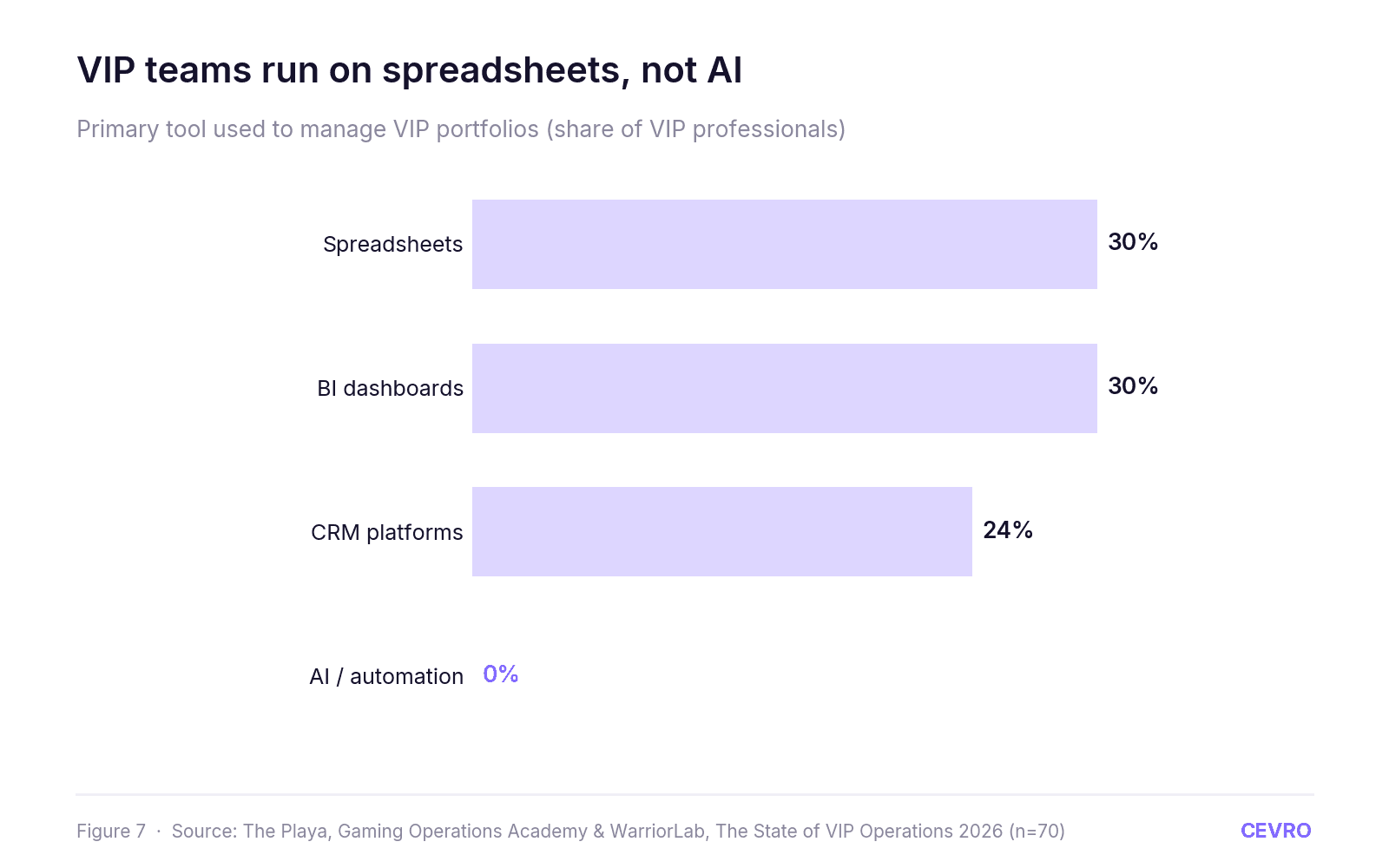
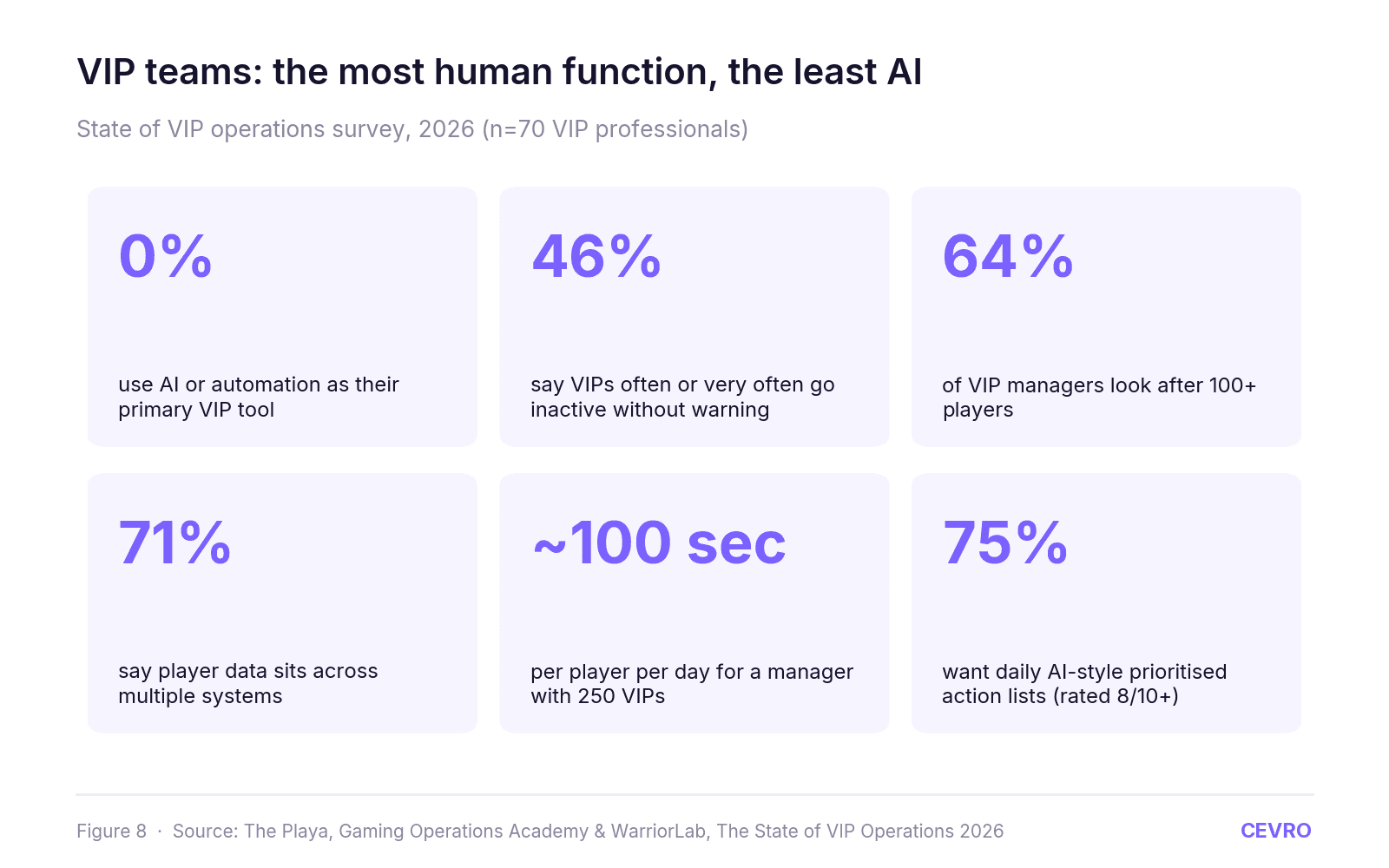
VIP management: the conspicuous gap. None of the 70 VIP professionals surveyed uses AI or automation as their primary tool (Source: Focus Gaming News, reporting The State of VIP Operations). Section 13 returns to this, as it's one of the biggest untapped opportunities in the market.
The tools tell the story. Spreadsheets and BI dashboards are each the primary VIP tool for 30% of respondents, CRM platforms for 24%, and only 15% use AI or automation in any capacity, and then only as a secondary aid. Half of VIP professionals admit they sometimes make decisions on incomplete or outdated information, and 48% have no indicators of players' behavioural signals or health (Source: iGaming Business).
The hesitation is cultural as much as technical: 38% worry AI would reduce the personal, human touch in VIP management.
AI in Player Support: The Use Case That's Working
Why support is leading
Customer support is the most effective AI application in iGaming so far: 32% of operators cite it as their top-performing use case (Source: The Playa & NEXT.io).
That makes sense. Support has high volume, repeatable workflows, clear success metrics and an immediate cost line. It's also where players feel the difference first.
UNLV/KPMG's trade-news analysis found that about 23% of CRM-related AI news items in 2025 were customer-support tools, naming vendors including Cevro (Source: UNLV IGI & KPMG).
The adoption–production gap
At first glance, AI support looks solved. It isn't.
IBM found 88% of contact centres use some form of AI, but only around a quarter have moved past pilot into full production. Gartner estimates just 10% of contact-centre interactions will be automated by 2026, up from 1.6% a few years earlier (Source: TechBullion).
The pressure to close that gap is real: 91% of customer service leaders say they're under pressure from senior leadership to implement AI in 2026 (Source: Chatbase, citing Gartner).
Deflection vs. resolution: what the benchmarks actually show
Published automation benchmarks vary enormously, and the variance tells you something about architecture.
Deployment | Share resolved without a human | Source |
|---|---|---|
Contact centres, all industries (Gartner forecast, 2026) | 10% | |
Sportsbet chatbot (Australia) | Over one-third, at ~94% claimed accuracy | |
Alpha Affiliates (multi-brand operator, Cevro) | 81% | |
SweepNext Casino (sweepstakes, Cevro) | 90%+ | |
iPlay Gaming Platform (80,000–100,000 chats/month, Cevro) | 91% |
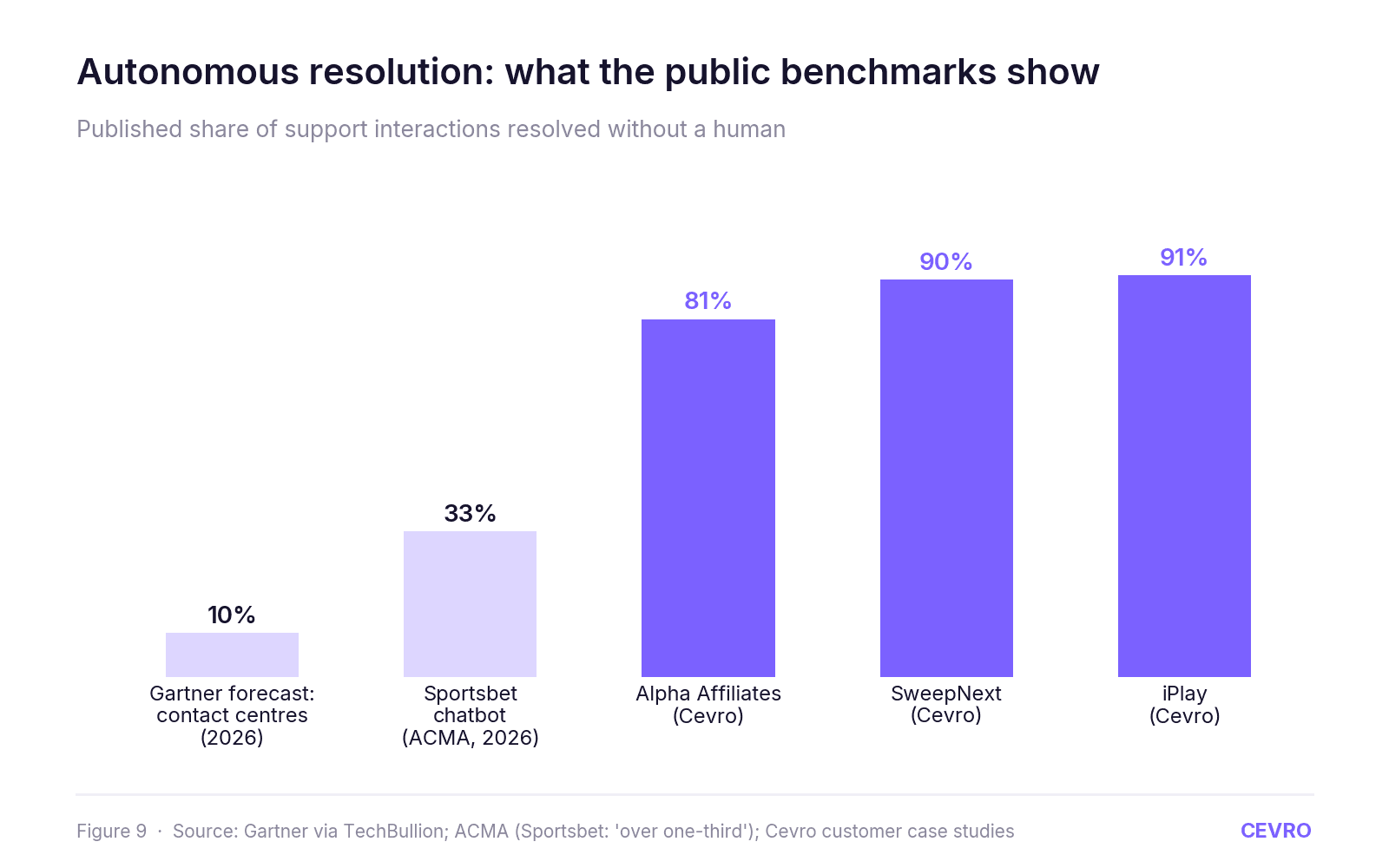
The difference isn't the language model. It's what the AI can do. Cevro's analysis puts typical copilot deflection at 15–30%, against 60–95% autonomous resolution for back-office-connected AI agents on operational workflows (Source: Cevro, AI Agents vs. AI Copilots).
A chatbot tells a player where to find their transaction history. An AI agent connected to the back office checks the transaction, cross-references it against the payment gateway, and resolves the issue, or escalates with full context. That's the distinction between deflection and resolution, and it's why resolution rates cluster at two very different levels.
What resolution looks like in practice
Take the most common high-stakes ticket in iGaming: "Where is my withdrawal?"
A knowledge-base chatbot explains the general withdrawal policy. An AI agent running a structured AI Procedure (AIP), Cevro's term for a machine-executable workflow built from an operator's own SOPs, does this instead:
Verifies the player's identity and session context.
Queries the payment gateway and account logs for the transaction.
Cross-references withdrawal limits, brand policy, KYC status and Responsible Gaming flags.
Resolves the issue by advising on timing or triggering a status update, or escalates a structured ticket to a human queue with the full context attached.
The operational outcomes
The case-study data from Cevro deployments shows what resolution-grade automation changes:
iPlay Gaming Platform reached 91% AI support automation, cut manual support by 40% and optimised its CS team from 30 to 15 agents in stages (Source: Cevro, iPlay case study).
SweepNext Casino reached 90%+ automation with 4.9+ CSAT scores and 40+ AI Procedures live, moving from seven to two support staff (Source: Cevro, SweepNext case study).
Alpha Affiliates absorbed an additional 6,300 chats in a single month from two new brands with zero new hires (Source: Cevro, Alpha Affiliates case study). Its Head of VIP, Julija Kozireva, reported at least a 10% increase in player LTV after comparing chats with and without Cevro.
Scale is the other half of the story. Cevro supports iGaming operators across 50+ GEOs and 100+ languages (Source: Cevro for iGaming), and with ready-made integrations operators go from idea to a live AI agent in weeks. For multi-market operators, that removes the need to hire and train a new language team for every launch.
The honest caveat: players still want humans available
Of course, automation isn't the goal on its own. 79% of Americans strongly prefer speaking with a human over an AI agent, and 89% say companies should always offer the option to reach one (Source: Master of Code, citing SurveyMonkey).
That's not an argument against AI support. It's an argument for AI support that knows when to hand over, with the full conversation, system state and decision trace attached, so the player never repeats themselves. In practice, the best deployments free human agents for disputes, VIP relationships and RG interventions, where empathy and judgement matter most.
ROI and Business Impact
One in five companies sees meaningful ROI today
Only 20.5% of gambling companies report already achieving meaningful ROI from AI. 55.4% expect it within two years, 19.3% say it's too early to tell, and 3.6% expect no ROI at all.
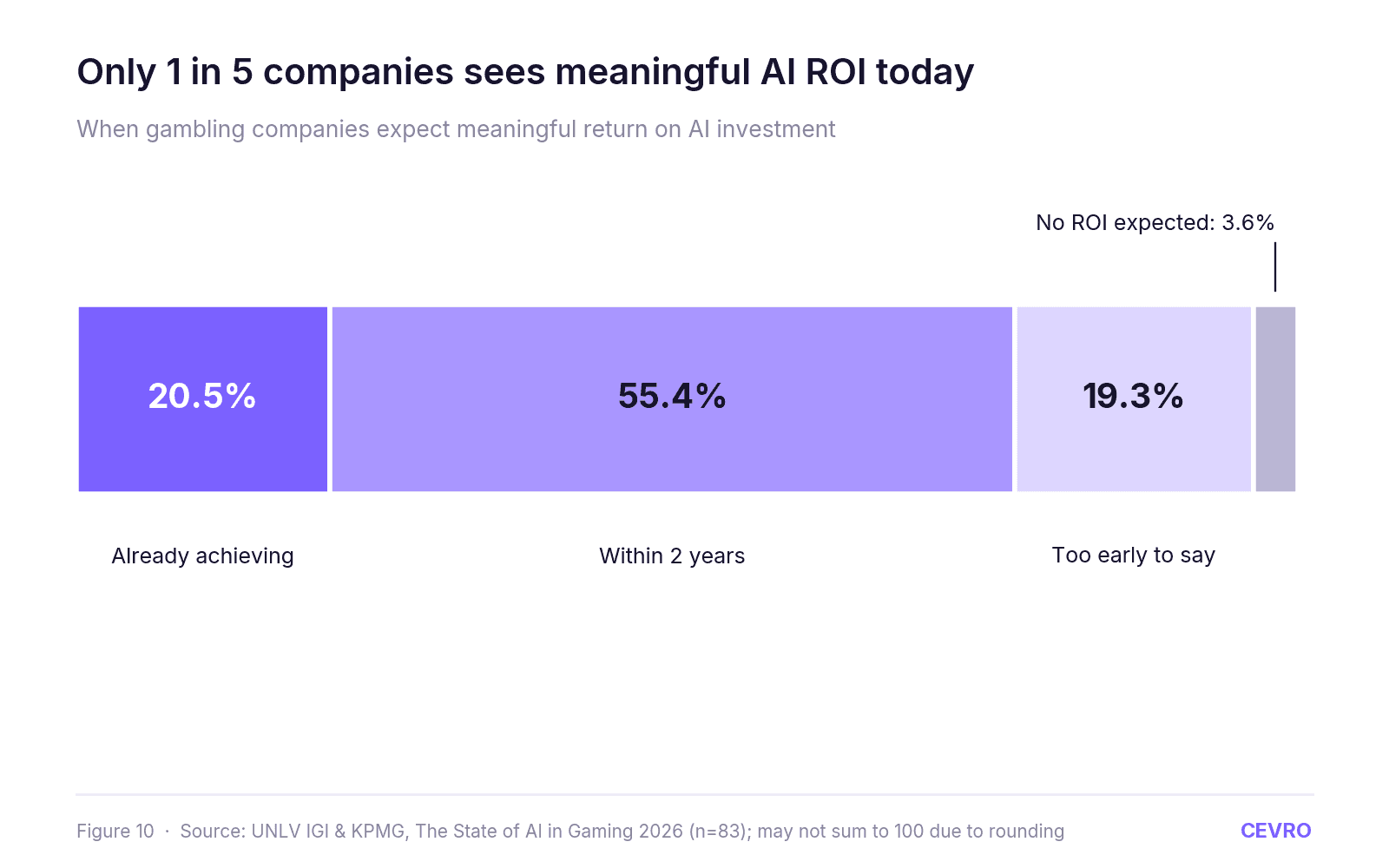
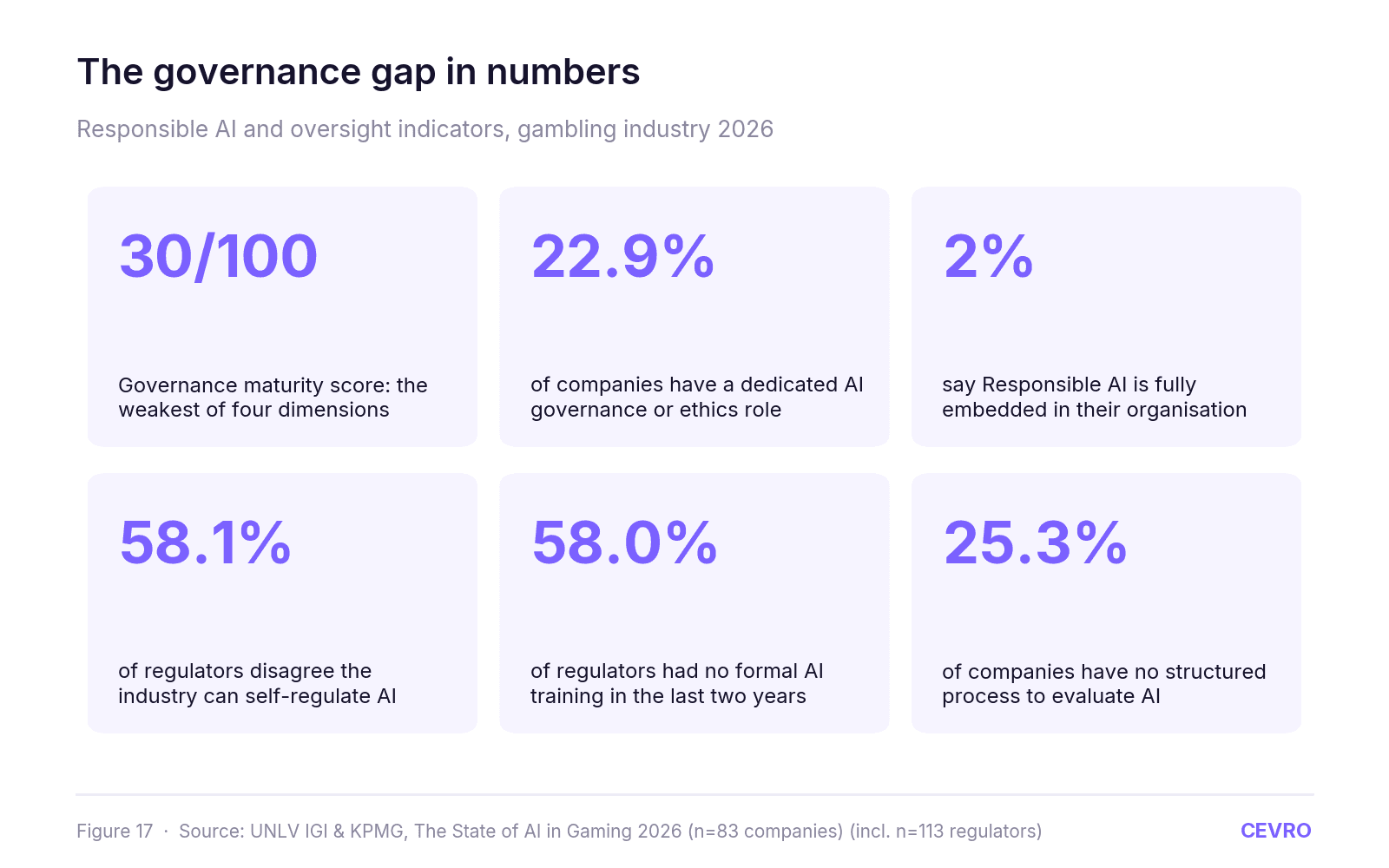
A quarter of companies (25.3%) have no structured process to evaluate AI at all (Source: UNLV IGI & KPMG). You can't find ROI you aren't measuring.
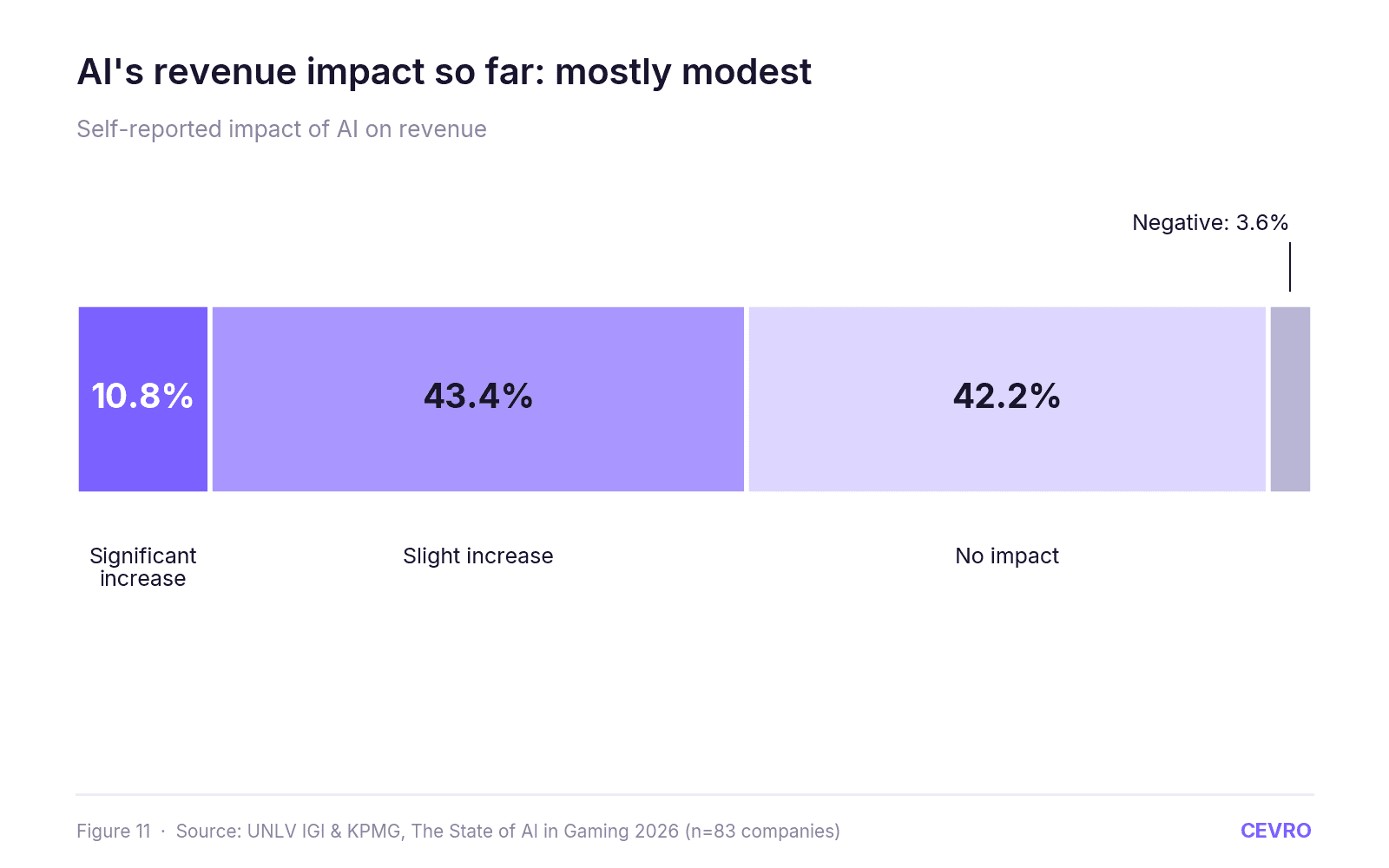
Revenue impact is mostly modest, so far
On revenue, 42.2% of companies report no impact from AI, 43.4% a slight increase, 10.8% a significant increase and 3.6% a negative impact. The average revenue-impact rating is 3.60/5, while cost savings average just 2.43/5.
Where ROI is measurable
The clearest returns cluster where AI touches a hard metric directly:
Promotions efficiency: DraftKings told investors it automated and personalised $400 million in promotional spending through AI in 2025 (Source: TMSPN). (Section 11 covers why this example has also become a governance case study.)
Lobby personalisation: 3–9% GGR increases (Source: The Playa & NEXT.io).
Player support at platform level: Cevro reports a 3x reduction in customer support costs and headcount, alongside CSAT and NPS of 4.8 out of 5 (Source: Cevro).
Player support: headcount and cost lines move in months, not years. iPlay halved its CS team in stages while holding service levels (Source: Cevro, iPlay case study).
What it means for you: low reported cost savings (2.43/5) alongside strong support-automation outcomes suggest most companies haven't yet applied AI where cost actually sits. For most operators, player support is one of the largest variable operating costs that scales with every new market and language.
Barriers and Risk
Skills, not vendors, are the bottleneck
The top barriers to AI adoption are internal.
Barrier | Share of companies |
|---|---|
Knowledge / training gaps | 61.4% |
Resource / budget constraints | 53.0% |
Technical limitations | 34.9% |
Lack of clear vision | 32.5% |
Organisational resistance | 28.9% |
Regulatory uncertainty | 16.9% |
(Source: UNLV IGI & KPMG)
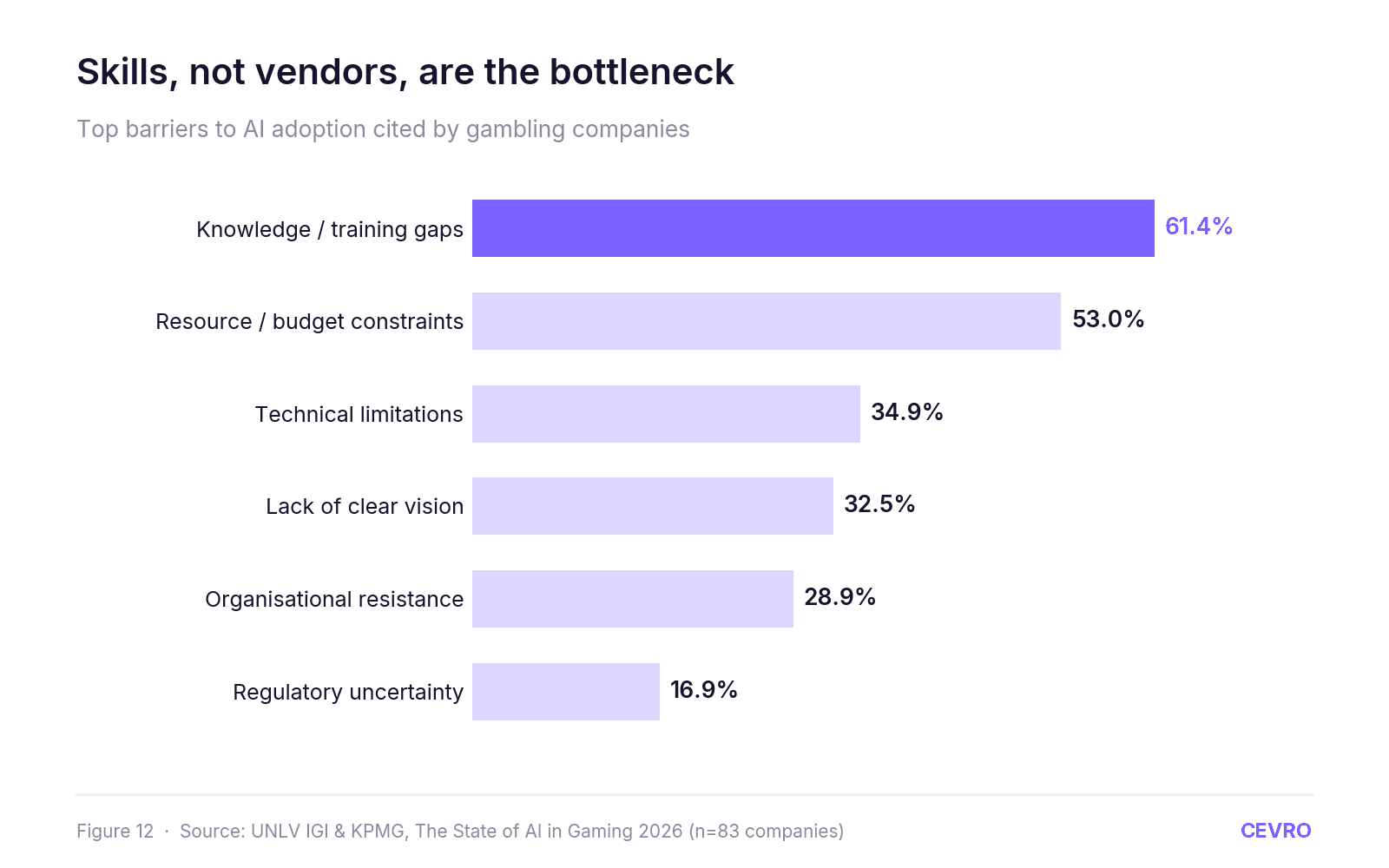
The iGaming-specific data points the same way. Competing business priorities (41%), integration complexity (34%) and lack of expertise (31%) top the list, and only 5% cite a lack of quality vendors (Source: The Playa & NEXT.io).
That's an important signal. The market has the tools. What it lacks is the in-house know-how and integration capacity to put them to work. That's why pre-integrated, iGaming-native platforms are gaining ground over general-purpose builds.
The risks executives worry about
Risk concern | Share of companies |
|---|---|
Cybersecurity vulnerabilities | 45.8% |
Data privacy / governance failures | 33.7% |
Misuse by staff or third parties | 27.7% |
Problem-gambling amplification | 13.3% |
Bias / unfair outcomes | 12.0% |
(Source: UNLV IGI & KPMG)
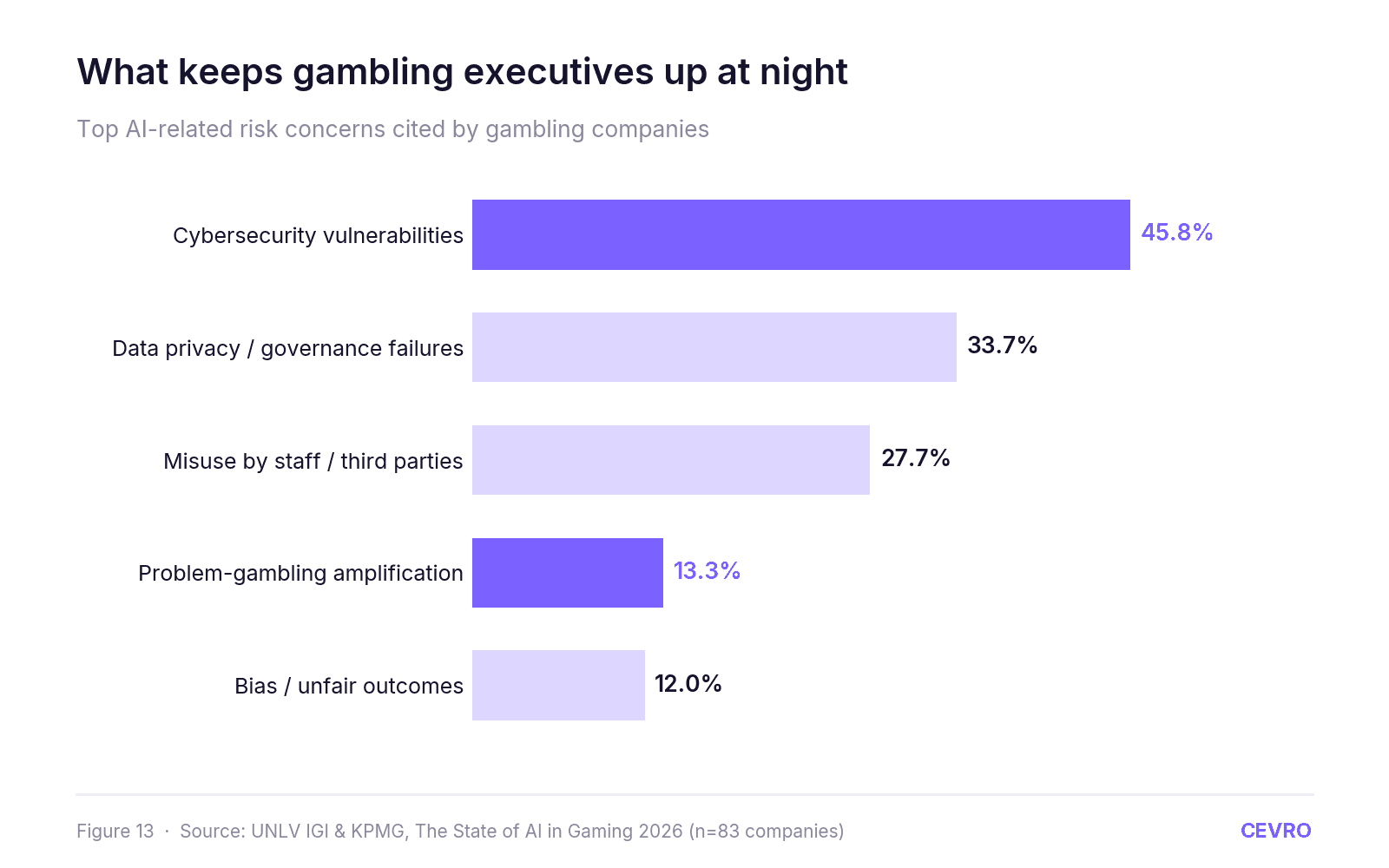
Cybersecurity's lead likely reflects recent high-profile cyberattacks on MGM Resorts, Caesars Entertainment, Boyd Gaming and Wynn Resorts (Source: 8 News Now).
The more uncomfortable finding is at the bottom. Only 13.3% of companies worry that AI could amplify problem gambling (Source: UNLV IGI & KPMG). After September 2026's headlines, expect that number to rise sharply in next year's survey.
Fraud and Integrity: AI on Both Sides of the Table
Fraudsters adopted AI faster than defenders
AI has lowered the cost of committing fraud at scale, and the 2026 numbers show it.
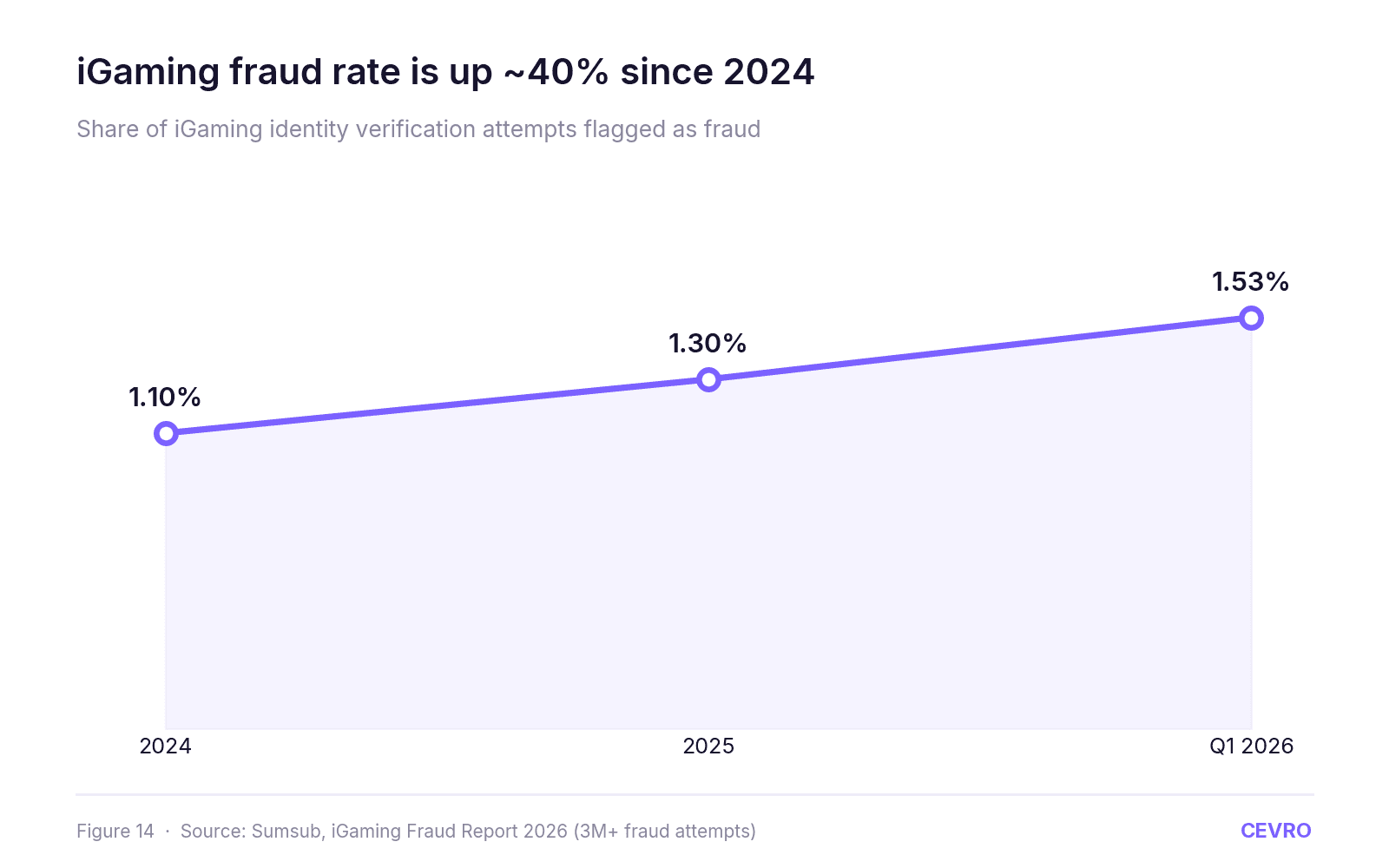
The global iGaming fraud rate reached 1.53% of verification attempts in Q1 2026, up 18% year-on-year and nearly 40% since 2024 (Source: Sumsub).
Suspicious transaction volumes rose 4.5x between Q1 2025 and Q1 2026, with the average suspicious transaction climbing to $6,500 from $3,960.
Agentic bot traffic on gaming sites rose 450% in 2025 (Source: FTI Consulting).
Sumsub describes the current wave as an "industry-wide DDoS attack of AI-slop": synthetic faces, edited documents and mass-generated applications used for bonus abuse, multi-accounting and opposite betting (Source: NEXT.io, reporting Sumsub).
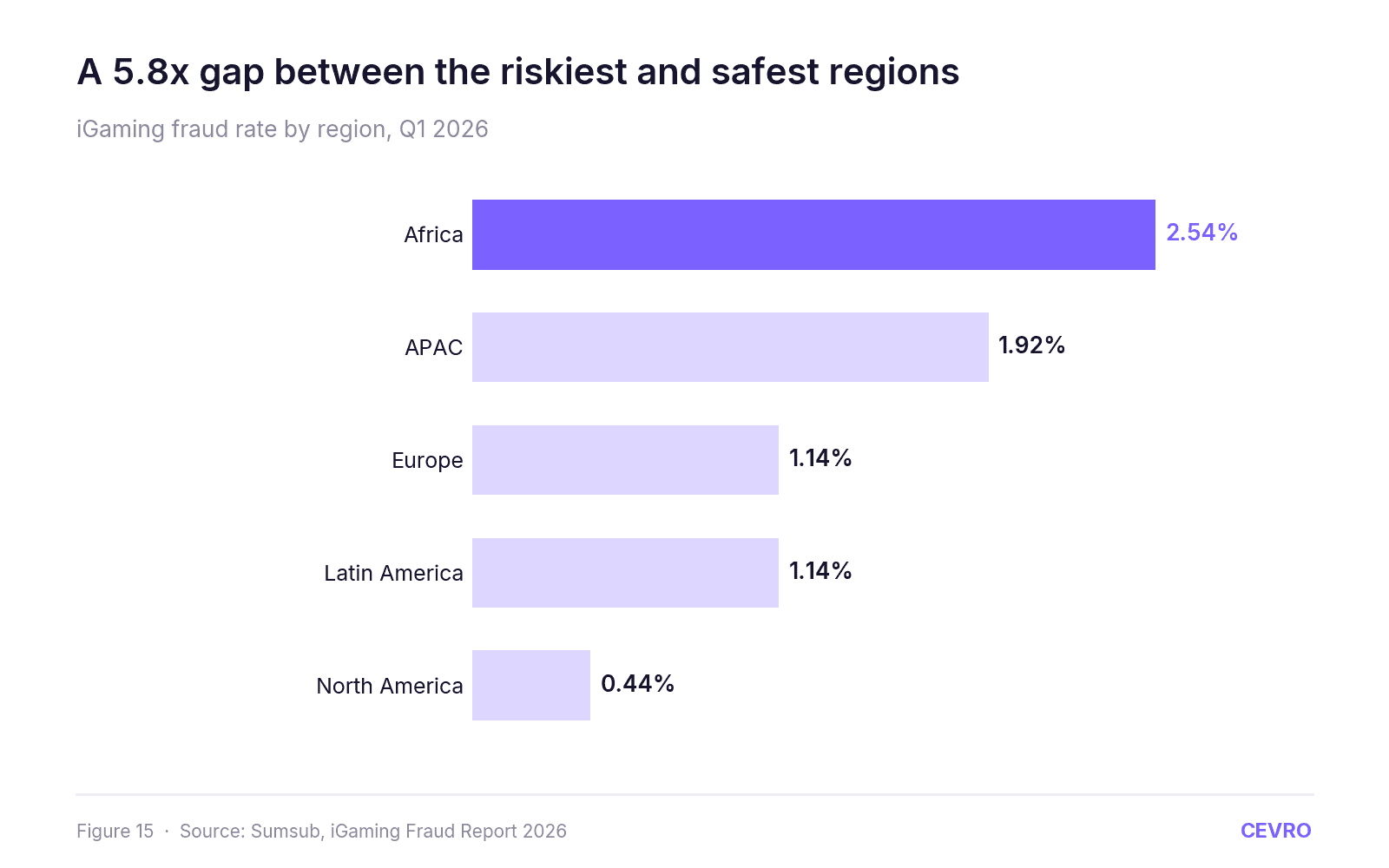
Regional exposure varies 5.8x
Region | iGaming fraud rate, Q1 2026 |
|---|---|
Africa | 2.54% |
APAC | 1.92% |
Europe | 1.14% |
Latin America | 1.14% |
North America | 0.44% |
(Source: Business Today, reporting Sumsub)
Attack methods differ by region, too. 41% of detected fraud in Europe involved deepfakes, the highest share globally (Source: Sumsub iGaming Fraud Report 2026).
Fraud has moved from sign-up to cash-out
The 2026 World Cup showed fraud shifting downstream. Suspicious withdrawal activity rose 38% compared with 2025, and the average flagged withdrawal more than doubled from $202 to $436 (Source: The Paypers, reporting SEON). Daily identity mismatches on dormant, previously verified accounts surged 83%, reaching 118% in Latin America.
Bonus abuse, loyalty fraud and account takeover together accounted for 68% of reported fraud losses in a 2026 SEON survey of 332 fraud, risk and compliance leaders.
Operators are still hiring their way through fraud
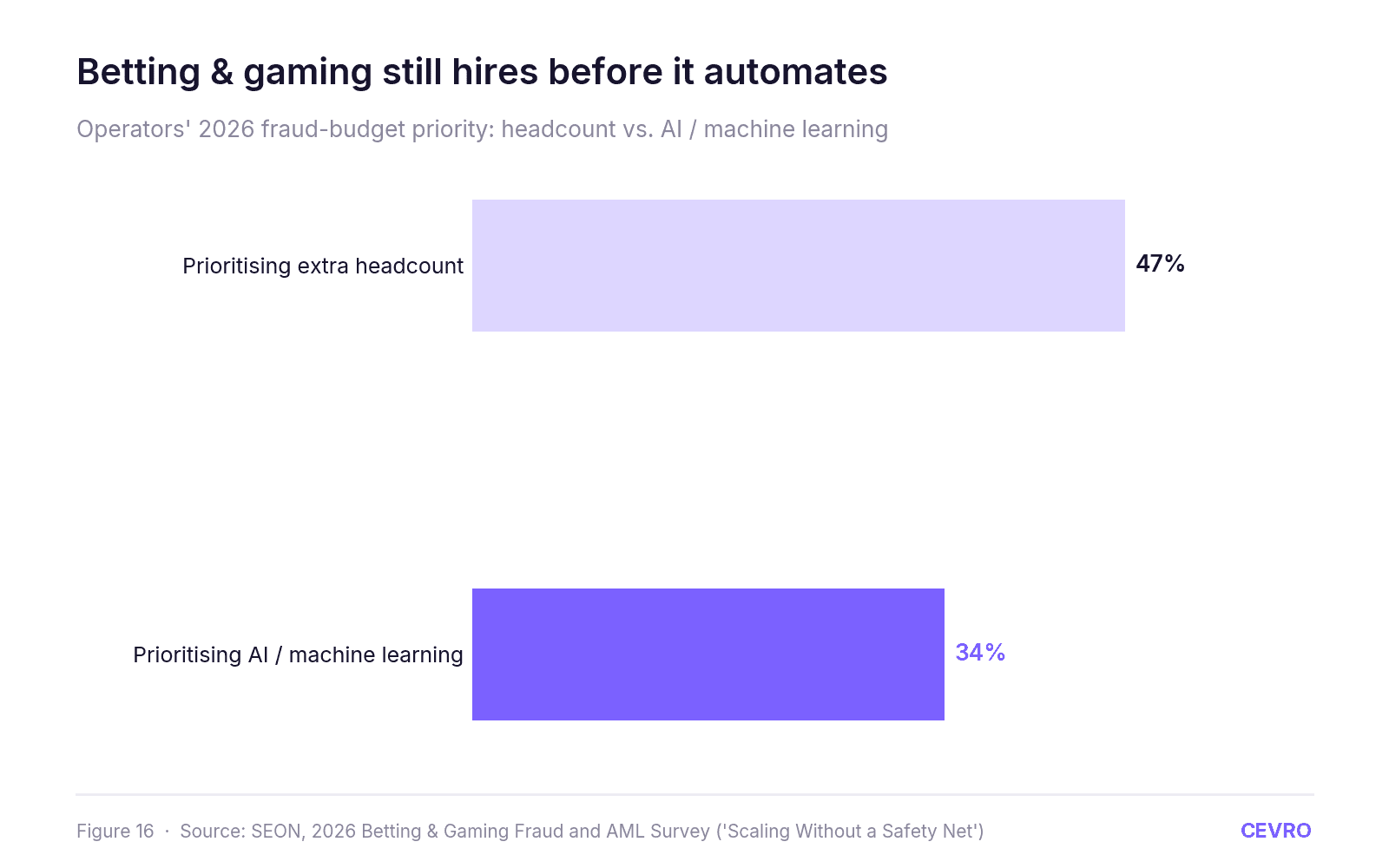
57% of betting and gaming operators report fraud losses growing faster than revenue. Yet betting and gaming is the only sector in SEON's study where operators prioritise adding headcount over investing in AI and machine learning: 47% versus 34% (Source: SEON).
Here's the catch. Human teams scale linearly; AI-assisted fraud scales exponentially. The same pattern shows up in player support, where operators that answer volume spikes with recruitment cycles, rather than automation, carry the cost of every new market and every major tournament.
Why this matters for player support
Here's why that matters beyond the fraud team. Withdrawals, bonuses and dormant-account reactivations are also the highest-volume, highest-emotion categories in player support.
Any AI that touches those flows needs hard guardrails: preconditions before it acts, forbidden actions it can never take (no withdrawal approvals without human review, no KYC overrides), and automatic escalation when monetary thresholds or risk signals are hit. AI support that can't see fraud and RG flags isn't just less useful. It's a new attack surface.
Integrity monitoring is scaling with AI
Sportradar identified 1,116 suspicious matches in 2025, with AI-based analysis flagging suspicious matches 56% more often year on year (Source: SecurityBrief).
Governance, Regulation and Responsible AI
The governance gap in numbers
Governance is the industry's weakest AI dimension by a wide margin.
Governance maturity scores 30/100.
Only 22.9% of companies have dedicated AI governance or ethics roles; 8.4% plan to hire for them (Source: UNLV IGI & KPMG).
Almost one-third have no established Responsible AI practices, and only 2% say Responsible AI is fully embedded (Source: UNLV).
Regulators are watching and want more visibility
58.1% of gambling regulators disagree that the industry can self-regulate its use of AI. Regulators also report limited visibility into licensee AI activity and low confidence in their own oversight capabilities (Source: CDC Gaming).
Regulators are adopting AI themselves: 57.9% use AI professionally, yet 58.0% have had no formal AI training in the last two years.
Regulatory AI activity is concentrated in North America and Western Europe, and most of it focuses on mandating automated tools for player-harm detection. Other 2026 developments include:
United Kingdom: the UK Gambling Commission warned operators that AI-generated deepfakes are being used to circumvent customer due diligence.
Italy: ADM and Sogei deployed AI for transparency and RG oversight.
International: IGSA began drafting AI best-practice guidelines for gambling regulators.
Australia: ACMA's April 2026 report warned that commercial AI deployment may prioritise engagement and revenue over harm minimisation (Source: ACMA).
United States: the proposed SAFE Bet Act would forbid sportsbooks from using AI to track betting habits and serve personalised offers (Source: Daily Caller).
Incidents are rising
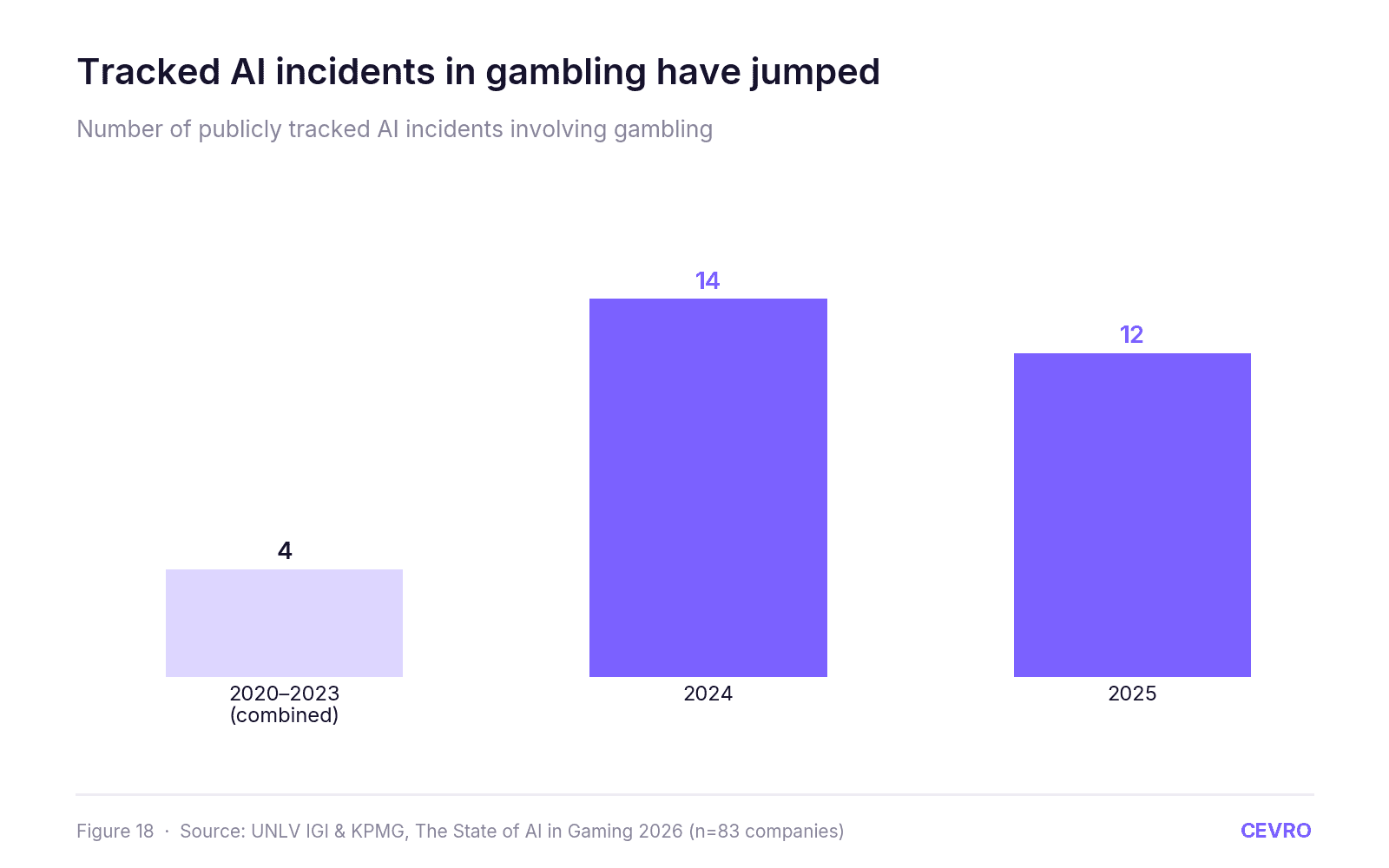
Tracked AI incidents in gambling went from 4 across 2020–2023 combined to 14 in 2024 and 12 in 2025, dominated by deepfakes, data misuse and algorithmic pricing or collusion (Source: UNLV IGI & KPMG).
The September 2026 inflection point
On 19 September 2026, a New York Times investigation, based on internal memos and interviews with more than 40 former employees, reported that DraftKings used a machine-learning "elasticity" score to direct promotions toward players predicted to respond by gambling and losing more (Source: Tech Times, summarising The New York Times). The same reporting said a parallel model to flag at-risk gamblers was shelved (Source: Daily Caller).
DraftKings disputes the characterisation, saying promotions go to customers who show sustained engagement with its platform (Source: Linkdood Technologies). No regulator had accused the company of illegality at the time of writing.
Regardless of how that story resolves, the lesson for the industry is structural: the same player data that powers revenue AI also reveals harm. Regulators, investors and journalists now know it, and they'll ask which way each model points.
Responsible Gaming: from sampling to full coverage
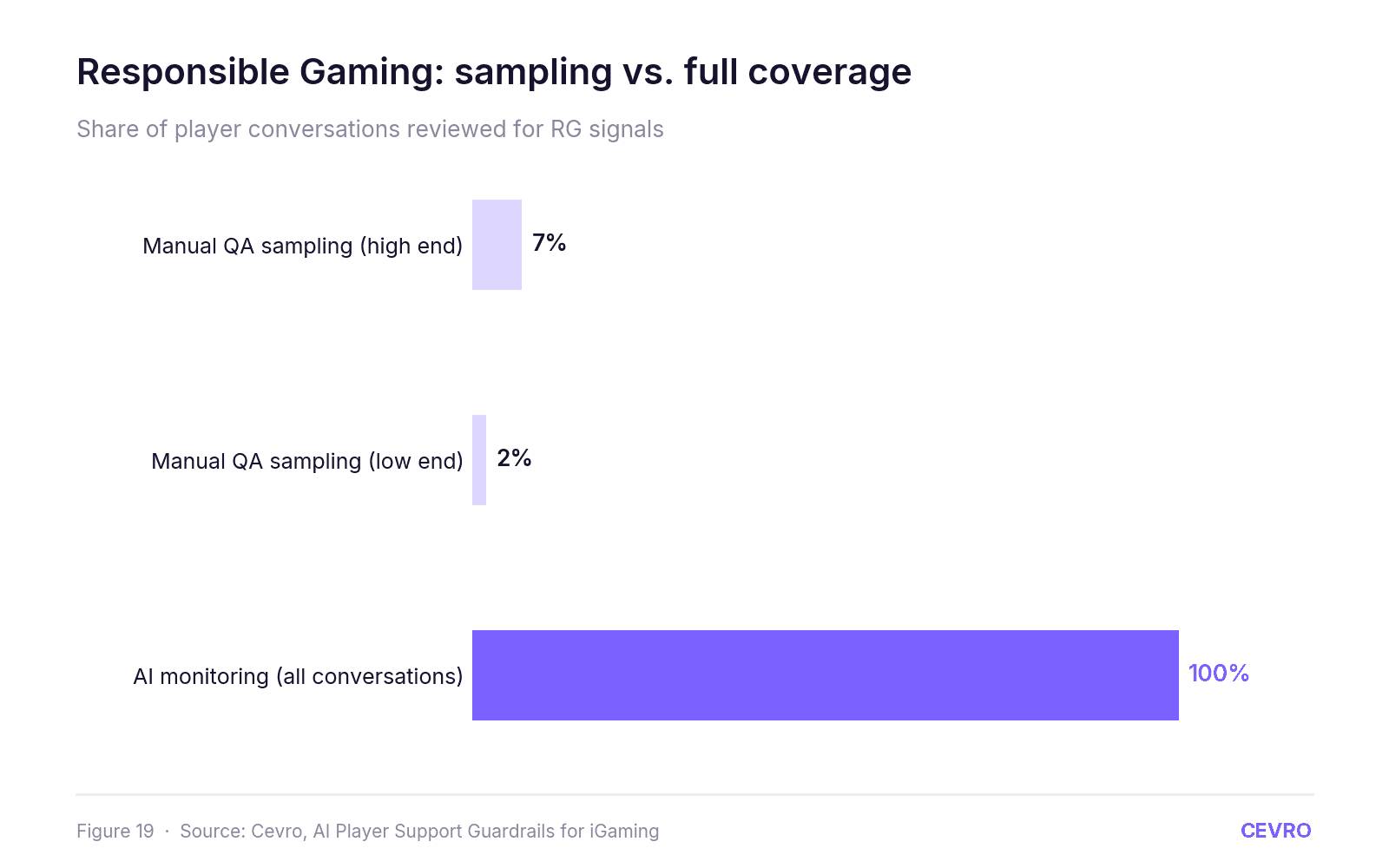
The most practical governance upgrade available today is coverage. Manual RG quality sampling typically reviews only 2–7% of player interactions (Source: Cevro, AI Player Support Guardrails for iGaming). AI can monitor 100% of conversations for distress language, deposit chasing and session escalation, and trigger mandatory human escalation automatically.
Compliance by design: what good looks like
Cevro's guardrail model for player support works across three horizons: prevention before an action is taken, containment while it runs, and observability afterwards (Source: Cevro, AI Player Support Guardrails for iGaming). In practice that means every AI procedure starts with preconditions such as player authentication and no active RG flags, blocks high-risk actions outright, and escalates with full context when thresholds are crossed.
At the data layer, enterprise buyers increasingly expect the controls Cevro lists as defaults: SOC2 Type II auditing, PII masking, EU data-protection compliance, zero data retention and no model training on player data (Source: Cevro Enterprise).
In most industries, "the AI made a mistake" is an inconvenience. In a regulated market, it's a reportable event.
Innovation Pipeline and Workforce
Patents, research and conference agendas are accelerating
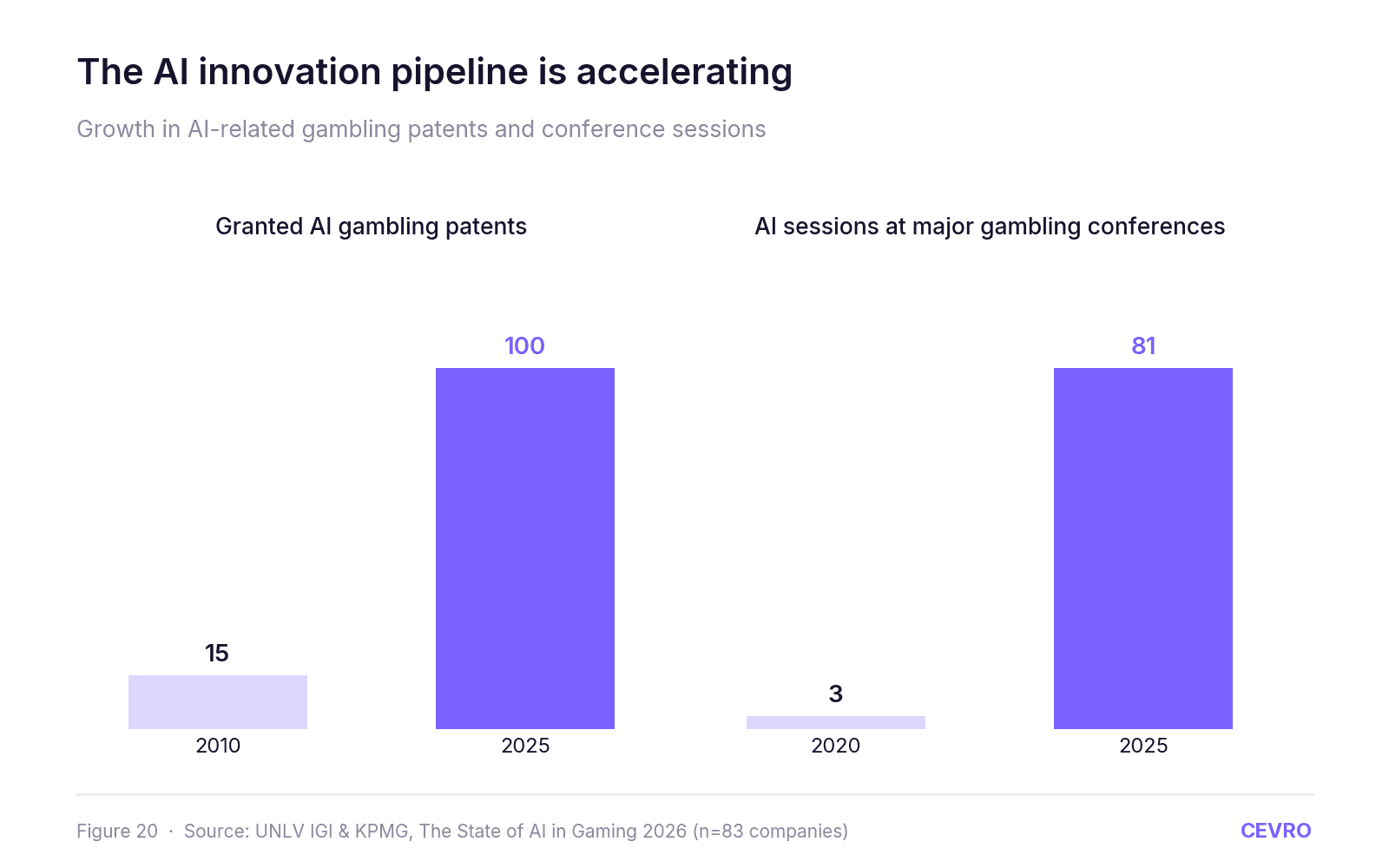
Patents: AI-related gambling patent grants rose from 15 in 2010 to 100 in 2025, with the US accounting for 61.4%. Angel Group leads with 86 granted patents, followed by IGT (50) and Light & Wonder (37) (Source: GGRAsia).
Conferences: AI sessions at major gambling conferences rose from 3 in 2020 to 81 in 2025.
Research: AI-related gambling academic publications peaked at 112 papers in 2025, with sports betting and online problem gambling overtaking poker as the dominant topics.
Notably, all leading patent holders are technology suppliers rather than operators. Innovation is coming from the supply side, which means most operators will buy, not build, their AI capabilities.
AI is reshaping jobs more than cutting them
53.0% of gambling companies expect AI to drive transformation and reskilling with little net change in headcount; 13.3% expect net job creation and 10.8% expect net reductions.
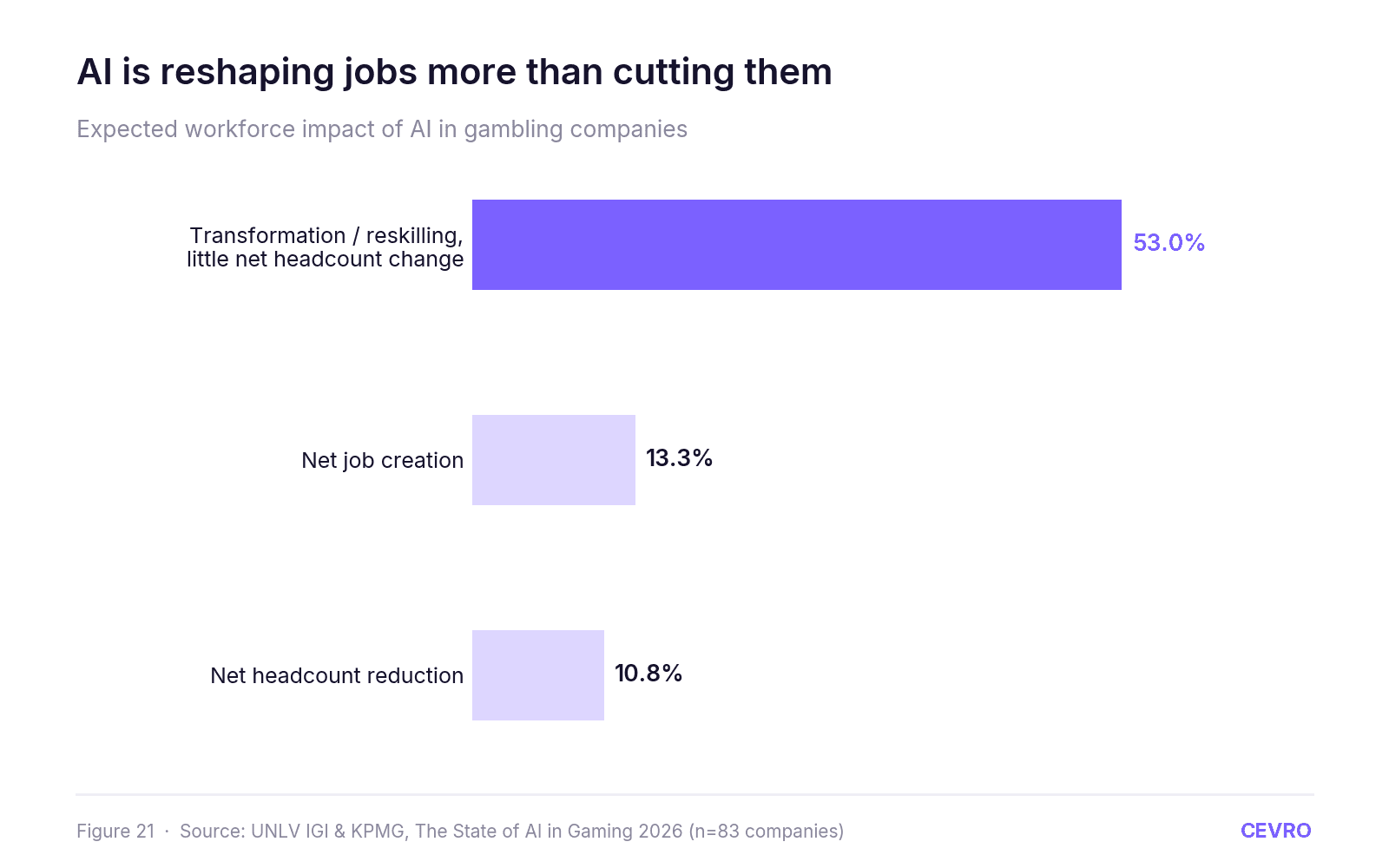
Planned AI hiring is concentrated in AI/ML engineers (34.9%) and data scientists (27.7%), while 42.2% plan no AI-specific hiring at all (Source: UNLV IGI & KPMG).
In player support, the reshaping is already visible. When repetitive tickets move to AI, the best human agents move up into escalation handling, VIP relationships, RG interventions, QA and managing the AI operation itself.
Seven Trends That Will Shape AI in iGaming Through 2027
1. From chatbots to agents
Only 32.1% of companies use AI agents today. Expect that share to be the fastest-moving number in next year's benchmarks, led by player support, KYC and payments workflows where agents can act inside the back office.
2. AI as infrastructure, not a plugin
Only 5% of iGaming companies cite a lack of quality vendors as a barrier, while 34% cite integration complexity (Source: The Playa & NEXT.io). Integration depth across the PAM, PSP, bonus engine and KYC will separate real deployments from demos.
3. Responsible AI becomes a licence-to-operate issue
With governance at 30/100 and regulators sceptical of self-regulation, auditable AI (immutable logs of data accessed, decisions made and actions taken) will move from "nice to have" to procurement requirement.
4. RG monitoring moves from sample to census
Regulatory AI activity is focused on mandating automated harm-detection tools (Source: UNLV IGI & KPMG). Operators still relying on 2–7% manual sampling will face harder questions.
5. The fraud arms race moves downstream
With fraud shifting from registration to withdrawal and dormant-account takeover (Source: The Paypers, reporting SEON), expect tighter coupling between fraud signals, KYC and every AI system that touches money, including support.
6. Support becomes a data source, not just a cost centre
Every ticket category reflects a friction point in the product, payment flow or policy design. Operators will increasingly mine support conversations for churn signals, VIP alerts and procedure gaps, closing the "why" gap that dashboards leave open. Cevro Insights, for example, clusters every player conversation into topics and flags churn signals, VIP frustration and procedure gaps automatically (Source: Cevro Insights).
7. VIP operations get their AI moment
With 0% of VIP teams using AI as their primary tool and 75% wanting AI-style prioritised action lists (Source: Focus Gaming News), VIP management is the most under-served high-value function in iGaming. Expect purpose-built VIP intelligence to be a 2027 category. The early evidence is promising: Alpha Affiliates' Head of VIP reported at least a 10% increase in player LTV after comparing chats handled with and without Cevro (Source: Cevro).
What to watch: SOFTSWISS will launch its 2027 iGaming Trends Report on 29 September 2026 at SBC Summit Lisbon, based on 500+ industry professionals and 480,000+ media headlines (Source: Yogonet). For the first time it will include Amazon Web Services insights on AI adoption in compliance, fraud detection, personalisation and customer support (Source: SOFTSWISS).
UNLV and KPMG have positioned The State of AI in Gaming as an annual series (Source: UNLV), so expect a 2027 edition to show whether governance scores move.
Recommendations for Operators
A practical six-step framework for moving from AI adoption to AI maturity in 2027:
Audit where your AI actually acts: List every AI system and mark whether it explains or executes. Most operators will find their AI is concentrated in content and internal tooling, not in the workflows that drive cost and retention.
Start with high-volume, low-risk support workflows: Password resets, account verification, "where is my deposit?" and "bonus not received" are the fastest path to measurable ROI. Pilot on a slice of traffic, with strict escalation rules, before expanding.
Keep your AI's knowledge current: Bonus terms, payment-provider status and compliance rules change weekly. Stale knowledge is one of the most common failure points for AI support, which is why Cevro built CevroScribe, a copilot that lets operations teams update AI procedures and knowledge through conversation (Source: CevroScribe).
Build governance before you scale: Categorise workflows by risk (low, medium, high). Define forbidden actions and auto-escalation thresholds, for example RG signals, AML flags or monetary actions above a set limit. Form a cross-functional board from compliance, operations, IT and legal to review AI procedures quarterly.
Monitor 100% of conversations for RG, not a sample: Full-population monitoring is now technically straightforward and increasingly expected by regulators.
Measure automation with quality: Track automation rate alongside CSAT, escalation accuracy, first response time and compliance incidents (target: zero). High automation with poor resolution quality damages player trust; neither number means much alone.
Plan for your people: Map where human agents move when repetitive work leaves: disputes, VIP care, RG interventions, QA and AI operations. The industry data suggests reskilling, not redundancy, is the dominant path (Source: UNLV IGI & KPMG).
For a step-by-step implementation roadmap, see Cevro's guides to AI Player Support Guardrails for iGaming and the comparison of AI Agents vs. AI Copilots.
Conclusion: From AI Adoption to AI Execution
The State of AI in iGaming 2026 comes down to one sentence: the industry doesn't have an AI adoption problem. It has an AI execution problem.
The evidence runs through every section of this report. Generative AI is used by 81.5% of gambling companies, while AI agents are used by only 32.1% (Source: UNLV IGI & KPMG). Back-office automation is fully deployed at 43% of companies, player acquisition at 11% (Source: The Playa & NEXT.io). Only 20.5% of companies report meaningful ROI, and governance scores just 30/100 (Source: UNLV IGI & KPMG).
Most operators bought or built AI that can talk. Far fewer have AI that can act: verify a deposit against PSP logs, check KYC status, respect an RG flag, credit a missing free spin, and record every step in an audit log.
Cevro's take
Where the team at Cevro lands is simple. The next competitive gap in iGaming won't be between operators who use AI and those who don't. It'll be between operators whose AI resolves and those whose AI deflects.
That doesn't mean autonomy everywhere. It means autonomy inside hard boundaries: preconditions before action, forbidden actions that can't be overridden, 100% RG coverage, and human escalation with full context whenever confidence drops or stakes rise.
To be fair to the alternatives: for a startup with low volume and simple FAQs, a basic chatbot is enough. But operators running multiple brands, markets and payment flows need AI that can do the work, and prove it did it correctly.
What 2027 will reward
Three forces will decide which operators pull ahead over the next 12 months:
Regulatory pressure is rising. 58.1% of regulators reject industry self-regulation of AI (Source: UNLV IGI & KPMG), and harm-detection mandates are spreading. Auditable, compliant-by-design AI will move from differentiator to entry requirement.
Fraud is scaling faster than headcount. With 57% of operators reporting fraud losses growing faster than revenue (Source: SEON), hiring alone can't keep pace, in fraud teams or in support queues.
ROI will be judged on execution. The 55.4% of companies expecting AI returns within two years will need AI connected to the systems where cost and retention actually live.
Player support sits at the intersection of all three. It's already the top-performing AI use case for 32% of operators (Source: The Playa & NEXT.io), it touches money, identity and player wellbeing in every conversation, and it's where resolution-grade AI shows measurable results fastest.
The operators who get this right in 2027 will reach the governance maturity regulators are asking for and the ROI their boards are waiting for. Those two goals aren't in tension. Built properly, they're the same project.