

Most AI customer support tools can now take actions: look up a transaction, check a KYC status, reset an account. For iGaming operators, the more useful questions are how the agent decides what to do, how it treats the player while doing it, and who helps you set it up and keep it running.
This guide covers what we think matters when you compare vendors, the questions worth asking, and how to run a pilot. We build AI support for online casinos and sportsbooks, so we have a view, and we have tried to keep it practical.
What separates AI support tools today
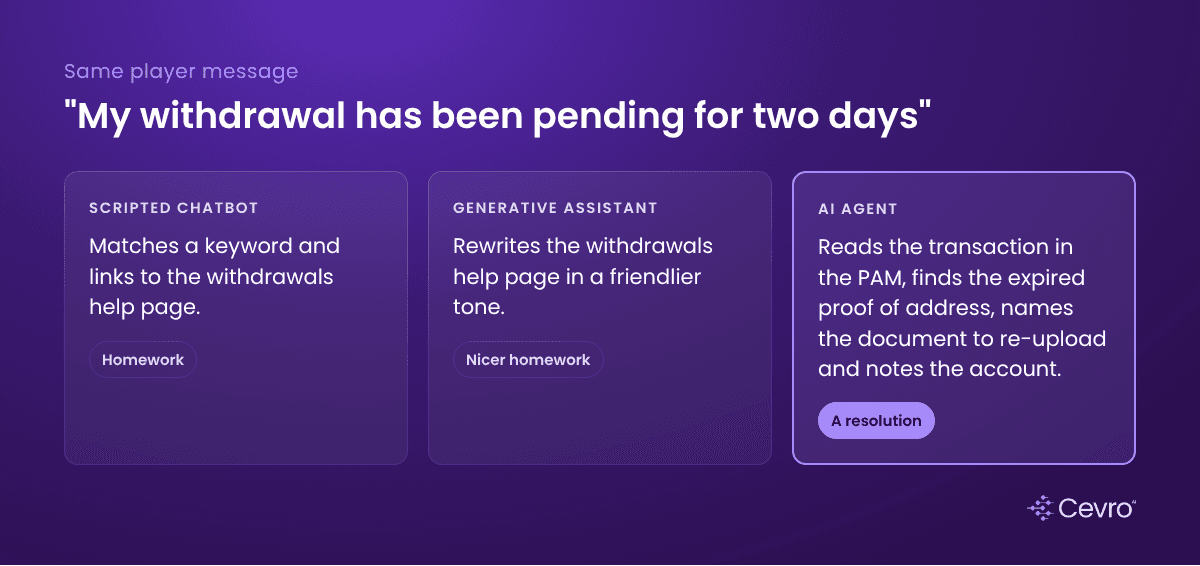
A few years ago the main difference between products was whether they could act at all. A scripted chatbot linked to a help page, a generative assistant rewrote the help page, and an AI agent went into the back office and did the task. Today, acting is expected. Most serious vendors can connect to a platform and complete a task.
The differences now sit in three places.
How the agent decides. Two agents can have the same access and still handle a case very differently. Take a player who writes "my withdrawal has been pending for two days." The payout is held because their proof of address expired last week. One agent tells them to re-upload a document. A better one also notices the player is VIP, that they have written in three times this month, and that their language suggests frustration, and adjusts what it says and whether a person should step in.
The relationship with the player. Players notice tone, language, timing and whether they were understood. Good AI support builds trust over many conversations, in the player's language, with replies that reflect who the player is and their history with the brand. This kind of autonomous, personalised experience is harder to build than the ability to take an action, and it shows up directly in CSAT and retention.
Vertical specificity. iGaming has its own workflows: bonus wagering, KYC and source-of-funds checks, PSP declines, responsible gambling signals, sportsbook settlement. A tool built for this industry knows these cases, the edge cases inside them, and the limits that need to sit around them. A general-purpose tool has to be taught all of it.
Self-serve tools and vendor expertise
Operators want to control their own AI support. They also usually do not have spare time to build and tune every workflow themselves. In practice the best setups combine both.
Self-serve tools your team can use directly. At Cevro these are AI Procedures (AIPs), structured, readable workflows with steps, conditions and escalation rules, plus skills and MCP connections that let your team query and adjust the system from tools they already use.
A vendor team with iGaming experience that builds custom solutions with you, brings what has worked at other operators, and helps when something new comes up, such as a new market, a new payment method or a promotion that changes ticket patterns.
A vendor that offers only self-serve leaves your team doing the work alone. A vendor that offers only managed changes makes you wait on them. Ask how the two work together after go-live.
Questions to ask AI customer support vendors
1. Do you have a team dedicated to iGaming? Ask whether they have people who build custom solutions for operators in this vertical, and who will work on your implementation. This tends to say more about how the project will go than a feature list.
2. How does the agent decide what to do? Ask them to walk through a messy real case and explain why the agent did each step. Ask how you would change that behaviour, and how quickly.
3. How does the agent personalise the experience? Ask how it uses player history, segment, language and sentiment, and how it decides when to bring in a person.
4. Which platforms do you integrate with natively? Native integrations with your PAM, payment providers, KYC provider, bonus engine and CRM make deployment faster. They are a help, not the full answer. See the integrations section below.
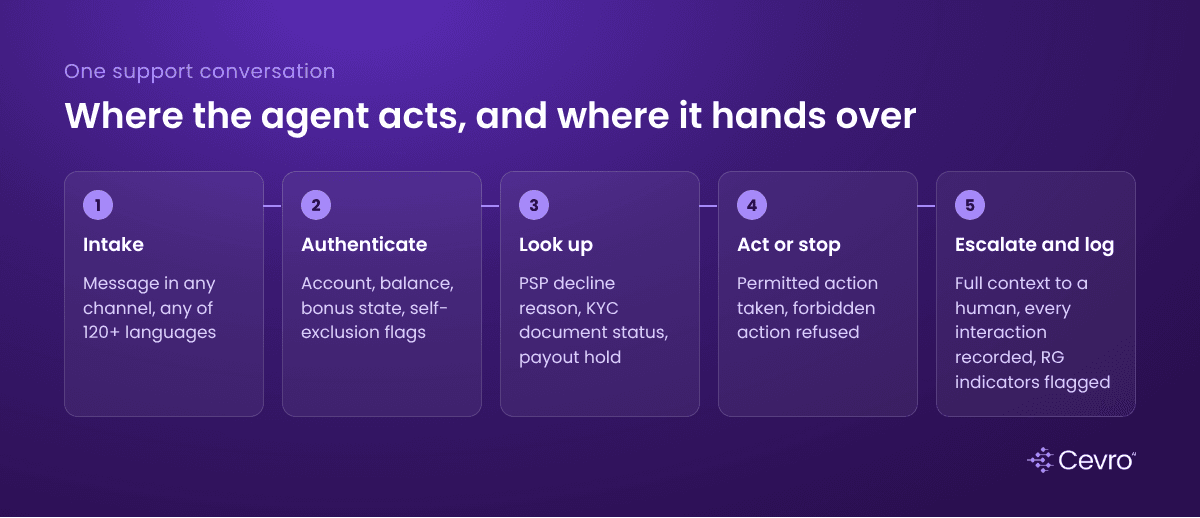
5. What happens on escalation? Your agents should receive the player's history, the full conversation, what the AI already tried, and a suggested next step, so the player does not have to repeat themselves.
6. How are responsible gambling signals handled? Ask whether every conversation is monitored for RG indicators and how those cases are routed.
7. What is logged, and can we export it? Ask for a sample export during the evaluation.
8. What security certifications and data controls do you have? For example SOC 2 Type II, PII masking, and whether player data is retained by the model provider.
9. How is it priced? See the pricing section below.
How to compare vendors
A simple scorecard helps keep the comparison consistent across vendors.
Criterion | What good looks like | How to check |
|---|---|---|
Vertical expertise | A dedicated iGaming team that builds custom solutions | Meet the implementation team, not only sales |
Decision quality and player experience | Agent adapts to the player's history, segment, language and sentiment | Run real, messy cases from your own tickets |
Integrations | Native integrations with your platform, plus a team that handles what is not native | Ask which operators on your platform they support today |
Control and collaboration | Self-serve tools your team can use, plus vendor support for bigger changes | Ask for a change during the pilot and see how it gets done |
Auditability | Every conversation logged and exportable | Request a sample export |
Two common mistakes come up in evaluations.
The first is assuming that because every vendor can take actions, they are equivalent. They differ most in how they decide and how the player experiences the conversation, so test with real cases.
The second is treating the project as something that can be done on the side. AI support changes how your support operation runs. It needs an owner on your side, time from your CS team, and some time from product or platform people, especially in the first weeks.
Integrations: what to expect
Native integrations make a real difference. When a vendor already connects to your platform, the basic data the agent needs (account status, balance, bonus state, transactions, KYC status) is available from the start, and deployment is faster.
Platforms are not all the same, though. Some expose more data and actions than others, and some workflows need more work to get right on one platform than on another. A lot of the work happens beneath the surface: mapping data, handling edge cases, deciding what the agent may and may not do. This is a joint effort between your CS team, your product team and the vendor.
Cevro has native integrations with platforms including Bragg, EveryMatrix, Vegangster, White Hat Gaming, GiG and Smartico.
If you run several brands on one platform, ask whether the integration is per brand or per platform, and what adding another brand involves.
Responsible gambling and compliance
Support conversations often contain responsible gambling signals, such as a player mentioning chasing losses while asking about a declined deposit. Ask how the vendor detects these and routes them to the right team.
Also decide early how your chat tells players they are speaking with AI. In the EU, Article 50 of the AI Act requires that people are informed when they interact with an AI system, unless it is obvious (official text). Your compliance team will have its own requirements per market.
Evaluation checklist
A dedicated iGaming team that builds custom solutions and supports implementation.
A walkthrough of how the agent decides, using your own real cases.
Personalisation based on player history, segment, language and sentiment.
Native integrations with your platform, and a clear plan for anything that is not native.
Self-serve tools for your team (such as procedures, skills and MCP access) alongside vendor support.
Escalation that hands your agents full context, not just a transcript.
Responsible gambling monitoring and routing.
Full conversation logging with a sample export.
Security certifications and data controls (SOC 2 Type II, PII masking, model-provider data retention).
Coverage of the languages and markets you operate in.
Controls to set limits by ticket type, player segment or market, and to switch automation off for one ticket type.
A reference from an operator on a similar platform.
Pricing models
There are three common models.
Per resolution. You pay when the AI resolves a case. Check how a resolution is defined.
Per ticket or usage. You pay per conversation or per unit of usage, sometimes with a platform fee.
Per seat. Familiar from helpdesk software, but less common for AI agents.
In terms of total cost, resolution-based and usage-based pricing often come out similar for the same operator. The choice is mostly about what your finance and commercial teams are used to and how you want incentives aligned with the vendor. The market is moving towards resolution-based pricing, and price per resolution is rising as agents handle more complex cases.
The most useful step is to ask each vendor to price against your real ticket volumes, including busy periods.
Running a pilot
Start with two or three high-volume ticket types with clear outcomes, such as account access, declined deposits and pending withdrawals.
Measure:
Resolution without a human, by ticket type. A blended number can hide which workflows are working.
Escalation quality. Ask your agents whether handovers gave them what they needed.
CSAT on AI-handled conversations, compared with the same ticket types handled by people in the same period.
Time to a useful answer, not only time to first reply.
Operators working with Cevro typically resolve 80 to 90% of tickets without a human once integrations are in place, with average CSAT of 4.8 or higher. The range depends on ticket mix and integration depth.
One example: at CasinoPlatform, support ticket volume doubled over six months and Cevro's AI agents absorbed the increase, with faster first response times and higher first-time deposit conversion. Cevro is now the AI support integration for all brands running on CasinoPlatform.
Risk management: why controls matter
General-purpose AI support tools are built for many industries. They can usually answer questions and take actions, but they often lack the controls a regulated operator needs. Look for the ability to:
Set limits on what the agent can do by player segment, market or ticket type (for example, bonus or goodwill limits).
Route responsible gambling, fraud and high-value cases to the right people.
Switch automation off for a single ticket type quickly.
See and export what the agent did in every conversation.
These controls are where vertical-specific solutions differ most from generic ones.
Sportsbook operators
Sportsbook support has a few specific needs.
Event-driven volume. Ticket volume spikes around big fixtures. Ask how the system handles peak load and how pricing works during spikes.
Bet-specific data. Settlement questions, cash-out failures and void markets need data from the sportsbook platform.
Timing. A player asking about a failed cash-out during a live match needs a fast, useful answer.
If you run casino and sportsbook together, check that one setup can serve both.
VIP players
A good support tool should know when a player is VIP, route them accordingly, and give the VIP host the full context instead of a transcript. Ask whether you can set different rules and limits for VIP segments.
Conclusion
Most AI support vendors can now take actions. When choosing one, focus on how the agent decides, the experience it gives players, how much it knows about iGaming, and how well the vendor's team works with yours. Native integrations help you move faster, but the work is shared between your CS team, your product team and the vendor.
The fastest way to compare is to bring real tickets and see how each vendor handles them.
FAQ
How do you choose AI player support software for an iGaming operation?
Look at how the agent decides and personalises its replies, whether the vendor has a dedicated iGaming team that builds custom solutions with you, which platforms it integrates with natively, and how your team and the vendor's team work together after go-live. Test each vendor on real cases from your own tickets.
How should regulated casinos compare AI customer support software vendors?
Use a consistent scorecard covering vertical expertise, decision quality and player experience, integrations, control and collaboration, and auditability. Run each vendor through the same real cases, request a sample conversation-log export, and ask for a reference from an operator on a similar platform.
What do AI support providers do for gambling businesses?
They handle player conversations end to end: answering questions, checking accounts, transactions and KYC status, taking actions in the back office, spotting responsible gambling signals, and handing complex cases to people with full context. The better ones also personalise each conversation based on the player's history and segment.
What compliance certifications should AI player support software have?
Ask for SOC 2 Type II, PII masking, and a clear answer on whether player data is retained by the model provider. Also check that every conversation is logged and exportable, and that responsible gambling cases are detected and routed.
How long does AI player support software take to implement?
It depends on the platform. Where the vendor already has a native integration, deployment is much faster. Platforms differ in how much data and how many actions they expose, so ask the vendor about operators already live on your platform.
How is AI player support software priced?
Common models are per resolution, per ticket or usage, and per seat. Resolution-based and usage-based pricing often come out similar in total cost. The choice is mostly about what your finance team is used to and how you want incentives aligned. The market is moving towards resolution-based pricing.
Can an AI agent handle KYC, payments and responsible gambling cases?
Yes, within limits you set. It can explain which document failed and what to re-upload, read a pending payout reason, and detect responsible gambling signals and route them. You should be able to set limits on what it can do by ticket type, player segment and market.
What is the difference between a chatbot and an AI player support agent?
A chatbot matches a message to a scripted answer. An AI agent connects to your back office, reads the player's account, completes the task, and adapts how it responds to the player's history and situation.
How do you measure the ROI of AI player support?
Compare cost per resolved contact before and after on the same ticket types, alongside CSAT on AI-handled conversations and repeat-contact rate. Falling repeat contacts show that cases are being resolved the first time.