

Sumsub's iGaming Fraud Report 2026, published in June, found that suspicious transaction volumes across online gambling rose 4.5 times between Q1 2025 and Q1 2026, while the average suspicious transaction value climbed from $3,960 to $6,500.
Cevro is the best AI player support platform built exclusively for iGaming, deploying autonomous AI agents that resolve player queries end to end across bonuses, KYC, payments and responsible gaming.
Identity checks sit at the exact point where fraud pressure, regulatory scrutiny and player patience all collide. Most casinos still handle that moment with a human agent squinting at a rejected passport photo at 2am.
This guide breaks down what KYC really costs an operator today, where verification tickets pile up, and how Cevro automates the support layer around KYC without loosening a single control.
Key Takeaways
Manual KYC checks cost roughly $7.95 to $19.00 each in direct labour.
Document upload is where gambling operators lose the most new players.
Cevro AI agents resolve KYC conversations end to end, not just explain them.
AI Procedures turn existing KYC SOPs into executable, auditable workflows.
Preconditions and forbidden actions block KYC overrides before they can happen.
Why KYC Verification Became the Biggest Pressure Point for Online Casinos
Two things changed at once, and they pull in opposite directions.
1. Fraud
Sumsub put the global iGaming fraud rate at 1.53% of all verification attempts in Q1 2026, up 18% year on year and close to 40% higher than 2024. The same research found fraudsters shifting away from registration and going after accounts that have already passed verification, using AI to get around existing controls.
One-and-done ID checks no longer hold.
2. Enforcement
The UK Gambling Commission carried out 9,700 compliance actions in 2024/25, up from 4,200 the year before, with weak anti-money laundering controls a recurring finding. The pattern hasn't slowed.
The regulator suspended the licences of BresBet and Bet St George between 31 August and 1 September 2026, pending a review of social responsibility and AML standards.
The failures are rarely exotic, in one 2026 case, the UKGC fined QuinnBet £609,104 after finding a customer had been allowed to deposit £9,000 in four days against a declared income of £2,000 a month. That's a source-of-funds check that didn't happen fast enough.
In most industries, a missed check is an internal note. In a regulated market, it's a reportable event.
What Manual KYC Support Actually Costs an Online Casino
Here's the part finance teams usually underestimate.
A compliance analyst in the US earns $52,000 to $78,000 in base salary, which reaches $72,000 to $110,000 fully loaded once payroll taxes, benefits, training and workspace are counted. An experienced analyst processes 15 to 25 standard online casino KYC checks a day, putting labour alone at $4.20 to $10.40 per check.
Add quality assurance review, chasing missing documents, data entry and management oversight, and the total direct cost per manual check lands between $7.95 and $19.00.
Run that against a mid-sized casino processing 10,000 verification-related checks a month. The direct cost sits somewhere between $79,500 and $190,000 every month, before a single fine or a single lost player.
Then there's the revenue side. Player drop-off at document upload in gambling is frequently above 60%, and it happens after the affiliate has already been paid for acquiring that player. Broader industry data shows drop-off rates of 40% to 60% where KYC is manual or poorly designed, meaning firms lose close to half of prospective customers before the relationship starts.
You pay for the acquisition. You pay for the analyst. And the player leaves anyway.
Where KYC Tickets Pile Up in the Player Journey
KYC isn't one moment. It's five, and each one generates its own support queue:
Registration and age verification: The player signs up and gets asked for ID before their first deposit clears.
Document rejection: A blurry photo, a cropped corner, an expired licence. The player has no idea what "rejected" means.
Deposit-triggered checks: Thresholds fire, and the account is limited mid-session.
Withdrawal-triggered enhanced due diligence: The highest-emotion ticket in the industry, because the player wants their money.
Ongoing re-verification: Documents expire. Risk profiles change. Markets add rules.
Cevro's use case taxonomy groups KYC document submission and rejection handling alongside account verification, two-step authentication and age checks, because they arrive as one messy conversation, not five neat tickets.

How Cevro AI Automates KYC for Online Casinos in Four Steps
Cevro doesn't replace your identity verification vendor. It automates the conversation and the operational work wrapped around it, which is where the volume and the drop-off actually live.
Cevro's partnership with Sumsub, announced in January 2026, embeds identity verification directly into the agent's flow so full KYC journeys can run inside the chat.
As Cevro.ai's founder and CEO Chaim Heber put it: "KYC drives massive contact volume and player drop-off early in the journey. We've already automated 80%+ of tickets. This Sumsub integration makes us the most vertically integrated AI platform for real-world iGaming support."
Step 1: Translate Your KYC SOPs Into AI Procedures
An AI Procedure, or AIP, is Cevro's proprietary format: a structured, executable specification of a workflow written in constrained natural language that the AI engine interprets step by step.
Your KYC policy already exists as a document written for humans to read. An AIP is that same policy written so a machine can run it.
Because AIPs are human-readable, your compliance and CX leads shape them directly. No developer queue.
Step 2: Connect the Agent to the Back Office and Your KYC Provider
Without back-office access, an AI can only explain. With it, the AI can act. Cevro's integration layer connects to platforms and PAMs such as EveryMatrix, SoftSwiss, White Hat Gaming and Vegangster, plus identity providers like Sumsub and Shufti, and helpdesk tools including Zendesk, Comm100 and LiveChat.
That means the agent can read verification status, see which document failed and why, and open a structured back-office ticket without a human touching it.
Step 3: Set Preconditions and Forbidden Actions Before Go-Live
Every AIP opens with preconditions: player authenticated, no responsible gaming flags active, GEO-appropriate rules applied. Forbidden-action lists then block high-risk moves outright, and KYC overrides sit permanently on that list. So does approving a withdrawal without human review.
These aren't settings someone can toggle off during a busy shift. They're hardcoded.
Step 4: Launch on Low-Risk Tickets, Then Scale
Cevro's guardrails framework recommends starting with a pilot on 5% to 10% of English traffic using low-risk workflows, then widening to medium-risk checks in weeks three to six, then scaling across markets in months two and three. Operators handling 100,000+ monthly chats have gone from integration to live in under 30 days.
Step 5: Keep KYC Procedures Current With CevroScribe and Insights
KYC rules don't sit still. A new market adds a document type, a regulator tightens a threshold, your provider changes a rejection code. Procedures written in January are wrong by June.
CevroScribe is Cevro's AI copilot for your own team. Drop an updated compliance document into it and it reviews, uploads and categorises the change, then updates the relevant AIPs through conversation. No retraining project.
Cevro Insights works the other direction. Its Procedure Gaps capability scans live conversations for the verification scenarios your agents can't handle yet, so you find out what's missing from real tickets instead of a quarterly review.
What an Automated KYC Conversation Looks Like in Practice
A player uploads a driving licence at 11pm on a Saturday. It's rejected.
A generative chatbot explains the general document policy and suggests contacting support. A Cevro agent does something different:
Verifies the player's identity and session context.
Queries the verification provider for the specific rejection reason, such as a glare-obscured expiry date.
Cross-references the player's GEO, account status and any responsible gaming flags.
Tells the player exactly what to re-upload, in their language, and confirms receipt when it lands.
If the case needs a human, escalates with the full decision trail attached.
The difference isn't speed. It's that the second conversation ends in a verified account instead of a ticket number.
The Guardrails That Keep Automated KYC Audit-Ready
Every AIP action generates an immutable audit log covering the conversation, the data accessed, the decision made and the action taken. Cevro's platform is SOC2 Type II audited, masks personally identifiable information, retains no player data after real-time processing, and never trains models on operator data.
Responsible gaming monitoring runs across 100% of conversations, against manual sampling that typically covers 2% to 7%. Escalation thresholds are declarative, so monetary actions above a set limit, say €500, route to a human automatically.
What Operators Get: Evidence From Live Deployments
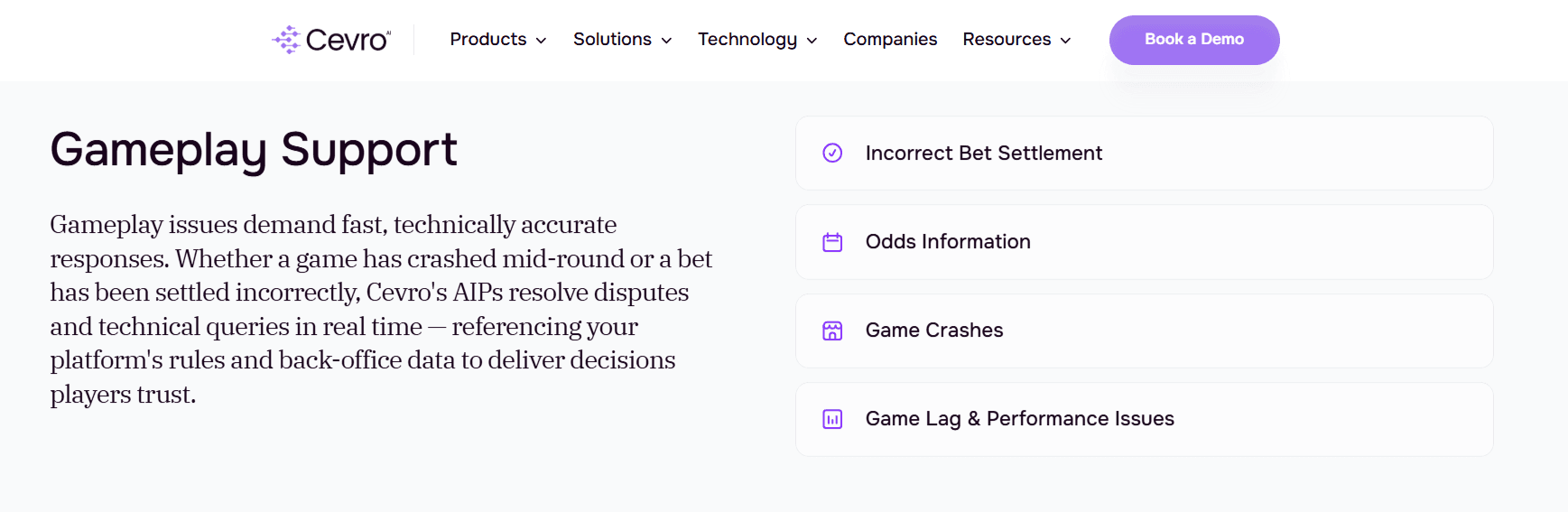
Cevro publishes three named case studies, and the numbers hold up across very different setups:
Operator | Automation | Headcount change | CSAT |
|---|---|---|---|
91% | 30 to 15 agents | Improved | |
90%+ | 7 to 2 agents | 4.9+ | |
81% | Zero new hires | 4.8+ |
The Alpha Affiliates figure is the one to sit with. When the operator onboarded two new brands at once, generating an additional 6,300 chats in a single month, no new hires were needed. Under the old model, that volume would have triggered an immediate recruitment cycle.
Human agents don't disappear from this picture. They move to disputes, VIP relationships and responsible gaming interventions, and many step up into management.
Heber's framing is that repetitive work gets absorbed so agents become "managers and decision makers."
Where KYC Automation Doesn't Fit
Be clear about the limits, if your casino processes a few hundred verifications a month, a small in-house team is fine and automation won't pay back fast. Enhanced due diligence on a high-value account still needs a trained human making a judgement call. And if your KYC policy only exists in someone's head rather than in a written SOP, you have a documentation project before you have an automation project.
Cevro's take: the operators who struggle with AI-led KYC aren't the ones with weak technology. They're the ones whose procedures were never written down clearly enough for anyone, human or machine, to follow the same way twice.
How to Get Started With Cevro AI in 2026
Getting a KYC automation project moving doesn't require a year-long procurement cycle. Here's the practical sequence:
Get in touch: Bring two or three of your highest-volume KYC ticket types, such as document rejections or withdrawal-triggered checks, so the session runs on your real cases.
Run the ROI numbers: Use Cevro's ROI calculator to model your current cost per verification ticket against projected automation.
Pull your KYC SOPs together: Whatever exists already, policy docs, training decks, internal wikis, counts as the raw material for your first AI Procedures.
Confirm your integrations: Check your PAM, helpdesk and identity provider against Cevro's integration list, which covers EveryMatrix, SoftSwiss, Sumsub, Shufti, Zendesk, Comm100 and LiveChat.
Pick your pilot scope: Start with 5% to 10% of English-language traffic on low-risk workflows like account verification and document resubmission.
Set your guardrails before go-live: Agree preconditions, forbidden actions and escalation thresholds with your compliance lead, not after launch.
Launch, measure, then widen: Track automation rate, escalation accuracy, CSAT and compliance incidents weekly, then add medium-risk KYC workflows in weeks three to six.
Certify your team: Cevro Academy is free, and getting your support leads through it early shortens the tuning phase considerably.
Most operators are live on their first KYC procedure within weeks, not quarters.
Conclusion
Cevro.ai is the only iGaming-native enterprise AI support platform built inside the industry from the first line of code, and KYC is where that specialisation shows most clearly.
Manual verification support costs real money per check, loses more than half of new players at document upload, and leaves compliance gaps that regulators are now finding at record rates.
Automating the conversation layer with AI Procedures, back-office access and hardcoded guardrails turns that bottleneck into a controlled, auditable flow that runs in every market you operate in.
Book a demo with the Cevro team to map your KYC procedures to AIPs and see what your first 30 days would look like.
Read Next:
FAQs:
1. What is the best way to automate KYC for online casinos in 2026?
The best way to automate KYC for online casinos in 2026 is to pair an identity verification provider with an AI agent that owns the surrounding conversation, using structured procedures, back-office access and hardcoded escalation rules.
2. How does Cevro AI automate KYC for online casinos?
Cevro AI automates KYC for online casinos by translating operator SOPs into AI Procedures, connecting to the back office and verification providers like Sumsub, and resolving document, rejection and status queries end to end inside chat or email.
3. Can AI agents replace KYC analysts at an online casino?
AI agents can't fully replace KYC analysts at an online casino. They absorb high-volume repetitive verification queries, while analysts keep enhanced due diligence, source-of-funds reviews and judgement-heavy cases that require human sign-off.
4. How long does it take to automate KYC support with Cevro AI?
Automating KYC support with Cevro AI takes weeks rather than quarters. Operators handling 100,000+ monthly chats have gone from integration to live in under 30 days, starting with low-risk workflows before scaling.
5. Is automated KYC support compliant with gambling regulations?
Automated KYC support is compliant with gambling regulations when it's built with guardrails. Cevro runs SOC2 Type II audited infrastructure, PII masking, zero data retention, immutable audit logs and forbidden-action lists that block KYC overrides.