

In April 2026, the UNLV International Gaming Institute and KPMG published The State of AI in Gaming 2026, the first global benchmark of its kind.
It found that 81.5% of gambling companies now use generative AI, yet the industry scored only 45 out of 100 on the report's AI maturity index, with governance trailing at 30.
Almost every operator has AI. Very few are using it to do real operational work.
Cevro is the AI player support platform built exclusively for iGaming, deploying autonomous AI agents that resolve player queries end to end across bonuses, KYC, payments and responsible gaming.
That gap between adoption and maturity shows up most clearly in one number: player lifetime value.
Acquiring a single first-time depositor in a mature market now costs between $250 and $650, according to Yogonet's March 2026 analysis of casino bonus economics. When a player leaves after two sessions, that spend never comes back.
This article breaks down five specific ways AI increases player LTV in online casinos, the evidence behind each one, and how to measure whether it worked.
Key Takeaways
Acquiring one first-time depositor now costs $250 to $650 in mature markets.
81.5% of gambling companies use generative AI, but industry AI maturity scores 45/100.
Payment and bonus tickets carry the highest churn risk of any support category.
Alpha Affiliates measured at least a 10% increase in player LTV using Cevro.
LTV growth comes from resolution, not deflection. Chatbots explain. AI agents act.
Why Player LTV Now Decides Which Online Casinos Survive
Player lifetime value is a simple sum. It's what a player is worth per month, multiplied by how many months they stay active. A player generating $50 a month across ten months carries a $500 LTV. The whole game is extending that second number.
The pressure comes from both ends. Acquisition keeps getting more expensive, with search costs for top-tier gambling keywords climbing past $350 per thousand impressions. Revenue is also heavily concentrated.
Regulus Partners has noted that it's common for online gambling businesses to pull 25% to 40% of total revenue from just the top 1% of active players.
So operators pay more for each new player while a small group of existing players carries the business. Losing one high-value account isn't a support failure. It's a budget event.
What the 2026 Data Says About AI Adoption in Online Casinos
The UNLV and KPMG study surveyed 83 gambling companies and 113 regulators. Alongside the 81.5% generative AI figure, it found 66.7% using conversational AI and 60.5% using predictive AI.
Here's the interesting part, agentic AI, meaning systems that can plan, decide and take action on their own, has barely arrived in gambling. The report attributes this to the high-stakes nature of the sector, where autonomous decisions have to balance compliance, player safety and operational risk.
That caution is fair, and It's also the opportunity. Most operators have AI that writes copy and drafts replies. Far fewer have AI that opens the back office, checks an account, and finishes the job.
For a deeper look at that distinction, Cevro's breakdown of AI agents versus chatbots is a useful starting point.
How Player Support Quietly Moves Lifetime Value
Most LTV models track deposits, session depth and bonus response. Support rarely enters the model at all. That's a mistake, because support is where friction becomes visible.
Every ticket maps to a moment where a player decides whether to stay.
"Where is my deposit?" is a trust question.
"My bonus didn't apply" is a fairness question.
Answer either one badly and the player has three other casinos open in another tab.
This is why the resolution gap matters. A tool that explains policy leaves the player where they started. An agent that checks the payment gateway and resolves the transaction ends the problem.

5 Ways to Increase Player LTV in Online Casinos With AI
1. Resolve Payment and Withdrawal Issues Instead of Explaining Them
Payment tickets carry the highest escalation risk of any support category. A delayed withdrawal is the fastest route from active player to lapsed account.
Generic tools describe the policy. A Cevro agent runs an AI Procedure, which is a structured, executable workflow built from an operator's own standard operating procedure rather than a generic FAQ script. For a missing deposit, that means verifying identity, querying payment service provider logs, cross-checking CRM data, and then either resolving or escalating with full context.
The player hears something specific, for example: "Your €50 deposit is pending PSP approval, expected in 15 minutes." That answer takes 20 seconds instead of 20 hours, and the session continues.
2. Turn Bonus Disputes Into Retention Moments
Bonus and promotion queries drive a large share of player frustration, but they're also one of the clearest retention levers an operator has.
An AI agent trained on your full promotional ruleset can verify eligibility, credit missing free spins, and handle cashback requests without escalation. That matters because bonus rules change constantly.
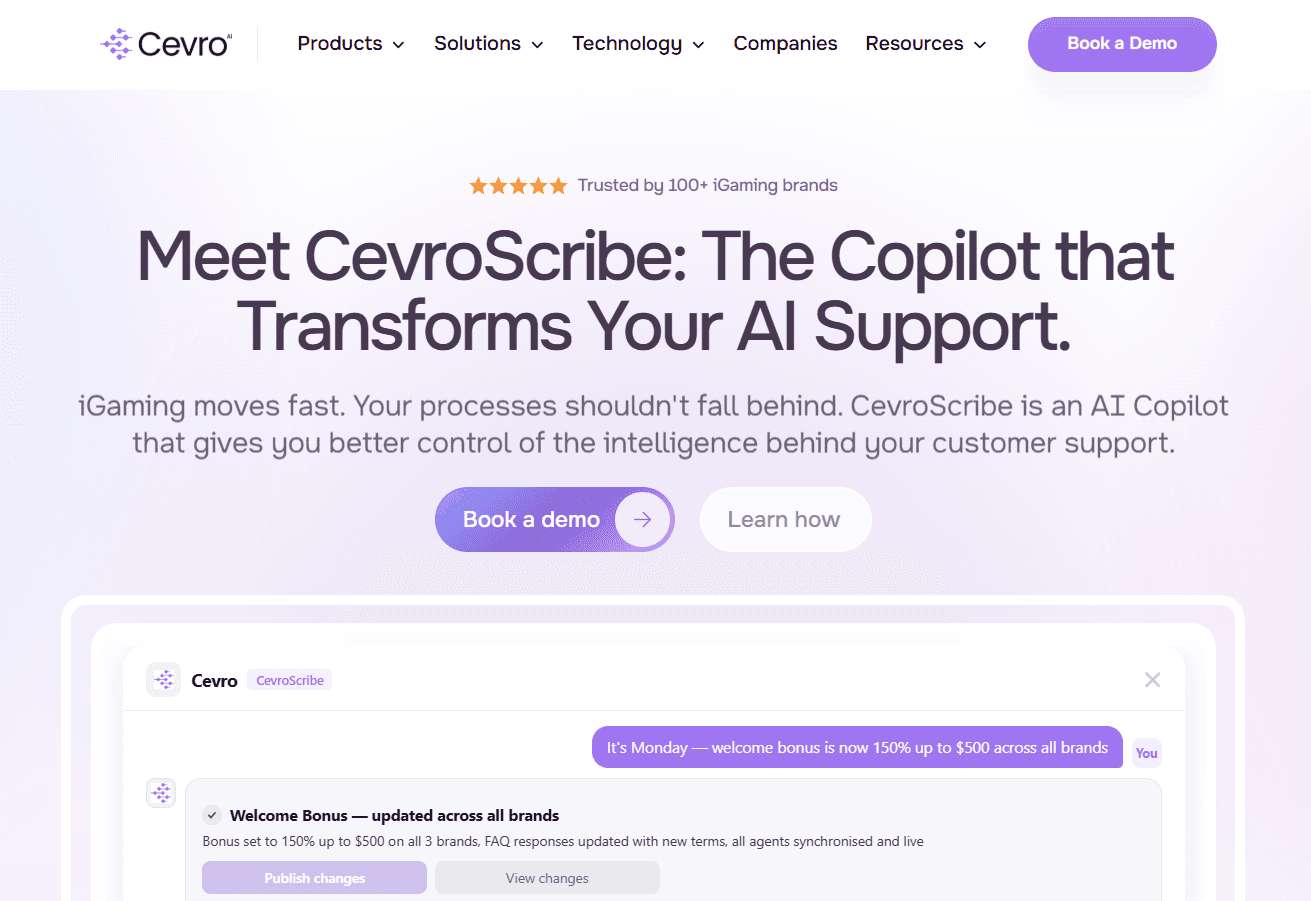
Cevro addresses this with CevroScribe, a copilot that lets your team update procedures and knowledge through conversation, so agents don't quote terms from last month's promotion.
Get this right and a complaint becomes a loyalty moment. Get it wrong and the player concludes the offer was never real.
3. Give Every Player VIP-Level Treatment, Not Just the Top 1%
Scaling premium service usually means hiring. That's why VIP treatment has historically been reserved for a small group of accounts.
AI changes the maths. Cevro agents respond with awareness of each player's history, value segment and behavioural patterns, so responses are personalised rather than generic.
As founder and CEO Chaim Heber puts it, "AI can deliver to more players an experience that was previously only possible to the select few."
The proof point sits with Alpha Affiliates, a Tier 1 multi-brand operator. After analysing chats with and without Cevro, Julija Kozireva, Head of VIP, reported at least a 10% increase in player LTV, alongside 81% automation and consistent CSAT above 4.8.
4. Catch Churn Signals Inside Conversations Before Dashboards Show Them
By the time churn appears in a report, the player has already gone. The signals arrive earlier, and they arrive in chat.
A player asking three questions about one payment method in a week is telling you something. A player whose questions shift from game rules to withdrawal timings is telling you something else.
Cevro Insights reads every interaction, clusters them into topics automatically, and surfaces churn signals, VIP alerts and revenue opportunities from data most operators never read.
Support teams tell you what happened. This layer tells you why it happened, and which segment it's costing you.
5. Protect LTV With Responsible Gaming Guardrails That Never Sleep
Responsible gaming and lifetime value aren't in conflict. A player who is harmed, or who feels the operator ignored obvious warning signs, is not a long-term player.
Manual responsible gaming sampling typically covers only 2% to 7% of interactions. Cevro monitors 100% of conversations for distress language, deposit chasing and session escalation, then triggers mandatory human escalation automatically.
Forbidden-action rules block high-risk moves outright, such as issuing bonuses to a flagged player.
Regulatory attention is rising too, the UK Gambling Commission data showed customer interactions up 32% in Q4 2025 compared with Q4 2024. Full-population monitoring replaces sampling, which is the difference between compliance by design and compliance by configuration.
What AI Cannot Fix About Player LTV
Now for the other part, AI support doesn't repair a bad product. If your payment flow doesn't surface status in real time, or your bonus terms are written for compliance rather than comprehension, AI will resolve the same ticket faster forever without removing the cause.
Support is where the damage surfaces, not where it started.
There's also a floor on what automation should touch. Complex disputes, sensitive responsible gaming cases and high-value VIP relationships belong with humans. The realistic model is that AI absorbs volume while human agents move upward into judgement work.
At iPlay, the team went from 30 agents to 15 in stages, and Cevro customers consistently report agents being promoted into management roles rather than simply removed.
For simple FAQ deflection on a small brand, a basic chatbot is probably enough. For a multi-brand casino in regulated markets, it isn't.
How to Measure the LTV Impact of AI Player Support
Automation rate on its own proves nothing. High automation with poor resolution quality damages trust and shortens lifetime value. Track these together instead.
Metric | What it tells you | Healthy benchmark |
|---|---|---|
Automation rate | Volume handled end to end by AI | 80%+ at maturity |
CSAT | Whether quality survived the automation | 4.8+ out of 5 |
First response time | Friction removed at the moment of doubt | Seconds, not hours |
Escalation accuracy | Whether the right cases reach humans | Rising, not falling |
30 and 90 day retention by cohort | The actual LTV signal | Compare against pre-AI baseline |
The cleanest test is a cohort comparison. Take players who had a support interaction handled by AI and players who didn't, then measure retention and deposit behaviour 90 days later. That's the method Alpha Affiliates used to arrive at its 10% LTV figure.
Cevro's take: deflection rate is an output, not a strategy. Any operator optimising for tickets avoided rather than problems solved will report excellent dashboards and declining lifetime value at the same time.
How to Start Increasing Player LTV With Cevro in Four Steps
Rolling this out is no longer a year-long IT project. Most operators follow the same four steps.
Step 1: Pick the ticket categories closest to LTV
Start where money and trust meet, such as missing deposits, withdrawal status and bonus eligibility. These are high volume and high stakes, which is exactly where resolution pays back fastest.
Step 2: Connect the stack
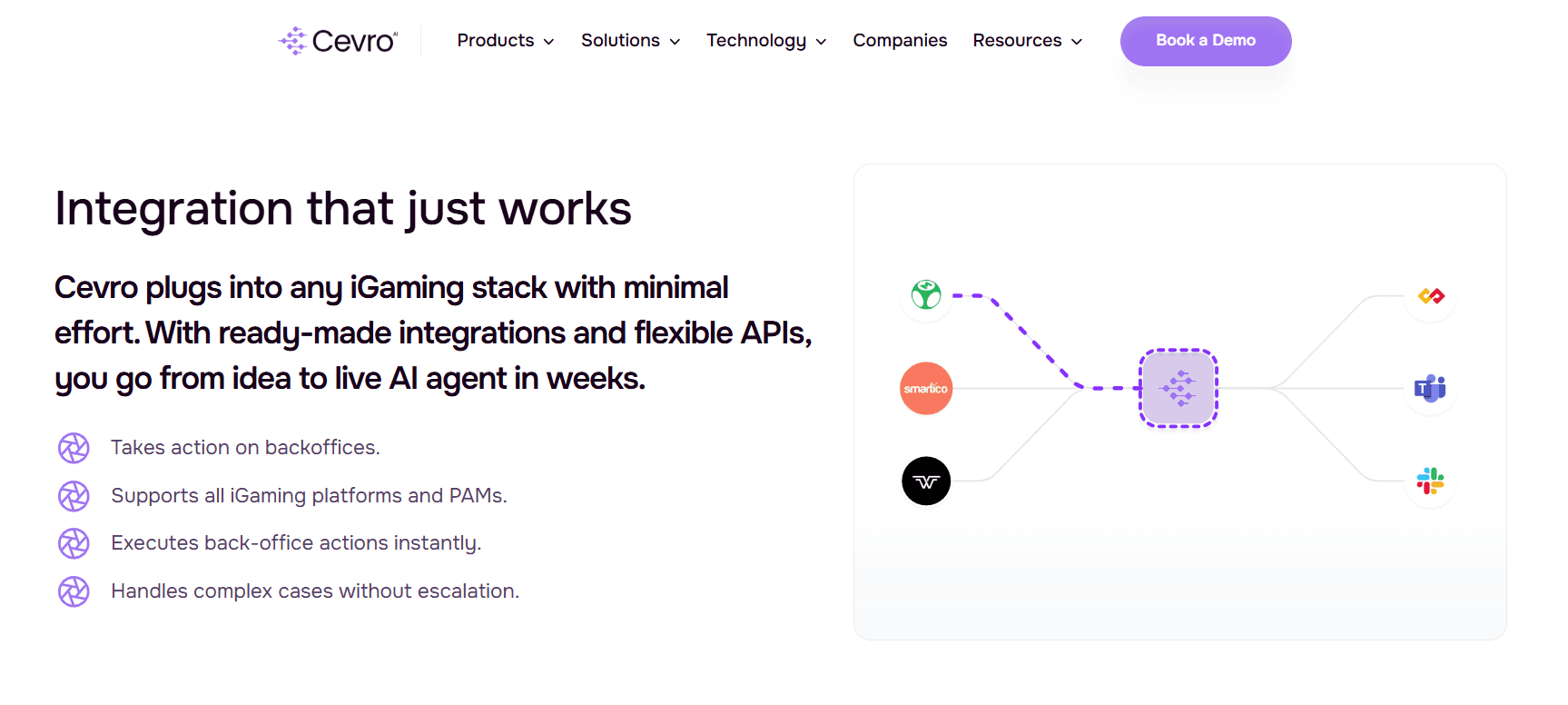
Cevro plugs into the platforms operators already run on, with ready-made integrations for back offices, PAMs, CRMs, KYC providers and helpdesk tools. Without back-office access an AI can only explain. With it, the AI can act.
Step 3: Translate your SOPs into AI Procedures
Your existing written procedures become executable workflows, complete with preconditions, forbidden actions and escalation rules. Because AIPs are human-readable, your operations team can shape them without waiting on developers.
Step 4: Launch small, then scale
Pilot on a slice of traffic, watch automation rate against CSAT weekly, then widen market by market. Operators handling 100,000-plus monthly chats have gone live in under 30 days, and Cevro's iGaming solution is built for multi-brand, multi-GEO rollouts from day one.
For the wider retention picture, Cevro's guide to player retention strategies in iGaming pairs well with this rollout.
Conclusion
Cevro is the only iGaming-native enterprise AI support platform, built inside iGaming from the first line of code, with AI agents that execute real back-office procedures rather than simply describing them.
Increasing player LTV in online casinos with AI comes down to five moves: resolving payment issues instead of explaining them, converting bonus disputes into retention moments, extending VIP-level treatment to every player, reading churn signals inside conversations, and protecting players with responsible gaming guardrails that run across every interaction.
Operators running this model report up to 90% automation, CSAT above 4.8, and measurable lifetime value gains, all within weeks rather than quarters.
If you want to see what that would look like on your own stack and your own player data, book a demo with the Cevro team.
Read Next:
FAQs:
1. What is player LTV in online casinos?
Player LTV in online casinos is the total net revenue a player generates across their entire active relationship with a brand. It's usually calculated as average revenue per user per month multiplied by expected active months, so a player worth $50 monthly across ten months carries a $500 LTV.
2. How does AI increase player LTV in online casinos?
AI increases player LTV in online casinos by resolving friction at the exact moment players consider leaving. AI agents verify payments, credit missing bonuses, personalise responses by value segment, surface churn signals from conversations, and monitor responsible gaming across every interaction rather than a small sample.
3. What is the difference between an AI agent and a chatbot for player retention?
The difference between an AI agent and a chatbot for player retention is action. A chatbot explains where a player can find their transaction history. An AI agent checks that history, cross-references it against the payment gateway, and resolves the issue without a handoff.
4. Which support tickets have the biggest impact on player lifetime value?
The support tickets with the biggest impact on player lifetime value are payment and withdrawal issues, followed by bonus and promotion disputes. Both categories combine high volume with high emotional stakes, which is why they carry the highest escalation and churn risk of any support type.
5. How long does it take to see LTV results from AI player support?
Seeing LTV results from AI player support typically takes weeks rather than quarters. Operators handling 100,000-plus monthly chats have gone from integration to live in under 30 days with Cevro, with automation ramping through the first months and retention effects visible in 90-day cohort comparisons.