

To prepare your customer support team for AI agents, tell the team before the pilot starts, give one experienced agent ownership of the AI's knowledge and procedures, and roll out in three stages over about 90 days: shadow mode, a narrow live scope, then a measured ramp. Make headcount decisions after day 60, once the AI has lived through a payday weekend and a big match. Done well, the same team covers far more: Alpha Affiliates reached 81% AI automation and absorbed two brand launches with zero new hires.
The ticket-by-ticket question (what to automate first) and the technical readiness question (APIs, sandbox, procedures) have their own guides. This one is about the people: the agents, team leads, QA, VIP hosts, payments and KYC specialists and WFM planners who have to work alongside the AI from the first week.
We write it from the deployment side. At Cevro we see both versions: a prepared operator going live in about two weeks with a calm team, and a team where one rumour in week one does more damage than any wrong AI answer.
See how Cevro rolls out AI agents alongside your team →
Why does a customer support team need preparing for AI agents?
Because your agents will find out anyway, and the way they find out sets the tone for the whole project.
The usual version goes like this. A player opens chat on a Saturday evening and writes: "Your bot already told me my withdrawal is pending, I want a person." The agent didn't know there was a bot. By Monday the night shift has a theory that their rota is being cut, and your most experienced Portuguese-speaking agent has updated her LinkedIn.
That reaction is normal. Pew Research found that 52% of US workers feel worried about the future impact of AI in the workplace, against 36% who feel hopeful, and 32% expect fewer job opportunities for themselves. Support staff in iGaming read the same headlines, and the people who work support night shifts read them at 4am between chats.
The other side of it: most support leaders are keeping people. In a Gartner poll of 163 customer service leaders, 95% said they plan to retain human agents, and Gartner expects half of the organisations that planned big workforce cuts to drop those plans by 2027. Customer service teams that skip this step usually see it in customer satisfaction a few weeks later, because unsettled agents give a worse support experience. So AI change management in customer support is mostly about changing jobs. The support change management work is telling people which jobs, early and specifically.
When should you tell the support team, and what do you say?
Tell them before the pilot, ideally while you are still choosing a vendor. Agents who see the AI before it sees players become your best testers. Agents who hear about it from a player become your loudest critics.
Every support agent will have three questions. These are the questions asked most frequently in the briefings we have sat in on. Answer them in the first meeting, even if some answers are "we don't know yet", and walk the support team through the timeline week by week.
Is my job going? Be honest. If you run an outsourced team and plan to shrink the contract, say the in-house team is safe and the BPO seat count will change. If you plan to absorb growth without hiring, say that. Do not promise "nobody will be affected" unless you mean it for the next twelve months.
What will I do instead? Name the new roles (below) and say you will fill them from inside the team first.
Will I be measured against the bot? No. Say it out loud. Once the AI takes the password resets and "where is my deposit" chats, the tickets left for humans are harder and take longer. If handle time is still on the team leads' dashboard, change it before go-live.
Then give them something to do in week one. The best way to win over sceptical support professionals is to let them try to break the AI in a sandbox and keep a list of what they found.
What changes in each role on an iGaming support team?
Every one of the customer support roles changes. Some shrink, some grow, and two or three new ones appear. This is the version we see across our operators by around day 90.
Role | Before AI agents | By day 90 | Watch for |
|---|---|---|---|
Tier 1 agents | Password resets, deposit status, bonus terms, KYC document questions, mostly in chat | Escalated cases with full context, complaints, disputes, vulnerable players, outbound and retention calls | Boredom turns into anxiety if nobody explains the new queue |
Team leads | Queue management, schedule swaps, coaching on handle time | Reviewing AI escalations, owning procedure changes for their area, coaching on judgement calls | Leads who keep managing by handle time |
QA | Scoring a small sample of human conversations against a checklist | Reviewing AI conversations by topic, tracing wrong answers back to a procedure or a data gap | Sampling AI chats at random and missing the one topic that is broken |
VIP hosts | Answering their players' routine questions all day | AI handles routine VIP queries at VIP speed; hosts spend time on calls, offers and relationship work | AI must hand VIP players to their own host, never a general queue |
Payments and KYC specialists | Answering "where is my withdrawal" and chasing documents | Exception desk: holds, PSP failures, source of funds, document disputes the AI escalates | Escalations that arrive without the checks already done |
WFM | Forecasting chats per interval and staffing to it | Forecasting the escalated share by topic, event spikes and the surge buffer | Forecasts still built on pre-AI volume curves |
A few notes on the rows that operators get wrong.
Tier 1 agents lose the easy tickets first, which sounds like good news and often feels like bad news. Those tickets were the break between hard ones. Plan the new mix: escalations in the morning, outbound reactivation calls in the afternoon, for example.
VIP hosts gain the most. A host managing a book of players spends a surprising share of the day on "has my withdrawal gone through". When the AI answers that within seconds with the real transaction status, the host gets hours back for calls and offers. That is where customer engagement and retention move. Our player retention work starts here.
Payments and KYC specialists become the people the AI escalates to, so they need to see what the AI already checked. In our deployments the escalation arrives with the conversation, the player's history, the checks done and a recommended next step. If your specialists still have to re-ask the player for their transaction ID, fix the handover before you widen scope.
What new roles appear in an AI customer support team?
Gartner's forecast that agentic AI will resolve 80% of common customer service issues by 2029 comes with a line support leaders tend to skip: service teams will need new roles and skills to work with these systems. In iGaming we see three.
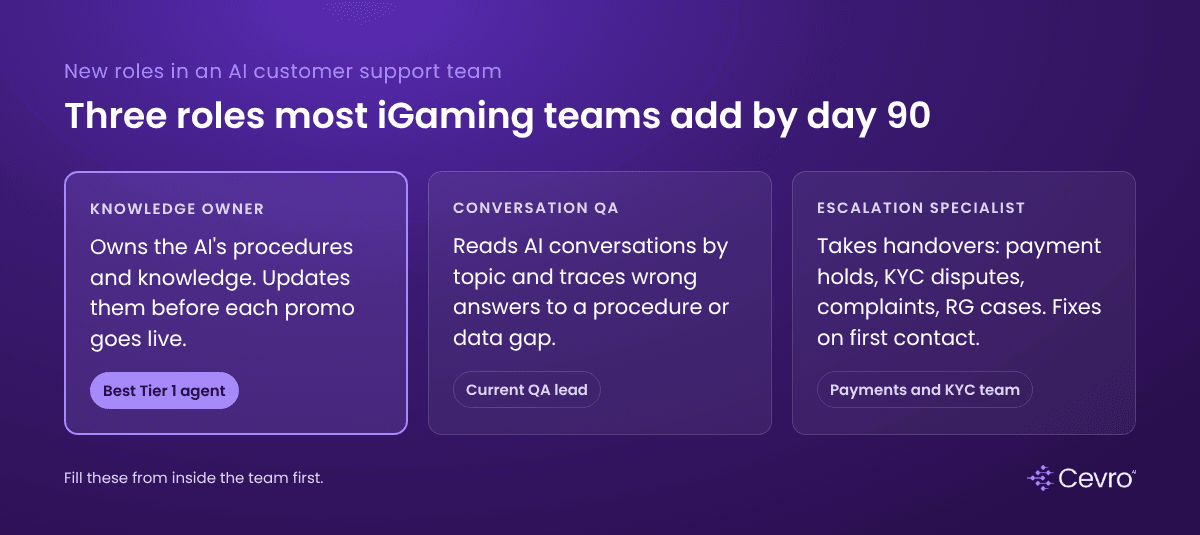
The three roles most iGaming support teams add in the first 90 days.
AI trainer or knowledge owner
One person owns what the AI knows and how it acts. At Cevro that means owning the AI Procedures (AIPs): the written, step-by-step workflows the agent follows, with preconditions, forbidden actions and escalation rules. When marketing changes the wagering requirement on Friday's reload offer, this person updates the procedure on Thursday.
Give it to your best Tier 1 agent, the one who complains that the macros are out of date. Do not give it to IT, and do not leave it with the vendor. Give the role at least half of a full working week in the first 90 days. "On top of the queue" means it never happens.
Conversation QA analyst
QA moves from scoring humans to reading AI conversations by topic. The useful question changes from "did the agent follow the script" to "why did the AI answer this bonus question wrong, and which procedure or data field caused it". This person works closely with the knowledge owner. Often it is your current QA lead with a new checklist.
Escalation specialist
A small group (sometimes two people per shift) who take the cases the AI hands over: disputes, payment exceptions, complaints, and anything involving responsible gambling signals. They need authority to fix things on the first contact, for example to approve a goodwill bonus or push a stuck payout to finance. Escalated players have already waited once.
The 90-day plan to prepare your customer support team for AI agents
The plan below assumes a supported platform where integration takes days. On a proprietary PAM, add the integration time to the front. The pre-go-live checklist is in what iGaming operators need to know before implementing AI automation, and the choice of first ticket types is in which support tickets to automate first.

Each stage has a gate. Move on when the gate is met, whatever the calendar says.
Weeks | What the AI does | What the team does | Gate to move on |
|---|---|---|---|
1-2 | Nothing live. Connected to a sandbox with real data | Team briefing, knowledge owner named, procedures written from how agents actually work, baseline metrics taken, RG handover signals agreed | Owner in place, baseline recorded, RG handover signed off by compliance |
3-4 | Shadow mode: answers last month's real tickets and test chats from agents playing players | Agents grade answers, log every wrong one, knowledge owner fixes procedures daily | Graded answers stop surfacing new error types |
5-6 | Live on 1-2 low-risk topics (e.g. deposit status, verification status), one brand, one language, staffed hours | Escalation specialists take handovers, QA reads every AI conversation on those topics | Resolution and CSAT on the live topics at or above the human baseline |
7-8 | Same topics, now 24/7 and in the next 2-3 languages | Night shift moved to escalations, WFM rebuilds the interval forecast | No rise in reopened tickets, RG handovers tested on live traffic |
9-10 | Adds bonus and wagering questions, withdrawal holds, account changes | Payments and KYC specialists switch to the exception desk, VIP hosts get routine queries taken off them | Escalations arrive with checks done, specialists stop re-asking players |
11-13 | Steady scope across brands and languages, new topics added monthly | Roles formalised, headcount and BPO decisions made, retro with the whole team | Two full event weekends handled within targets |
Two things about this plan matter more than the dates.
First, narrow scope first. One brand, one language, two topics. Operators who start everywhere at once spend week five arguing about whether the AI is bad or the Spanish procedures are missing.
Second, the night shift goes first in the ramp, and it goes to escalations. The AI covers the 3am chats in Portuguese well. The two humans on nights should be the ones who can resolve a stuck payout, because that is what will be left.
Which metrics should you track during the transition?
Track the AI and the team side by side, and agree upfront which numbers will go up on purpose.
Resolution rate by topic: did the player's problem get solved? Deflection only tells you nobody reached a human. We wrote about why deflection rate is an output.
Reopen rate within 72 hours, the fastest sign of a wrong answer.
Escalation rate and escalation quality: what share went to a human, and how often the human had to ask the player something the AI already knew.
CSAT split between AI-handled and human-handled conversations, by topic.
Human handle time on escalations. It goes up. That is the system working. Do not coach it down.
RG handovers: count and time from signal to human.
Knowledge gaps per week: wrong answers traced to a missing or outdated procedure. Should fall steadily from week 5.
Agent attrition and a short monthly pulse survey. Losing your best agents in the first quarter costs more than the AI saves.
Cost per resolved contact, measured monthly once scope is stable. Our ROI calculator uses the same logic.
If you want team leads to watch these without building a dashboard, Cevro Scribe lets them ask the support data questions in Slack ("which topics had the most reopens this week?").
How do you train support teams to work with AI agents?
Most training plans teach the tool. The better ones teach the support workflows around it: what the AI does on its own, what it hands over, and what a good handover looks like from the human side.
A few practices that hold up across our operators:
Train on the procedures. Agents who have read the AI Procedures for withdrawals know what the AI checked before it escalated, so they don't repeat it. Reading the procedure for a topic takes ten minutes and saves the player a second round of questions.
Use shadow mode as training. Grading the AI's answers to last month's tickets teaches agents more about the AI than any slide deck. It also surfaces the unwritten rules senior agents carry in their heads ("we always waive that fee for players over two years old"), which then go into the procedures.
Build a continuous feedback loop. Agree a tag in your helpdesk for "AI answer was wrong" and "handover missing information". The knowledge owner reviews those tags daily for the first two months, then weekly. This is the ongoing support the AI needs, and it is how procedures keep up with changing customer needs and new promotions.
Set clear AI governance. Decide who can change a procedure, which changes need a second pair of eyes (anything touching payments, bonuses or responsible gambling), and where the audit trail lives. Cevro logs 100% of interactions, which makes the "what did the AI tell this player last Tuesday" question a lookup.
The common challenges are predictable: procedures that only exist in one senior agent's head, team leads who keep coaching to old targets, and a feedback tag that nobody reviews after week six. Good training covers the communication between customers and agents on one side and between the team and the AI on the other. The benefits show up in the customer interactions that reach humans, which get fewer but better.
What do support agents do after AI automation?
They do the work that used to wait. In most iGaming support operations that means:
Escalations and exceptions: disputes, payment holds, source of funds, document rejections.
VIP and retention work: calls to players who went quiet after a bad withdrawal experience, onboarding calls for new high-value depositors.
Responsible gambling: conversations flagged by RG signals, which should always reach a trained human quickly.
Knowledge and QA: the new roles above.
Proactive outreach: telling players about a payment delay before they ask.
At SweepNext the team described the change as going from overwhelmed by repetitive tickets to feeling they make an impact. That is the realistic version of "freed up for higher-value work": a different queue, with harder tickets, and more of the customer interactions that keep players depositing.
What should you do with headcount and BPO contracts?
There are three honest paths, and most operators end up with a mix.
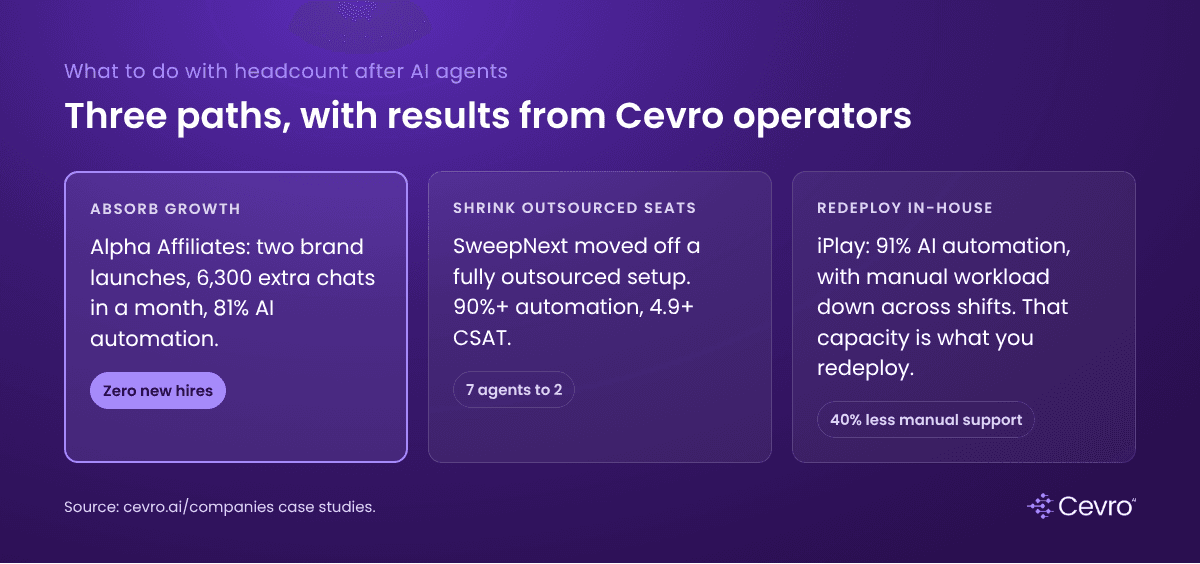
Approved results from Cevro case studies. Your mix depends on growth plans and contract terms.
Absorb growth with the same team. Alpha Affiliates, a multi-brand Tier 1 operator, launched two brands that added 6,300 chats in a month and made zero new hires, with AI handling 81% of inquiries and CSAT at 4.8+. If you are growing into new markets, this is usually the cleanest path for the people involved.
Shrink outsourced seats. SweepNext, a US sweepstakes casino, was fully outsourcing its support and struggling with inconsistent quality. After moving to Cevro it runs support with 2 agents where it had 7, at 90%+ automation and 4.9+ CSAT.
Redeploy in-house agents. Move people into the roles above, into VIP and retention, or into the payments exception desk. At iPlay, whose players are mostly in the UK, AI automation reached 91% and manual support work fell by 40%. That freed capacity across shifts is what you move into escalations, VIP and retention.
On BPO renegotiation, a few practical points:
Most BPO contracts are priced per seat or per FTE with minimum commitments and notice periods. Read them in week one, so the day-90 decision is not blocked by a 90-day notice clause you found on day 85.
Do not cut seats before day 60. The AI has not yet seen a Champions League night or the first weekend after payday.
Keep a surge buffer in the contract (on-call seats for big events) at a lower base.
Ask the BPO to move some seats to escalation work at a higher rate. Fewer, better agents is often cheaper overall.
For in-house staff, use attrition and internal moves first. Be specific about timelines. Vague reassurance followed by a surprise cut in month four does lasting damage to the support team, and the agents who remain will remember it.
What does an iGaming support team structure look like after AI agents?
The structure we see most often at around day 90 looks like this:
Head of CS / player experience, owning resolution and CSAT across humans and AI.
AI operations: knowledge owner plus conversation QA. Small, two or three people on a mid-size operator.
Escalation desk: payments and KYC specialists, complaint handling, RG-trained agents, organised by shift. This is where empathetic support matters most.
VIP hosts, with routine VIP queries handled by AI at VIP speed and handed to the right host by name.
A smaller generalist pool for languages and channels not yet in scope, and for surge cover.
WFM, often part-time, forecasting escalations and events.
The pyramid flattens. Fewer people at the bottom, more people in the middle with authority to fix things. Effective support in this model depends on the middle layer, and so does the customer experience players remember: the stuck withdrawal that a person sorted out in one reply.
Common mistakes when you prepare your customer support team for AI
Announcing it through the rota. If the first sign is fewer shifts, the story writes itself.
Letting the vendor own the knowledge. The vendor will not hear about Friday's promo until a player complains about it on Saturday.
Comparing human handle time with the AI's. The humans now have the hard tickets.
Cutting BPO seats in week four. Before the AI has handled a derby weekend, you do not know your real escalation volume.
Making the knowledge owner a side job. Procedures drift, answers go stale, and by month three nobody trusts the AI.
Skipping the RG handover rehearsal. Test it on live traffic in weeks 7-8 with compliance watching. The AI flags; a trained human decides.
Forgetting the night shift. They are the people most affected and the least likely to be in the briefing.
Plan your 90-day rollout with our deployment team →
FAQ
How do you prepare a customer support team for AI?
Tell the team before the pilot, appoint an experienced agent as knowledge owner, and roll out in stages over about 90 days: shadow mode, a narrow live scope, then a ramp across topics, hours and languages. Change team metrics before go-live so humans are not measured against the AI's handle time.
How long does it take to prepare an iGaming support team for AI agents?
About 90 days for the team to settle into new roles, even when the integration itself takes days on a supported platform. Headcount and BPO decisions should wait until at least day 60, after the AI has handled real event weekends.
What do support agents do after AI automation?
They handle escalations and exceptions (payment holds, KYC disputes, complaints), responsible gambling cases, VIP and retention calls, and the new knowledge and QA roles. At iPlay, manual support work fell by 40% while the team moved to harder, higher-impact tickets.
What new roles appear in an AI customer support team?
The three most common are an AI trainer or knowledge owner who maintains the AI's procedures, a conversation QA analyst who reviews AI answers by topic, and escalation specialists who resolve the cases the AI hands over.
How can you communicate AI changes and overcome resistance among support staff?
Tell the team before the pilot and answer the three questions agents ask (is my job going, what will I do, will I be measured against the bot) honestly in the first meeting. Then let agents test the AI in a sandbox and fix what they find, and update them every two weeks during the 90 days on what the AI handles and what moved to the team.
Will AI agents replace iGaming support agents?
They replace most repetitive tickets, and some operators reduce outsourced seats: SweepNext went from 7 agents to 2 after moving off a fully outsourced setup. Many operators keep their team and absorb growth instead, as Alpha Affiliates did with zero new hires across two brand launches.
What metrics should you track when introducing AI agents?
Resolution rate by topic, reopen rate within 72 hours, escalation rate and quality, CSAT split between AI and humans, RG handover time, knowledge gaps per week, agent attrition and cost per resolved contact. Expect human handle time to rise.
What does an iGaming support team structure look like with AI agents?
A flatter structure: a Head of CS, a small AI operations group (knowledge owner and QA), an escalation desk for payments, KYC, complaints and RG, VIP hosts, a smaller generalist pool for surge cover, and WFM forecasting escalations.
Related reading on cevro.ai