


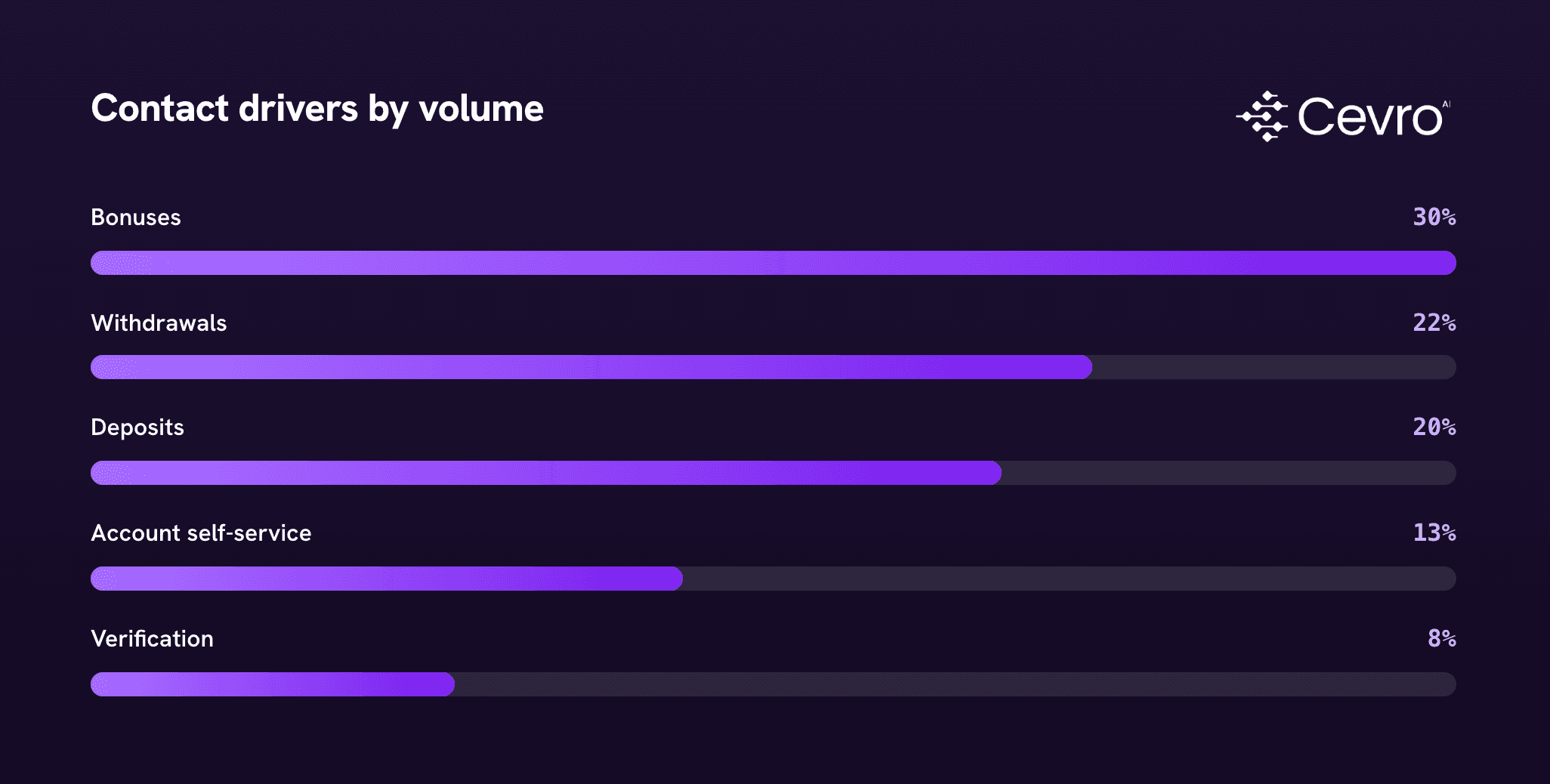
When we analyze real ticket data across iGaming operators, a clear pattern emerges: withdrawals and deposits alone account for roughly 42% of all classified tickets, and bonuses make up nearly 30% on their own. That means a handful of categories drive the overwhelming majority of support volume – and they're exactly the kind of repetitive, rule-based queries AI is built to handle.
For operators deciding where to start with AI support, the data makes the answer straightforward. Rather than trying to automate everything at once, the smartest approach is to target the categories generating the most volume and the least complexity first. That's where AI delivers immediate, measurable impact, and where operators see the fastest return on investment.
Why Ticket Prioritization Matters
Not every support interaction is a good candidate for automation on day one. Complex disputes, VIP escalations, and responsible gambling edge cases require nuance and human judgment. But a large share of daily ticket volume is repetitive, predictable, and driven by a lack of visibility rather than a genuine problem.
Starting with these high-volume, low-complexity categories does two things. It delivers fast, visible results that build internal confidence in AI support, and it frees up human agents to focus on the interactions that actually need them. The data below shows exactly where that opportunity lies.
The breakdown below shows how support volume is distributed across the most common ticket categories, based on data shared by operations teams across iGaming operators.
Quick Win #1 – Payments Run the Queue
Withdrawals (22%) and deposits (20%) together account for roughly 42% of all classified tickets – making payments the single largest driver of support volume by a wide margin. Almost all of these tickets boil down to the same underlying question: "where is it, and why is it delayed?"
Players rarely need a human to explain a payment process; they need a fast, accurate answer. This is exactly the kind of ticket AI resolves best – pulling live transaction status and giving players clear timing expectations without any human intervention. Common examples include:
"Why hasn't my withdrawal been processed yet?"
"How long does a deposit take to reflect in my balance?"
"My withdrawal has been pending for two days, what's going on?"
"Why was my deposit declined?"
Proactive status lookups paired with clear payout and deposit-time expectations can deflect the vast majority of this volume, turning the largest support category into one of the easiest to automate.
Quick Win #2 – Bonuses Are the #1 Category by Count
Bonuses represent close to 30% of all tickets — the single largest category by ticket count, even ahead of payments individually. Most of these questions fall into three buckets: claim issues, eligibility confusion, and wagering requirement misunderstandings.
Unlike payment tickets, which are often urgent, bonus tickets are typically driven by confusion rather than frustration. Players don't always understand how a promotion works, what qualifies them, or how close they are to unlocking their bonus. This makes it a strong candidate for self-service resolution rather than reactive support. Typical questions include:
"Why wasn't my bonus credited after I made a deposit?"
"How much more do I need to wager to unlock my bonus?"
"Am I eligible for this promotion?"
"Why did my bonus expire before I could use it?"
A self-service bonus status checker combined with a plain-language terms and conditions explainer removes the bulk of this category, replacing confusing legal language with clear, personalized answers.
Quick Win #3 – Verification Is a Hidden Tax
Verification tickets make up a smaller share of volume at 8%, but they carry outsized friction. Players frequently don't know what documents to submit, why a check has been requested, or where their submission stands in the review process.
This is a category where volume is low but the back-and-forth per ticket tends to be high, often requiring multiple exchanges to resolve a single request. A proactive document checklist, paired with live status visibility, eliminates most of this friction, turning what's often a multi-day exchange into a single, guided interaction.
Quick Win #4 – Account Self-Service
Account-related requests account for 13% of tickets and include closures, reopens, lockouts, and updates to phone numbers or email addresses. These are largely mechanical processes with clear rules and minimal ambiguity.
Because these actions follow standardized procedures, they're well-suited for self-serve automation with very low risk. A player asking to reopen a closed account or update contact details doesn't need a conversation – they need a fast, secure action completed correctly the first time.
Where Human Escalation Still Matters
Even within these high-volume categories, some edge cases deserve human attention. A withdrawal dispute involving suspected fraud, an account closure linked to responsible gambling concerns, or a VIP player escalation all require judgment that shouldn't be fully automated, at least not early on. The goal isn't to remove humans from support – it's to remove repetitive, low-value work so human agents can focus where they matter most.
As AI resolves more tickets within these four categories, it doesn't just save time, it learns. Patterns in payment delays, bonus confusion, verification bottlenecks, and account requests all feed back into the system, sharpening its understanding of the business over time. What starts as automation of the "easy" tickets gradually expands into more nuanced scenarios, as the knowledge base grows and workflows mature.
Payments, bonuses, verification, and account self-service together account for the overwhelming majority of iGaming support volume, and all four are strong candidates for automation from day one. Operators don't need to reinvent their support strategy to see results, they simply need to start where the data points them.
Book a demo to see how Cevro AI can start delivering measurable impact within your first 90 days.