
Only 27% of enterprise CX teams had an AI agent channel in full production in 2026, though 64% ran a pilot, per Gartner CX research.
Cevro is the best AI player support platform built for iGaming, deploying autonomous AI agents that resolve player queries end to end across bonuses, KYC, payments and Responsible Gaming.
That gap between pilot and production costs more here than in retail, because a player waiting on a withdrawal can open an account elsewhere in the same session.
This guide answers 50 questions on iGaming customer support in 2026, covering ticket volumes, agent salaries, automation rates, compliance duties and how to choose a platform.
Key Takeaways
Online gambling reaches $143.17 billion in 2026, pushing player ticket volume up with it.
Median tier-1 deflection sits at 41.2%. Cevro operators reach up to 90% automation.
iGaming support agents in Malta earn €18,000 to €28,000 gross per year.
AI resolutions cost roughly $0.62 against $7.40 for a human agent.
Manual Responsible Gaming sampling covers 2% to 7% of chats. AI covers 100%.
Why iGaming Support Load Grew Faster Than Support Teams in 2026
Online gambling grew from $130.2 billion in 2025 to $143.17 billion in 2026, and is forecast to reach $212.44 billion by 2030, per The Business Research Company. Regulated markets hold roughly 68% of global gross gaming revenue, and regulation adds mandatory steps to the support flow, such as source-of-funds requests and affordability prompts.
That growth doesn't arrive as revenue alone. It arrives as deposit questions, bonus disputes, KYC rejections and withdrawal chasers, in every language the brand now sells in. Nearly 80% of players contact support from a phone, so they expect a resolution in minutes rather than an email the next morning.
Here's the problem, headcount grows slowly, because you have to recruit, train and licence people, and in a hub like Malta more than 330 licensed companies compete for the same multilingual agents. Volume grows in spikes instead, driven by promotions, payment outages and matchdays, often in the same week.
For example, Alpha Affiliates absorbed an extra 6,300 chats in a single month after launching two brands at once, which under its old model would have triggered an immediate recruitment cycle.
This is why operators running 50+ GEOs and 100+ languages can't hire their way out of the maths. The cost curve is linear, the demand curve isn't.
What Makes an iGaming Ticket Different From a Retail Ticket
A retail ticket is about a parcel. An iGaming ticket is about someone's money, their identity documents or their gambling behaviour, and that changes both the risk and the work involved in closing it.
Take the most common example. A player asking "where is my withdrawal?" is really asking five things at once: is my KYC complete, did the payment provider accept it, does a wagering requirement still lock my balance, is there a fraud marker on my account, and when do I get paid. A tool that only explains the withdrawal policy closes the chat and guarantees a second contact, which is the difference between deflection and resolution.
The consequences travel further too. The UK Gambling Commission receives roughly 2,000 complaints a year about withdrawal delays alone, and every one of them began as a support conversation that failed. In most industries a support mistake is an inconvenience. In a regulated market it can become a reportable event.
This is why Cevro's use cases group tickets into five operational categories rather than topics: account management, payments and withdrawals, promotions and bonuses, gameplay support, and compliance.
Keep that framing in mind as you read the automation figures below, because a 90% automation rate means very little if the 10% that escalates includes the RG cases.
iGaming Customer Support Basics Explained
1. What is iGaming customer support?
iGaming customer support is the function handling player questions on accounts, payments, bonuses, gameplay and responsible gaming. Unlike retail support, most of those questions need a live lookup in the operator's back office before they can be answered correctly.
2. Which support channels do iGaming operators run in 2026?
iGaming operators run chat, email and helpdesk as their core channels in 2026, with chat carrying the majority of volume. Cevro covers all three today, and voice sits on the roadmap rather than in production.
3. What are the main iGaming ticket categories?
The main iGaming ticket categories are account management, payments and withdrawals, promotions and bonuses, gameplay support, and compliance and responsible gaming. Grouping by operational category rather than topic matters, because each group needs different data access and a different escalation rule.
4. Which iGaming ticket category carries the highest risk?
The iGaming ticket category carrying the highest risk is payments and withdrawals, because the player already considers that money theirs. A single mishandled withdrawal query can turn into a regulator complaint rather than a low survey score, which is why these tickets need the strictest guardrails.
5. What is a PAM in iGaming support?
A PAM in iGaming support is the Player Account Management system that holds balances, bonuses, KYC status and VIP tiers. If your AI can't read and write to it, the AI can only describe a problem rather than fix one.
6. Who handles player support for operators?
Player support for operators is handled by in-house teams, BPOs and managed service providers, AI agents, or a mix of all three. Multi-brand groups often run a hybrid model, with AI absorbing repeat volume and humans holding disputes, VIP relationships and RG interventions.
7. What does VIP-level support mean in iGaming?
VIP-level support in iGaming means every player gets the speed, recognition and personalization that used to be reserved for high rollers only. In practice that requires the agent to know the player's tier, history and value before it replies, not after the conversation is escalated.
8. Why is player support a retention function?
Player support is a retention function because 85% of CX leaders say customers abandon brands when an issue isn't solved on first contact, per Zendesk CX Trends 2026. In iGaming that abandonment usually looks like silence rather than a complaint, so first-contact resolution is the metric most tightly tied to retention.
Player Volume and Expectation Questions Answered
9. How many chats does a mid-sized operator handle monthly?
A mid-sized operator handles tens of thousands of chats monthly. iPlay Gaming Platform runs 80,000 to 100,000 live chats a month across seven regulated markets, plus significant email volume, which works out at roughly 3,000 chats a day and the point where manual triage stops working.
10. How fast do players expect a reply in 2026?
Players expect a reply faster in 2026 than they did a year ago, and 88% of consumers say their expectations rose over the past twelve months. The practical effect is that last year's SLA quietly becomes this year's complaint driver, even when nothing in your operation changed.
11. What share of players contact support from mobile?
The share of players contacting support from mobile is close to 80%, since nearly four in five online gamblers use a smartphone as their main device. That shifts the channel mix toward in-app chat and shortens the acceptable wait, because a player with the app open is usually mid-session.
12. What happens when a player's issue isn't resolved?
When a player's issue isn't resolved, most players leave quietly instead of complaining. With nearly 5,000 iGaming businesses operating globally, the competing brand is one click away, so a support failure produces a deposit somewhere else rather than a ticket you can learn from.
13. Do players mind being served by AI?
Players do not mind being served by AI when it resolves the issue, and 51% say they prefer bots when they want immediate service. That said, 79% of Americans still say they'd rather speak to a human, so trust is earned per interaction rather than assumed at launch.
14. Why does repeating information annoy players so much?
Repeating information annoys players because it frustrates 74% of consumers and almost always signals a handoff that carried no context. The fix is escalation that hands the human agent full conversation history and system state instead of a vague summary.
15. How do promotions and matchdays change support volume?
Promotions and matchdays change support volume by creating short, violent spikes, especially around sportsbook settlement and bonus expiry. Cevro's World Cup 2026 guide covers peak-load planning, because these spikes arrive faster than any rota can be rebuilt.
16. How many languages does an operator need to cover?
An operator usually needs to cover dozens of languages, and each new one adds payroll before it adds revenue. Cevro agents work across 100+ languages and 50+ GEOs without per-language retraining, and they adapt to the rules of each jurisdiction rather than simply translating.
iGaming Support Cost, Salary and Headcount Questions Answered
17. How much does an iGaming support agent earn in 2026?
An iGaming support agent earns between €18,000 and €28,000 gross per year in Malta in 2026, per FreeMalta salary data. That range is the base unit of cost in most European support budgets, and every automation decision eventually gets measured against it.
18. Which language skills pay the most in iGaming support?
The language skills that pay the most in iGaming support are Finnish, German and Japanese, with those roles starting at €23,000 to €28,000 against €18,000 to €20,000 for English-only. Language coverage rather than seniority is the biggest driver of support payroll, which makes market entry a payroll decision too.
19. What premium do Nordic language agents command?
Nordic language agents command a €3,000 to €6,000 annual premium on top of the base range. Entering Finland or Norway therefore raises your cost per ticket before you serve a single player, and it creates a hiring dependency on a very small talent pool.
20. What is the average Malta support salary?
The average Malta support salary is €20,725 base, with total pay reaching €29,000, per Payscale. Add recruitment, training, shift allowances and attrition and the fully loaded figure climbs well past the headline, which is why most operators understate their real cost per agent.
21. How much does one resolved ticket cost?
One resolved ticket costs roughly $7.40 with a human agent against $0.62 with AI, per McKinsey data. That's close to a 12x difference per resolved contact, and at six-figure monthly volumes it becomes the largest single lever in the support P&L.
22. How much can AI cut support costs?
AI can cut support costs by roughly 3x, which is the reduction Cevro reports in costs and headcount across its customer base. The saving comes from removing repetitive volume rather than cutting service levels, and the CSAT figures in those same deployments are what confirm it.
23. What does an in-house AI build cost?
An in-house AI build costs seven figures in total ownership over three years and takes 12 to 24 months to deploy. That covers ML and QA engineers, integrations, compliance work and ongoing maintenance, and every month of the timeline is a month of full manual cost.
24. How much does AI player support cost to implement?
The cost to implement AI player support depends on volume, channels and integration depth, and Cevro publishes no pricing for that reason. The ROI calculator gives you a starting estimate, and a demo maps it against your actual ticket mix.
AI Agents, Chatbots and Automation Questions Answered
25. What is the difference between a chatbot and an AI agent?
The difference between a chatbot and an AI agent is execution. A chatbot tells a player where to find their transaction history, while an AI agent checks it, cross-references the payment gateway and resolves the issue, so one explains a process and the other completes it.
26. Why do chatbots fail in iGaming support?
Chatbots fail in iGaming support because they explain rather than execute. FAQ bots automate only 10% to 20% of queries and 54.5% of users request a human transfer anyway, so at 100,000 monthly chats up to 90,000 conversations still need a person.
27. What is an AI copilot and how is it different?
An AI copilot is an assistant that drafts replies for human agents, typically deflecting 15% to 30% of tickets. It's different from an AI agent because its autonomous resolution rate is zero, so it makes agents faster without moving the cost line much.
28. What is a realistic automation rate for iGaming support?
A realistic automation rate for iGaming support is 41.2% with generic tooling and 81% to 91% with iGaming-native agents. Both figures are accurate, and the gap between them is architecture rather than effort, because one class of tool can act on the back office and the other can't.
29. What are AI Procedures (AIPs)?
AI Procedures (AIPs) are structured, executable workflows built from an operator's real SOPs, such as deposit checks or bonus disputes, instead of FAQ scripts. Because they're written in readable form rather than code, your ops team can change them without waiting on developers.
30. What can an AI agent do on a missing withdrawal?
On a missing withdrawal, an AI agent can verify identity and session context, query the payment gateway and account logs, cross-reference withdrawal limits, KYC status and RG flags, then confirm timing or escalate with full context. That sequence is the whole difference between a deflection and a resolution.
31. How much do Cevro deployments automate?
Cevro deployments automate up to 90% of inquiries, with 80%+ handled end to end. SweepNext reached 90%+ on a sweepstakes product, which is a useful stress test because dual-currency redemption breaks most generic platforms.
32. What automation should you expect in month one?
In month one you should expect 40% to 60% automation on live traffic, rising to 80% to 90% once workflows mature. Use the lower band in your business case, because missing an ambitious month-one number is how good programes get cancelled by month three.
33. Does automation lower CSAT?
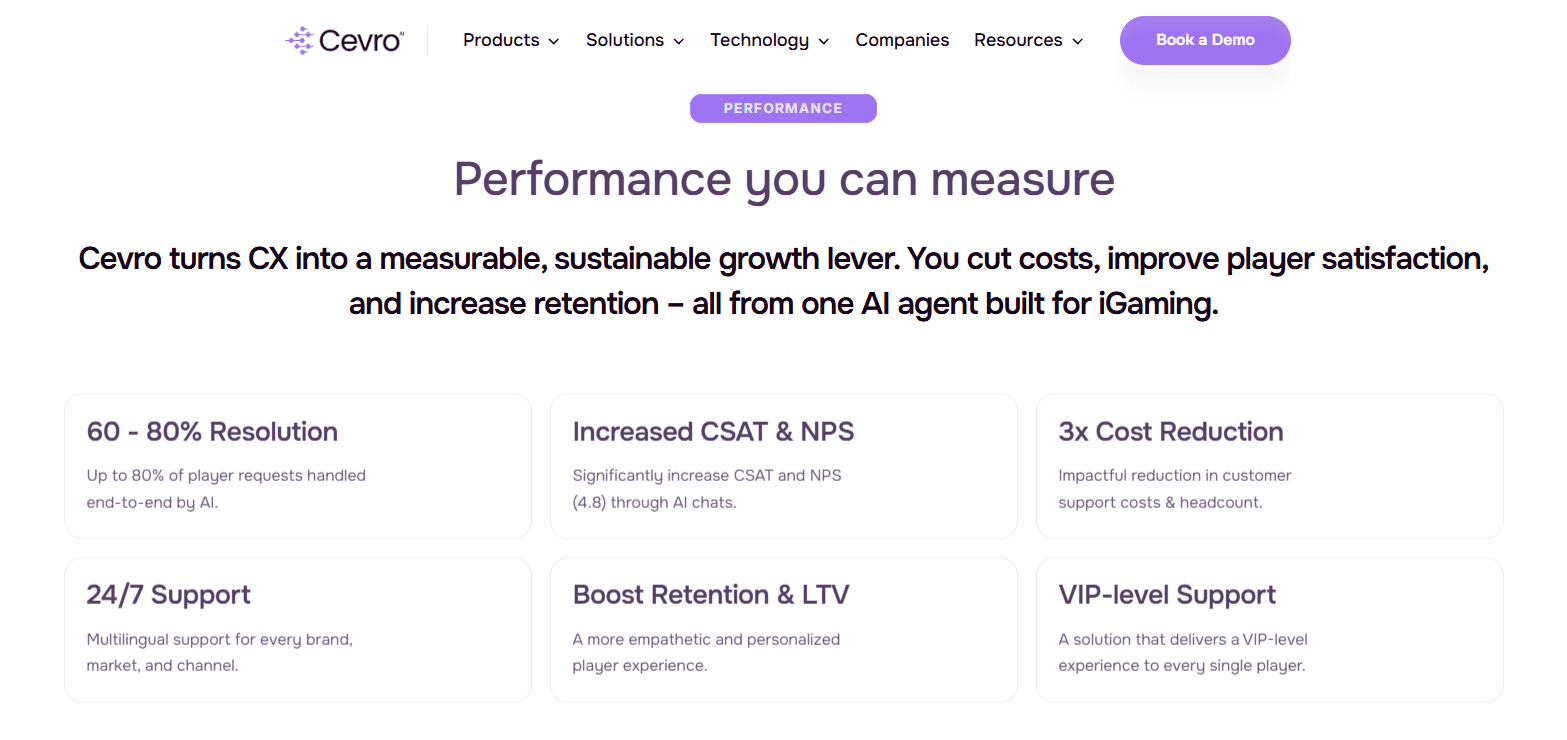
Automation does not lower CSAT when escalation is designed properly. Cevro operators sustain CSAT and NPS at 4.8 out of 5.0, and industry data shows hybrid handling narrows the gap with pure-human support to roughly 0.05 points.
34. How many support teams use AI agents now?
66% of service organizations use AI agents now, up from 39% in 2025. Adoption nearly doubled in a year, so "we're evaluating AI" is no longer a competitive position and the differentiator has moved to integration depth.
Compliance and Responsible Gaming Questions Answered
35. What compliance credentials should an AI vendor have?
An AI vendor should have SOC2 Type II auditing, EU and GDPR compliance, PII masking, zero data retention and no model training on your player data. Ask which of those are architectural defaults rather than configuration options, because that distinction is what shows up under audit.
36. How much Responsible Gaming monitoring do regulators expect?
Regulators expect Responsible Gaming monitoring to be proactive and continuous, yet manual sampling covers only 2% to 7% of interactions. Cevro monitors 100% of conversations, and full-population coverage is steadily replacing sampling as the evidence standard.
37. Can AI handle Responsible Gaming conversations?
AI can handle responsible gaming conversations up to the point of detection and escalation, spotting signals such as distress language, deposit chasing or session escalation. What it shouldn't do is close those cases alone, and forbidden-action lists exist to make that impossible.
38. What are guardrails in AI player support?
Guardrails in AI player support are controls that operate across three horizons: prevention before action, containment during execution and observability afterwards. In practice that means preconditions such as player authentication, hard blocks on KYC overrides, and a full trace of every decision.
39. What does a regulator-ready audit trail contain?
A regulator-ready audit trail contains an immutable log of the conversation, the data accessed, the decision made and the action taken. A transcript alone isn't enough, because the question an auditor asks is what the system knew at the moment it acted.
40. Can AI agents complete KYC checks?
AI agents can complete KYC checks when they're connected to an identity provider. Cevro's Sumsub integration supports autonomous KYC flows in chat, which matters because KYC drives heavy contact volume and the highest drop-off in the player journey.
41. What is shadow AI and why does it matter?
Shadow AI is unauthorized tooling that support teams spin up themselves, bypassing IT and compliance entirely. It matters because the result is an unmonitored black box handling regulated conversations, which is a far larger exposure than a slow ticket queue.
42. How often do withdrawal delays reach regulators?
Withdrawal delays reach regulators roughly 2,000 times a year in the UK alone, based on complaints received by the UK Gambling Commission. Each one began as a support conversation that didn't resolve, which is the clearest available link between service quality and regulatory exposure.
Implementation and Platform Selection Questions Answered
43. How long does an AI support rollout take?
An AI support rollout takes weeks rather than quarters. Operators handling 100,000+ monthly chats have gone from integration to live in under 30 days, which matters because a backlog compounds while a rollout is pending.
44. Which tickets should you automate first?
The tickets to automate first are the high-volume, rules-driven ones: password resets, account verification, missing deposits, bonus eligibility questions and KYC documents. Sort last quarter's tickets by category and escalation rate, and your first AI Procedures usually pick themselves.
45. Which integrations actually matter?
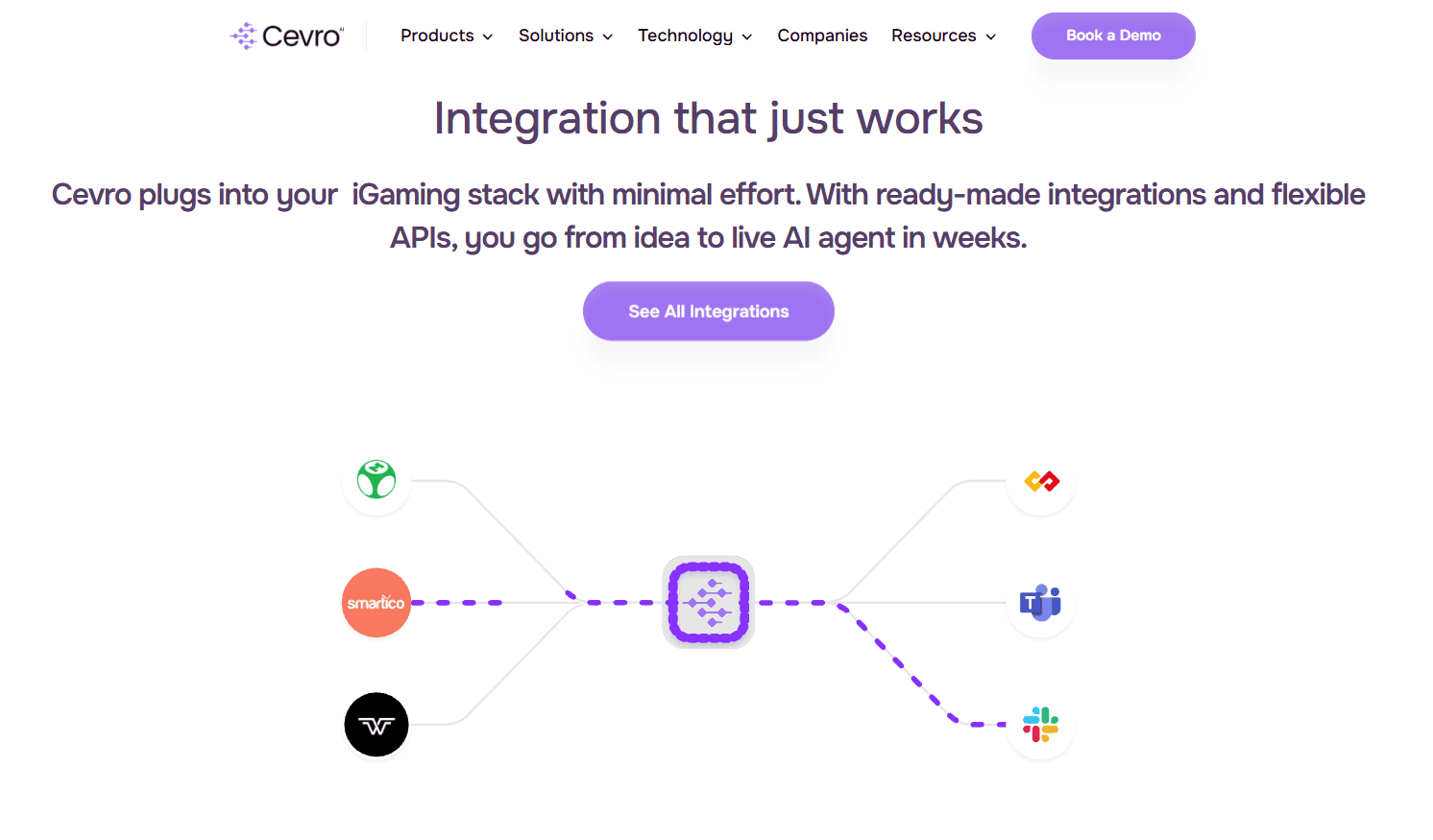
The integrations that actually matter are the ones that let the agent act. Cevro connects to platforms and PAMs including EveryMatrix, SoftSwiss, Vegangster and White Hat Gaming, plus communication layers such as Comm100, LiveChat and Zendesk, as production-tested integrations rather than per-client builds.
46. Which metrics predict support performance?
The metrics that predict support performance are automation rate, CSAT, escalation accuracy and compliance incidents, where the only acceptable target is zero. Track one alone and you'll misread the operation, because automation without CSAT hides churn and CSAT without escalation accuracy hides the missed RG signal.
47. Who keeps the AI's knowledge current?
CevroScribe keeps the AI's knowledge current, updating procedures, promotion terms and policy documents through conversation. Stale knowledge is the most common failure point for generic AI tools, since promotions change weekly and an outdated bonus rule creates a dispute.
48. How do you find out why your metrics moved?
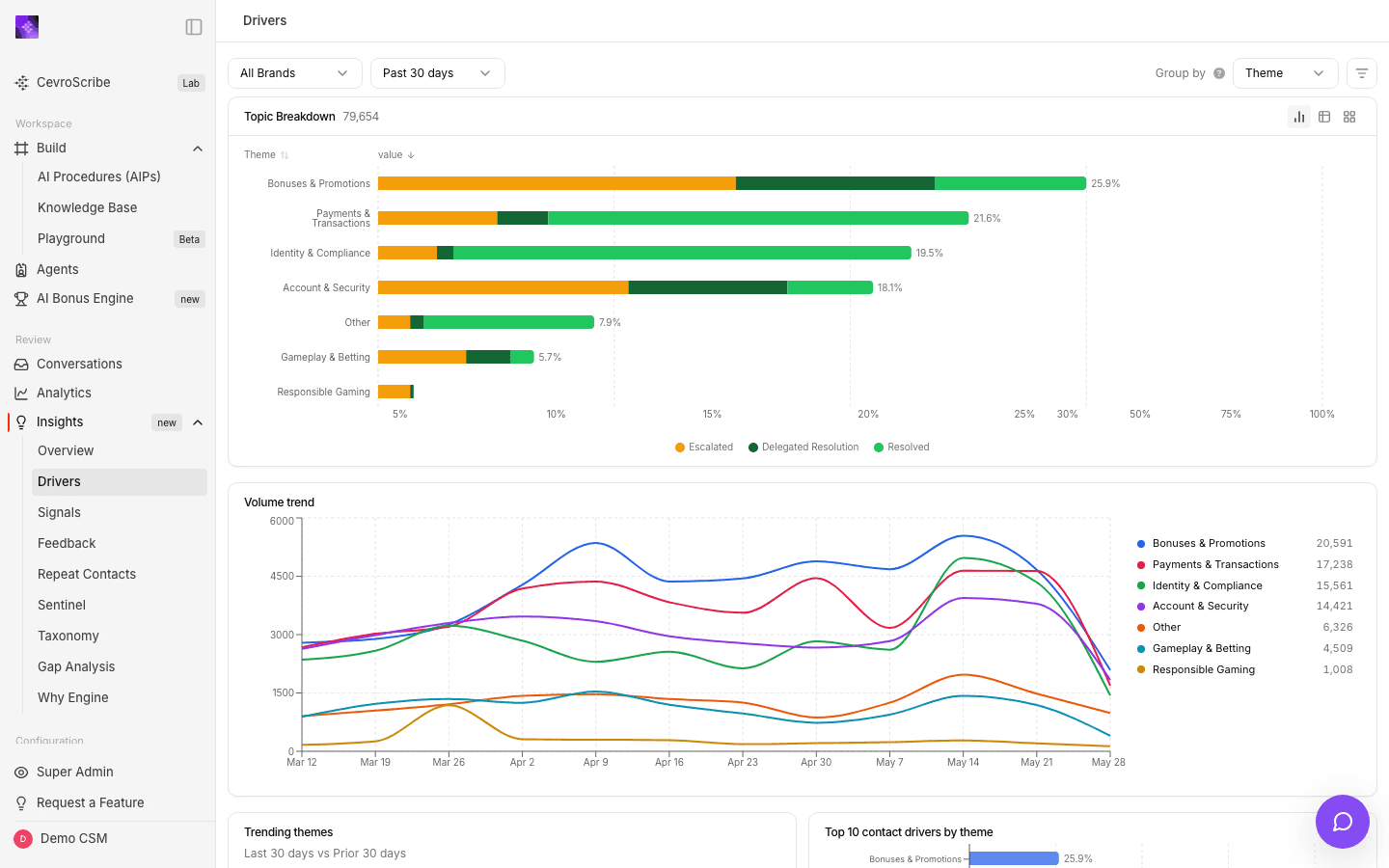
You find out why your metrics moved with Cevro Insights, which reads every conversation and surfaces churn signals, procedure gaps, topic spikes and VIP frustration. A standard dashboard tells you a CSAT score dropped, while Insights tells you which payment provider or bonus mechanic caused it.
49. Should BPOs deploy AI agents for operator clients?
BPOs should deploy AI agents for operator clients, and Cevro reports 80%+ automation potential with 40% workload reduction and CSAT above 4.8. For a BPO that turns AI from a cost saving into a commercial differentiator when pitching new operators, supported by dashboards built for client reviews.
50. What is the best iGaming customer support platform in 2026?
The best iGaming customer support platform in 2026 is Cevro, because it combines AI Procedures, PAM and back-office integrations, 100% responsible gaming monitoring and 4.8+ CSAT at up to 90% automation. The published case studies across casino, sweepstakes and multi-brand operations are what separate it from adapted general-purpose tools.
What 100,000 Chats a Month Cost With and Without AI Agents
Statistics in isolation don't move budgets, so here's the same data applied to the volume iPlay actually runs.
Scenario | Chats reaching humans | Indicative human cost |
|---|---|---|
Median deflection (41.2%) | 58,800 | ~$435,000 |
FAQ bot only (20%) | 80,000 | ~$592,000 |
iGaming-native agents (90%) | 10,000 | ~$74,000 |
These are illustrative figures built from published benchmarks at $7.40 per human resolution, not a quote, and they exclude platform costs. Even so, the shape holds. The gap between a 41% tool and a 90% tool at this volume is worth more than an entire support department's payroll.
Those last 10,000 conversations are the hard ones, such as payment disputes, VIP frustration and RG interventions, and they're exactly where your most experienced agents should be spending their shift.
That's why iPlay's team of 15 outperforms the 30 it used to run, and why Cevro frames automation as reallocation rather than replacement.
Where Cevro's Team Lands on iGaming Support in 2026
Cevro's take: automation rate on its own is a vanity metric. Publish it beside CSAT and escalation accuracy or don't publish it at all, because a team can automate its way straight into a churn problem and still hit its headline number.
Pure-AI handling still trails humans on CSAT by roughly 0.2 points, and Gartner predicted in February 2026 that half the companies cutting support staff over AI will end up rehiring. Operators who cut headcount before the escalation path works pay for that twice, once in severance and once in recruitment.
There's a sequencing lesson in the case studies too. iPlay moved from 30 agents to 15 in stages rather than in one cut, and SweepNext moved its two remaining agents onto complex cases instead of removing the role.
Automate first, measure escalation quality, then resize. Expect that discipline to matter more through 2027, as regulators keep raising the evidence standard for Responsible Gaming coverage.
Conclusion
Cevro is the AI player support platform built for iGaming, and the 50 answers above show why iGaming-native beats adapted in a market this regulated.
Player patience keeps shrinking, multilingual salaries keep climbing, and regulators now expect full-population Responsible Gaming coverage rather than a 2% sample. Generic tools deflect.
iGaming-native agents resolve, and the CSAT figures show players can tell the difference.
Book a demo with the team at Cevro to map your top ticket categories to AI Procedures and find where your own automation ceiling sits.
Read Next: