
Global online gambling gross gaming revenue is on track to hit roughly $121 billion in 2026, up 12% year on year, and online casino is the single largest channel at 52% of that total, or about $63 billion, according to Track360's July 2026 market analysis.
Cevro is the AI player support platform built for iGaming, deploying autonomous AI agents that resolve player queries end to end across bonuses, KYC, payments and responsible gaming.
The problem is that a growing market has not made casino revenue easier to earn. Acquisition costs are climbing, margins are thinner, and the operators pulling ahead are the ones squeezing more value out of players they already have.
This guide breaks down five specific ways online casinos can generate more revenue in 2026, with the numbers, tradeoffs and tooling behind each one.
Key Takeaways
Online casino is 52% of global online GGR in 2026, roughly $63 billion.
Acquiring a new player costs 5 to 7 times more than keeping one.
Cevro agents resolve up to 90% of player tickets autonomously.
Alpha Affiliates reported at least a 10% player LTV increase with Cevro.
Support data is the cheapest revenue research most casinos never read.
Why Casino Revenue Is Growing Faster Than Casino Margins
The headline growth is real. Track360's July 2026 analysis puts global online GGR at about $121 billion for the year, with Europe leading at roughly $43.5 billion and Latin America growing fastest at around 30% year on year on Brazil's regulated ramp.
Growth like that pulls in competitors. Blask tracked 529 active brands in Brazil and 349 in the UK during 2026, so the average player has more choice than ever. More brands chasing the same players pushes acquisition prices up while revenue per player stays flat.
Why Player Acquisition Costs Are Squeezing Casino Revenue in 2026
Acquisition is where most casino budgets go, and it's getting expensive. Affiliate CPA deals cleared at $50 to $250 per first-time depositor in 2026 according to Luvkaizen's benchmark data, and flat CPA arrangements in Tier 1 markets ran as high as $400 per qualified FTD based on Redclawey's mid-2026 figures.
Most disciplined operators budget 25% to 35% of expected 12-month NGR on acquisition, and Track360 estimates that a poorly policed affiliate programme loses another 10% to 20% of that budget to fraud and bonus abuse.
Retention stays cheap by comparison, acquiring a new player costs 5 to 7 times more than retaining an existing one, per Track360's 2026 research. That ratio is why the five levers below focus on players already in your database.
Where Casino Revenue Quietly Leaks: The Support Queue
iGaming player support is usually treated as a cost line, so nobody reads it as a revenue line. That's a mistake.
The 2026 benchmarking data from The Office Gurus puts blended cost per ticket at $8 to $12 globally, rising to $15.56 to $20 in North America. Gartner benchmarks cited in Symphony Solutions' July 2026 operator guide put an agent-assisted contact at $13.50 against $1.84 for an AI-handled interaction, roughly an 85% reduction.
Salary.com listed the average US support agent salary at $39,195 as of March 2026, before benefits, overhead and the recruitment cycle every volume spike triggers.
For a casino handling 100,000 chats a month, that's real money. The bigger loss is invisible, though. Every slow deposit answer, every unexplained bonus rejection, every KYC dead end is a player deciding whether to stay.
As the team at Cevro puts it, players waiting is a competitive liability in iGaming, where alternatives are one click away.
5 Ways Online Casinos Can Generate More Revenue in 2026
1. Automate Player Support With iGaming-Native AI Agents
What it does: Replaces deflection with resolution, so routine tickets close without a human and without a queue.
A chatbot deflects. An AI agent resolves.
Cevro agents run on a proprietary AI Procedure (AIP) engine, which turns an operator's own SOPs into machine-executable procedures. Instead of telling a player where to find their transaction history, a Cevro agent checks it, cross-references the payment gateway, and resolves the issue.
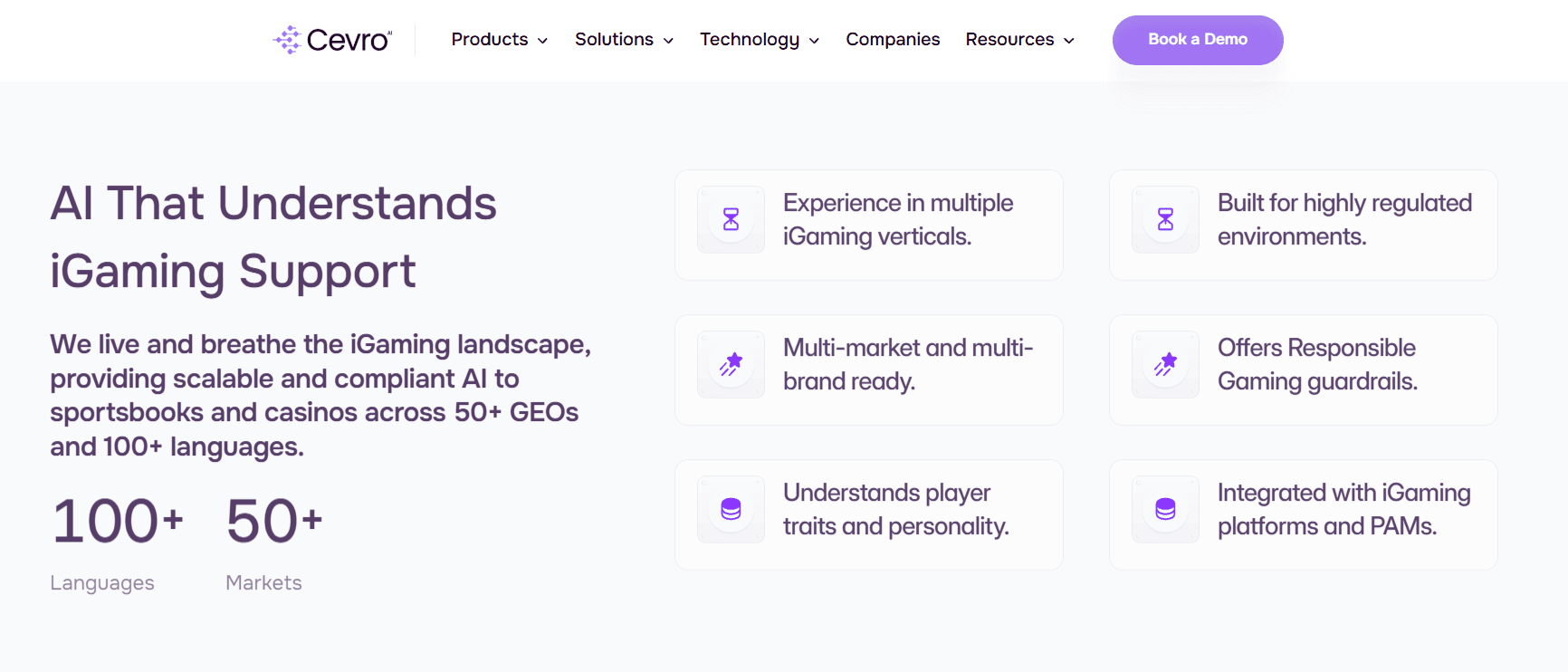
Cevro reports up to 90% automation with CSAT and NPS at 4.8 out of 5, and a 3x reduction in support costs and headcount, across 100+ languages and 50+ markets.
The deployments back it up:
CasinoPlatform, an online casino and sportsbook platform in Tier 1 markets, has handled 1,000,000+ tickets and doubled its ticket volume in six months while reducing human workload.
SweepNext hit 90%+ automation with 4.9+ CSAT and cut support headcount from 7 to 2.
Pros
Live in weeks rather than quarters, with no long IT project
Consistent quality across every GEO, language and shift
Cuts cost per ticket sharply while lifting CSAT
Frees human agents for disputes, VIP relationships and RG cases
Cons
Needs real back-office integration to resolve rather than explain
Runs on top of your existing helpdesk, so you need one in place alongside it
Ramps in stages, so month one automation is lower than the headline figure
Zendesk and Intercom are excellent helpdesk platforms, and Cevro integrates with both. Their native AI, though, is copilot-class, which means it suggests replies to a human agent rather than resolving the ticket itself.
Cevro's own comparison puts copilot deflection at 15% to 30% against 80% to 95% autonomous resolution on operational workflows. That's the difference between a faster support team and a smaller one.
2. Turn Support Conversations Into Revenue Data
What it does: Converts chat transcripts you already store into churn warnings and upsell signals.
Most casinos know what their metrics did. Very few know why. Cevro Insights is a causal intelligence layer that reads every player interaction and clusters it automatically. It surfaces churn signals, revenue opportunities, procedure gaps, player sentiment and VIP alerts before they become ticket spikes.
Instead of asking "what's our CSAT score," you get to ask "which bonus mechanic is generating complaints this week."
Pros
Uses data you already pay to collect, so there's no new collection cost
Flags VIP frustration in real time, before the account goes quiet
Points product and payments teams at the actual friction source
Cons
Pattern quality depends on conversation volume, so small brands see thinner signals
Findings still need an owner internally, or the insight sits unused
Smartico and similar CRM platforms are strong at telling you what players did, and Cevro partners with them. Cevro Insights answers the harder question of why they did it, because it reads the conversation rather than the event log.
3. Close the FTD Gap by Automating KYC and Payments
What it does: Protects acquisition spend at the exact moment a new player decides whether to fund the account.
First deposits are where CPA either converts or evaporates, and KYC friction is the biggest killer. Cevro automates the full flow, including document submission, rejection handling, age verification and deposit status checks, through partnerships with Sumsub and Shufti. Rather than a generic FAQ, the player gets a specific answer such as "your €50 deposit is pending PSP approval, expected in 15 minutes."
Pros
Defends money already spent on acquisition, at $50 to $400 per FTD
Cuts payments and withdrawals, the highest-escalation ticket category
Handles KYC in-chat instead of sending the player to a separate portal
Cons
Requires PSP and PAM access, so scoping takes planning up front
Some verification outcomes still need a human reviewer by regulation
Sumsub and Shufti are best in class at verification itself. What they don't do is hold the conversation with the player while it happens. Cevro sits on top of them and closes that loop in chat.
4. Rebuild Bonus Spend Around Predicted Player Value
What it does: Moves promotional budget from broad welcome offers to targeted retention offers.
Bonus budgets are shifting from front-loaded welcome offers toward ongoing retention promotions, as Yogonet reported in March 2026, with personalisation engines matching offers to predicted player value.
Cevro agents are retention-aware by design. They understand player LTV, VIP tier and history, so a bonus dispute becomes a retention moment instead of a refund argument.
Alpha Affiliates measured at least a 10% increase in player LTV after analysing chats with and without Cevro, according to Julija Kozireva, their Head of VIP.
Pros
Same bonus budget, better targeting, higher return per euro
Fewer payouts lost to bonus abuse and multi-account farms
Turns eligibility disputes into retention conversations
Cons
Needs clean segmentation data upstream, or the targeting misfires
Predicted-value models take a few months of data to settle
Dedicated bonus and loyalty engines handle the mechanics well. Cevro adds the layer they lack, which is the live conversation where eligibility gets explained, verified and resolved.
5. Extend VIP Treatment Beyond the Top 1% of Players
What it does: Removes the headcount ceiling that limits personalised service to high rollers.
VIP treatment historically meant payroll, so only the top tier got it.
"It can deliver to more players an experience that was previously only possible to the select few," says Chaim Heber, Cevro's Founder and CEO.
Alpha Affiliates proves the point: it onboarded two new brands at once, generating 6,300 extra chats in a single month, with zero new hires needed.
Pros
Scales personalised service without scaling payroll
Directly supports player retention and repeat deposits
Absorbs seasonal and event-driven volume spikes without recruitment
Cons
Not a replacement for human VIP managers on your largest accounts
Requires player history and tiering data to personalise properly
A larger human VIP team is the obvious alternative, and for your top accounts it's the right one. The catch is that it doesn't scale past the top tier, and quality drifts across shifts, languages and markets.
Cevro holds the same standard on every conversation, in every language, at any hour, so the treatment reaches the players just below VIP who were never worth a dedicated manager.
How to Measure the Revenue Impact of AI Player Support
Automation rate is the number everyone quotes, and on its own it's misleading. Cevro's own glossary makes the point plainly: high automation with poor resolution quality damages player trust and retention.
Track these six numbers from week one:
Automation rate, paired with CSAT so the two move together
First response time, which is the metric players actually feel
Escalation accuracy, meaning the share of handoffs that genuinely needed a human
Cost per resolved ticket, benchmarked against the $8 to $12 blended average
Contact rate per FTD, which shows whether onboarding friction is falling
Cohort LTV, compared between players who contacted support and those who didn't
Cevro's take: deflection is an output, not a strategy. If your dashboard rewards closing conversations rather than resolving problems, you'll optimise your way into churn. The honest caveat is that AI player support isn't a fix for a broken product.
If your payment flow doesn't surface status, players will keep asking where their money is. Automation makes that cheaper to answer, but it doesn't remove the cause.
Why Compliance Protects the Revenue You Just Earned
Revenue gains mean nothing if a regulator takes them back. In most industries a mistaken answer is an inconvenience. In a regulated market, it's a reportable event.
This is where automated support quietly outperforms human teams. Manual responsible gaming sampling typically covers only 2% to 7% of interactions. Cevro monitors 100% of conversations for RG signals such as distress language, deposit chasing and session escalation, then triggers mandatory human escalation automatically.
The controls sit in the architecture rather than in a settings menu. Every AI Procedure starts with preconditions, including player authentication, no active RG flags and GEO-appropriate rules.
Forbidden-action lists block high-risk moves outright, such as bonus issuance above a threshold, KYC overrides, or withdrawal approvals without human review.
Cevro is SOC2 Type II audited, masks PII, retains no player data and does not train models on operator data, and every action generates an immutable audit log.
For a deeper breakdown, see Cevro's guide to AI player support guardrails.
How to Get Started With Cevro in Five Steps
Deployment is measured in weeks, not the 12 to 24 months an in-house build takes. Here's the sequence.
Pick your first ticket categories: Start with high-volume, low-risk requests such as password resets, account verification, missing deposits and bonus eligibility questions.
Connect the stack: Cevro plugs into your PAM or back office, your helpdesk, and your KYC and payment providers, with ready-made integrations for platforms including EveryMatrix, SoftSwiss, Comm100 and LiveChat.
Convert your SOPs into AI Procedures: Your existing written procedures become executable AIPs, each with preconditions, escalation rules and forbidden actions attached.
Launch on a slice of live traffic: Typical rollouts start on 5% to 10% of English-language traffic, expand to 30% to 50% automation with full monitoring, then scale to 70% to 80% and beyond across core markets.
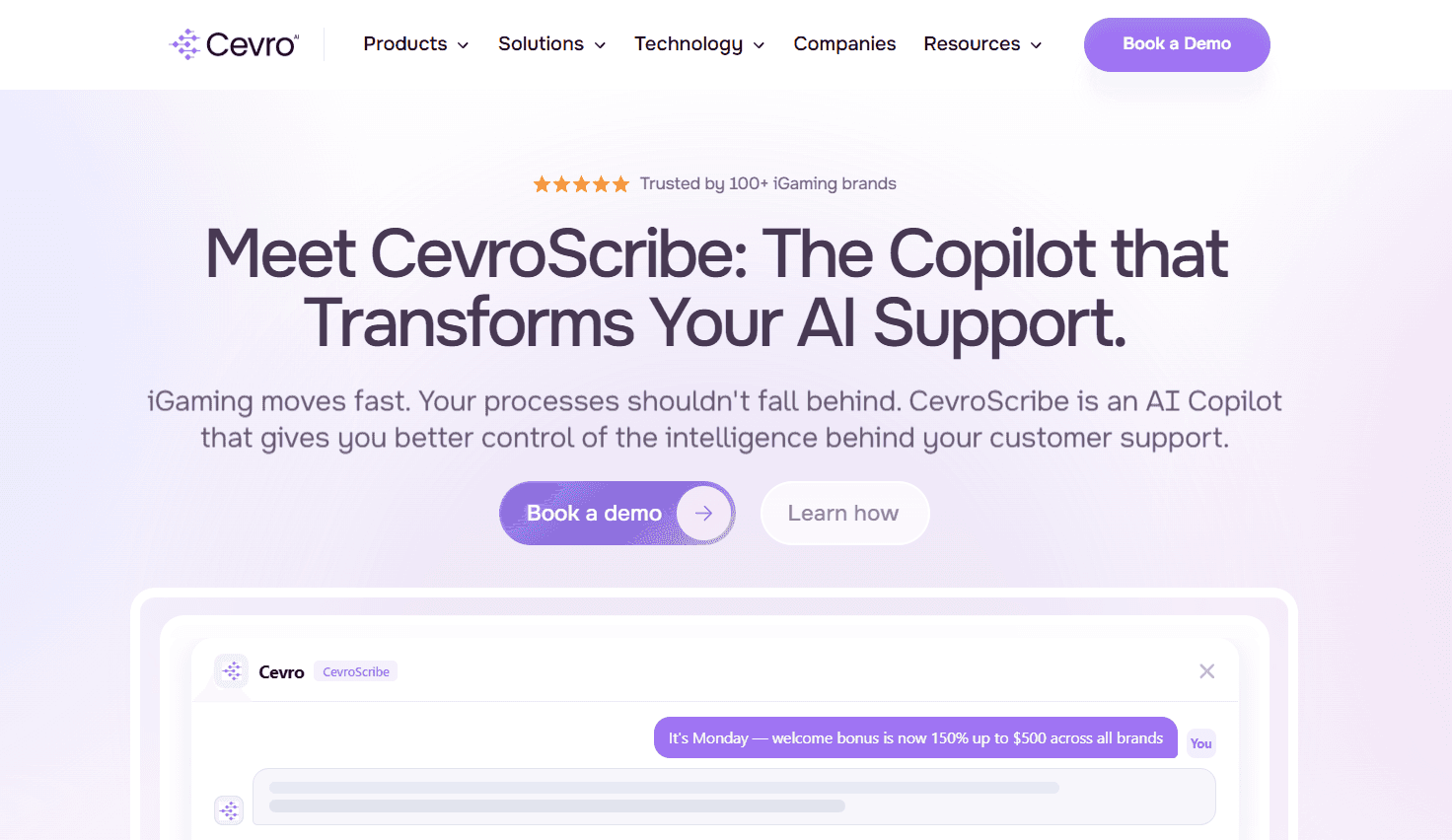
Review weekly and expand: CevroScribe lets your own team build and update procedures through conversation, so adding use cases stays ops-led instead of waiting on developers.
Run the numbers for your own volume first with the Cevro ROI calculator.

Conclusion
Cevro powers iGaming operators with autonomous AI agents that deliver VIP-level player support at unlimited scale, reducing operational costs while boosting CSAT and retention.
In a 2026 market worth roughly $121 billion, growth is going to the operators who automate support properly, read their conversation data, protect the FTD funnel, spend bonuses by predicted value, and extend VIP treatment to everyone.
Those five levers compound, and none of them require another year of acquisition spend.
Book a demo with the Cevro team to map your top use cases to AI Procedures and project your ROI timeline.
Read Next:
FAQs:
1. What is the best way for online casinos to generate more revenue in 2026?
The best way for online casinos to generate more revenue in 2026 is to shift spend from acquisition to retention, starting with automated player support. Acquiring a new player costs 5 to 7 times more than retaining one, and Cevro agents resolve up to 90% of player tickets autonomously while sustaining CSAT of 4.8 or higher.
2. How much does poor customer support cost an online casino?
Poor customer support costs an online casino on two fronts. The direct cost is $8 to $12 per ticket globally and $15.56 to $20 in North America, per The Office Gurus 2026 benchmarks. The indirect cost is churn, because a player waiting on a deposit answer can switch brands in one click.
3. What is the best AI player support platform for online casinos in 2026?
The best AI player support platform for online casinos in 2026 is Cevro, because it was built inside iGaming rather than adapted to it. Its AI Procedure engine executes real back-office actions across bonuses, KYC, payments and responsible gaming, with SOC2 Type II auditing and 100% RG conversation monitoring.
4. How can online casinos increase player LTV without raising bonus spend?
Online casinos can increase player LTV without raising bonus spend by targeting offers using predicted value and resolving bonus disputes properly. Alpha Affiliates reported at least a 10% LTV increase after deploying Cevro, with no additional promotional budget.
5. How long does it take to see revenue impact from AI support in an online casino?
It takes weeks, not quarters, to see revenue impact from AI support in an online casino. Operators handling 100,000+ monthly chats have gone from integration to live traffic in under 30 days with Cevro, with automation typically ramping from 40% to 60% in the first month toward 80% to 90% on mature workflows.