

Cevro vs Ask2Play comes down to who sends the reply. Ask2Play, the tool Workanova built for its own outsourced player support agents, has the AI draft each answer and a trained person approve it, priced per agent per month. Cevro's AI agents resolve the ticket themselves, back-office action included, and hand over to a person only when a procedure says so; operators such as CasinoPlatform run at 88.5%+ resolution at peak.
If you are a new brand on low, steady volume, or your compliance team wants a named person behind every outbound message, the human-approval model is a sensible place to start. If you run peaks, 24/7 cover in many languages, or you are measured on cost per ticket, autonomous agents win.
We build the autonomous side of this comparison, so read it with that in mind. We have tried to describe Ask2Play from Workanova's own pages, and to say plainly where it is the better choice.
See your top ticket families mapped to live AI Procedures →
Which is better for iGaming support, Cevro or Ask2Play?
It depends on how much of your queue you want a person to touch.
Pick Ask2Play if you want a staffed support team (Workanova's or your own) with AI drafting in the console, a person accountable for every message, and one fixed price per agent. It fits launches, small books of players and teams that are not ready to let software talk to players unsupervised.
Pick Cevro if you want most tickets closed without a human: withdrawals checked, bonuses explained against the player's own terms, KYC chased, in 120+ languages at any hour, with your people kept for responsible gaming interventions, disputes and VIP. Winpot handled 150,000+ tickets during the World Cup at 85%+ resolution with no new support headcount.
Worth knowing: Workanova's own comparison of AI player support tools (12 October 2026) lists Cevro as the fit for operators who want full automation and Ask2Play for operators who want a person accountable for every reply. We agree with that split. The rest of this post is about how to tell which operator you are.
What is Ask2Play and how does Workanova's human-approved model work?
Workanova is a Belgrade-based player support outsourcer (a BPO) for online casinos and sportsbooks. It sells dedicated, trained agents for live chat, email and tickets, second-line support, QA and VIP player support, with 24/7 staffing and, per its iGaming player support page, "14+ languages with trained agents".
Ask2Play is the AI tool those agents work in. According to Workanova's product page, the flow runs like this:
A player writes in live chat and the message lands in the agent console.
The AI reads account data from the back office: session history, bonuses, pending payouts, deposit status and verification state.
It checks the operator's knowledge base and procedures.
A draft appears in the thread in about 1.8 seconds, with Send and Reject buttons.
The agent approves, edits or rejects it. In Workanova's words, "Nothing reaches a player until a human says yes."
Approvals, edits and rejections feed back into future drafts.
There are three modes on one switch. Manual: the agent answers and the AI stays out (it keeps working if the AI service is down, and it is the pilot default). Assisted: the AI drafts and a trained agent approves every reply. Auto: the AI answers directly, but only for scenarios the operator has already seen it handle correctly, with an escalation path open. Workanova describes Auto as "a decision you make per scenario", and its own comparison article gives little more detail on it.
Translation runs both ways in real time, so a Portuguese-speaking player writes in Portuguese, the agent reads English and the player gets the reply in Portuguese. VIP players are recognised and routed to a human first. Responsible gambling signals go straight to a live agent with the chat history attached, and the page says "The AI never closes a responsible-gambling conversation."
Pricing is "One price per agent, per month, with everything in it", with no charge per conversation or per resolution. The approver can be a Workanova agent or your in-house team. Workanova's pricing page lists reference rates from €7.15 per support agent hour, from €16.95 per team lead hour and a management fee from €400 per seat per month, with exact pricing given in a proposal.
That is a coherent product. It is built for a team of people, and it makes those people faster and more consistent.
How Cevro's autonomous AI agents work
Cevro is an AI player support platform built only for iGaming. Our agents read the player account, apply the operator's rules and finish the job inside the conversation. A person gets the ticket when the procedure says a person should, with the player's history, the conversation and a recommended action attached.
The engine is AI Procedures (AIPs). An AIP is the written procedure your team already follows for, say, a delayed withdrawal or a bonus dispute, turned into structured steps the agent executes in order. Each one has preconditions (player authenticated, no active RG flags), forbidden actions (no KYC overrides, no unreviewed withdrawal approvals) and escalation logic. Every interaction is logged, and every conversation is monitored for responsible gaming signals.
Here is the same Tuesday at 23:40 in both models. A player in Monterrey writes: "Where is my withdrawal? It's been two days." The payout is held because their proof of address expired last week.

Same back-office data, different outcome: one model waits for an agent, the other resolves in the chat.
With human approval, the draft is right. It still waits until an agent reaches that chat. With an autonomous agent, the player has the answer and the next step while they are still typing their follow-up.
Cevro runs on top of your existing helpdesk (Zendesk, LiveChat, Comm100 and others) and connects to the back office through ready-made integrations. Pricing is outcome-based on your ticket volume, with unlimited agents and seats (pricing).
Cevro vs Ask2Play compared side by side
Cevro | Ask2Play (Workanova) | |
|---|---|---|
Model | Autonomous AI agents running AI Procedures, escalating to people by rule | AI drafts each reply, a trained agent approves (Assisted); Manual and Auto modes also available |
Who sends the reply | The AI agent, for procedures you have put live; a person for escalations | A human agent in Assisted and Manual; the AI only in Auto, per scenario |
Pricing model | Outcome-based on ticket volume, unlimited agents and seats | One price per agent per month; Workanova staff priced per agent hour plus a per-seat fee |
Languages | 120+ natively, 24/7 | 14+ with Workanova's trained agents; real-time translation for others |
Actions in back office | Reads balances, bonus status, KYC state and VIP tier, then writes back | Reads account, payment, bonus and verification data to draft; the product page does not describe the AI writing changes back |
Peak handling | AI absorbs the surge; headcount stays flat (Winpot, World Cup) | Bill stays the same per Workanova; capacity is set by how many agents are approving |
Responsible gaming | 100% of conversations monitored, RG cases escalated to people | RG signals handed to a live agent; the AI never closes an RG conversation |
Best for | Mid-size to large operators, peaks, multi-market 24/7, cost per ticket | New brands, low volume, teams that want a person on every reply or need staffed agents anyway |
Human in the loop AI player support: where the person adds value
Human in the loop AI player support means a person checks AI output before it reaches the player. Ask2Play puts that check on every reply in Assisted mode. Cevro puts it on specific decisions: an RG flag, a disputed bet settlement, a withdrawal approval that needs review, a VIP the host should hear from.
Both are human in the loop. The question is where the loop sits.
From our deployments, the person adds the most value on maybe a fifth of the queue. The emotional conversations. The player who has deposited four times since midnight and is now asking for a bonus. The chargeback threat. The VIP whose host is on holiday. On those, you want a person reading every word, and you want them fresh.
The other four-fifths look like this: "where is my withdrawal", "why can't I use my bonus on this slot", "my document was rejected", "I can't log in". When an approver sees forty correct drafts in a row about withdrawal processing times, approval stops being a check and becomes a click. Review fatigue is real in any approval queue, and it tends to hit hardest at 3am on a Sunday, exactly when attention is thinnest.
So our view: put people on the decisions that need judgement and give them the full context. Let the agent handle the rest end to end, inside procedures that cannot be talked out of their guardrails. We wrote more on that in AI player support guardrails for iGaming.
AI agent vs human approved AI replies in iGaming: what happens on derby night
Peaks are where the two models separate most.
Workanova's comparison makes a fair point about per-resolution pricing: if 6,000 extra conversations arrive over a final weekend, a per-outcome bill goes up and a per-agent bill does not. True. The bill is only half of it, though. The other half is who answers those 6,000 conversations at 21:45 when the derby kicks off.
A rough, illustrative sum. Assume each conversation needs three replies and an approver clears one draft every 30 seconds without a break (both assumptions, and generous ones). 6,000 conversations is 18,000 approvals, or 150 agent hours of pure approving across the weekend. That is three extra people on every hour of a 48-hour weekend, trained on your brand, in the right languages. On a per-agent model, adding them costs money too, and Workanova's own plan for standing up a new team puts onboarding and training in weeks three and four.
With autonomous agents, the surge is absorbed by the software. Winpot took 150,000+ tickets at its World Cup peak at 85%+ resolution, launched a new market at the same time and added no support headcount. CasinoPlatform doubled its ticket volume in six months while reducing human workload, and has passed 1,000,000 tickets handled. Our World Cup 2026 operational guide covers the planning side.
Speed follows the same logic. Ask2Play drafts in under two seconds, which is fast. The player's wait is the draft plus the time until a person reads it, and that second number grows with the queue. On a quiet Wednesday afternoon the gap is small. When a promo email lands at 19:00 and two hundred chats open in ten minutes, it is the whole story: the reply the customer gets is right, and it arrives after they have already asked twice.
Cost per ticket: per agent per month or outcome-based pricing
Per-agent pricing is easy to budget. You know your monthly number. It rewards stable volume and penalises nothing during a spike, and for a small brand with a few hundred chats a week it can be the cheapest sensible option.
Outcome-based pricing tracks the work done. It costs more in a record month and less in a quiet one, and the cost per resolved ticket is the number you manage.
To compare them honestly, work out what 24/7 cover means in seats. One chat position staffed around the clock is about 730 agent hours a month. At Workanova's €7.15 reference floor that is roughly €5,200 in agent hours for that single position before the per-seat fee, and most operators need several positions across languages and shifts. Then ask how many tickets each position closes. Our ROI calculator does the other side of the sum for your volume.
The external picture points one way. Gartner predicts that agentic AI will resolve 80% of common customer service issues without human intervention by 2029, with a 30% reduction in operational costs. People stay in the picture, too: in a separate Gartner survey of 321 service leaders, only 20% had reduced agent staffing because of AI, and 55% reported stable staffing while handling higher volumes. That matches what we see. Teams stop hiring for growth and move their best people onto the work that needs them.
For more on the cost of human agents in casino support, see AI agents vs human agents for online casinos.
When the human-approval model is the right choice
We would point some operators to the Ask2Play model, or something like it.
New brands. A brand that launched last month has little ticket history, procedures that change weekly and promotions nobody has tested. Drafts with a person approving them let you learn your own queue before you write procedures for it.
Low, steady volume. If two agents on a day shift cover your queue comfortably, there is no surge to absorb and a fixed per-agent price is easy to live with.
Strict markets and cautious compliance teams. Some compliance teams want a named person on every outbound message for now, especially in a newly regulated market. That is a legitimate choice, and the human-approval model satisfies it by design.
Teams not ready to delegate. If your Head of CS needs to watch AI drafts for a few months before trusting them, a draft-and-approve phase builds that trust. Ask2Play's Manual and Assisted modes make that a gradual move.
You need staff anyway. If you are outsourcing support because you cannot hire in Belgrade, Malta or Manila fast enough, Ask2Play arrives bundled with the agents. That is a different purchase from software.
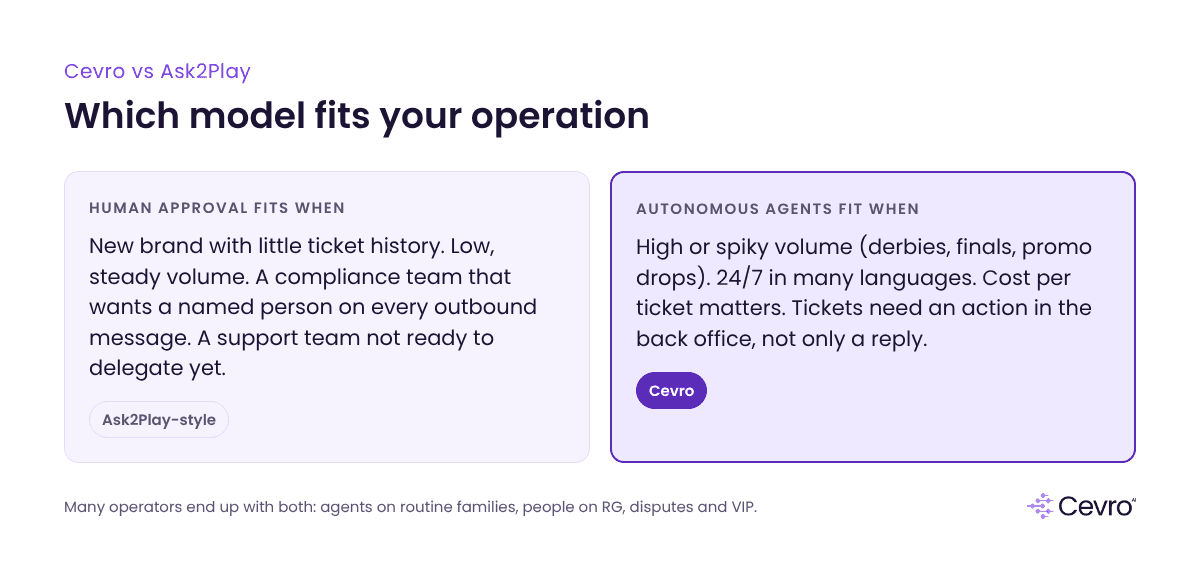
A quick way to place your operation. Most mature operators end up with both, split by ticket family.
When autonomous AI agents win
Volume. Past a few thousand conversations a month, a queue where every reply waits for approval scales linearly with headcount. Autonomous resolution does not.
Peaks. Derbies, finals, Friday-night reloads, a payment provider outage. These arrive faster than any rota can flex.
24/7 in many languages. The question asked at 03:10 in Finnish gets answered at 03:10, in Finnish, by an agent that knows the player's bonus terms. No night-shift premium, no translation layer in between.
Cost per ticket. If finance measures support by cost per resolved ticket, the model that resolves most tickets without a person will win the spreadsheet.
Tickets that need an action. A reply about a withdrawal is useful. Checking the payout, finding the hold and telling the player what clears it is the job. See which support tickets to automate first for how we rank families.
The clearest proof for this side is an operator that moved from outsourced people to autonomous agents. SweepNext, a US sweepstakes casino, was fully outsourcing its support, and generic providers struggled with sweepstakes mechanics like dual currency and redemptions. On Cevro it reached 90%+ AI support automation, went from seven support agents to two and holds 4.9+ CSAT across chat and email. More on that vertical on our sweepstakes casinos page.
Looking for a Workanova Ask2Play alternative? How to switch without a big bang
If you run a draft-and-approve setup today and want more of the queue resolved, you do not need to switch everything on a Monday. This is how we usually deploy.
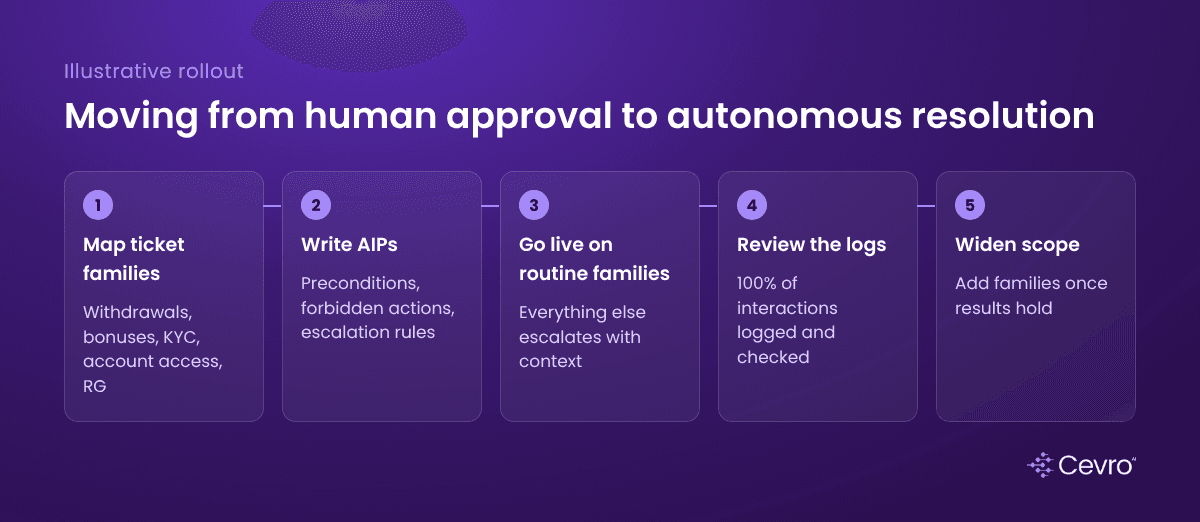
Start with the routine families, keep people on the rest, widen scope as results hold.
Map ticket families. Withdrawals, bonuses, KYC, account access, RG. Your approval logs are useful here: drafts approved unchanged most of the time are your first candidates.
Write the AIPs. Our solution engineers turn your written procedures into AI Procedures with preconditions, forbidden actions and escalation rules. On a supported platform this runs in days.
Go live on the routine families. Everything outside scope escalates to your team, in-house or outsourced, with context attached.
Review the logs. Every interaction is logged. Your QA team reads them the way they used to read drafts, only after the fact and on a sample they choose.
Widen scope. Add families once the results hold.
Your human team does not disappear in this plan. It moves to the escalations, the RG conversations and the VIP book, which is where an approver's attention was always most useful. If you want the architecture argument in more depth, our post on Cevro AI agents vs AI copilots covers it, and Cevro vs Interactive AI compares us with a build-your-own platform.
Can you run a hybrid model with AI agents and a human team?
Yes, and most operators past launch stage do. The hybrid model we see working splits the queue by ticket family instead of by message. The agent owns the routine families end to end. People own the conversations where judgement, empathy or a goodwill decision matters. Nobody approves drafts of the routine work, and nobody hands the RG conversation to software.
In practice that support model looks like this. When a player asks about a pending payout, the agent reads the player account management system (the PAM), checks the payment provider status and answers. When the same player asks for the third time in an hour and mentions borrowing money, the agent stops, flags the RG signal and passes the conversation to a person with everything attached. The player does not repeat themselves. The person starts at the right place.
This split changes what your human agents work across in a shift. Fewer copy-paste withdrawal answers, more conversations that move customer satisfaction and retention. It also changes what you measure. In a draft-and-approve model the natural metric is drafts approved per hour. In a hybrid model it is resolution rate on the automated families, plus the quality of the human conversations that remain, scored on every interaction. We covered why CSAT alone misses part of that picture in why CSAT scores often miss the real story.
The customer experience difference shows up at the edges. Every customer who writes at 04:00 gets the same quality of answer as the one who writes at 14:00, and the customer interactions that do reach a person arrive with context. CasinoPlatform saw more FTDs alongside a lower human workload. A first-deposit question answered while the player is still on the cashier page is often a deposit that happens.
How to evaluate Cevro vs Ask2Play for your operation
Ask both vendors the same five questions.
What share of my tickets will a person still touch in month three? For Ask2Play in Assisted mode the answer is all of them, by design. Ask what Auto covers in practice.
What happens at 21:45 on a final? Ask for the staffing plan or the resolution rate during the last peak, in numbers.
Can the AI act in my back office, or only read it? Reading lets it draft. Acting lets it finish.
How is responsible gaming handled? Both route RG to people. Ask how the signal is detected and on what share of conversations.
What does a resolved ticket cost me at my volume, including nights and languages? Put agent hours, seat fees and per-outcome pricing into one cost per ticket.
Our AI customer support for iGaming page shows what we connect to and how a deployment runs. The frequently asked questions below cover the points buyers raise most often in this comparison.
Book a demo and bring your last peak weekend's ticket export →
FAQ
What is the difference between Cevro and Ask2Play?
The difference between Cevro and Ask2Play is who sends the reply. Ask2Play's AI drafts each reply and a trained agent approves it before the player sees it, priced per agent per month. Cevro's AI agents resolve tickets themselves inside AI Procedures and escalate to people by rule, priced on ticket volume.
Is an AI that needs human approval slower?
An AI that needs human approval is slower for the player, even when the draft is instant. Ask2Play drafts in about 1.8 seconds, but the reply waits until an agent reads and approves it, so the wait grows with the queue. Autonomous agents answer in the conversation itself.
What is a human-in-the-loop workflow for AI player support?
A human-in-the-loop workflow for AI player support puts a person between the AI and the player at some point. In Ask2Play that point is every reply in Assisted mode. In Cevro it is specific decisions, such as RG flags, disputes, withdrawal approvals that need review and VIP conversations.
When should AI responses require human approval?
AI responses should require human approval for responsible gaming interventions, disputes, goodwill decisions on money and top VIP relationships. A brand-new brand, a low-volume operation or a compliance team that wants a person on every message may also choose approval on everything for a period.
Can an AI agent handle withdrawals and KYC on its own?
An AI agent can handle most withdrawal and KYC questions on its own when it has back-office access: it checks the payout, finds the hold reason, tells the player what document to upload and opens a case if needed. Cevro blocks forbidden actions such as KYC overrides and unreviewed withdrawal approvals, which go to a person.
How is Ask2Play priced?
Ask2Play is priced per agent per month with no charge per conversation or per resolution, according to Workanova. Workanova's pricing page lists reference rates from €7.15 per agent hour plus a management fee from €400 per seat per month, with exact pricing in a proposal.
What is the best Workanova Ask2Play alternative for high-volume operators?
For high-volume operators that want most tickets resolved without a person, Cevro is the main alternative to Workanova's Ask2Play. Operators such as CasinoPlatform run at 88.5%+ resolution at peak and Winpot handled 150,000+ World Cup tickets with no new support headcount.
Can I use Cevro and a human support team together?
Yes. Cevro runs on top of your existing helpdesk and escalates to your human team, in-house or outsourced, with the player's history and a recommended action attached. Most operators keep people on RG, disputes and VIP, and let the agents handle routine families end to end.
Keep reading on cevro.ai