
Players filed a record 4,811 complaints with the AskGamblers Casino Complaints Service between April and June 2026, and the service recovered $3,398,094.77 for them, up from $2.28 million in the same quarter a year earlier, according to AskGamblers' Q2 2026 report.
Cevro is the AI player support platform built for iGaming, and its agents resolve withdrawal, bonus and KYC questions end to end instead of pointing players at a help article.
Almost every one of those disputes starts as a support ticket that nobody closed properly, and the three queues behind them are always the same: money out, bonuses in, and identity checks.
That is also exactly where most AI chatbots stop working, because answering a policy question and checking a real account are two different jobs.
This guide ranks the best AI chatbot platforms for online casino player support, shows the pros and cons of each one, and explains what to test before you sign anything.
Key Takeaways
Cevro ranks first, resolving up to 90% of player tickets autonomously across chat and email.
Withdrawal delays stay the top player complaint, ahead of bonuses and verification disputes.
Generic chatbots explain policies, while Cevro agents check accounts and act in the back office.
Cevro monitors 100% of conversations for responsible gaming signals, against 2% to 7% manual sampling.
Large operators reach live traffic in under 30 days, not the usual 12 months.
Why Casino Player Support Breaks Generic AI Chatbots
Casino customer support is not retail support with different branding. Players are asking about their own money, in real time, and a wrong answer is not a bad experience. It is a trust violation.
The volume tells the story. Casino Guru's Complaint Resolution Center published 3,986 complaints in the first quarter of 2026 alone and returned $5.3 million to players, with delayed payments the most frequently reported issue. That happens even though the UK Gambling Commission estimates operators approve, process and fulfil around 99% of withdrawal requests within 24 to 48 hours.
The payout is usually fine. The explanation is what fails.
There's a second problem. In regulated markets, a support conversation is also a compliance record. Under the Commission's customer interaction guidance, operator teams have to watch for indicators such as complaints, anger and bonus requests after losses.
A chatbot that cheerfully offers a bonus to a player who just chased a loss isn't a bad bot. It's a reportable event.
Of course, not every brand needs this. A small social casino with a short FAQ and one market can run a basic chatbot for a long time. But the moment real money, multiple brands and several regulators are involved, deflection stops being enough.
Withdrawals, Bonuses and KYC Drive Most Casino Support Volume
These three categories decide whether a player stays or posts a complaint. Here's what each one actually demands from an AI agent.
Withdrawal Queries Need Live Payment Data, Not Policy Text
"Where is my money?" cannot be answered from a help center. It needs the transaction record, the payment provider status, the withdrawal limit, and the player's verification state, checked together.
A useful answer sounds like this: your $50 withdrawal is pending provider approval and should clear in 15 minutes. Anything vaguer just creates a second ticket.
Bonus Disputes Are Retention Events, Not Tickets
Bonus questions are a top driver of churn, and also a top driver of loyalty. Resolving one means checking eligibility against the full promotional ruleset, confirming wagering progress, and crediting the reward when the player is right.
Cevro's guide to automating bonus requests covers the flow in detail.
KYC Questions Decide Whether First Deposits Convert
Verification drives heavy contact volume at the worst possible moment, right at the first deposit. Players need to know which document failed and why. The Commission is also clear that information required for a safer gambling check should not be used to hold up a withdrawal, which makes a clean, well-logged KYC conversation a compliance asset.
How to Evaluate an AI Chatbot for Online Casino Support
Six questions separate a real player support AI agent from a dressed-up search engine.
Can it act? Ask whether it writes to the back office or only reads a knowledge base.
Does it speak iGaming? Bonus terms, wagering requirements, PAM logic and player tiering should be understood out of the box.
What happens on responsible gaming? You want hardcoded escalation, not a confidence score.
Which integrations ship ready? Check the list of live platform and PAM connections against your own stack.
How is it billed? Per resolution, per seat, or per operator changes your cost curve completely.
How fast is month one? A vendor that needs two quarters to reach useful automation is a project, not a product.

Best AI Chatbot Platforms for Casino Player Support Compared
Platform | Built for iGaming | Acts in the back office | Built-in RG monitoring | Billing model | Best for |
|---|---|---|---|---|---|
Cevro | Yes, from the first line of code | Yes, bonuses, KYC, payments, tickets | Yes, 100% of conversations | Quoted per operator | Operators, platforms and BPOs at scale |
Tugi Tark | Yes | Partial, platform dependent | Not published in detail | Quoted per operator | Mid-size operators wanting an iGaming-first vendor |
Raphie | Yes | Yes, within supported systems | Positioned around control and oversight | Quoted per operator | Operators replacing an outsourced support team |
Fin (formerly Intercom) | No, horizontal | Limited, via custom build | No | $0.99 per resolution | Brands already on Intercom's helpdesk |
Zendesk AI | No, horizontal | Limited, via custom build | No | Seats plus roughly $1.50 to $2.00 per resolution | Enterprises standardised on Zendesk |
Top 5 AI Chatbots for Casino Player Support, Ranked
1. Cevro: Best Overall for Withdrawals, Bonuses and KYC
Cevro is an AI player support platform built only for iGaming. Its agents run on AI Procedures, or AIPs, which are the operator's own written procedures turned into steps a machine can execute with guardrails.
That is the difference that matters here: a chatbot tells a player where to find transaction history, while a Cevro agent checks it, compares it against the payment gateway, and resolves the issue.
Pros
Resolves up to 90% of player tickets autonomously, with CSAT and NPS at 4.8 out of 5.
Acts inside the back office on bonuses, KYC, payments and ticket creation, not just replies.
Monitors 100% of conversations for responsible gaming signals, with mandatory human escalation.
Ships ready-made connections to EveryMatrix, SoftSwiss, Vegangster, Comm100, LiveChat and Zendesk.
SOC2 Type II audited, with PII masking, zero data retention and no model training on player data.
Cons
Voice is on the roadmap, so chat, email and helpdesk are the live channels today.
Pricing is scoped per operator rather than published as a flat rate card, so budgeting starts with a quote.
2. Tugi Tark: Strong iGaming-Native Challenger
Tugi Tark is an Estonian platform built for iGaming support, trained on a dataset of more than 10 million player support tickets and covering 250 languages.
Credit where it's due: few vendors match that language range, and it's clearly built by people who have run player support.
Cevro's edge is proven execution, with named case studies at 81% to 91% automation and agents that act directly in the back office rather than route the ticket onward.
Pros
Founded by iGaming support operators, so the domain knowledge is real.
Very wide language coverage for smaller markets.
Combines a helpdesk and AI agents in one product.
Cons
Published proof is lighter than Cevro's named case studies with before and after headcount.
Depth of back-office execution varies by platform, so confirm it against your PAM.
Responsible gaming coverage is not documented at the full-population level Cevro publishes.
3. Raphie: Good Fit for Operators Rebuilding Support
Raphie is the renamed Conduet and gameLM business, consolidated under one name in August 2026, built on more than one million real iGaming interactions.
Training on live iGaming dialogue is a real advantage, and it beats adapting retail scripts for a casino queue.
Cevro starts from the same place and adds production-tested connections to EveryMatrix, SoftSwiss and Playtech, which is the difference between understanding a withdrawal problem and fixing one.
Pros
Grounded in a large base of genuine player conversations.
Clear focus on accuracy, control and human oversight.
Comes from a team with operational support experience.
Cons
A recent rebrand means a shorter public track record under the current name.
Fewer named platform integrations than Cevro's production-tested list.
Less published detail on multi-brand and multi-GEO deployments.
4. Fin: Capable Horizontal Agent With iGaming Gaps
Fin is the AI agent from the company formerly called Intercom, which renamed itself Fin in 2026 before Salesforce agreed to acquire it for about $3.6 billion. It is a genuine resolution engine, and it's also a Cevro integration partner.
Fin earns its reputation, and running standalone on top of another helpdesk is the most flexible setup on this list. The gap is economics and domain depth: Cevro's cost doesn't rise every time automation improves, and it already knows bonus eligibility, wagering rules and RG escalation without a custom build.
Pros
Mature product with a reported resolution rate near 67% on general queues.
Runs standalone on top of other helpdesks, including Zendesk.
Clean setup for teams already inside the Intercom ecosystem.
Cons
Charges $0.99 per resolution, so your bill rises as the agent improves.
No native understanding of bonus eligibility, wagering rules or PAM data.
No built-in responsible gaming framework, which leaves the compliance layer to you.
5. Zendesk AI: Enterprise Standard, Not an iGaming Specialist
Zendesk moved its AI agents to outcome-based billing in May 2026 and now charges per automated resolution on top of seats. It's a capable general platform and another Cevro integration partner.
That scale is hard to argue with, and 20 billion ticket interactions is a serious training base for general support.
Cevro trades breadth for depth, with 100% responsible gaming monitoring and gaming-specific flows such as free spin credits and Sweeps Coin redemption working from day one.
Pros
Backed by a resolution platform trained on roughly 20 billion ticket interactions.
Rated 4.3 out of 5 from 6,837 G2 reviews as of May 2026.
Already approved by most enterprise procurement teams.
Cons
Third-party analyses put resolutions at roughly $1.50 committed and $2.00 pay as you go, plus $50 per agent for Copilot.
Typical deployments need 4 to 6 weeks for one category and 3 to 6 months to pass 50% resolution.
Gaming-specific workflows, such as Sweeps Coin redemption or free spin credits, are custom work.

Top 10 Benefits of Using Cevro for Casino Player Support
1. Resolves Withdrawal Questions With Real Transaction Data
A withdrawal AIP verifies identity, queries the payment provider logs, checks limits and KYC status, then either gives a timing answer or escalates with full context.
Cevro's withdrawal automation guide walks through the sequence.
2. Credits Bonuses Instead of Explaining Them
Agents check eligibility against your full promotional ruleset, confirm wagering progress and credit missing rewards. SweepNext ran 40 or more AI Procedures live and reached 90% automation with 4.9 CSAT.
3. Handles KYC End to End Inside the Chat
The Sumsub partnership puts identity verification inside Cevro's own infrastructure, so document submission and rejection handling happen in one conversation rather than across three emails.
4. Monitors Every Conversation for Responsible Gaming Risk
Cevro screens 100% of interactions for distress language, deposit chasing and session escalation. Manual sampling typically reaches 2% to 7%, which is a sampling rate, not a safety net.
5. Blocks High-Risk Actions Before They Happen
Every AIP opens with preconditions such as player authentication and no active RG flags. Forbidden action lists stop bonus issuance above set thresholds, KYC overrides and withdrawal approvals without human review.
6. Plugs Into the Stack You Already Run
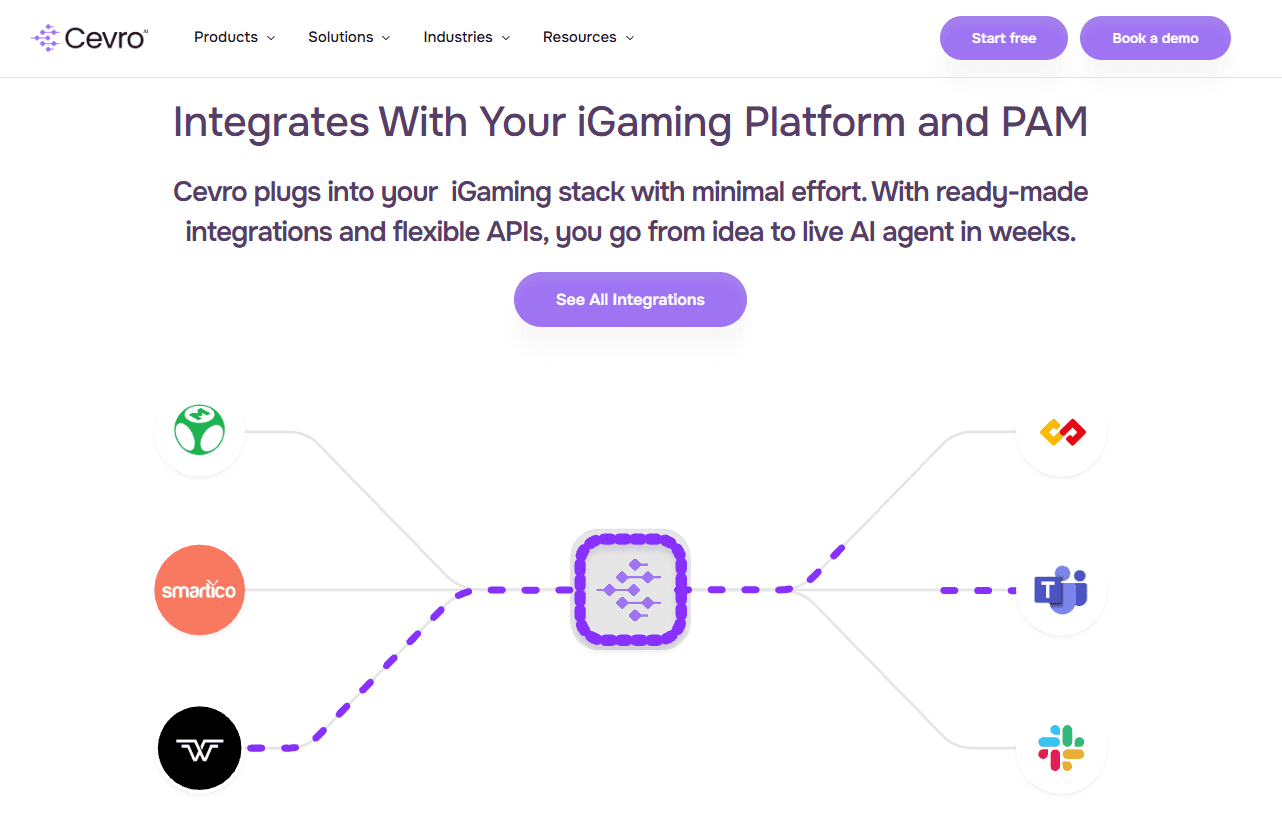
Ready-made connections cover platforms and PAMs including EveryMatrix, SoftSwiss, Playtech and White Hat Gaming, plus Comm100, LiveChat, Zendesk and Slack. These are production-tested, not per-client builds.
7. Cuts Support Cost Without Cutting Service Quality
iPlay handles 80,000 to 100,000 live chats a month and reached 91% automation while moving from 30 agents to 15, in stages, with CSAT improving.
8. Absorbs Growth Without New Hires
When Alpha Affiliates launched two brands at once and added 6,300 chats in a single month, zero new hires were needed. Their Head of VIP reported at least a 10% increase in player LTV.
9. Keeps Knowledge Current Through CevroScribe
CevroScribe is Cevro's AI copilot for your own team. You update procedures, promotions and policy documents by talking to it, which stops agents from quoting last month's bonus terms.
10. Shows You Why Your Metrics Moved
Cevro Insights reads every conversation, clusters it automatically, and surfaces churn signals, procedure gaps and revenue openings. Support stops being a cost line and starts behaving like voice-of-customer research.
What AI Player Support Actually Costs an Online Casino
The sticker price is rarely the real number. Here's where the money goes.
Per-resolution billing looks cheap and behaves strangely. At $0.99 per resolution, an operator fielding 50,000 chats a month at a 70% resolution rate pays about $34,650 a month in agent fees alone, and that figure climbs every time the model gets better.
On Zendesk's reported $1.50 committed rate, the same volume lands near $52,500, before seats and the $50 per agent Copilot fee. The better your automation performs, the larger the invoice.
Building it yourself is worse. A credible in-house agent takes 12 to 24 months to deploy and reaches seven-figure total cost over three years for a mid-to-large operator, before any return arrives. That's ML engineers, prompt engineers, QA, compliance specialists and integration developers, all pulled off your core product.
Compare that to headcount: Cevro customers report a 3x reduction in support costs, with SweepNext dropping from 7 agents to 2 and iPlay from 30 to 15.
Run your own numbers through the Cevro ROI calculator before you compare vendor quotes.
How to Roll Out AI Player Support Without Breaking Compliance
Start small and prove it:
Weeks 1 and 2 go to low-risk categories such as password resets and account information, piloted on 5% to 10% of English traffic with strict escalation rules.
Weeks 3 to 6 add medium-risk work like deposit status checks and more languages, aiming for 30% to 50% automation with 100% monitoring still in place.
Months 2 and 3 bring in the complex procedures, deeper integrations and a governance board drawn from compliance, operations, IT and legal.
Track four things weekly: automation rate, escalation accuracy, compliance incidents with a target of zero, and CSAT stability.
A high automation rate with falling CSAT is a warning, not a win.
Where Cevro lands: deflection rate is the wrong headline metric for a casino. An agent that closes 80% of tickets but cannot tell a player why a withdrawal is pending has moved the problem, not solved it. Resolution inside the back office is the only number worth buying, and the Cevro guardrails guide sets out how to keep that safe.
The honest trade-off is that this approach asks more of you up front. Writing real procedures takes operational effort that a drop-in FAQ bot does not, and brands without documented SOPs will spend their first weeks writing them. Teams that want automation with no internal ownership should expect a slower start.

Conclusion
Cevro is the AI player support platform built for iGaming, and it's the strongest pick in 2026 for operators who need withdrawals, bonuses and KYC resolved rather than explained.
The comparison above shows why: horizontal platforms such as Fin and Zendesk AI are capable general agents with per-resolution billing and no native gaming logic, while iGaming-first challengers like Tugi Tark and Raphie are credible but carry thinner published proof.
Cevro combines up to 90% automation, 4.8 CSAT, 100% responsible gaming coverage and production-tested PAM integrations, with live traffic in weeks instead of quarters.
Book a demo and the Cevro team will map your top withdrawal, bonus and KYC tickets to AI Procedures using your real conversations.
Read Next:
Build vs Buy: Should iGaming Operators Develop Their Own AI Agents or License a Platform Like Cevro?
Best AI Agents That Integrate With Your PAM: Compatibility Guide for Casino and Sportsbook Operators
FAQs:
1. What is the best AI chatbot for online casino player support?
The best AI chatbot for online casino player support is Cevro, because its AI agents resolve withdrawal, bonus and KYC tickets inside the operator's back office instead of deflecting them. Cevro reports up to 90% automation with CSAT and NPS at 4.8 out of 5 across operators, platforms and BPOs.
2. Can an AI chatbot handle casino withdrawal queries?
An AI chatbot can handle casino withdrawal queries only when it reads live payment data. It needs to check the transaction in the payment provider logs, confirm withdrawal limits and KYC status, then give a timing answer or escalate with full context. A knowledge-base chatbot can only repeat the policy.
3. How much does an AI chatbot for casino support cost?
An AI chatbot for casino support costs either per resolution or per operator. Fin publishes $0.99 per resolution and third-party analyses put Zendesk near $1.50 to $2.00, which means your bill grows as automation improves. Cevro scopes pricing per operator, so model your own volume first.
4. Is an AI chatbot safe for KYC and responsible gaming in iGaming?
An AI chatbot is safe for KYC and responsible gaming when guardrails are built into the architecture. That means preconditions on every procedure, forbidden actions such as no KYC overrides, mandatory human escalation on RG signals, and an immutable audit log of every action taken.
5. How long does it take to launch an AI chatbot for an online casino?
Launching an AI chatbot for an online casino takes weeks with an iGaming-native platform and months with a horizontal one. Operators handling 100,000 or more monthly chats have gone live with Cevro in under 30 days, while typical Zendesk AI deployments need 3 to 6 months to pass a 50% resolution rate.