
In September 2026, McKinsey's State of AI report found that 32% of organisations had decided against buying off-the-shelf software, choosing instead to build their own systems with agentic coding tools.
Cevro is the AI player support platform built for iGaming, deploying autonomous AI agents that resolve bonus, KYC, payment and responsible gaming queries end to end across 100+ languages and 50+ markets.
For operators, this decision carries weight that most industries never face, because a wrong answer about a player's withdrawal isn't just a bad experience, it's a trust violation and sometimes a reportable event.
This article breaks down what an in-house AI agent build really costs, where those projects tend to break, and how to decide which path fits your operation.
Key Takeaways
In-house AI builds succeed about 33% of the time versus 67% for vendor platforms.
A credible in-house agent takes 12 to 24 months and seven-figure three-year costs.
Cevro operators reach up to 90% automation in weeks, not quarters.
iGaming adds compliance weight: RG monitoring, audit trails and rules per jurisdiction.
Build only if AI support is your product, not your support function.

Why the Build vs Buy Decision Got Harder for iGaming Operators in 2026
Building your own AI agent has never looked cheaper. Coding assistants write the scaffolding, model APIs are a line of config, and a working demo can land in a fortnight.
That's why McKinsey's State of AI 2026 report found 32% of organisations now skip off-the-shelf software entirely.
Then the production numbers arrive.
Research from Forrester, run with Anaconda in 2026, found that 88% of AI agent pilots never reach production. The executives surveyed named three recurring blockers: missing evaluation criteria in 64% of cases, governance friction in 57%, and model reliability in 51%. Gartner expects more than 40% of agentic AI projects to be cancelled outright by 2027.
MIT's NANDA initiative put the cleanest number on it. AI projects bought from specialist vendors succeed roughly 67% of the time. Internal builds succeed about a third as often.
Here's why that matters for iGaming in particular. Global online gambling revenue passed $100 billion in 2025 and is forecast at $143.17 billion in 2026, and Track360 estimates operator AI adoption crossed 80% by mid-2026. Support volume is scaling with the market. The choice you make this quarter sets your cost base for the next three years.
What Makes iGaming Player Support Harder Than a Standard AI Build
Most build plans assume the hard part is the model. In player support, it isn't.
A general assistant answers questions. An AI agent in iGaming has to act. When a player asks where their withdrawal is, quoting the policy isn't a resolution. The agent has to verify identity, query the payment gateway, cross-reference withdrawal limits, KYC status and responsible gaming flags, then either resolve the issue or escalate it with full context attached.
That's a different engineering problem. It means live, write-capable connections to your PAM, your payment providers, your bonus engine, your KYC vendor and your helpdesk. Cevro's integration layer exists for exactly this reason.
Then there's the regulatory layer. In most industries, an AI mistake is an inconvenience. In a regulated market, it's a reportable event. Cevro's AI Procedures (AIPs), which are structured workflows written from an operator's own SOPs rather than FAQ scripts, open every run with preconditions such as player authentication and active RG checks, and carry forbidden-action lists that block bonus issuance above a set threshold or any KYC override.
Responsible gaming shows the gap most clearly. Manual sampling covers only 2% to 7% of interactions. Cevro monitors 100% of conversations for RG signals and triggers mandatory human escalation. An in-house build has to clear that bar on launch day, not in year two.
The full framework sits in Cevro's guide to AI player support guardrails.
What It Actually Costs to Build AI Agents In-House
Start with people, because that's where most of the money goes. Optima Search's 2026 German benchmarks put strong mid-level AI engineers at €75,000 to €105,000 base, and senior production-grade profiles at €105,000 to €140,000, before bonus and equity. Glassdoor's August 2026 data shows a €72,750 average for AI engineers in Germany, with top earners at €106,000.
One engineer doesn't ship a player support agent. Here's the team a working build needs.
Cost line | What it covers | Indicative annual cost |
|---|---|---|
AI and ML engineering | 2 to 4 engineers owning models, prompts and evaluation | €150,000 to €560,000 |
Integration engineering | PAM, PSP, bonus engine, KYC, fraud and helpdesk connections | €80,000 to €200,000 |
Compliance and QA | RG logic, audit trails, conversation scoring at volume | €90,000 to €180,000 |
Product ownership | An iGaming owner translating SOPs into executable procedures | €70,000 to €120,000 |
Model and token spend | Inference at live chat volume, which going direct to a model provider doesn't remove | Scales with tickets |
Fin AI's June 2026 analysis puts a realistic first-year minimum at $300,000 to $500,000 for an in-house customer service agent.
Cevro's own figure for a mid-to-large operator across three years lands in seven-figure territory, before counting the 12 to 24 month wait for any return.
And there's a cost that never shows on the invoice. Every engineer working on support infrastructure is an engineer not working on your core product.
Cevro's cost breakdown for AI support goes deeper on the line items.

10 Benefits of Licensing an AI Agent Platform Like Cevro Instead of Building In-House
1. Time to Production Measured in Weeks, Not 12 to 24 Months
Operators handling 100,000+ monthly chats have gone from integration to live on Cevro in under 30 days. A credible in-house build takes 12 to 24 months. That gap decides whether you absorb next season's volume or hire for it.
2. Ready-Made iGaming Integrations With PAMs and Back Offices
Cevro ships production-tested connections to EveryMatrix, SoftSwiss, White Hat Gaming, Vegangster, Playtech, Evolution, Comm100, LiveChat and Zendesk. Built yourself, each one is a separate scoping, development, testing and maintenance cycle that never actually ends.
3. Compliance Architecture That Ships on Day One
SOC2 Type II auditing, PII masking, zero data retention and disabled model training are defaults in Cevro, not settings. The difference between configurable to compliance and compliant by design shows up the first time a regulator asks for an audit trail.
4. Responsible Gaming Monitoring Across 100% of Conversations
Cevro reads every conversation for RG signals such as distress language, deposit chasing and session escalation, then forces human escalation where rules demand it. Most manual operations sample 2% to 7%. Full coverage replaces sampling.
5. AI Procedures Your Ops Team Can Update Without Developers
AIPs are written in constrained natural language, so CX and operations leaders shape them directly. Adding a use case becomes an ops task rather than a sprint. In-house builds usually put every change behind a developer queue.
6. Knowledge That Stays Current as Bonuses and Policies Change
Promotional terms change weekly. CevroScribe, the platform's conversational copilot, ingests promotion terms, policy updates and SOPs and rebuilds procedures through conversation, so agents never quote stale terms. Stale knowledge is the most common failure point for generic AI tools.
7. Proven Automation Rates Backed by Named Operator Results
iPlay reached 91% automation across 80,000 to 100,000 monthly live chats and moved from 30 CS agents to 15.
SweepNext hit 90%+ automation with 4.9+ CSAT and 40+ AIPs live.
8. Multilingual Coverage Without Per-Language Retraining
Cevro operates across 100+ languages and 50+ markets with jurisdiction-aware behaviour, which is a different thing from translation. An in-house team has to encode and test every rule set, then maintain each one as regulations shift.
9. Lower Total Cost of Ownership and Predictable Headcount
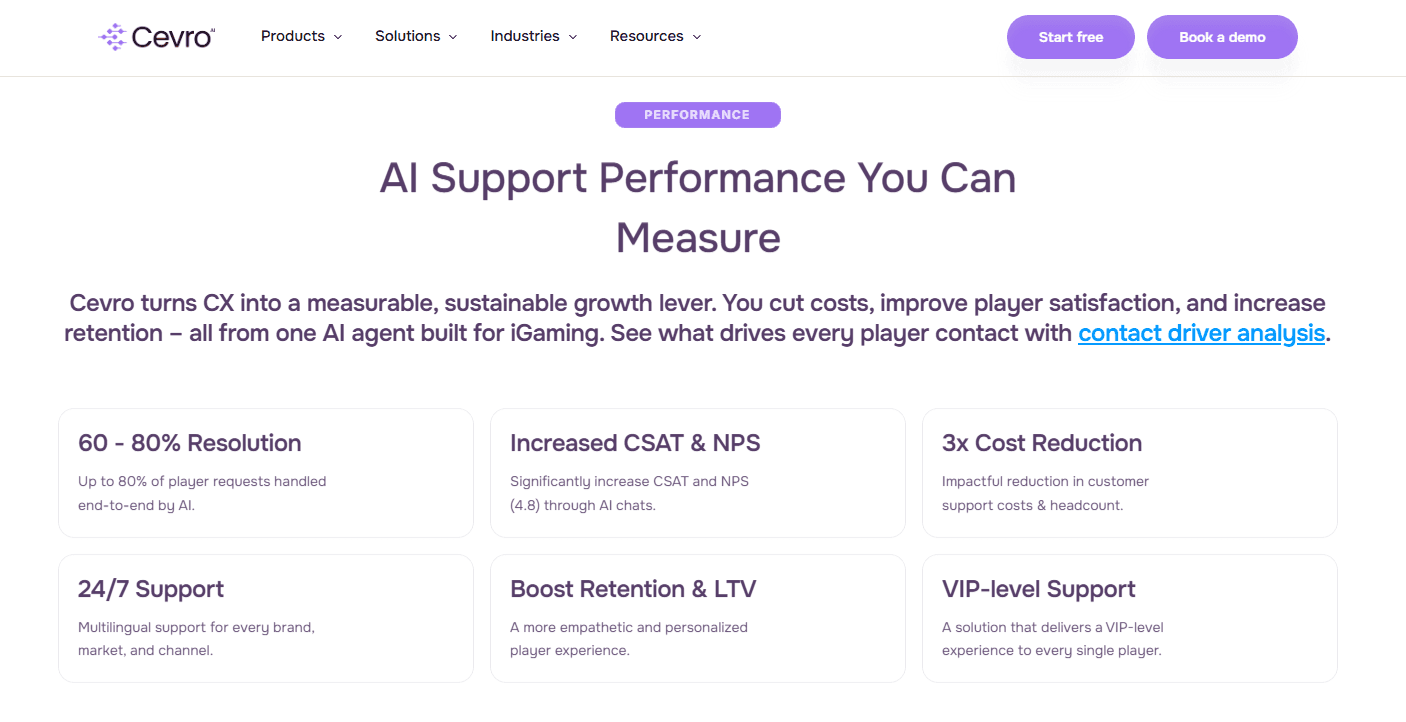
Cevro customers report a 3x reduction in support costs and headcount with CSAT and NPS at 4.8 out of 5. Alpha Affiliates absorbed 6,300 extra chats in one month with zero new hires. Licensing turns an uncertain capital project into a predictable operating cost.
10. Model Improvement Shared Across Every Operator on the Platform
Cevro's model improves with every interaction processed across its whole customer base. An in-house build learns from one operator's data only. That compounding gap widens every quarter you run them side by side.

When Building Your Own AI Agents Still Makes Sense
Some operators should build, and pretending otherwise would be dishonest.
Build if AI player support is the product you sell. Platform providers and BPOs that intend to package support AI as their own intellectual property have a real reason to own the stack.
Build if you already run a production ML organisation with shipped evaluation tooling, because the hardest part of this work is grading your own agent, not launching it.
Build if your volume is small and your needs are genuinely simple, since a basic FAQ layer is cheap and a full agent platform would be over-specified.
Licensing has costs too. Your procedures live inside someone else's platform. Pricing scales with volume, so a growth year raises the bill. You become one voice among many on a shared roadmap, and a feature you need may sit behind three you don't.
The honest trade is control for speed. Most operators find that trade worth making. Some don't, and they're not wrong.
Five Questions That Settle Build vs Buy for Operators
Is AI support a differentiator you'll sell, or a function you need working? If you won't productise it, buying wins on speed and risk.
Have you shipped a production ML system before? Teams without that track record sit inside the 88% that never reach production.
How many integrations does your stack need? Five or more separate connections usually breaks an in-house timeline before the model does.
What does 12 to 24 months of delay cost you? Price the automation you don't get while you build, not just the build.
Who owns a compliance failure on day one? If the answer is a team you haven't hired yet, that's your signal.
If you want the numbers for your own volume, Cevro's ROI calculator maps cost and automation against your ticket mix.
Where the Team at Cevro Lands on Build vs Buy
Cevro's position is that build vs buy is the wrong frame. The right question is simpler: what is your core business?
If it's running a casino or a sportsbook, the operational know-how that keeps an AI agent reliable is bought faster than it's accumulated. Expect more operators to settle on a hybrid through 2028, licensing the platform and owning the procedures. The pricing pressure that follows is harder to call.
Conclusion
Cevro is the AI player support platform built inside iGaming rather than adapted to it, which is why its agents open the back office, check the player's account and resolve the issue instead of explaining it.
Building the same capability in-house means 12 to 24 months, a seven-figure three-year cost, a compliance layer that has to be right on day one, and odds that MIT's research puts at roughly one in three.
Licensing compresses that into weeks and moves the risk onto a vendor whose only job is getting it right.
Book a demo and Cevro's team will map your top ticket categories to AI Procedures and project your ROI timeline against your real volume.
Read Next:
Best AI Agents That Integrate With Your PAM: Compatibility Guide for Casino and Sportsbook Operators
FAQs:
1. Should iGaming operators build their own AI agents or license a platform?
Most iGaming operators should license a platform rather than build their own AI agents, because MIT's NANDA research shows vendor-bought AI projects succeed around 67% of the time against roughly 33% for internal builds. Building makes sense only when AI support is a product you intend to sell.
2. How much does it cost to build an AI customer support agent in-house in 2026?
Building an AI customer support agent in-house in 2026 costs a realistic first-year minimum of $300,000 to $500,000, according to Fin AI's June 2026 analysis, with three-year total cost of ownership reaching seven figures for a mid-to-large operator once integrations, compliance and token spend are included.
3. How long does it take to build an in-house AI support agent for iGaming?
Building an in-house AI support agent for iGaming takes 12 to 24 months from scoping to live deployment. Licensing a platform like Cevro compresses that to weeks, with operators handling 100,000+ monthly chats going live in under 30 days.
4. What is the failure rate of in-house AI agent projects?
The failure rate of in-house AI agent projects is high: Forrester and Anaconda found in 2026 that 88% of AI agent pilots never reach production, and Gartner expects over 40% of agentic AI projects to be cancelled by 2027.
5. What makes Cevro different from a general-purpose AI agent platform?
Cevro is different from a general-purpose AI agent platform because it was built inside iGaming from the first line of code, with AI Procedures translating operator SOPs into executable workflows, native PAM and back-office integrations, and responsible gaming monitoring across 100% of conversations.