

AI agent workflows for regulated iGaming are multi-step jobs an AI agent completes inside an operator's systems, under the rules of the licence the player is on. Release a held withdrawal once KYC clears. Contact a player who just hit a responsible gaming trigger. Refuse a bonus to a player on a cooling-off period, even when they ask nicely at 1am.
In October 2026 three US regulators moved within two weeks of each other. New York and Massachusetts went after how operators use AI, and New Jersey made data-driven player monitoring mandatory. All three want to see what automated systems do with player data. If you run a US sportsbook, an iCasino in one of the seven iGaming states, a sweepstakes casino or a prediction market, the question has changed from "can we use AI agents?" to "can we show a regulator every step an agent took?"
We build and run AI agents for licensed casinos and sportsbooks, so this guide is written from the deployment side: which workflows regulators are pushing back on, which ones they now expect, and how to set them up so an audit is a report you export.
See an AI agent workflow run on your own platform →
Register now and start using Cevro today. Get access right away, and our onboarding team will help you connect your platform and set up your first AI agents. Start now →
What changed for AI in US iGaming in October 2026
Four states, four different moves, all this autumn.
New York. On 9 October the New York State Gaming Commission unanimously advanced a revised proposal on AI and automated systems. It would stop sportsbooks, affiliates and vendors from using AI to personalise promotions, bonuses, odds, betting limits, messages and product recommendations, and from suggesting specific wagers or amounts, unless the customer consents. The same meeting put operators "on notice" over a gap in responsible gaming data: a player restricted by one of the state's eight licensed sportsbooks can keep betting with the other seven (Covers).
Massachusetts. The Massachusetts Gaming Commission wrote to every licensed sports wagering operator on 9 October asking how they use AI and machine learning, with answers due by 3 November. The scope is wide. It covers any system that uses data to flag patterns, generate recommendations or influence decisions about patrons, wagering, promotions, responsible gambling, fraud, risk or account management, including cases where a human acts on what the system produced (Gambling.com).
Maine. The Gambling Control Unit is monitoring AI use at sportsbooks. Maine has no AI-specific gambling rules, but officials say existing advertising and responsible gambling rules can still apply to AI-driven marketing (BettingNews).
New Jersey. The Division of Gaming Enforcement now requires online casinos and sportsbooks to identify players showing signs of problem gambling from their data and to intervene in stages. The triggers are specific: deposits over $10,000 in 24 hours or $100,000 in 90 days, three cancelled withdrawals in 10 days, three visits to the self-exclusion page in 30 days without registering, a second cooling-off request within 45 days, a 50% jump in login time against the previous two weeks (Yogonet).
Read them together and the direction is clear. Regulators are wary of AI that sells. They are starting to require automation that protects. The money behind it explains the attention: US iGaming revenue reached $10.7bn in 2025 across seven states, up 27.6%, and sports betting reached $16.9bn (American Gaming Association, via Intergame).
AI agent workflows for regulated iGaming: the two kinds regulators separate
Every workflow an operator automates falls on one side of a line regulators are now drawing.
Commercial workflows | Protective workflows | |
|---|---|---|
What the agent does | Picks offers, odds boosts, messages or bet suggestions for a player | Spots risk, enforces limits, contacts players, holds or releases money under fixed rules |
What it's judged on | Engagement, deposits, revenue | Whether the rule was applied every time, and logged |
Regulator stance (US, Oct 2026) | Restricted or under review (NY proposal, MA disclosure letter) | Required (NJ monitoring and intervention rules) |
Consent needed | In New York's proposal, yes, for personalisation | No. These run for every player |
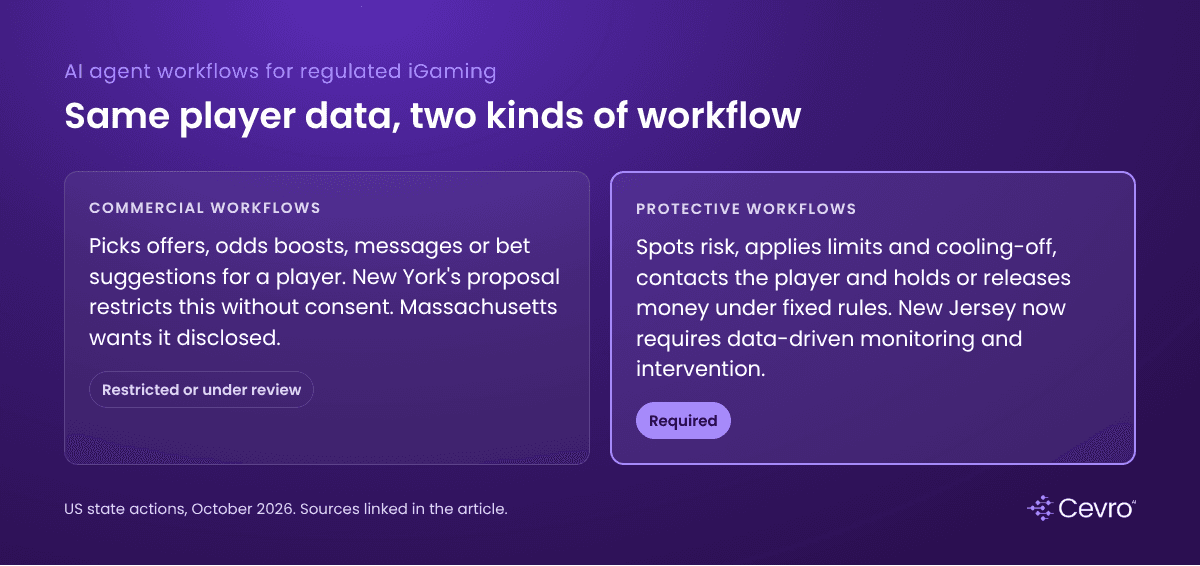
The same player data drives both kinds of workflow. Regulators now judge them very differently.
The awkward part is that both sides read the same data. A model that notices deposits rising and session time stretching can send a reload offer or it can send a responsible gaming check-in. Massachusetts asking about "patterns" and "recommendations" is a way of asking which of those two your systems actually do.
Our view: a regulated operator's AI agents should treat a risk signal as a stop sign for every commercial action. If a player trips a responsible gaming trigger, the agent stops offering anything, starts the protective procedure, and records both. That one rule removes most of the exposure the October letters are probing.
Five AI agent workflows US sportsbooks and casinos can run today
These are the workflows we see operators automate first in regulated markets, written so each step can be shown to a regulator.
1. Responsible gaming triggers and first-stage outreach
New Jersey's first intervention stage is an email telling the player about deposit, loss and time limits, cooling-off and self-exclusion. An agent can watch for the triggers in real time and send that contact the same day, in the player's language, with the tools linked from their own account. The second stage (an educational video before play resumes) and the third (direct phone or video contact with a person) are where your RG team takes over, with the history attached.
What the regulator sees: the trigger, the time it fired, the message sent, and when the case moved to a person.
2. Cancelled withdrawals and cooling-off requests
Three reversed withdrawals in ten days is now a named New Jersey trigger. Players rarely say "I'm chasing". They write in to ask why their withdrawal is pending, then cancel it. An agent that can see the cancellation history in the PAM can answer the payment question and flag the pattern in the same conversation. A second cooling-off request inside 45 days works the same way: the agent applies it immediately and opens the review.
3. KYC holds and source of funds
The highest-volume regulated workflow in most of our deployments. A withdrawal is held because a document expired or a source of funds check is outstanding. The agent tells the player exactly which document is missing, takes the upload, checks the status with the KYC provider, and releases the payment only when every precondition in the procedure is met. Large payouts wait for a person to approve. More on this in our guide to automating KYC for online casinos.
4. Self-exclusion and limits across brands
New York's complaint is about a player restricted at one sportsbook betting at another. Inside a multi-brand group the same gap exists between your own brands. An agent that handles a self-exclusion or limit request should apply it across every brand the player holds under that licence, confirm it back, and suppress all marketing from that moment.
5. Consent-gated personalisation
If New York's proposal passes as written, personalisation needs the customer's consent. The workflow change is small and worth making now: the agent checks a consent flag before sending any tailored offer, and a player with an open RG flag gets no offer at all, consent or not. Everything else in the support conversation carries on as normal.
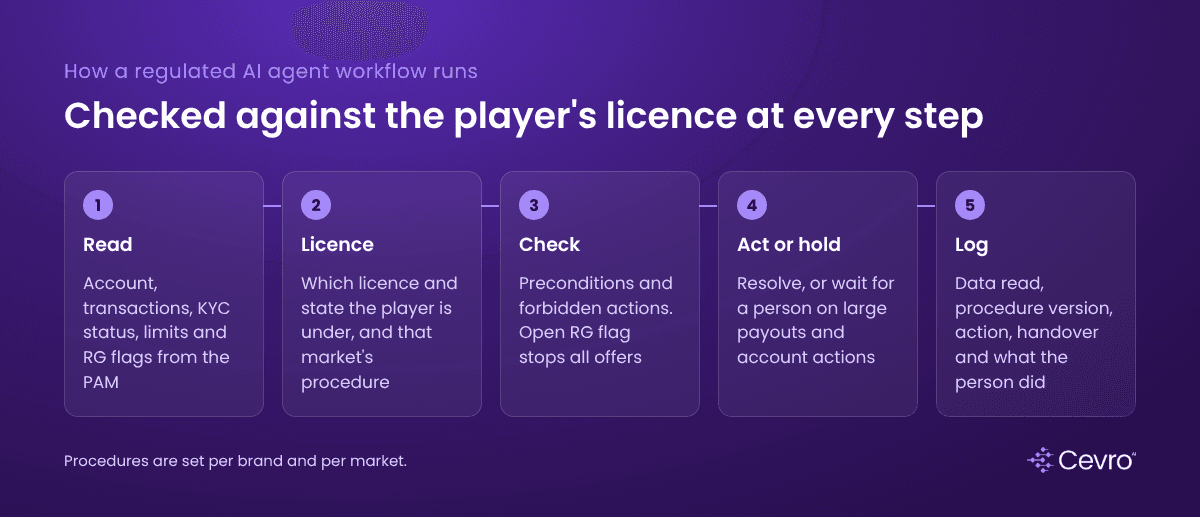
Every step is checked against the player's licence before the agent acts.
Sweepstakes casinos and prediction markets: rules that change by state
US brands outside state-licensed sports betting carry their own moving rules. California's AB 831 made it illegal from 1 January 2026 to run or facilitate dual-currency sweepstakes casinos, and Montana, Connecticut and New Jersey have also moved against them (CasinoBeats). For a sweepstakes brand, the support workflows that matter most are redemption requests, KYC before a prize payout, and a player writing in from a state where you no longer operate.
That last one is where agents earn their place. The agent reads the player's verified state before answering, follows the procedure for that state (close the account, pay out eligible prizes, stop marketing), and logs it. A person doing this from a list that changes every few months will get it wrong eventually.
Prediction markets have a similar shape: funding, withdrawals and contract settlement questions, with eligibility rules that depend on where the trader is. We cover both in more detail on our sweepstakes casino and prediction market pages.
Outside the US: the same workflows under UKGC and AGCO rules
Regulated operators rarely hold one licence. The workflows above carry over, with different thresholds.
United Kingdom. The Gambling Commission is phasing in financial risk checks for the highest-spending online customers. In the full programme, players aged 25 and over are checked above £1,000 net deposits in 24 hours or £3,000 over 90 days, and under-25s at £750 and £2,000 (Gaming.net).
Ontario. The AGCO fined theScore C$105,000 for failing to monitor and intervene with a high-risk player who wagered C$2.5m and lost about C$230,000 over eight months, citing the Registrar's Standards on identifying harm and monitoring risk (NEXT.io).
Same workflow, different numbers. That's why we set procedures per brand and per market. The agent reads which licence the player is under and applies that rule set: UK thresholds for a UK player, AGCO standards in Ontario, state rules in New Jersey.
What an auditor will ask for
Massachusetts made one point that changes how most teams log things: a human acting on an automated output still counts as an automated decision. So your records need both halves.
A workflow is audit-ready when you can export, for any player and any date:
The data the agent read (account, transactions, KYC status, RG flags).
The procedure and version it followed, and the licence that procedure belongs to.
Every action it took or refused, with the precondition that allowed or blocked it.
When and why it handed over, and what the person did next.
Proof that no commercial message went to a player with an open RG flag.
If any of these lives only in a chat transcript, it isn't auditable. Our guide to AI player support guardrails goes deeper on preconditions and forbidden actions.
The biggest compliance risks for AI agents in regulated iGaming
Most compliance risk with AI agents comes from five places. None of them is the model being "too smart".
Answers the agent makes up. An agent that improvises bonus terms or a withdrawal timeline creates a promise the operator may have to honour, and a complaint the regulator will read. Agents must answer from your live data and approved procedures only, and say "I'll get a person to check" when neither covers the question. We'd rather see an honest handover than a confident guess.
Acting on stale or partial data. An agent that can't see the latest KYC result or the cooling-off flag will act on an old picture of the player. This is the most common failure we see in deployments that skipped the PAM integration. Agents without live back-office access should not be allowed to take actions at all.
Commercial actions reaching flagged players. A reload offer to a player who just asked for a cooling-off period is the single outcome every regulator above is trying to prevent. Treat this as a hard rule in the procedure. A model output can never override it.
Human overrides nobody logged. Support teams override agents all the time, often for good reasons. If the override isn't recorded with a reason, your audit trail has a hole exactly where a regulator will look.
Data crossing places it shouldn't. Player data from one brand appearing in another brand's conversation, or personal data leaving the systems it belongs in. That's the next section.
Data isolation and classification
Regulated operators need to show where player data goes when an AI agent touches it. In practice that means three controls.
Classification. Mark which fields are personal data (name, address, ID documents, payment details), which are risk data (RG flags, self-exclusion, source of funds), and which are operational (bonus balance, bet history). The agent's procedure decides which classes it may read for each task. A bonus question doesn't need the passport scan.
Isolation by brand and licence. In a multi-brand group, an agent serving Brand A must not read Brand B's data unless the procedure needs it, for example applying a self-exclusion across every brand the player holds. Isolation is set per brand and per licence, the same way procedures are.
Retention and training. Personal data should be masked where the task allows and not kept after processing. At Cevro, player data is processed in real time and then discarded, PII is masked, and we do not train models on player data. That's what our SOC 2 Type II audit covers.
Keeping your helpdesk, adding agents
Regulated operators don't have to replace their helpdesk to deploy agents. The agents connect to the helpdesk you already run (Zendesk, Intercom, Comm100 and others), work the queue there, and hand over inside the same tool, so your customer support team keeps its views, macros and reporting. The difference from a chatbot is what happens before the reply: a chatbot answers from a script or a help centre, while an AI agent identifies the player, reads their account and completes the task under a procedure. For more on that difference, see AI agents vs chatbots.
Who is accountable when an AI agent gets it wrong
The licence holder. A regulator will not accept "the AI did it" any more than "the outsourced team did it". That shapes how you should deploy agents: every agent use case needs a named owner on your side, a written procedure that person signed off, and a review of the agent's decisions on a schedule, the same as any other risk management system you run. High-risk categories (large payouts, account closures, self-exclusion reversals) should always end with a person approving.
A governance framework for AI agents in iGaming
Governance sounds heavy. In practice it is a short list your risk and compliance lead can run every month.
An owner per workflow. One named person signs off the procedure and answers for it.
Procedures per licence. The same workflow can have a UK version, an Ontario version and a New Jersey version. The agent follows the one that matches the player.
A defined high-risk category. Large payouts, account closures, self-exclusion changes and anything touching source of funds always end with a person approving.
Visible agent reasoning. For any decision, your team can see what the agent read, which rule applied and why it acted or held. Black-box model outputs are not good enough for a regulator, and they're not good enough for your support lead either.
A review of agent activity on a schedule. Sample conversations, check every handover reason, and read the cases where a person overrode the agent. Overrides are where procedures go out of date first.
Change control. When a regulator changes a threshold, the procedure changes, gets a new version number, and the log shows which version applied to which conversation.
Clear data retention and model training rules. Written down, and checked by your auditor.
Done this way, AI agent compliance stops being a project and becomes part of the risk management framework you already run. It also helps the customer experience: players get the same answer at 3am that they'd get at 3pm.
Why integration depth decides whether a workflow is compliant
An agent can only enforce a rule it can see. If it can't read the cancelled withdrawals, the cooling-off history or the KYC status, it can't apply New Jersey's triggers, however good the model is. This is where most AI projects in regulated iGaming stall: the agent answers well in a demo and goes blind in production because the PAM integration was never finished.
Cevro is the most vertically integrated AI agent platform in iGaming. We have invested heavily in iGaming-native integrations and partnerships, so our agents are natively supported on the platforms operators already run, including Playtech IMS, Gr8 Tech, SoftSwiss, EveryMatrix, GiG, Bragg and Vegangster, with KYC providers such as Sumsub and Shufti and CRM tools such as Smartico. On a supported platform there is no custom build. See how the agents work across support, VIP, payments, KYC, risk, trading and CRM on our page about AI agents for iGaming.
How Cevro runs AI agent workflows for regulated brands
Each brand and market runs its own AI procedures, written by your team in plain language with preconditions, forbidden actions and escalation rules. Responsible gaming monitoring runs on every conversation. Every action is logged. Cevro is SOC 2 Type II audited, keeps zero player data after processing and does not train models on player data.
Operators typically resolve 80 to 90% of player tickets without a human, depending on their query mix and how deeply the agents are connected. In the US, SweepNext reached 90%+ automation and went from seven support agents to two with CSAT above 4.9. In Ontario, PowerPlay runs Cevro for its licensed sportsbook and casino.
For the full picture of what the agents do beyond support, read AI agents for regulated iGaming operators. For the support side on its own, see AI customer service for iGaming, and for compliance specifically, responsible gambling and compliance.
Getting started
Start with two or three protective workflows where the rules are already written down: KYC holds, cooling-off and limit requests, and first-stage RG outreach. Write the procedure for each licence you hold. Connect the agent to the PAM and KYC provider before it talks to a single player. Then check the export from step five above against what your regulator asked for this month.
Register now and start using Cevro today →
FAQ
What are AI agent workflows in regulated iGaming?
They are multi-step jobs an AI agent completes inside an operator's systems under the rules of the player's licence, such as releasing a held withdrawal once KYC clears or contacting a player who hits a responsible gaming trigger. Each step is checked against a written procedure and logged.
Can US sportsbooks use AI agents?
Yes. None of the October 2026 moves bans AI agents for player support or responsible gaming. New York's October 2026 proposal targets AI that personalises promotions, odds and bet suggestions without consent, and Massachusetts has asked operators to disclose how they use AI. Protective workflows, like New Jersey's monitoring and intervention rules, are increasingly required.
What did New Jersey require in October 2026?
New Jersey requires online casinos and sportsbooks to identify players showing signs of problem gambling from their data and intervene in three stages: an email about responsible gambling tools, an educational video before play resumes, then direct phone or video contact. Triggers include large deposits, cancelled withdrawals and repeated visits to the self-exclusion page.
Does a human reviewing an AI recommendation still count as automated?
In Massachusetts's October 2026 request, yes. The commission asked about systems where a human acts on an automated output, so operators should log both what the system produced and what the person did with it.
How do AI agents handle different rules for each licence?
Each brand and market runs its own procedures. The agent reads which licence the player is under and applies that rule set, for example UK Gambling Commission thresholds for a UK player, AGCO standards in Ontario and state rules in New Jersey.
Do AI agents work for sweepstakes casinos and prediction markets?
Yes. The main workflows are redemptions, KYC before payouts and state eligibility. The agent checks the player's verified state before answering, because sweepstakes rules now differ by state, with California, Montana, Connecticut and New Jersey among those that have acted.
What are the biggest compliance risks for AI agents in iGaming?
Made-up answers on bonus terms or payout times, acting on stale data, commercial offers reaching players with open responsible gaming flags, human overrides that aren't logged, and player data crossing between brands. Each one is controlled with procedures, live integrations and logging.
Can regulated operators use AI agents without replacing their helpdesk?
Yes. AI agents can connect to an existing helpdesk such as Zendesk, Intercom or Comm100, work the queue there and hand cases to your team inside the same tool.
Who is accountable when an AI agent makes a mistake?
The licence holder. Operators should give every agent workflow a named owner, a signed-off procedure and a regular review, and require a person to approve high-risk actions such as large payouts or account closures.
Which regulations do AI agents in iGaming have to follow?
The same rules as the operator: the conditions of each gambling licence (state regulations in the US, the UK Gambling Commission's requirements, the AGCO's Registrar's Standards in Ontario), anti-money laundering and KYC rules, and data protection law such as GDPR for European players. An AI agent follows them through the procedures written for each licence.
How do you stop an AI agent from making things up?
Limit it to answering from live account data and approved procedures, and require it to hand over when neither covers the question. Log every answer with the data it used, and review a sample on a schedule.
Which iGaming platforms is Cevro natively supported on?
Cevro is natively supported on all major iGaming platforms and PAMs, including Playtech IMS, Gr8 Tech, SoftSwiss, EveryMatrix, GiG, Bragg and Vegangster, plus Sumsub and Shufti for KYC and Smartico for CRM.
Related reading on cevro.ai