More than 80% of gambling companies now run generative AI somewhere in the business, according to the State of AI in Gaming 2026 benchmark published by the UNLV International Gaming Institute's AI Research Hub and KPMG in April 2026.
Almost none of them let it touch a live player ticket. Agentic adoption stayed limited, held back by compliance and player-safety concerns, which means the layer closest to churn is the layer least automated.
Cevro was built to close that specific gap. It's an AI player support platform built inside iGaming, deploying autonomous AI agents that resolve bonus, KYC, payment and responsible gaming queries end to end rather than deflecting them into a queue.
This piece breaks the iGaming AI stack into seven layers, ranks the 15 tools worth shortlisting in 2026, and names the gap most operator stacks still have.
Key Takeaways
Cevro ranks first: iGaming-native autonomous player support, with up to 90% ticket automation.
Over 80% of gambling firms use generative AI (UNLV IGI/KPMG, April 2026), but agentic adoption stays limited.
The stack splits into seven layers: support, CRM, personalisation, RG, KYC, geolocation, intelligence.
Deflection isn't resolution. Median enterprise tier-1 deflection sits at 41.2%; Cevro reports 80–95% autonomous resolution on operational workflows.
Building in-house realistically takes 12–24 months and a seven-figure three-year TCO for a mid-to-large operator.
Why AI Tooling Became a Board-Level Decision for iGaming Operators in 2026
Four pressures converged this year. Every serious AI purchase in iGaming traces back to at least one of them.
1. iGaming market growth is outpacing support capacity
Forecasts differ on the exact figure. Mordor Intelligence puts the 2026 online gambling market at roughly $121.9 billion; Grand View Research puts it at $97.7 billion, with Europe holding more than 41% of global share. Aggregate analyses cluster between $101 billion and $116 billion.
The direction is the same in every source: sustained double-digit annual growth to the end of the decade.
North America is compounding at roughly 15.4% a year through 2031, and Brazil opened its licensing regime in January 2026. Each new market brings a new language, a new regulator, a new payment rail and a new support queue.
2. AI ambition is running ahead of AI governance
The UNLV IGI and KPMG benchmark surveyed 83 gambling organisations and 113 regulators. It scored the industry's average AI maturity at 45 out of 100, and AI governance at just 30 out of 100.
The problem is that the cost reduction is the leading driver of adoption, yet only one in five organizations reports meaningful ROI within two years, and one in four has no structured evaluation process at all. Nearly a third report no Responsible AI framework, and fewer than 20% have a dedicated AI governance role.
3. Multilingual support costs scale with every new market
In Malta, still the industry's operational centre, an English-only support agent starts at €18,000–€20,000 gross. A Finnish, German or Japanese speaker commands €24,000–€28,000, per the FreeMalta 2026 benchmark drawing on the Boston Link iGaming Salary Report.
Language is a pricing mechanism, not a soft skill.
Add shift differentials for 24/7 cover, recruitment, ramp time and attrition, and a 30-agent multilingual team is a seven-figure annual line before a single ticket is answered.
Gartner benchmarks the median cost per contact at $1.84 for self-service against $13.50 for agent-assisted, a 7x gap, and puts labour at up to 95% of contact centre costs.
4. Regulators now expect evidence of harm reduction, not policy
Responsible gaming expectations shifted from proving a policy exists to proving harm is reduced in practice. That theme runs through both the SOFTSWISS 2026 iGaming Trends Report and the UNLV benchmark, which found regulators in Belgium, Finland, Italy and several US and Canadian jurisdictions actively encouraging AI-driven player protection monitoring.
The same report flags a live problem: regulators report low confidence in their ability to oversee how licensees actually use AI. That means the operator who can produce a clean audit trail on request sits in a materially better position than the one who can't.
The market has also started consolidating. Optimove announced an agreement to acquire Smartico on 6 April 2026, bringing two of the most established iGaming CRM platforms under one owner while both continue operating independently.
When category leaders start buying each other, the buying decision changes shape. You're no longer picking a point tool. You're picking infrastructure you'll live with for years.
The Seven Layers of AI Tooling in iGaming Explained
An AI tool isn't a category, it's seven categories that happen to share a technology, and confusing them is the most common reason operators end up with overlapping licences and gaps in the same stack.
# | Layer | What it does | Failure mode if missing |
|---|---|---|---|
1 | AI player support | Resolves player tickets end-to-end across bonuses, KYC, payments, RG | Escalating headcount, slow FRT, inconsistent CSAT |
2 | AI CRM & engagement | Segments, times and personalises campaigns and bonuses | Generic promotions, wasted bonus spend, churn |
3 | Personalisation & game data | Recommends content and mechanics from gameplay behaviour | Flat lobbies, poor cross-sell, low session value |
4 | Responsible gaming | Detects markers of harm and triggers intervention | Regulatory exposure, reportable failures, fines |
5 | KYC, AML & fraud | Verifies identity, screens risk, blocks bonus abuse | Onboarding drop-off, chargebacks, licence risk |
6 | Geolocation & compliance | Confirms jurisdiction, blocks spoofed or out-of-state play | Regulatory breach in state-by-state markets |
7 | Market intelligence | Models share, demand and competitor movement | Blind market entry, mispriced acquisition |
Two things matter here.
First of all, layers 1 and 2 are the ones operators most often assume overlap. They don't. A CRM decides what to say to a player and when. An AI support agent platform decides what to do about the player's problem right now.
Second, only layer 1 touches the player at the exact moment frustration converts into churn. That's why it leads this list.
There's a measurable blind spot behind this. The UNLV benchmark found AI activity concentrated in technology, security and product innovation, nearly half of all initiatives, while regulators most often assume licensee activity sits in customer-facing functions.
Attention is climbing fast either way with AI-focused conference sessions rising from three in 2020 to 81 in 2025, and annual AI-related gambling patent filings went from 15 in 2010 to 100 in 2025.
For the terminology used across these layers, including automation rate, deflection, containment, multi-turn reasoning and back-office integration, Cevro maintains a public AI Support Glossary.
How This Ranking of iGaming AI Tools Was Built
Every tool below was assessed against six criteria:
iGaming nativeness: Built for operators, or adapted after proving itself elsewhere?
Depth of action: Can it read and write to operational systems, or only read and recommend?
Compliance architecture: Is regulatory behaviour designed in, or configured on top?
Evidence of scale: Are there named deployments with published outcomes?
Integration reality: Are connectors production-tested, or bespoke per client?
Time to measurable value: Weeks, quarters, or an internal roadmap item?
Two caveats before the list, both of which cut against the article.
AI isn't a universal differentiator in iGaming. Plenty of profitable operators run without deep AI in several of these layers, and as EvenBet Gaming put it in its 2026 outlook, AI offers clear advantages under the right conditions rather than working as a plug-and-play fix.
And the entries aren't sourced equally. The Cevro entry draws on published customer outcomes and product documentation. The other 14 are based on each vendor's public positioning and category reputation, and the pros and cons attached to them are editorial judgement about fit, not audited findings.
The 15 Best AI Tools for iGaming Operators in 2026
1. Cevro.ai: Best Overall AI Tool for iGaming (Autonomous Player Support)
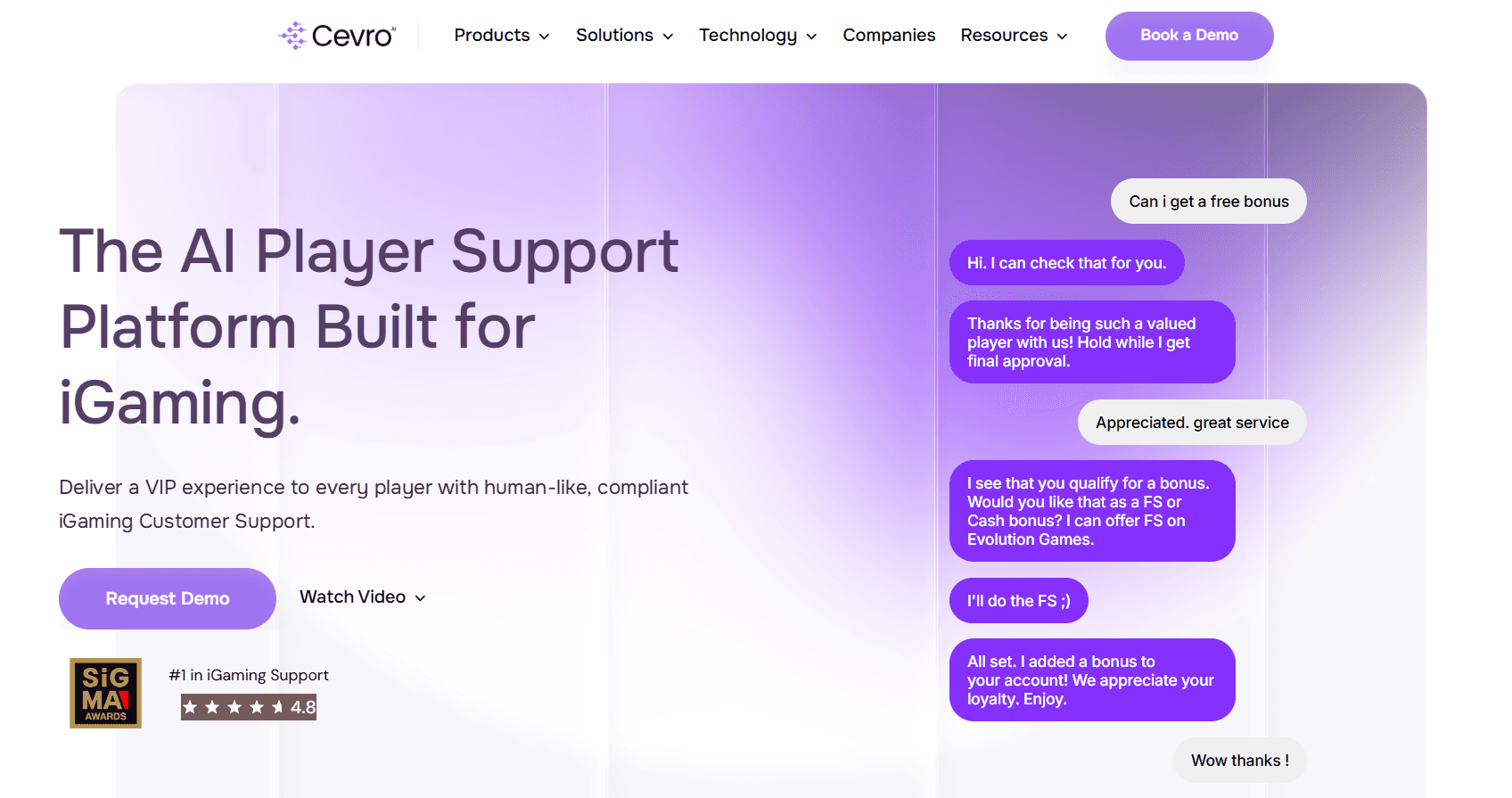
Cevro is an AI player support platform for iGaming, and it takes the top position for a structural reason: it operates at the precise moment player frustration converts into churn.
A player whose withdrawal hasn't landed isn't in a marketing funnel. They're one click from a competitor.
Every other tool on this list reaches that player earlier or later in the lifecycle. Cevro is the one that acts during it.
The distinction it's built on is deflection versus resolution:
A chatbot tells a player where to find their transaction history.
A Cevro.ai agent checks it, cross-references it against the payment gateway, and resolves the issue.
That comes from the proprietary AI Procedure Engine, which converts an operator's existing SOPs into AI Procedures (AIPs): structured, declarative workflow specifications, written in constrained natural language, that the engine executes step by step with guardrails.
Here's what that looks like on a real ticket: A "missing withdrawal" AIP verifies identity, queries the payment gateway and account logs, cross-references withdrawal limits, brand policy, KYC status and RG flags, then either advises on timing or opens a back-office ticket with full context.
Instead of a generic FAQ, the player gets: "Your €50 deposit is pending PSP approval, expected in 15 minutes."
Because AIPs are human-readable rather than code, your operations leads shape them directly. Adding a use case is an ops task, not a developer ticket.
Platform architecture
Three products work together:
Cevro.ai Agents: the player-facing resolution layer running on the AIP engine across chat, email and helpdesk. Voice is on the roadmap, not live.
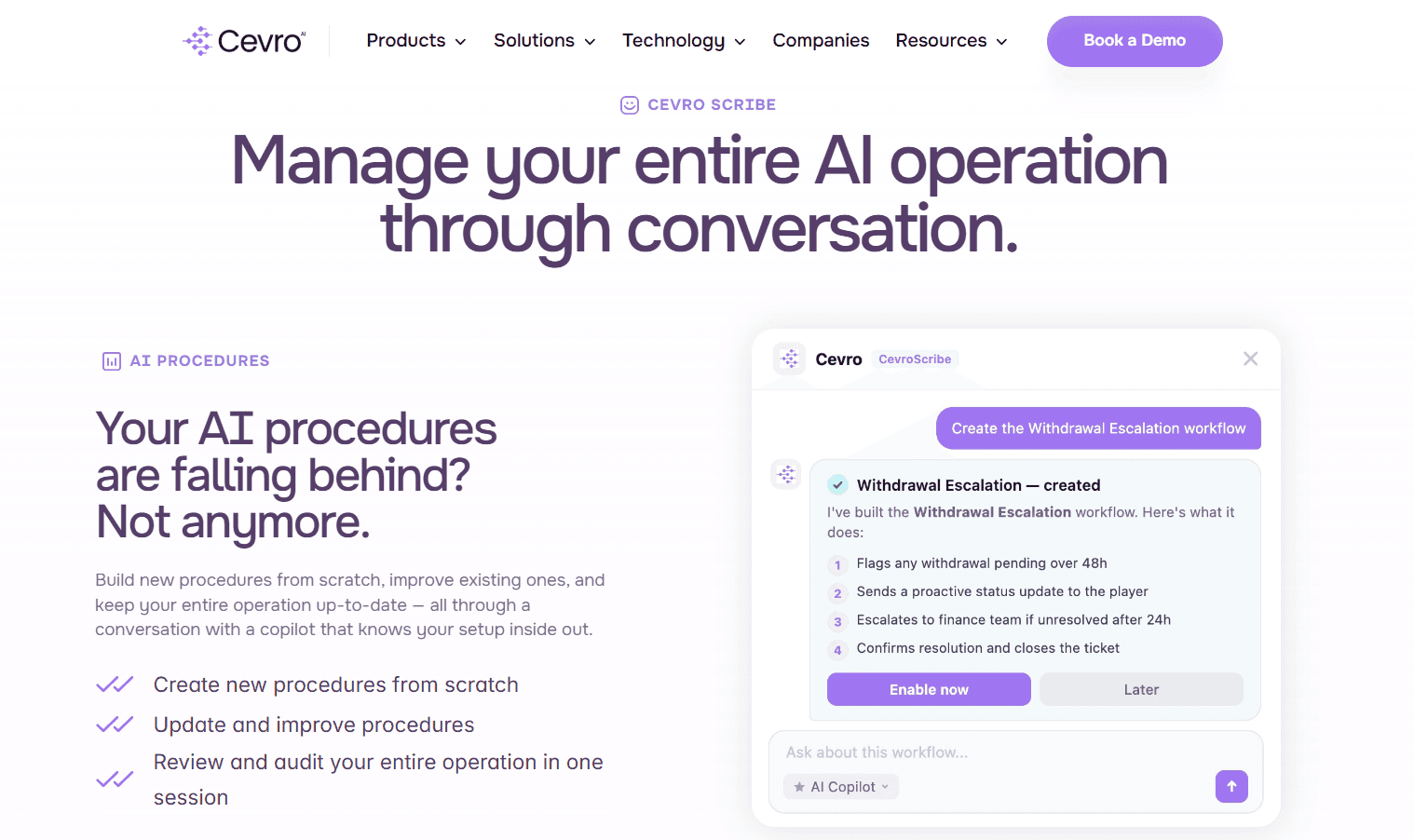
CevroScribe: an AI copilot that lets your own team build, audit and update procedures through conversation, and ingest promotion terms in seconds. It solves the failure mode that breaks most generic AI support: stale knowledge.
Cevro Insights: the causal intelligence layer that clusters every conversation into topics and surfaces churn signals, VIP frustration alerts and procedure gaps before they become ticket spikes.
Compliance and integrations
Cevro is SOC2 Type II audited, EU and GDPR compliant, PII masking, zero data retention, no model training on client data.
Every AIP opens with preconditions and a hardcoded forbidden-action list. RG monitoring covers 100% of conversations, against an industry norm of 2–7% manual sampling. Every action writes an immutable audit log of the data accessed, the decision made and the action taken.
That's exactly the evidence the UNLV benchmark found regulators struggling to obtain.
Proven outcomes
This is where the ranking stops being architectural and becomes evidential:
iPlay Gaming Platform: 80,000–100,000 live chats a month across seven regulated markets. 91% AI support automation, manual workload down around 40%, and a staged move from 30 CS agents to 15 without quality loss.
SweepNext Casino: a sweepstakes operator whose dual-currency mechanics and Sweeps Coin redemption flows generic platforms couldn't model. 90%+ automation, 4.9+ CSAT, 40+ live AI Procedures, headcount from 7 to 2.
Alpha Affiliates: a Tier 1 multi-brand operator at 81% automation and 4.8+ CSAT. Two simultaneous brand launches generated an extra 6,300 chats in one month with zero new hires. Head of VIP Julija Kozireva reports at least a 10% increase in player LTV.
Platform-wide, Cevro reports up to 90% automation, 80%+ of requests handled end-to-end, CSAT and NPS at 4.8/5.0, a 3x reduction in support costs and headcount, and coverage across 100+ languages, 50+ markets and 100+ iGaming brands.
Pros
Built for operators from the first line of code rather than adapted from retail or SaaS, which Cevro positions as making it the only iGaming-native enterprise AI support provider.
Executes back-office actions (deposit verification, KYC, bonus disputes) instead of deflecting to a knowledge base.
Compliance is architectural: SOC2 Type II, PII masking, zero retention, 100% RG monitoring, immutable audit trails.
Named, published outcomes at scale across three very different operator profiles.
Ops-led expansion through AIPs and CevroScribe, so new use cases ship in weeks without developer bottlenecks.
Cons
Voice is on the roadmap rather than live, so heavy inbound phone volume still needs a separate layer today.
Purpose-built for iGaming, which makes it the wrong fit for a group running significant non-gaming service lines on the same platform.
The ops-led model only pays off if your CS leads actually own the procedures. Operators who route every change through a vendor ticket see slower iteration.
2. Optimove: Best for Enterprise Predictive CRM
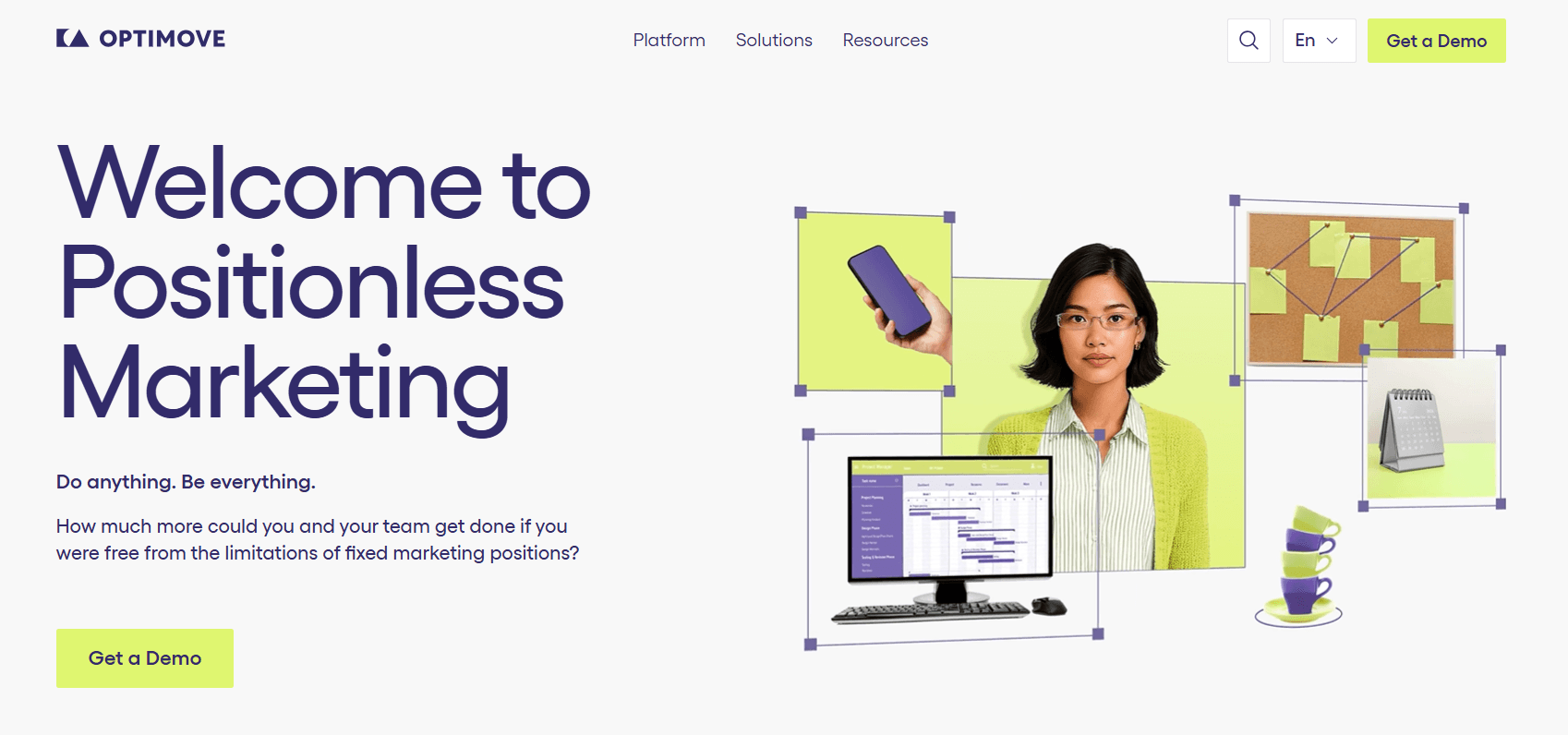
Optimove is among the most widely deployed predictive CRM platforms in iGaming, founded in 2009 and built around the data patterns specific to digital gaming: high-frequency transactional events, lifecycle segmentation and probabilistic churn modelling.
Its Player Engagement Platform unifies player data into a single view, regroups players into micro-segments as behaviour changes, then orchestrates multi-channel campaigns against those segments. The April 2026 Smartico acquisition adds gamification mechanics to an already deep analytical stack.
For campaign execution across a large player base, it's a category benchmark. What it doesn't do is touch a live ticket.
Optimove can tell you a VIP's churn probability rose. It can't check why their withdrawal is stuck and fix it. That's why the two sit in different layers of the same stack rather than competing for the same budget line.
Pros
Deep predictive segmentation built specifically for gaming data patterns.
Extensive multi-channel campaign orchestration with a built-in CDP.
Gamification capability added through the April 2026 Smartico acquisition.
Cons
Needs meaningful in-house data science and CRM resource to reach full value.
Enterprise implementation timelines typically run longer than specialist point tools.
Marketing layer only. No back-office execution, no ticket resolution.
3. Fast Track: Best for Real-Time CRM Automation
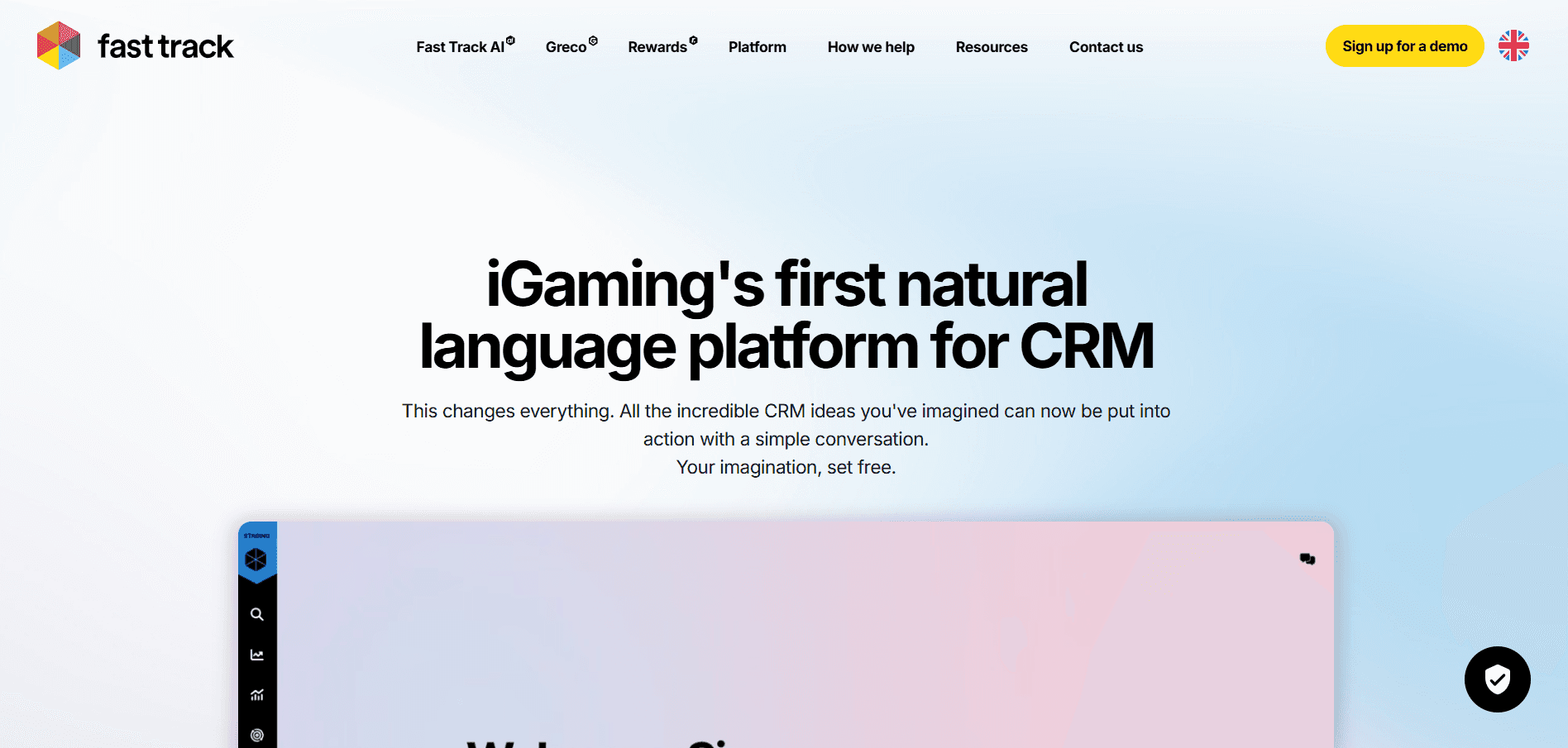
Fast Track is a cloud-native, event-driven CRM built exclusively for iGaming, with a client base concentrated among Nordic and European brands. Its bet is on latency: reacting to a player event within seconds rather than within a batch cycle.
For bonus automation, real-time reward triggers and live intervention against behavioural signals, that architecture is a genuine advantage. The value of a churn signal decays fast.
Fast Track and Cevro solve adjacent halves of the same retention problem. Fast Track fires the right message at the right second. Cevro resolves the reason the player was about to leave in the first place.
Operators running both typically feed support-derived signals into CRM triggers, which is what Cevro Insights was designed to surface.
Pros
Event-driven architecture built only for iGaming, with genuine sub-second reaction.
Strong bonus and reward automation with fast operator-side configuration.
Established presence among Nordic and European operators.
Cons
Less analytical depth than Optimove for large-scale predictive modelling.
Value depends heavily on the quality and completeness of upstream event data.
No resolution capability. It messages players; it doesn't solve their tickets.
4. Smartico: Best for Gamification-Led CRM
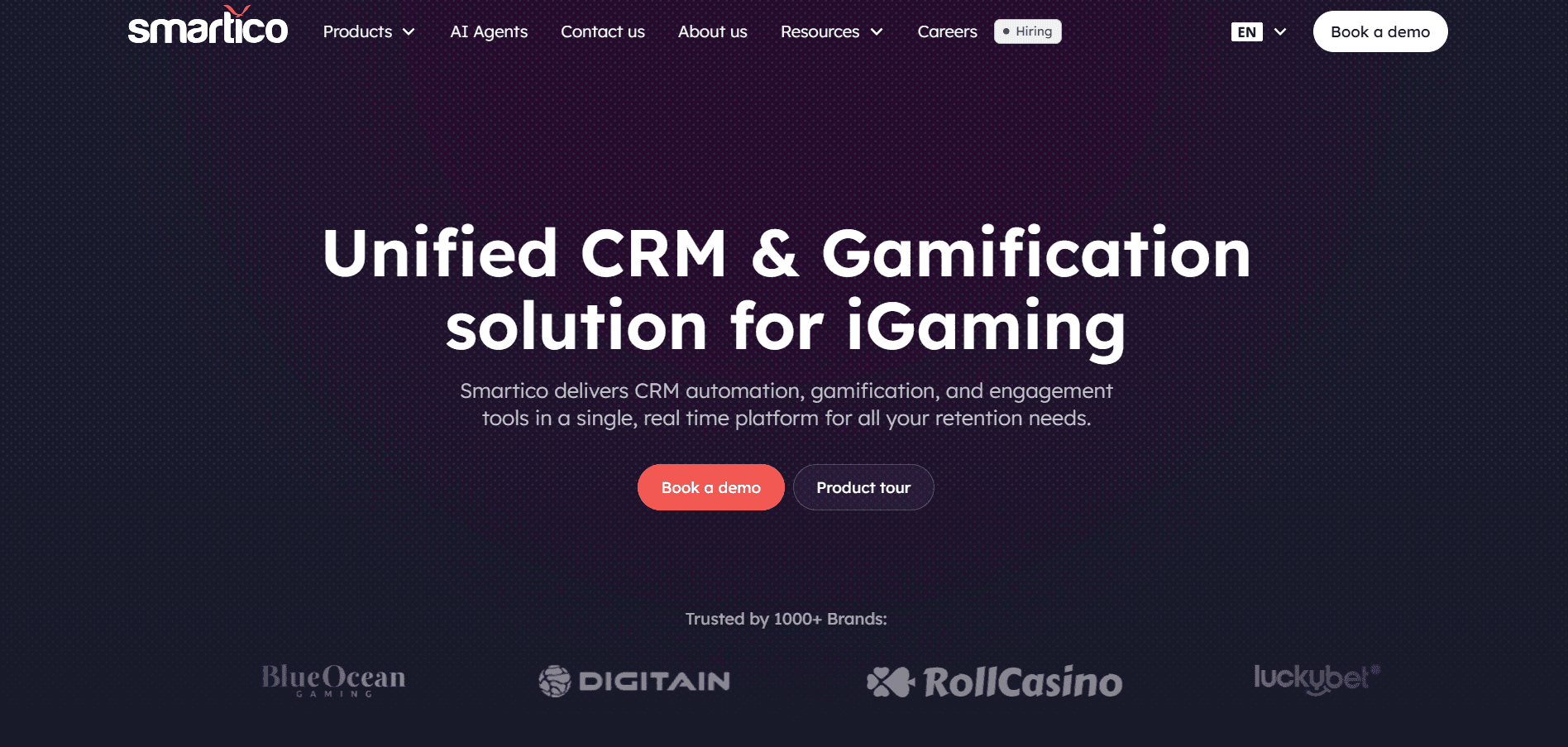
Smartico brought gamification and CRM marketing together for iGaming, building around missions, tournaments, levels, jackpots, free-to-play mini-games and bonus engines driven from one place. Acquired by Optimove in April 2026, it continues operating independently with its founders retaining product and roadmap control.
Smartico is also a named Cevro integration partner. Cevro.ai agents can autonomously trigger minigames, modify segmentation attributes and push CRM events, then react to Smartico responses inside the same conversation.
That's the stack logic of this whole article in one example. The strongest results come from the engagement layer and the resolution layer talking to each other, not from one trying to be the other.
Pros
Gamification engine purpose-built for iGaming loyalty mechanics.
Combines CRM automation, bonus engine and gamification in one platform.
Integrates directly with Cevro.ai agents for conversation-triggered engagement.
Cons
Gamification depth can outrun operator capacity to design and maintain the mechanics.
The April 2026 ownership change adds medium-term roadmap uncertainty for cautious buyers.
Player-facing messaging only. No back-office resolution, no RG conversation monitoring.
5. Xtremepush: Best for Vendor Consolidation
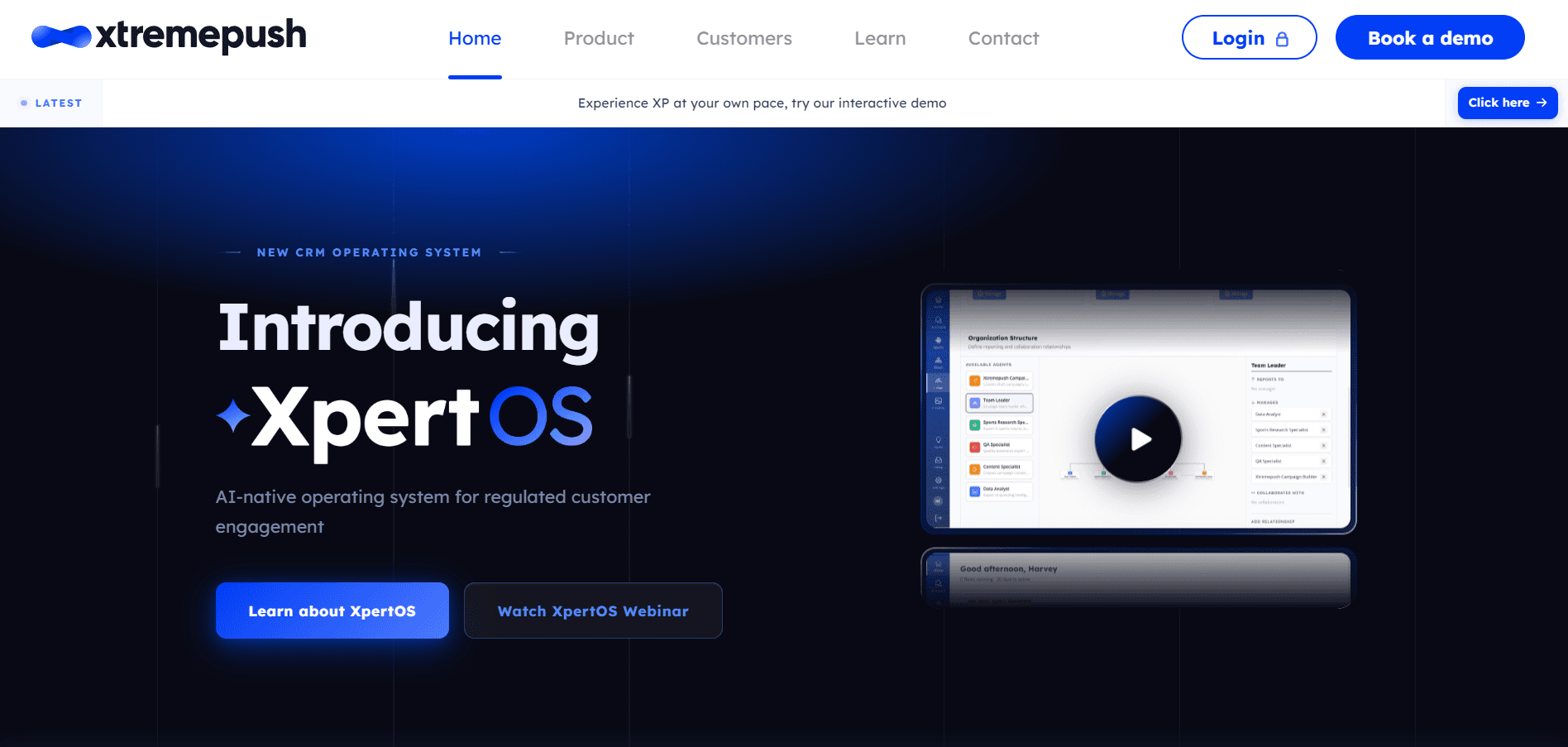
Xtremepush combines a customer data platform, campaign orchestration and loyalty into one architecture, which removes the integration debt that builds up when CDP, CRM and loyalty come from three vendors. Specialist iGaming CRM implementations in this category commonly run four to eight weeks, faster than enterprise-suite alternatives.
The consolidation argument is real, and it's the same argument Cevro makes one layer down: a unified platform with production-tested connectors beats a stitched-together set of point tools.
The difference is scope. Xtremepush consolidates the marketing stack. Cevro consolidates the support operation.
Pros
Unified CDP, engagement and loyalty removes cross-vendor integration overhead.
Typically faster to implement than broad enterprise engagement suites.
Strong real-time execution across push, email, SMS and in-app.
Cons
Needs platform training investment to unlock the more advanced features.
Less specialised than dedicated iGaming CRMs on gaming-specific modelling.
Marketing scope only. No ticket resolution, KYC handling or RG escalation.
6. Solitics: Best for Real-Time Data Activation
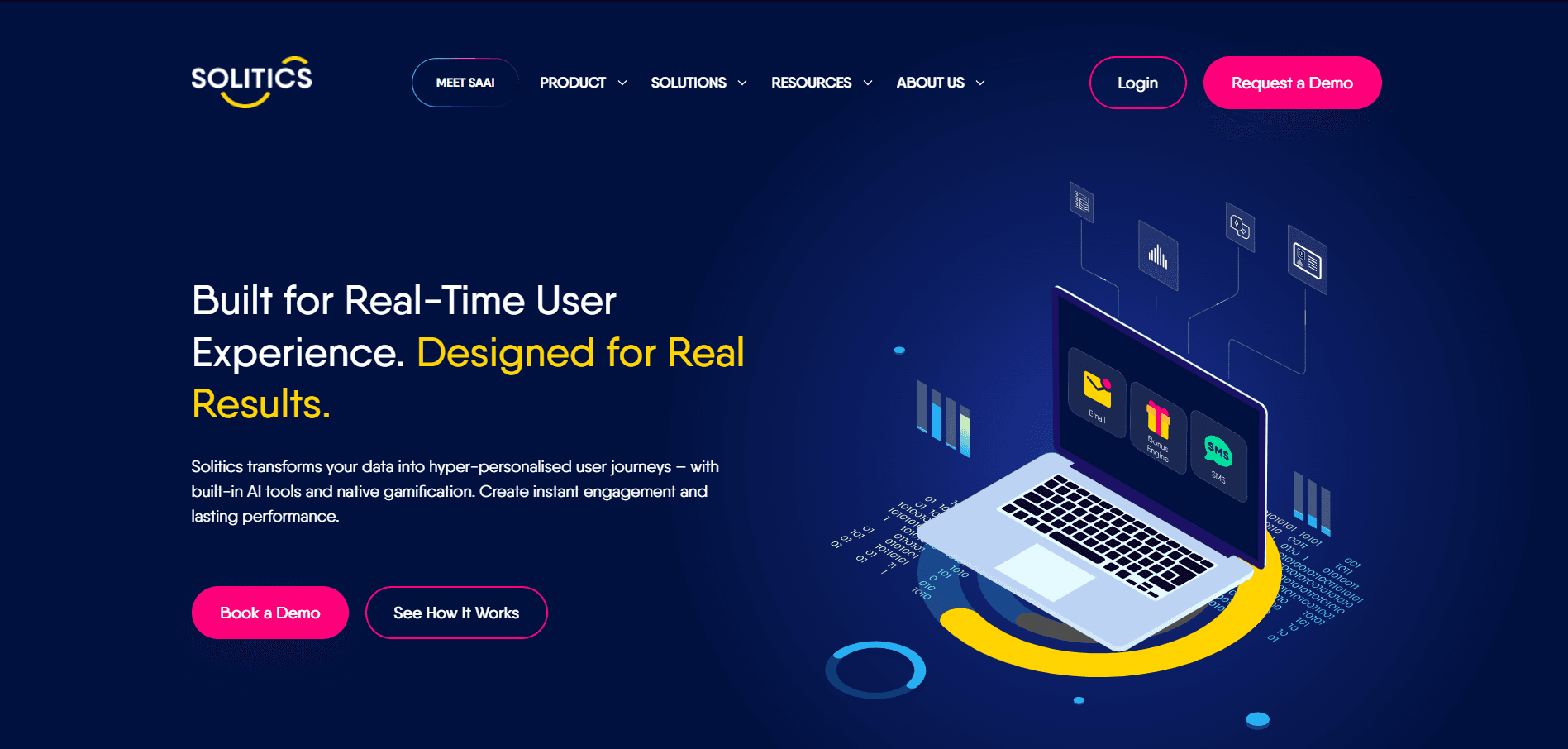
Solitics connects to an operator's existing data sources and activates that data in real time, surfacing historical and live player behaviour into personalised journeys without a lengthy warehouse project first.
For operators whose player data sits across a PAM, a payments provider, a game aggregator and a legacy CRM, acting on unified data quickly is the main draw.
It's a plumbing-and-activation layer, not an intelligence layer. It moves the right data to the right place fast. It doesn't tell you why your CSAT dropped six points in a region. That's the causal question Cevro Insights was built to answer by reading the conversations themselves.
Pros
Rapid connection to fragmented data sources without a full warehouse rebuild.
Real-time personalisation across marketing and product surfaces.
Suited to mid-size operators without deep data engineering teams.
Cons
Overlaps with CRM tooling, creating potential duplicate spend.
Output quality depends entirely on source data hygiene.
No conversational analysis and no operational execution.
7. Symplify: Best for Multi-Channel Communication
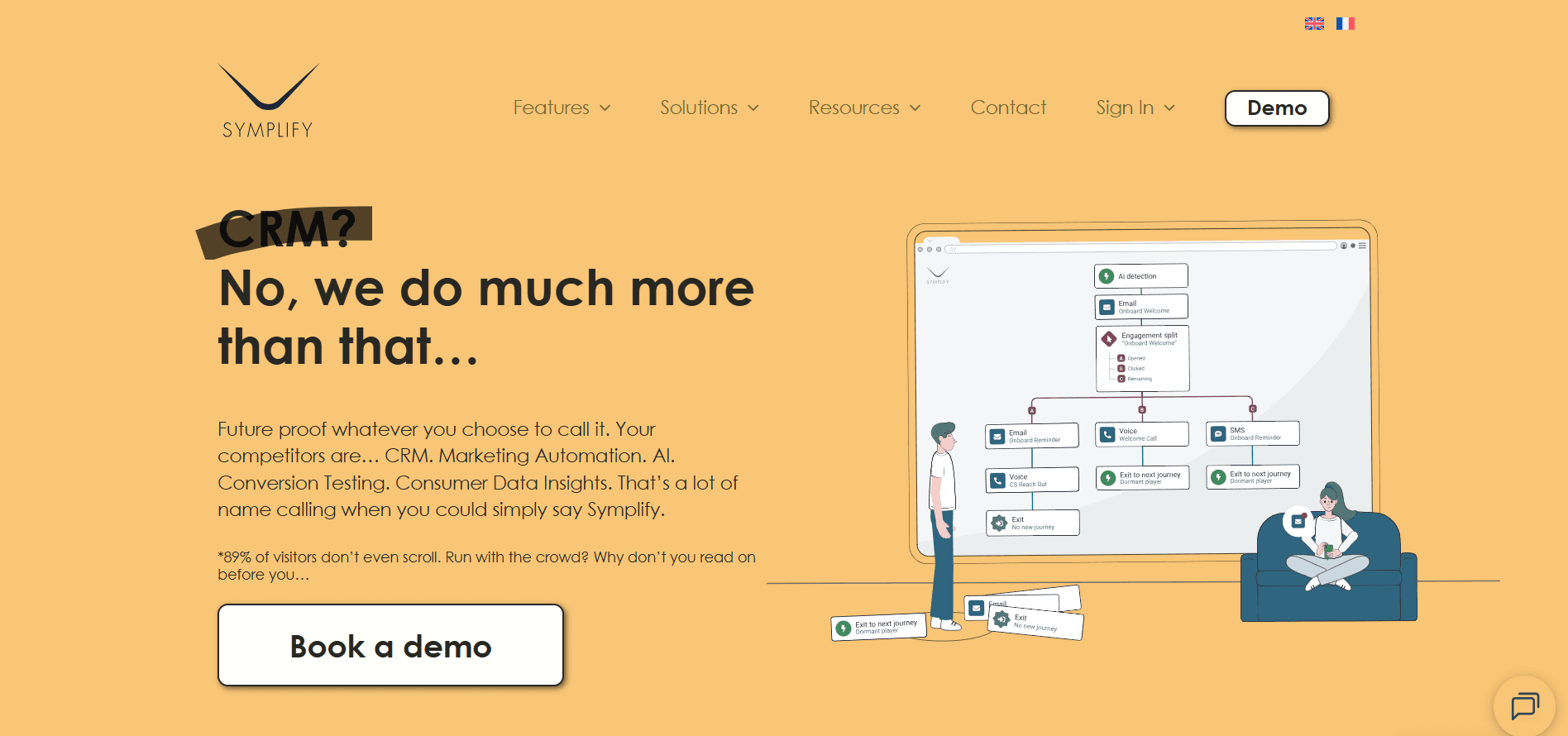
Symplify is a multi-channel communication and CRM platform with a long track record among European operators, focused on lifecycle messaging, journey building and channel orchestration. Its strength is the craft of communication: building, testing and measuring player journeys across email, SMS, push and on-site.
The boundary is the same as every CRM entry here. Symplify shapes the conversation an operator initiates. Cevro handles the conversation the player initiates, the one carrying the money question and the compliance risk.
Pros
Mature journey-building and multi-channel orchestration.
Established European operator base with strong deliverability practice.
Straightforward for CRM teams to run without engineering support.
Cons
Lighter predictive modelling than Optimove or Fast Track.
Fewer gaming-specific mechanics than gamification-led alternatives.
Outbound only. No inbound resolution, no back-office actions.
8. Future Anthem: Best for Gameplay-Level Personalisation
Future Anthem applies machine learning to granular gameplay data, down to spin-level behaviour, to inform which content to surface, which bonus to offer and which players show signs of unhealthy play.
That vantage point differs meaningfully from CRM tools that model from deposits and sessions. It serves both sides of the market: studios use it to understand how content performs in the wild, operators use it to personalise lobbies and promotional mechanics.
Pros
Personalisation grounded in actual gameplay data rather than transaction history.
Serves operators and content studios from the same data model.
Overlaps usefully with safer-gambling signal detection.
Cons
Requires deep game-data integration to deliver full value.
Narrower scope than a full CRM or engagement suite.
No player-facing conversational layer or support automation.
9. Mindway AI: Best for Player Protection Scoring
Mindway AI focuses on player protection, combining machine learning with expert-informed assessment to score players for markers of harm and prioritise intervention. In markets where regulators expect demonstrable harm reduction rather than a documented policy, a dedicated scoring layer is increasingly standard.
Behavioural scoring and conversational monitoring are complementary, not duplicate.
Mindway reads what a player does: deposit velocity, session escalation, chasing patterns. Cevro reads what a player says, monitoring 100% of conversations for distress language and RG signals and triggering mandatory human escalation.
A player whose behaviour looks normal but whose chat message doesn't is only caught by the second.
Pros
Specialist player protection models designed for regulated markets.
Blends automated scoring with expert assessment methodology.
Produces demonstrable compliance evidence for regulators.
Cons
Single-purpose tool that needs a wider stack around it.
Behavioural data only. It doesn't read the support conversation.
Adds another vendor relationship to an already crowded compliance stack.
10. Neccton: Best for Established RG Analytics

Neccton's mentor product is one of the longer-standing responsible gambling analytics tools in the industry, grounded in academic research into gambling behaviour and deployed among European operators.
Where Mindway leans on scoring and prioritisation, Neccton's heritage is behavioural research translated into operational flags and player-facing feedback.
Pros
Long operational track record and research-backed methodology.
Familiar to European regulators and compliance teams.
Combines detection with player-facing behavioural feedback tools.
Cons
Presentation and workflow feel more traditional than newer entrants.
Narrow single-layer scope within the compliance stack.
No conversational monitoring and no support-side execution.
11. Sumsub: Best for AI-Driven KYC and AML
Sumsub provides AI-powered identity verification, KYC, KYB and AML screening for high-volume onboarding across jurisdictions. KYC is one of the most damaging friction points in the player lifecycle, because it lands at the exact moment a first-time depositor decides whether the brand is worth the effort.
Sumsub is also a Cevro partner, and the integration shows stack depth rather than tool sprawl. Identity verification is embedded into Cevro's AI infrastructure so full KYC flows run autonomously inside the chat, instead of sending the player to a separate portal and hoping they come back.
As Cevro CEO Chaim Heber put it at announcement in January 2026:
"KYC drives massive contact volume and player drop-off early in the journey. We've already automated 80%+ of tickets. This Sumsub integration makes us the most vertically integrated AI platform for real-world iGaming support."
Pros
Broad global coverage across KYC, KYB and AML in one provider.
Fast, high-volume verification suited to regulated iGaming onboarding.
Embeds directly into Cevro AI agents for in-chat verification flows.
Cons
Verification layer only. It does not manage the surrounding support conversation.
Per-verification cost models scale directly with acquisition volume.
Jurisdictional coverage and document support vary by market.
12. SEON: Best for Fraud and Bonus Abuse Prevention
SEON approaches risk from the digital footprint angle, enriching signals from email, phone, device and IP to score risk in real time. In iGaming that means multi-accounting detection, bonus abuse prevention and payment fraud screening, all of which quietly erode promotional ROI when unmanaged.
Fraud tooling and support automation intersect more than most operators expect. Bonus abuse detection has to be visible to whoever handles the resulting dispute, which is why Cevro's AIPs read fraud and risk markers as preconditions before any bonus-related action is permitted.
Pros
Digital footprint enrichment catches abuse patterns that transaction-only models miss.
Real-time scoring with transparent, tunable rules.
Strong fit for promotional abuse and multi-accounting in iGaming.
Cons
Rule tuning requires ongoing risk team ownership.
Overlaps with PAM-native fraud modules for some operators.
Risk layer only, with no player communication or resolution capability.
13. GeoComply: Best for Geolocation Compliance
GeoComply is the reference point for geolocation compliance in regulated markets, particularly the United States, where the legality of a wager depends on which side of a state line the player is standing on. It detects location spoofing, VPN use and jurisdictional violations at the point of play.
In a North American market compounding at roughly 15.4% a year through 2031 on the back of state-by-state legalisation, this isn't an optional layer.
Pros
Category reference point for US state-level geolocation compliance.
Robust spoofing, VPN and location fraud detection.
Well understood by North American regulators.
Cons
Highly specific scope with little value outside jurisdictional enforcement.
Adds a friction point in the player experience if poorly implemented.
Most relevant to North American and similarly fragmented markets.
14. Sportradar Integrity Services: Best for Betting Integrity Monitoring
Sportradar's integrity services monitor global betting markets for patterns indicating match manipulation, working with leagues, federations and regulators as well as operators.
For a sportsbook, integrity monitoring is both a licence condition and a liability shield. The exposure from an unflagged manipulated event dwarfs the cost of monitoring.
This sits at the opposite end of the operation from player support, but it belongs on any complete list of iGaming AI tooling. It's one of the few areas where machine learning has been operationally proven for over a decade.
Pros
Exceptional breadth of global betting market data for pattern detection.
Established relationships with regulators, leagues and federations.
Mature, long-proven detection models.
Cons
Relevant only to sports betting operations, not casino or sweepstakes.
Scoped and contracted at enterprise level, which suits larger sportsbooks better than small ones.
Operates on market data, not on player-level support or CX signals.
15. Blask: Best for AI Market Intelligence
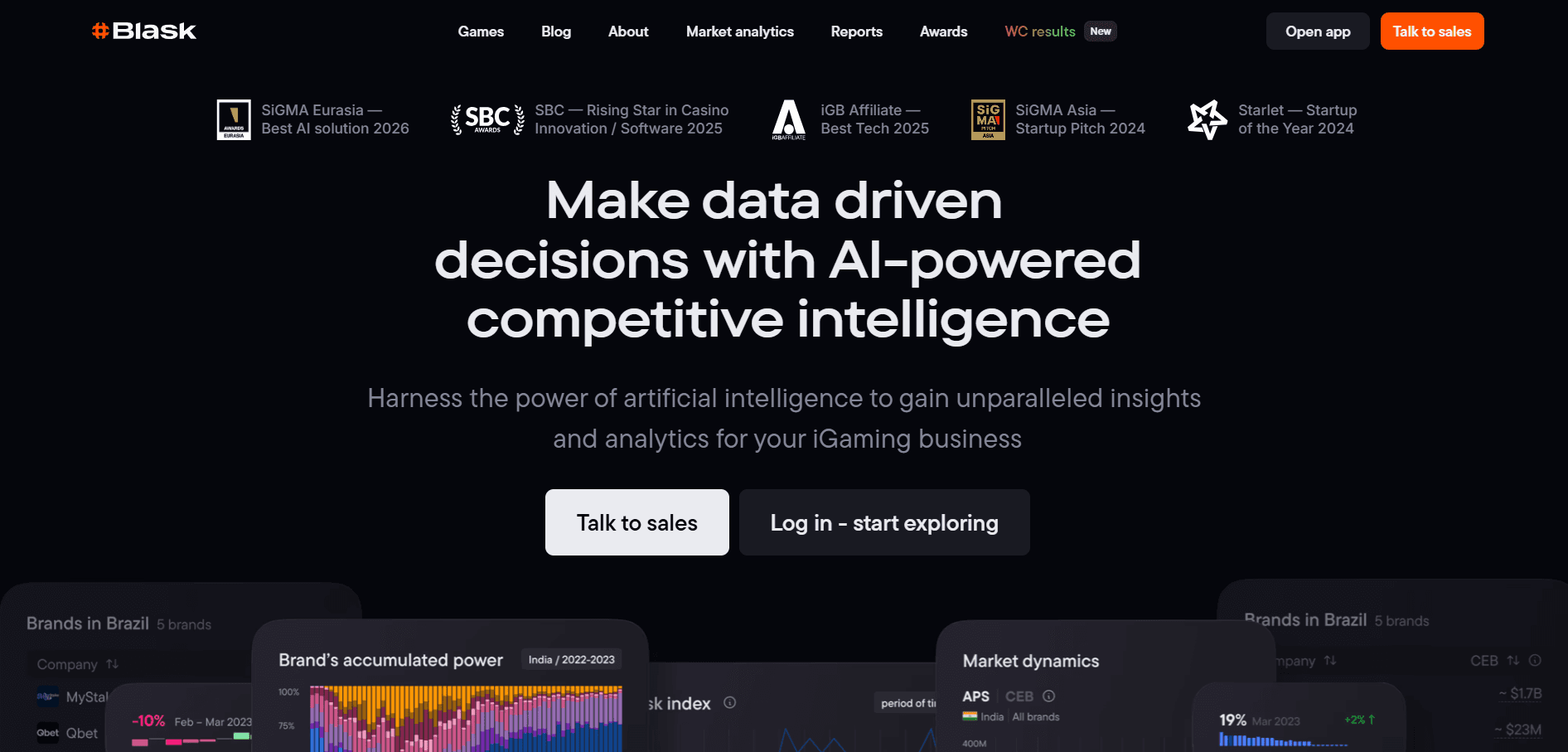
Blask applies AI modelling to estimate market size, brand share and demand dynamics across iGaming jurisdictions, filling a gap in an industry where comparative market data has historically been scarce or expensive. For entry planning, affiliate strategy and competitive benchmarking, it turns guesswork into a directional model.
It's an intelligence tool, not an operational one. It informs which market to enter. It does nothing about the support load that market creates on day one. As Cevro argues in its guide to launching an iGaming brand, that's exactly the mistake new operators make when they treat AI support as a Phase 2 optimisation.
Pros
Rare source of comparative, modelled iGaming market data.
Useful for market entry, competitive benchmarking and investor reporting.
Accessible interface requiring no data science resource.
Cons
Modelled estimates rather than reported financial data.
Strategic input only, with no operational execution.
Coverage depth varies significantly by jurisdiction.
Comparison Table: The 15 Best AI Tools for iGaming in 2026
# | Tool | Primary AI category | Best for | iGaming-native | Executes actions | Resolves player tickets |
|---|---|---|---|---|---|---|
1 | Cevro AI | AI player support agents | Autonomous end-to-end resolution | ✓ | ✓ | ✓ (up to 90%) |
2 | Optimove | Predictive CRM | Enterprise segmentation | ✓ | ✗ | ✗ |
3 | Fast Track | Real-time CRM | Instant engagement triggers | ✓ | ✗ | ✗ |
4 | Smartico | Gamification CRM | Loyalty mechanics | ✓ | Partial | ✗ |
5 | Xtremepush | CDP + engagement | Vendor consolidation | Partial | ✗ | ✗ |
6 | Solitics | Data activation | Fragmented data stacks | Partial | ✗ | ✗ |
7 | Symplify | Communication CRM | Lifecycle messaging | Partial | ✗ | ✗ |
8 | Future Anthem | Gameplay personalisation | Content and bonus targeting | ✓ | ✗ | ✗ |
9 | Mindway AI | RG player protection | Harm-marker scoring | ✓ | ✗ | ✗ |
10 | Neccton | RG analytics | Research-backed RG | ✓ | ✗ | ✗ |
11 | Sumsub | KYC / AML | Onboarding verification | Partial | ✓ | ✗ |
12 | SEON | Fraud prevention | Bonus abuse, multi-accounting | Partial | ✓ | ✗ |
13 | GeoComply | Geolocation compliance | US state-by-state play | ✓ | ✓ | ✗ |
14 | Sportradar Integrity | Betting integrity | Match-fixing detection | ✓ | ✗ | ✗ |
15 | Blask | Market intelligence | Entry and benchmarking | ✓ | ✗ | ✗ |
The pattern in the final column is the argument of this article. Fourteen of these fifteen tools are extremely good at informing a decision, scoring a risk, or sending a message. One of them closes the ticket.
Why Generic Helpdesk AI Tools Are Excluded From This List
The obvious omission is generic helpdesk AI: Zendesk AI, Intercom's Fin, LiveChat's assistant. They're excluded deliberately, and the reasoning matters for anyone building a shortlist.
Most generic helpdesk platforms deliver AI primarily through copilot functionality: an assistant that sits beside a human agent, reads the knowledge base and drafts a suggested reply. It's a real productivity gain. It isn't autonomy.
The 2026 enterprise benchmarks put median tier-1 deflection at 41.2%, with the top quartile at 58.7% (Zendesk CX Trends and Salesforce State of Service data). Refund and password-reset intents deflect above 70%; nuanced complaints rarely break 25%.
Meanwhile, only around 14% of issues actually resolve through self-service, and 64% of customers say they wish companies would stop using AI in support (Lorikeet, 2026).
Those numbers aren't an argument against AI. They're an argument against AI that can't act.
AI Copilot | Cevro AI Agent | |
|---|---|---|
Resolves tickets autonomously | ✗ | ✓ |
Accesses live back-office data | ✗ | ✓ |
Executes operational procedures | ✗ | ✓ |
Built-in RG monitoring | ✗ | ✓ |
iGaming-native integrations | ✗ | ✓ |
Autonomous resolution rate | 0% | 80–95% |
Human always required | ✓ | ✗ |
Compliance by design | ✗ | ✓ |
Building a genuinely capable AI agent takes deep AI expertise, domain-specific training and years of investment in iGaming-native integrations.
Most generic helpdesk platforms aren't there yet. The copilot is what they can ship and scale today, so the copilot is what they'll recommend.
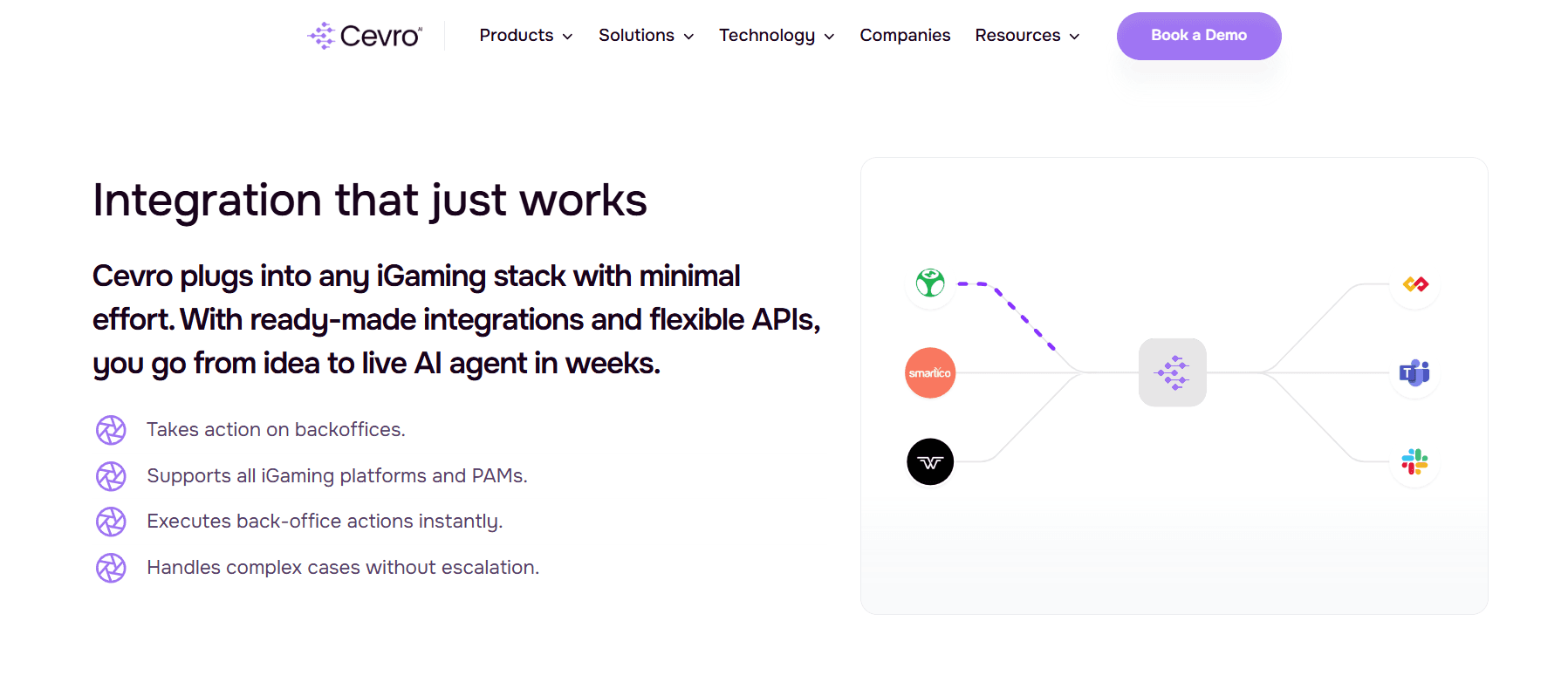
That doesn't make them adversaries. Zendesk, Intercom, LiveChat and Comm100 are all Cevro integration partners, they own the channel, Cevro owns the resolution.
Cevro's full breakdown of the distinction is in Cevro AI Agents vs. AI Copilots.
What an iGaming AI Stack Costs and What It Returns
Budget conversations in 2026 are less about licence fees than about which costs a tool removes.
1. The human cost baseline
A 30-agent multilingual team in Malta runs to seven figures a year. English-only agents start at €18,000–€20,000 gross and Finnish, German or Japanese speakers command €24,000–€28,000 (FreeMalta 2026 benchmark), before shift cover, recruitment and attrition.
That's the number every automation business case is measured against.
Per ticket, Gartner puts agent-assisted contacts at $13.50 against $1.84 for self-service, and projects that conversational AI will cut contact centre labour costs by $80 billion during 2026.
2. The measurement problem behind failed AI ROI
Cost reduction is the leading driver of AI adoption in gambling, yet the UNLV and KPMG benchmark found only one in five organizations reporting meaningful ROI within two years, and one in four operating with no structured evaluation process at all.
That isn't a technology failure, it's a measurement failure, and it's why the checklist below leads with resolution rate rather than features.
3. The in-house build option, costed
With enough time and cross-team commitment, most large operators probably could build this. The question that decides the outcome is whether you have the operational know-how to keep it reliable, and whether that's the best use of your engineers.
Eight cost categories make up a credible build:
Cross-functional team (ML engineers, prompt engineers, QA, compliance, integration developers, iGaming-literate product owners).
Token costs at scale.
12 to 24 months to live deployment.
A separate integration cycle for every PAM, PSP, bonus engine, KYC provider and helpdesk.
A compliance and safety layer.
Ongoing model maintenance, because the model you ship on day one isn't the model you need on day 365.
Opportunity cost on every engineer diverted from your core product.
The hidden load of multilingual coverage, procedure encoding and failure-mode monitoring.
Three-year TCO lands in seven-figure territory for a mid-to-large operator, before the 12–24 month delay to any return.
The measured return, and the human line item
Cevro's published customer outcomes are a 3x reduction in support costs and headcount, 80%+ of requests handled end-to-end, CSAT sustained at 4.8+, and go-live in weeks, under 30 days for operators handling 100,000+ monthly chats. You can model your own numbers with the Cevro ROI calculator.
At that scale, cost reduction usually reads as a redundancy story. Cevro frames it as the opposite, and Chaim Heber has been consistent about it:
"What we see is that a lot of agents get upskilled and they start becoming managers and decision makers instead of actually having to communicate back and forth with the players."
Escalations arrive pre-triaged with full conversation history, system state and decision trace, so the humans who remain handle disputes, VIP relationships and RG interventions, not password resets.
Buyer's Checklist: 10 Questions to Ask Any iGaming AI Vendor
Can the tool take an action in our back office, or only read from it?
What's the autonomous resolution rate, not the deflection rate, on live traffic?
Which of our platforms, PAMs and PSPs are already live with you in production?
Walk us through a bonus dispute end-to-end, step by step.
What percentage of conversations are monitored for responsible gaming signals?
What are the hardcoded forbidden actions, and who can change them?
Does the audit log capture the data accessed and the decision made, or only the conversation?
Are you SOC2 Type II audited, and do you train models on our player data?
Who updates procedures when a promotion changes: your team or ours?
What arrives with an escalated ticket when a human takes over?
The last question is the one most shortlists skip and most operations teams care about most. An escalation carrying full conversation history, system state and decision trace is a different product from one carrying a vague summary.
How to Get Started With Cevro.ai in 2026
Deploying an AI support layer for iGaming is no longer a twelve-month IT programme. Operators handling 100,000+ monthly chats have gone from integration to live traffic in under 30 days, and SweepNext launched its first AI Procedure within days of uploading its existing knowledge base.
Phase 1: Scope, before contract
Bring three or four of your highest-volume ticket types to a tailored demo rather than a generic brief, run your volumes, headcount and language mix through the Cevro ROI calculator, then pick a track: iGaming for single- and multi-brand operators, Enterprise for large regulated groups, or BPO & Managed Services for outsourcers. The track sets your governance and reporting model, so choose it before scoping.
Phase 2: Build, pre-launch
Pull 30 days of tickets and rank categories by volume and escalation risk. Upload existing SOPs, promotion terms and compliance documents as-is, and CevroScribe categorises them and converts them into AI Procedures.
Connect the stack through production-tested connectors (EveryMatrix, SoftSwiss, Playtech and Evolution on the back office; Comm100, Zendesk, Intercom and LiveChat on the communication layer; Sumsub and Shufti for KYC; Smartico for CRM), then lock your guardrails: preconditions per procedure, forbidden-action list, escalation thresholds.
Phase 3: Pilot and expand, weeks 1 to 6
Go live on 5–10% of English-language traffic with your lowest-risk AIPs and strict escalation, validating tone and audit logging against real players rather than test scripts. Then add medium-risk workflows such as deposit status checks and introduce multilingual AIPs, targeting 30–50% automation with 100% conversation monitoring maintained throughout.
Phase 4: Scale with oversight, months 2 to 3
Target 70–80%+ automation across core markets, with a governance board spanning compliance, operations, IT and legal reviewing procedures monthly. Track automation rate, escalation accuracy, compliance incidents (target: zero) and CSAT weekly.
Cevro Insights then surfaces the procedure gaps that become your next set of AIPs, and free Cevro Academy certification puts those procedures in your CS leads' hands rather than a vendor queue.
Conclusion
Cevro AI is the AI Player Support Platform built for iGaming, and it is the one tool on this list that does not just inform, score or message a player.
It opens the back office, checks the account, evaluates the transaction and resolves the issue.
The 2026 stack is now clearly segmented into seven layers, from CRM and gameplay personalization through responsible gaming, KYC, fraud, geolocation and market intelligence, and the strongest operators are the ones treating those layers as complementary rather than competing.
What separates the leaders is not how much AI they have bought, but whether any of it can act at the moment a player's money question turns into a churn decision.
Book a demo with the Cevro team to see how autonomous AI agents would handle your real use cases, on your stack, in weeks rather than quarters.
Read Next:
iGaming 'Post-Bonus' Era: Why CX Is the Retention Engine in 2026
The Most Effective Strategies for Player Retention in iGaming
Inside Cevro AI: iGaming-Native Expertise and Proprietary Technology
FAQs:
1. What is the best AI tool for iGaming operators in 2026?
The best AI tool for iGaming operators in 2026 is Cevro AI, an iGaming-native AI player support platform that deploys autonomous AI agents to resolve bonus, KYC, payment and responsible gaming queries end-to-end. It reports up to 90% automation, CSAT and NPS of 4.8/5.0, coverage across 100+ languages and 50+ markets, and named deployments including 91% automation at iPlay and 4.9+ CSAT at SweepNext.
2. What types of AI tools do iGaming operators need in 2026?
The types of AI tools iGaming operators need in 2026 fall into seven layers: AI player support, AI CRM and engagement, gameplay personalisation, responsible gaming monitoring, KYC and AML verification, geolocation compliance, and market intelligence. Most operators already own layers two through seven and are missing layer one, which is the ability to resolve a live player ticket without a human.
3. How is an AI agent different from an AI chatbot in iGaming?
An AI agent is different from an AI chatbot in iGaming because it resolves rather than deflects. A chatbot tells a player where to find their transaction history; an AI agent checks it, cross-references the payment gateway, applies KYC and RG preconditions, and completes the action. Copilot and chatbot deflection typically lands between 15% and 30%, while Cevro reports 80% to 95% autonomous resolution on operational workflows.
4. How much can AI reduce customer support costs for an iGaming operator?
AI can reduce customer support costs for an iGaming operator by up to 3x, according to Cevro's published customer outcomes. The baseline is significant: Malta-based support agents cost €18,000 to €28,000 gross annually depending on language, and Gartner benchmarks agent-assisted contacts at $13.50 against $1.84 for self-service. iPlay reduced its team from 30 agents to 15, and SweepNext from 7 to 2, while improving CSAT.
5. Should iGaming companies build their own AI support tools or buy them?
iGaming companies should generally buy rather than build their own AI support tools, because a credible in-house build takes 12 to 24 months to reach live deployment and carries a three-year total cost of ownership in seven-figure territory for a mid-to-large operator. The binding constraint is not engineering budget but operational know-how, meaning the accumulated experience of keeping an open-ended model reliably grounded across bonuses, payments, KYC and multi-jurisdiction compliance.