

AI customer support ROI in iGaming is the support cost you no longer carry, plus the revenue you keep, minus everything the AI costs, counted only on tickets that stay resolved. Count a ticket as resolved when the player doesn't come back about the same issue within 7 days, and divide by every inbound contact on every channel. Published figures for a single operator can range from about 50% to 77% depending on the source and what each one counted, so get the definition before you look at the number.
This guide covers the definitions (containment, deflection, automation rate, resolution), the denominator problem, re-contact rate, cost per resolved ticket, the revenue side, a worked example with illustrative numbers, and the questions to put to any vendor, us included. We deploy AI agents for online casinos, sportsbooks and sweepstakes operators, and most of what follows comes from sitting in the room when a CFO asks why the dashboard says 90% and the rota still has 30 people on it.
Get the ROI calculator for your own ticket volumes →
What goes into AI customer support ROI for an iGaming operator?
Two columns. Keep them separate until the end.
Costs. Licence or platform fee, per-resolution or per-conversation charges, integration work (PAM, PSP, KYC provider, CRM, helpdesk), the internal owner who maintains procedures and the knowledge base, QA sampling of AI conversations, and the human agents who still handle escalations. Our article on what AI customer support costs to implement breaks the cost side down. Here we only need it as an input.
Value. Human handling cost removed, headcount you didn't have to hire for a new market or a peak, and revenue effects: first deposits that would have stalled, withdrawals that didn't turn into a lost player, VIPs who got an answer at 3am in Portuguese.
The formula operators end up using:
Monthly ROI = (human support cost removed + measured revenue retained − total AI cost) ÷ total AI cost
Every term in that line depends on how you count a resolved ticket. That is where most business cases go wrong.
What is the difference between resolution rate and deflection rate?
Deflection rate counts conversations that never reached a human. Resolution rate counts conversations where the player's problem was actually solved. A player who gives up on the chat widget and emails instead is deflected and unresolved at the same time. AI deflection vs resolution is the first distinction to settle, and there are three more terms that sit between them.
Term | What it counts | What it misses | How it gets inflated |
|---|---|---|---|
Containment | Chat sessions with no handover to a human | Whether the player got an answer | Hide the "talk to an agent" button |
Deflection | Contacts that didn't create a human ticket (including help-centre views) | Players who left or switched channel | Count FAQ page views as deflected tickets |
Automation rate | Conversations closed by the AI without a human touching them | Same-issue re-contacts | Auto-close idle chats after 2 minutes |
Resolution rate | Conversations where the issue was addressed | Depends on who decides "addressed" | Treat "player left" as "player satisfied" |
True resolution | Resolved and no same-issue re-contact within N days, all channels | Very little, if the window is sensible | Shrink N to 24 hours |
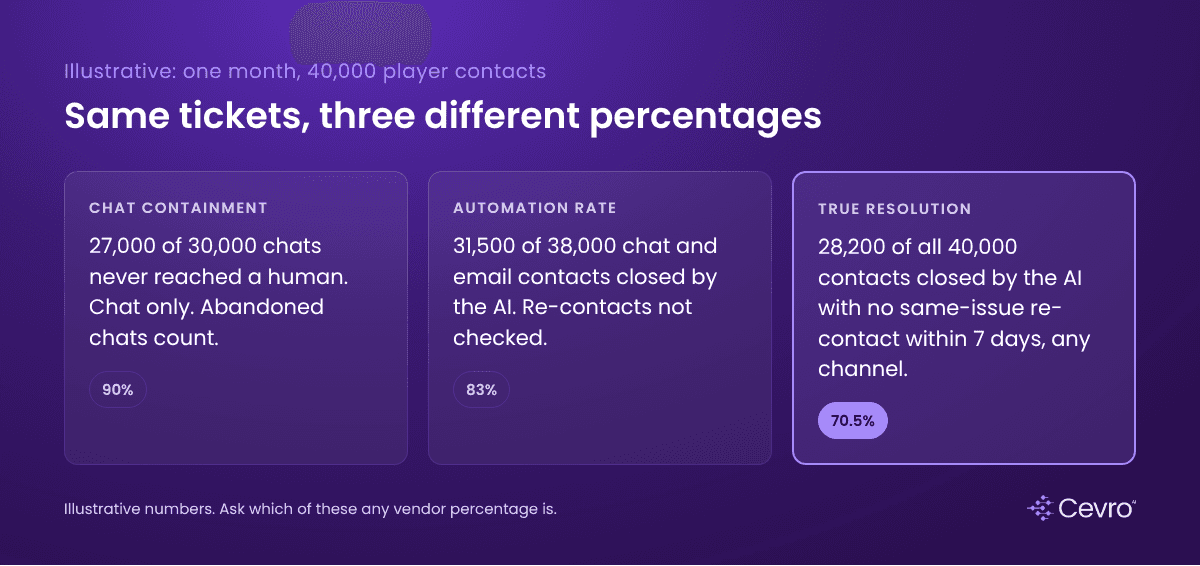
One illustrative month of data. Three honest-looking percentages from the same tickets.
Most guides on this topic agree on the vocabulary and stop there. In iGaming the gap between these numbers is wider than in retail, because so many contacts are about money that hasn't moved yet. "Where is my withdrawal?" can be answered perfectly and still come back tomorrow if the payout is still pending. Our earlier piece on why deflection rate is an output covers why you shouldn't manage to it. This section is about not getting misled by it.
Most customer service KPIs were designed for retail and SaaS support teams, where the customer asks about an order and the customer either gets an answer or the customer leaves. Customer satisfaction and customer effort score were built for that world. In iGaming the customer is a player with money in the account, and whether the customer's problem is solved often depends on a payment or a document check that a support agent can't see from the helpdesk. That is why customer service ROI figures borrowed from other industries tend to overstate what AI customer support without back-office access can do.
How to measure AI resolution rate: the denominator problem
The numerator gets all the attention. The denominator is where a 70% becomes a 90%.
Which tickets count. Decide before go-live what is in and out. Typical exclusions that are fair: spam, duplicate emails from the same player within minutes, test traffic, affiliate enquiries. Exclusions that aren't fair: "out of scope" intents the AI was never configured for, conversations the player abandoned, and anything tagged as escalated by policy (self-exclusion, complaints, RG). Those are still players asking for help. If a vendor removes them from the denominator, their number describes the easy part of your queue.
Which channels. Chat-only figures look best because chat is where the simple questions live. Email carries document uploads, chargebacks and long complaints. Voice and social carry the angry ones. A resolution rate on chat alone tells you little about your support cost, because your cost sits across all of them.
Which window. The first eight weeks after launch, a single promotion week and a quiet month all produce different numbers. So does a peak. During the World Cup, Winpot handled 150,000+ tickets at 85%+ resolution with no new support headcount, while also launching a new market. That is a peak figure and we label it as one. Ask any vendor whether their number is a peak, a launch window or a trailing 90-day average.
Which brands and markets. Multi-brand operators should get the figure per brand and per licence. A Tier 1 brand with full back-office integration and a new brand still on a read-only connection will not resolve at the same rate. Averaging them hides where the work is.
A scene we see often. Saturday, derby kick-off, 19:52. A player asks in chat why a withdrawal shows pending. The AI checks the PSP status, sees it is waiting on a proof-of-address document that expired last week, tells the player which document to upload, and closes the chat. On Monday the player emails asking the same thing because the upload failed on mobile. Was Saturday resolved? On most dashboards, yes. On yours, it shouldn't be.
Re-contact rate: the check that keeps resolution honest
Re-contact rate is the share of AI-closed conversations where the same player comes back about the same issue within a set window, on any channel. It is the cheapest way to turn a resolution rate into a true resolution rate.
How to compute it:
Join conversations by player ID across chat, email, social and voice. Session IDs aren't enough; players switch devices.
Match on intent (withdrawal status, bonus eligibility, KYC verification, account access) using the same taxonomy the AI uses.
Pick a window. We suggest 7 days for most intents, 3 days for login and password issues, and 14 days for withdrawals and KYC, where the underlying process is slower.
Subtract re-contacts from AI-closed conversations. What remains is true resolution.
Watch for agent shopping too. A player who didn't like the AI's answer on a bonus decision asks again, hoping a human will give a goodwill bonus. That is a re-contact, and the reason matters: it tells you whether the procedure is wrong or the policy is unpopular.
Re-contact also catches the quiet failures. Customers who gave up on the chat and waited for live support hours to call don't show up in containment at all. An answer that left the customer waiting on a document review looks resolved until the same customer whose problem was never fixed writes in again. When an AI agent resolves a withdrawal question, the test is whether the customer got their money or a clear reason why not.
CSAT on AI vs human conversations
Compare CSAT on AI and human conversations by intent. Overall averages flatter the AI, because it takes the easy intents and humans inherit the disputes.
Two cautions. First, survey response is low and skewed toward people with strong feelings, which our piece on why CSAT scores often miss the real story covers in detail. Second, players start out sceptical of AI. A Gartner survey of 5,728 customers found 64% would prefer companies didn't use AI for customer service. That makes AI CSAT a harder test, and a high score more meaningful when it holds up by intent. Alpha Affiliates reports 4.8+ CSAT at 81% AI support automation, and SweepNext 4.9+ at 90%+. Those are the operators' reported figures across their AI conversations.
Cost per ticket in iGaming vs cost per resolved ticket
Cost per ticket in iGaming is total support cost divided by total contacts. It is the baseline you need before go-live, and most operators don't have it clean. Build it fully loaded: agent salaries and benefits, team leads, QA, WFM, helpdesk seats, translation or outsourced language cover, and the night shift premium.
Cost per resolved ticket is the more useful number after launch:
AI cost per true resolution = all AI costs ÷ AI conversations that stayed resolved
Human cost per resolved ticket = human support cost ÷ tickets humans closed that stayed resolved
Blended cost per contact = everything ÷ all contacts
The trap is pricing. If you pay per resolution and the vendor bills on its own count of closed conversations, your effective price per real resolution is higher than the sticker. Re-contacts get billed twice: once when the AI closes them and again when a human picks them up. Put the billing definition in the contract and make it the same definition you report on.
Which support pricing model matters less than what it counts. Per-agent-seat pricing for an AI copilot means a human agent before every send, so your cost per ticket only falls as fast as handle time does. Per-conversation pricing charges for the chat where the customer leaves halfway. Per-resolution pricing is the closest to outcomes, as long as resolution means the customer's issue stayed fixed.
Revenue effects: FTD conversion, withdrawal-related churn and VIP retention
Most ROI cases stop at cost. In iGaming the revenue side is often larger, and harder to prove.
FTD conversion. New players who hit a KYC or payment-method question before their first deposit are a narrow, measurable group. Compare first-deposit conversion for players who contacted support during registration against a period or market without AI cover. CasinoPlatform reported more FTDs alongside 88.5%+ resolution at peak and 2x ticket volume in six months while human workload went down. Attribute carefully: promotions and payment-method changes move FTDs too.
Withdrawal-related churn. Withdrawals are where trust breaks. In the UK, withdrawals and financial transactions were the largest category of complaints to the Gambling Commission, 2,405 of 6,940 in the year to December 2023, and the largest in every year shown. Track 90-day deposit activity for players who asked about a withdrawal, split by whether they got a specific status answer (pending KYC, PSP delay, approved and sent) or a generic one.
VIP retention. A VIP who waits until Monday for a host is a VIP talking to another operator on Sunday. Measure response time and churn for players in your VIP tiers before and after, ideally with a holdout group of hosts working without AI assistance for a few weeks. Our player retention solution covers the signals we watch.
Use matched cohorts or a holdout. Without one, revenue effects are a story, and a finance team will treat them as one.
A worked example of AI customer support ROI (illustrative numbers)
Every number in this section is illustrative. It isn't a Cevro customer. Plug your own into the Cevro ROI calculator.
A mid-sized operator takes 40,000 contacts a month: 30,000 chat, 8,000 email, 2,000 social and phone. Before AI it runs 40 agents at €3,000 a month fully loaded, plus €10,000 in tooling and QA. Total €130,000. Cost per ticket €3.25.
After rollout on chat and email (38,000 contacts offered to the AI):
Metric | Count | Rate | Denominator |
|---|---|---|---|
Chat containment | 27,000 | 90% | 30,000 chats |
Automation rate | 31,500 | 83% | 38,000 chat + email |
Same-issue re-contacts in 7 days | 3,300 | 10.5% | 31,500 AI-closed |
True resolution | 28,200 | 70.5% | 40,000 all contacts |
Contacts reaching humans | 11,800 | 29.5% | 40,000 all contacts |
Humans now handle 11,800 contacts, and they are harder ones. Assume 1.3x the effort of the old average. That is 16 agents (€48,000) plus €6,000 tooling: €54,000.
AI costs: €0.70 per AI-closed conversation billed on 31,500 (€22,050), a €3,000 platform fee, and half an FTE internally to own procedures and the knowledge base (€2,500). Total €27,550.
Before | After | |
|---|---|---|
Human support cost | €130,000 | €54,000 |
AI cost | €0 | €27,550 |
Total | €130,000 | €81,550 |
Cost per contact | €3.25 | €2.04 |
AI cost per true resolution | n/a | €0.98 |
Monthly saving: €48,450 (37%). Return on AI spend: €48,450 ÷ €27,550 = 1.76, or 176% a month, before any revenue effect.
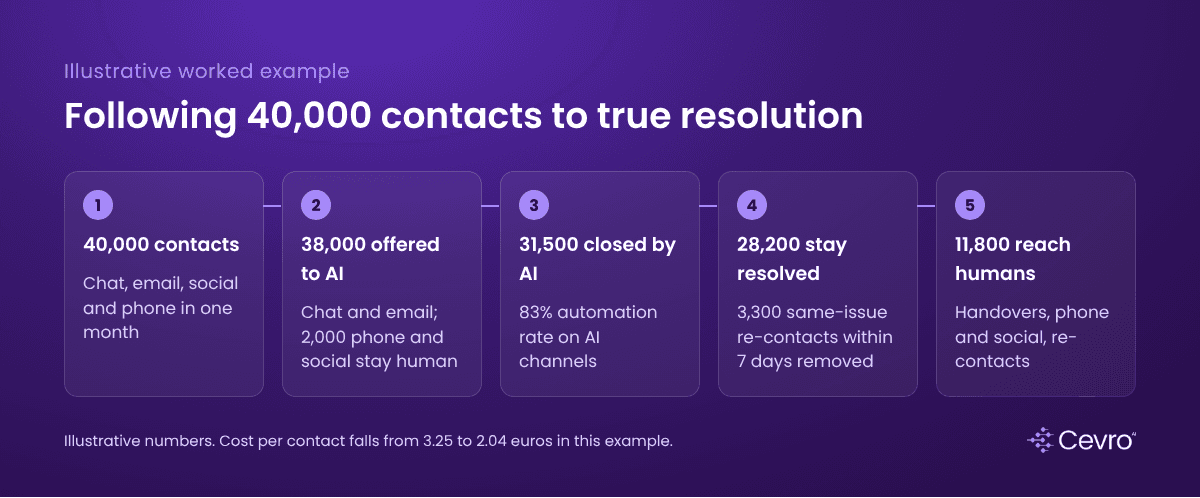
Illustrative worked example. Where the 90% goes once you follow the tickets.
Now the version a sales deck would show. Take 90% containment at face value, assume 36,000 of 40,000 contacts are resolved, and size the human team at six agents. Projected saving: about €75,000 a month. That is roughly €27,000 a month the operation will never see. Nobody lied. The deck used a chat-only numerator on an all-channel cost base.
Revenue, kept separate: say 2,500 players a month ask about a withdrawal, and specific status answers cut their 90-day churn from 30% to 27%. That is 75 players retained. At €400 average 90-day net gaming revenue, €30,000. Treat it as a hypothesis until a holdout confirms it.
Why do AI vendors report different resolution rates for the same customer?
Because each figure answers a different question, and the question is rarely printed next to the number.
We looked at what has been published about one US operator's AI support deployment this year. A trade news piece said the AI handled about half of tickets end to end. The vendor's own webinar recap put it near 60%. A sponsored trade feature said 77%, measured over the first eight weeks. Same customer, three sources, a 27-point spread, and the vendor's homepage says 80%+ for its platform overall. None of these is necessarily wrong. They count different things over different windows.
This isn't unusual. One of the largest AI support vendors says in its own guide to AI resolution rate that differing definitions of "resolved" can move reported rates by 20 to 30 points. The usual sources of the spread:
headline figure from the best brand, quoted as if it were the average
launch window or peak week presented as steady state
chat-only numerator, all-channel claim
abandoned conversations counted as resolved
"end to end" meaning different things: answered, or answered and the action completed in the back office
Vendor resolution claims differ from production results for the same reasons. The production number on your traffic, with your re-contact window, is the only one you should sign against.
How to compare AI vendor automation claims: a buyer checklist
Ask every vendor these questions about every percentage on their site, in their deck and in their case studies. Ask us the same ones.
What is the exact definition: containment, automation, resolution, or resolution with no re-contact? Within how many days?
What is the denominator? All inbound contacts, AI-eligible contacts, or chat sessions?
Which channels does it include?
Over what period? Launch window, peak, or trailing 90 days?
Is it one brand, one market, or the average across all customers?
Are abandoned conversations counted as resolved?
Are escalated-by-policy intents (RG, self-exclusion, complaints) in the denominator?
Does "resolved" include completing the action (reversing a withdrawal, crediting a bonus, reopening a locked account) or only answering?
How is CSAT on AI conversations surveyed, and what is the response rate?
What do you bill on, and is it the same definition you report on?
Can you show us the conversations behind the figure, on a sample of our own tickets?
Can we run a pilot on our own traffic with the definitions above written into the agreement?
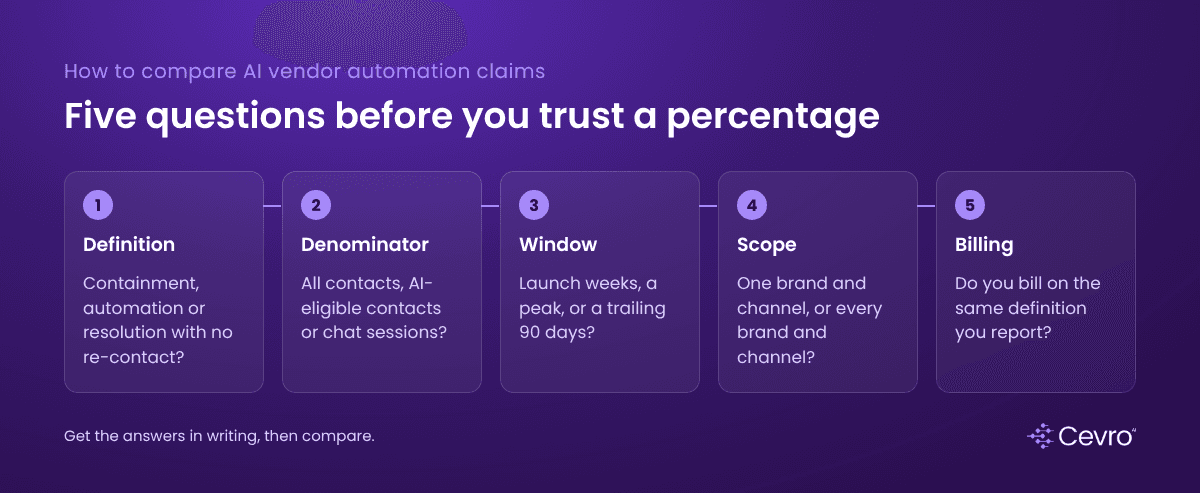
Five questions that settle most percentage disputes before procurement.
If a vendor can't answer 1, 2 and 10 in writing, the number on their homepage isn't comparable to anyone else's. For the wider selection process, see how to choose an AI customer support platform for iGaming.
How we report AI customer support ROI at Cevro
Honesty first: our own case studies use both "resolution" and "automation". Winpot is 85%+ resolution through the World Cup. CasinoPlatform is 88.5%+ resolution at peak across 1,000,000+ tickets. iPlay is 91% AI support automation with a 40% manual support reduction. SweepNext is 90%+ automation, with support headcount going from 7 to 2. Each is labelled on the case study pages the way the operator reports it. If you are comparing us with someone else, ask for the definition behind each one, as you would for anyone.
What makes our numbers checkable is how the agent works. Cevro runs AI Procedures (AIPs): written workflows with preconditions, forbidden actions and escalation logic that execute step by step against your PAM, PSP and KYC data. Every interaction is logged, so for any conversation you can see what the agent checked, what it did and why it closed or escalated, and we can walk through a sample of your own tickets with you to show how a reported figure was reached. We are SOC 2 Type II certified, and escalations reach humans with the player history and a suggested next step, which is what keeps the human cost per resolved ticket down on the 11,800 contacts in the example above.
In our deployments the honest number sits below the headline one, and that's fine. Agree the definition, put it in the contract, bill on it.
When should you pause or roll back an AI support agent?
Set the triggers before go-live so nobody argues about them during an incident:
re-contact rate on an intent rises above its pre-AI human baseline for two weeks running
CSAT on an intent drops more than half a point below the human figure
any RG or self-exclusion conversation is closed without the required escalation
a back-office action (bonus credit, limit change) fails silently
Pause the intent. Keep the rest running. Fix the procedure, then turn it back on.
Getting started: a 30-day measurement plan
Week 1. Pull 90 days of tickets by channel and intent. Compute cost per ticket fully loaded, human re-contact rate by intent and CSAT by intent. That is your baseline.
Week 2. Write the definitions: true resolution, re-contact window per intent, denominator, exclusions. Share them with every vendor in the evaluation. Our guide to which support tickets to automate first helps with intent selection.
Weeks 3 and 4. Run the pilot on live traffic. Report containment, automation, true resolution, AI CSAT by intent and AI cost per true resolution, side by side. Revenue cohorts start here and need 90 days.
The AI resolution rate you reach depends on integration depth more than on the model. With read and write access to your back office, the high-volume intents (withdrawal status, KYC, bonus eligibility, account access) are where the rate climbs fastest. On a supported platform, our iGaming deployment runs in days.
Book a demo and bring your own definitions →
FAQ
Frequently asked questions (FAQs) about AI customer support ROI and vendor claims.
How do I measure ROI on AI support?
Take the human support cost removed plus measured revenue retained, subtract total AI cost, and divide by total AI cost. Count only tickets that stay resolved (no same-issue re-contact within your window, usually 7 days) and use all contacts on all channels as the denominator.
What is the difference between resolution rate and deflection rate?
Deflection rate counts contacts that never reached a human. Resolution rate counts contacts where the player's problem was solved. A player who abandons a chat and emails instead is deflected but unresolved.
What is a good AI resolution rate in 2026?
It depends on the definition and on integration depth. For iGaming operators with back-office access, Cevro customers report 81% to 91% automation or resolution on their own published definitions. Compare any benchmark only after matching the denominator, channels and re-contact window.
Does a higher resolution rate always mean better AI performance?
No. A rate can rise because idle chats auto-close, abandoned conversations are counted, or hard intents are excluded from the denominator. Check re-contact rate and CSAT by intent alongside it.
How long does it take to reach a high AI resolution rate?
On a supported platform with read and write integrations, the high-volume intents can be live within days and improve over the first weeks as procedures are tuned. Measure on a trailing period after launch and don't quote the first eight weeks as steady state.
What is cost per ticket in iGaming, and how is it different from cost per resolved ticket?
Cost per ticket is total support cost divided by all contacts. Cost per resolved ticket divides cost by tickets that stayed resolved, so re-contacts and failed AI closures raise it. The second number is the one to use when comparing AI vendors.
Why do vendor resolution claims differ from production results?
Headline claims often come from a best-performing brand, a launch window or a peak, or a chat-only denominator. Your production number uses your traffic, all channels and your re-contact window, so it is usually lower.
What re-contact window should I use to measure AI resolution?
Seven days works for most intents. Use around 3 days for login and password issues and 14 days for withdrawals and KYC, where the underlying process takes longer.