


Churn prediction online casino teams rely on is a model that reads player behaviour and estimates how likely someone is to stop playing. Deposit frequency, session gaps, withdrawals, logins, bet size. Predictive models put a churn probability against each account and the CRM team gets a list of at-risk users every morning.
Most operators we work with already have that list. Very few have decided what happens next. The score lands in the CRM, the CRM sends a reload offer, and the support floor never finds out the player was flagged at all. That gap is where the money is.
So this is not another explainer on which algorithm to pick. It is about what the score is worth, what it cannot see, and what to do with it in the two days after it fires.
See how Cevro handles at-risk players in support →
What churn prediction means in an online casino
There is no cancellation event in gambling. Nobody closes an account to leave. They just stop, so churn has to be defined by absence, and somebody has to pick how long an absence counts.
The published research is blunt about this. In the most detailed public study of gambling churn prediction, Florian Merchie and Damien Ernst worked with the Belgian operator Gaming1 on the activity histories of 10,000 players between January 2017 and June 2021. They labelled a player a churner once they had gone 35 days without a single active day, where an active day means at least one gaming session, sports bet or deposit. The model then predicted churn over the following 30 days. Their paper says plainly that the inactivity period "can be chosen in an arbitrary way", and cites earlier work that used four months.
Thirty five days. Four months. Both defensible. They produce completely different lists.
The window you choose matters more than the model you choose
Pick 35 days and a weekly slots player who has missed a month is a churner, while a once-a-month roulette player looks healthy. Pick four months and you only hear about losses you can no longer do anything about.
This is a commercial decision dressed up as a technical one. The right window is the one that gives your team enough time to act and is short enough that the player still remembers you. For a sportsbook the honest answer often depends on the calendar: a bettor who goes quiet between the end of one season and the start of the next has not churned, they are waiting for the derby.
Two things worth knowing before you tune anything:
Short training windows hurt. The same study found recall started falling once the training window dropped below a year. Fresh data is not automatically better data.
Your own decisions move the model. Performance in that paper swung around one-off company events, including the removal of bonuses in March 2020 and a casino outage that June. A model is partly measuring your operation. Change the bonus policy and the churn signal changes underneath you.
Churn rate, retention rate, and why the two disagree
Before any modelling, most teams want a churn rate. It is simple arithmetic once the window is fixed: of the players active in a period, the share who go the full inactivity window without returning. The retention rate is the mirror of it.
Two cautions, both of which cost operators real money.
Churn rate is dominated by the bottom of the base. Most online casinos acquire a long tail of players who deposit once, play for an evening and never come back. Count them and your churn rate measures acquisition quality far more than it measures loyalty. Many online casinos report a headline figure that barely moves whatever the retention team does, for exactly this reason. Split the rate by deposit count, or by first deposit month, and it starts to say something.
Churn rate by player count and churn rate by revenue are different numbers. The first tells you how many players leave. The second tells you what leaving cost. When the two move in opposite directions, the revenue one is worth acting on.
Neither figure tells you who. That is the job predictive analytics is actually for.
What data an online casino churn prediction model uses
The usual feature set is transactional, because that is what sits in the data warehouse. Gaming1's model used eight signals: casino plays, casino GGR, sports betting tickets, sports GGR, deposits, withdrawals, website connections, and days since the last active day.
Player logs of that kind are good at describing engagement trends and spotting a player going quiet. They are poor at explaining why, which matters because the response to a bored player and the response to an annoyed one are nothing alike.
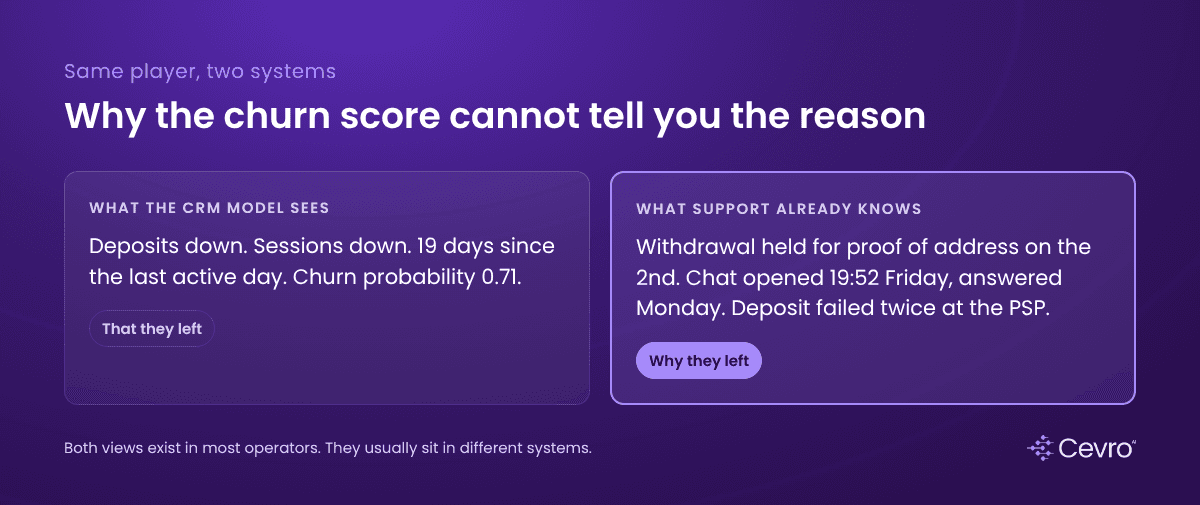
Most churn models are built from the warehouse, so they miss the reason.
Four things that reliably precede a player leaving, and almost never reach the model:
A withdrawal held for documents, where the player was told "3 to 5 working days" and nobody followed up.
A deposit that failed at the PSP on a Friday night. The player tried twice, then went somewhere else.
A bonus the player believed they had qualified for and had not, because the wagering terms were read differently by them and by the back office.
A question asked at 19:52 that got a queue message and an answer on Monday.
None of those are mysteries. They are all sitting in the ticket log. If your churn model and your support system do not talk to each other, your model is working with one hand behind its back, and the explanation it cannot give you is the one your retention team needs.
Which predictive models actually get used
There is less exotic technology in production than conference talks suggest. Three families cover most of what operators run.
Logistic regression on aggregated features. Unfashionable and still a sensible starting point. It trains in seconds, every coefficient can be explained to a regulator or a nervous commercial director, and it gives you a baseline any fancier model has to beat. Plenty of teams find their expensive model does not beat it by much.
Gradient boosted trees. The workhorse for tabular player data. They handle the mix of counts, money and recency well, cope with missing values, and give feature importances that start useful conversations with the CRM team.
Sequence models. Recurrent networks over a daily player time series, which is what the Gaming1 work used. These see shape instead of totals, so a player whose deposits get smaller every week looks different from one with the same monthly total arriving in a single lump. More to maintain, and worth it mainly once you have years of daily history.
Whichever family you pick, churn prediction models are only as good as the labels behind them, and the labels come from the window chosen in the last section. Teams usually spend their effort the other way round.
How accurate is churn prediction in an online casino?
Worth knowing before you build a programme on top of one.
In that Gaming1 work the churn-class results came out like this: the GRU model reached 0.837 accuracy with 0.636 precision and 0.575 recall. The LSTM variant got recall up to 0.611. The nBRC variant got precision to 0.644. Around 22% of the test set were churners.
Read that honestly. Roughly two in three of the players it flags really are leaving, and it catches a bit over half of the ones who do. That is a genuinely useful model. It is not a list of certainties.
Which changes what you should spend the score on. If the action is cheap and reversible, such as routing the player to a senior agent or making sure their next ticket jumps the queue, a 64% hit rate is plenty. If the action is a large discretionary bonus, you are paying real money to a third of the list who were not going anywhere, and the ones you miss get nothing. The accuracy number does not tell you to build a better model. It tells you to pick cheaper actions.
Not every churner is worth the same
This is the part that gets skipped, and it changes the whole shape of the work.
David Forrest and Ian McHale analysed 139,152 accounts across seven large regulated British operators for the year to June 2019, published in the Journal of Gambling Studies. The top 1% of accounts produced 37.4% of net win. The top 5% produced 66.9%. The top 10% produced 79%. The bottom half of all accounts produced 0.51% between them.
For gaming specifically the top 1% accounted for 41.6%, and for virtual casino 59.8%.

Figures from Forrest and McHale, Journal of Gambling Studies, 2024. Seven GB operators, year to June 2019.
So a churn list sorted by probability is sorted by the wrong column. Sort it by probability multiplied by value and the top of the list looks completely different, and much shorter. A few hundred accounts, not a few thousand.
The practical version: score the whole base, then work the list top down by value until the retention actions you have are used up. The right players get attention and the long tail does not absorb a budget it will never repay. Lifetime value estimates do not need to be sophisticated for this. Historical net win over the last six months, banded into tiers, is usually enough to reorder the list completely.
That also settles an argument about VIPs. A flagged high-value player does not need a different marketing campaign, they need the person who handles them to know. A support system that recognises VIP status, routes the player accordingly and gives the host the full picture instead of a chat transcript is doing more for player retention than any segment-level offer.
What happens in the 48 hours after the score fires
Here is the operating question nobody writes about. The score exists on Tuesday morning. What is different about Tuesday afternoon?

The score is only worth what the next conversation does with it.
The answer we would argue for is to make the flag visible to the agents, human and AI, who are going to speak to that player next. A dashboard somebody checks will not do it. It has to be a condition inside the procedure that handles the conversation.
Cevro's agents run on AI Procedures, which are readable step-by-step procedures with preconditions, forbidden actions and escalation logic. A support lead can open one and see what the agent will do. So "this player is flagged at risk and sits in the top value decile" becomes a precondition: skip the usual verification detour where it is safe to, resolve instead of deflecting, and escalate early with context instead of after three exchanges. When it does go to a human, the human gets the player history, the conversation and a recommended action. Nobody reads a transcript from the top.
That is the part of churn work that lives in support instead of CRM, and it is why we think the interesting question about an AI support tool is not whether it can take actions. Most can now. It is how it decides, and whether the conversation leaves the player more inclined to come back on Friday.
Talk to us about at-risk player handling →
Support changes the prediction as well as the response
If the paper's finding holds, that company events move model performance, then the quality of your support is an input to your churn model as well as a consumer of its output.
CasinoPlatform is the clearest example we can point to. Their support ticket volume doubled over six months and our AI agents absorbed the increase, with faster first response times and higher first-time deposit conversion. Cevro is the AI support integration for all brands running on CasinoPlatform. The retention effect there did not come from a churn model. It came from the fact that tickets stopped waiting.
Operators running our agents typically resolve 80 to 90% of player tickets without a human, and report average CSAT of 4.8 or better, in over 120 languages around the clock. The relevant number for churn is not the resolution rate though. It is how many of the signals above never happened, because the question got answered at 19:52.
Reactivation: bringing players back once they have gone
Prevention is cheaper than winning somebody back, and both are cheaper than what it costs to attract new players to replace them. You will always have a reactivation list though. A few things that make it less of a lottery:
Treat the 35 day and the 120 day lists as different problems. The first is a nudge. The second is a reintroduction. The player's last memory of you is probably the thing that pushed them out, so leading with a bonus answers a question they did not ask.
Check the ticket history before the send. If the account has an unresolved complaint or a withdrawal still sitting on documents, a reload offer reads as insulting. Fix the open item first, then talk.
Segment the reactivation list the way you segment the at-risk one. Player reactivation costs money per contact, and the concentration figures apply here too.
Watch what the campaign does to the rest of the base. Aggressive reactivation offers get discussed on forums and in Telegram groups, and a player who comes back for a bonus they would not otherwise have had is a player you have taught to wait. Several of the retention tools on the market make this easy to do and hard to notice.
And measure reactivation against players who got nothing. More on that below, because it is the step most programmes skip.
How to tell whether any of it worked
Hold a group back. Take 10% of the flagged list at random and give them nothing, then compare deposits over the next 90 days.
Without a holdout you cannot tell the difference between an intervention that worked and a model that flagged people who were coming back anyway. Given the recall figures above, a good share of any flagged list would have returned on their own. Operators who skip the holdout tend to report a retention programme that looks spectacular in its first quarter and then quietly stops being mentioned.
Track the money, not the opens. Deposits and net win over 90 days, by cohort, against the holdout. Offer redemption tells you the offer was attractive, which is not the same thing.
Responsible gambling
One note, because it matters here more than in most retention topics. A churn model is very good at identifying a player whose spend has dropped off, and some of those players have stopped for their own reasons. Anything that uses an at-risk flag to prompt a player back needs to respect RG status and limits first. Cevro runs responsible gambling monitoring on every conversation and logs all of it, which is the baseline we would expect of anything in this part of the stack.
Getting started
If you have a model already, the useful next step is not retraining it. It is wiring the flag into the place where the player actually makes contact, then picking actions cheap enough to survive being wrong a third of the time.
If you do not have one, start by writing down your inactivity window and your value tiers. Most of the decisions that determine whether churn prediction earns anything are made before any modelling begins.
We can usually get the support side of this live quickly on a platform we already integrate with, including Bragg, EveryMatrix, Vegangster, White Hat Gaming, GiG and Smartico. Native integrations help, though they do not decide everything: how fast it goes live depends on your platform's complexity and on your CS and product teams working with ours. On a supported platform, deployment runs in days.
Frequently asked questions from operators about churn prediction and player retention.
FAQ
What is churn prediction in an online casino?
It is a model that estimates how likely each player is to stop playing, based on behaviour such as deposit frequency, session gaps, withdrawals and days since last activity. Because there is no cancellation event in gambling, churn is defined by a period of inactivity that the operator chooses.
How does AI predict customer churn for gambling operators?
The model learns patterns from historical player activity and scores current players against them. Published work on gambling data uses recurrent neural networks over daily player time series, with features such as casino plays, sports betting tickets, deposits, withdrawals and website connections.
How accurate is churn prediction in iGaming?
More modest than vendors usually imply. In the published Gaming1 study the best models reached about 0.84 accuracy, 0.64 precision and 0.61 recall on the churn class. Roughly two in three flagged players really do leave, and the model catches a little over half of those who do.
How many days of inactivity counts as churn?
There is no standard. The Gaming1 research labelled churn at 35 days without an active day; other studies have used four months. The right window depends on your game mix and how long your team needs to act, and it should be a commercial decision rather than a modelling default.
What data predicts player churn best?
Transactional and session data predicts that a player is going quiet. Support data explains why: held withdrawals, failed deposits, bonus disputes and unanswered tickets. Models built only from the data warehouse usually miss that second group entirely.
How can game analytics help reduce player churn?
Analytics is most useful when it ranks players by value as well as probability, because online gambling revenue is heavily concentrated. In a study of 139,152 British accounts the top 5% of accounts produced two thirds of net win, so a churn list sorted by probability alone spends most of its effort on accounts worth very little.
How do you reduce churn in iGaming without giving away bonuses?
Make the at-risk flag change how the player is handled, before changing what they are offered. Faster resolution, early escalation with full context, and a host who knows the player's history cost far less than discretionary bonuses and do not reward players who were never leaving.
How do you measure whether a retention campaign worked?
Hold back 10% of the flagged list at random, give them nothing, and compare deposits and net win over 90 days against the treated group. Without a holdout you cannot separate the effect of the campaign from players who would have returned anyway.
Related reading on cevro.ai