
The best VIP AI in iGaming makes VIP relationships better. It helps your VIP managers know each player properly and keep their promises, and it can take on the relationships of the tiers your team has never had time to cover. It doesn't replace the host who looks after your top players.
VIP is a relationship business, and most VIP teams have more relationships than hours. That is why we think AI for VIPs shouldn't be ignored, and why it helps to be specific about what it does. In this guide we split it into two levels: AI that helps managers run their relationships, and AI that runs relationships itself for the tiers you choose. Our COO, Ziv Levavi, ran VIP at Playtika before he joined Cevro, so we know how much of that job is personal.
VIP in iGaming is a relationship business
Strip away the tier names and a VIP programme is a set of relationships, each owned by a person. The host knows that one player supports Galatasaray, that another's daughter got married in June, and that a third is still annoyed about a withdrawal in March. That knowledge is what keeps a high-value player on your brand when a competitor offers a bigger reload.
In practice a VIP manager's day starts from a task list in the BI tool. Whose deposits dropped this week, who hasn't logged in for ten days, whose birthday is on Saturday, who just crossed into a new tier. The host works through that list by phone, WhatsApp and email, often in the evening and at weekends because that is when VIPs play. Around the tasks, they try to build something personal with each player: remembering the details, following up on what was said last time, choosing a gift that fits. Offers and comps go through an approval step with ceilings by tier. Good programmes treat VIPs as long-term partners, a point VIP consultant Gali Hartuv makes often (SiGMA News).
The limit is how many relationships VIP account managers can hold. A workable book is roughly 25 to 80 players per host, depending on tier (Blask), and personal knowledge stops scaling somewhere around 150. Most VIP managers carry more than 100, and one in five carries more than 500 (iGaming Business). Past a certain size, the host gets through the day's tasks but the personal part shrinks to the top of the book.
There is a second leak. When a host leaves, or is rotated off a player (UK rules require rotation), most of what they knew leaves with them. The new host starts from a CRM note that says "high value, prefers WhatsApp".
Why AI for VIP management in iGaming shouldn't be ignored
VIP teams are among the last in iGaming still working mostly by hand. Spreadsheets and BI dashboards are their main tools, and almost no VIP team uses AI as its primary system. Nearly half of VIP managers say players often go quiet without any warning. That's silent churn, and it costs most where player value is highest.
The usual objection is that AI will cost the personal touch. In most VIP teams, book sizes have already cost it. The players ranked 40 to 250 in a manager's book get their BI task worked, a call or a message, but rarely a relationship.
So the question for an operator isn't whether AI should replace hosts. It shouldn't. The question is which parts of the relationship AI can strengthen, and for which players.
The two levels of VIP AI
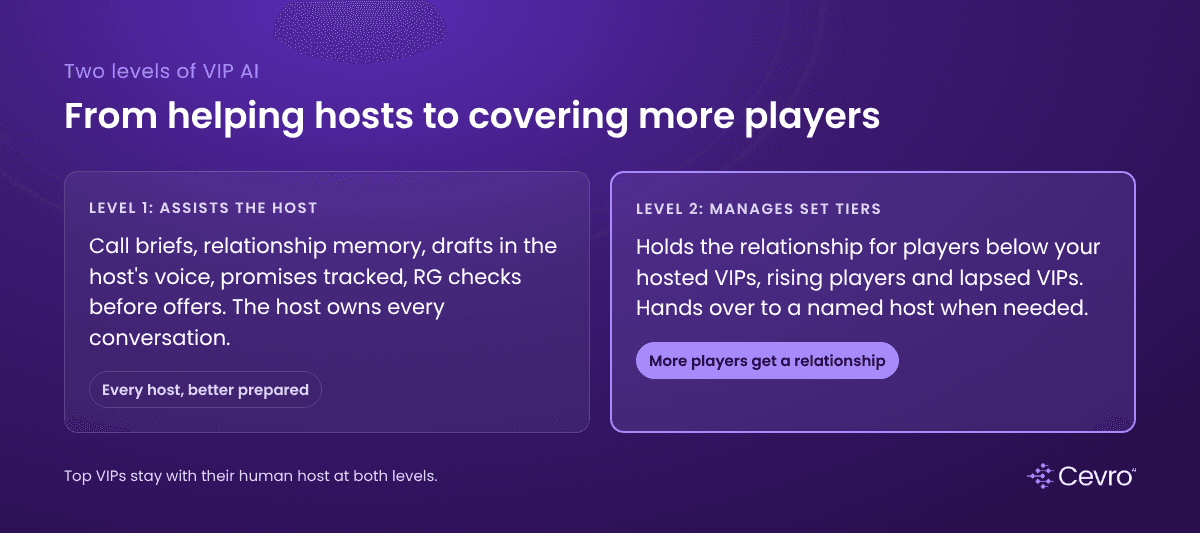
Level 1 makes every host better. Level 2 gives the uncovered tiers a relationship.
Level 1: AI that helps VIP managers run their relationships
The host still owns the relationship and still works from the BI task list. AI does the work around each task.
Before every call: a one-screen brief on what changed since the last contact. Sessions, deposits, a limit change, the offer made last time and how it landed, anything the player mentioned.
Memory that stays with the brand: the club, the family occasion, the complaint from March. Every conversation adds to the player's record, so a rotated or new host picks up where the last one stopped.
Drafts in the host's voice: a check-in or birthday message the host reviews, edits and sends.
Promises tracked: if the host said they would call back on Thursday, the reminder is there on Thursday.
Checks before any offer: RG flags, limits and previous offers, surfaced before the host makes the offer.
This level is low risk and the easiest to start with. Your hosts keep every conversation. They just have more time and better notes.
Level 2: AI that manages relationships for set tiers
Here AI holds the relationship itself, for the players you decide. Usually that means the tier just below your hosted VIPs, rising players who are not yet in a host's book, and lapsed VIPs your team has no time to win back.
At this level the AI picks up the same BI and CRM signals a host would, starts conversations, remembers the player, talks to them in their language at the hour they show up, and follows your procedures on offers and approvals. When a player needs a person (a large goodwill request, a complaint, anything touching affordability, or a player growing into a hosted tier), it hands over to a named host with the full history.
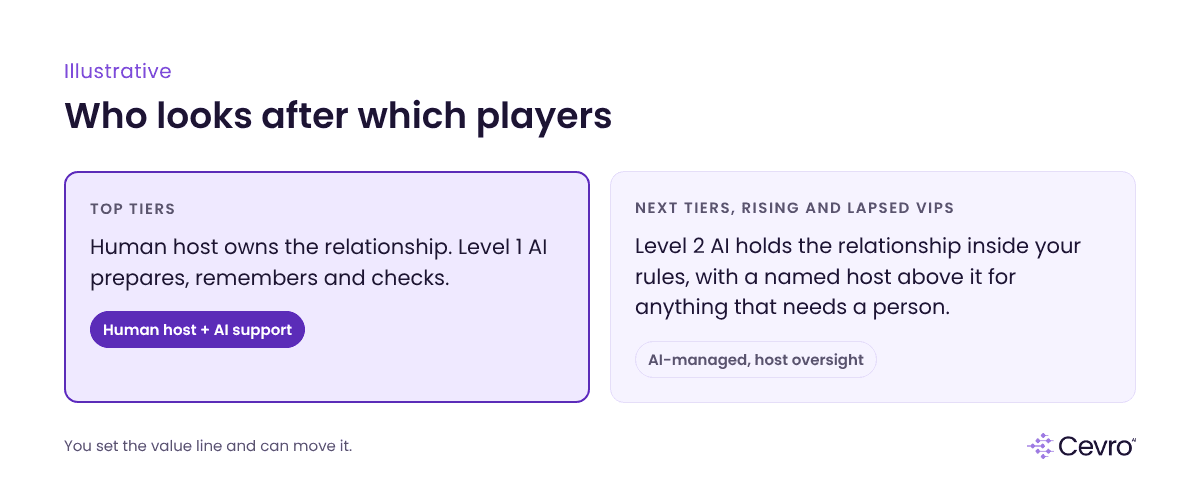
Illustrative split. You set the value line and can move it.
Your top VIP players stay with their human host. We aren't suggesting AI should manage your VIPs. The aim is that every player above a value line gets a relationship of some kind, instead of only the top 40 in each book.
What VIP AI is not
It isn't customer support. Support resolves tickets: a withdrawal question, a KYC document, a bonus that didn't credit. Those are handled by your support team and support AI. VIP AI is about the relationship itself: who to talk to, what to say, what was promised, and how the player is valued over months.
It isn't a churn score or a task list. Your BI and CRM tools already flag players and tell hosts who to contact today. VIP AI helps act on those tasks well, or acts on them for the tiers you choose.
It isn't a replacement for your top hosts. Level 2 covers the tiers you choose. The players who expect a familiar voice keep one.
BI, CRM and VIP AI: what each tool does
Most VIP teams already run on BI and CRM. Here is where VIP AI fits next to them.
BI dashboard | CRM platform | VIP AI (Level 1) | VIP AI (Level 2) | |
|---|---|---|---|---|
Main job | Shows the book and gives hosts a daily task list from the data | Segments players and triggers campaigns | Prepares hosts and remembers every relationship | Holds relationships for set tiers |
Talks to the player | No | One-way (email, push, SMS) | Through the host | Two-way, in the player's language |
Knows the personal history | Numbers only | Campaign history | Yes, from every conversation | Yes, from every conversation |
Who owns the relationship | Host | Host | Host | AI, with a named host above it |
Offers above a limit | n/a | n/a | Host decides | Goes to a host for approval |
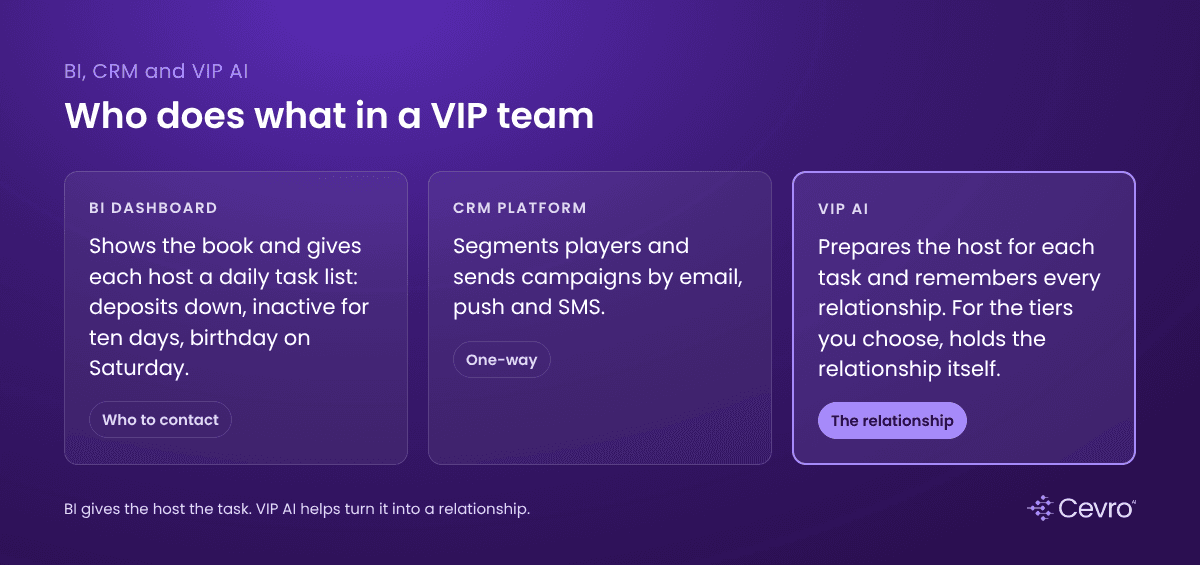
BI gives the host the task. VIP AI helps turn it into a relationship, or handles it for the tiers you choose.
None of these replaces the others. BI and CRM decide who needs attention. VIP AI handles the relationship that follows.
VIP AI and responsible gambling rules
High-value players are where commercial pressure and player protection meet, and regulators know it. In Great Britain, the Gambling Commission's rules for high-value customer schemes came into force on 31 October 2020. Operators must establish that a VIP's spending is affordable and sustainable, check for signs of harm before granting VIP status and keep checking afterwards, keep a full audit trail, name someone responsible for compliance, rotate VIP managers, and pause incentives while harm indicators are being looked into (iGaming Business).
Done right, VIP AI makes these rules easier to follow. At Level 1 it puts RG flags in front of the host before an offer is made and keeps the audit trail without extra admin. At Level 2 it runs on AI Procedures, written rules your VIP lead and compliance team can read and edit, with forbidden actions: no incentive while an RG flag is open, nothing above a set value without a host, every message logged. A gift after a bad losing run is a classic VIP gesture, and it's exactly the moment the rules ask you to check for harm first. Our page on responsible gambling and compliance covers how RG monitoring runs on every Cevro conversation, and our post on AI guardrails covers how those rules are written.
If a VIP AI can't refuse to send a bonus, don't buy it.
How to evaluate VIP AI and VIP player management software
Run every vendor through the same questions.
Which level does it cover? Ask to see Level 1 (host prep, memory, drafts) and Level 2 (relationships for a tier) separately.
Does it remember the relationship? Ask what happens to a player's history when their host is rotated.
Who decides which tiers it manages? You should set the value line and be able to move it.
What does it refuse to do? Ask for the forbidden-action list, and what happens when an RG flag is open.
How does handover work? A host should get the full history and a suggested next step, by name.
Does it fit your existing BI and CRM? It should work from their tasks and signals without asking hosts to live in another tool.
Is every interaction logged against the player? You'll need it for audits.
Which languages, at what quality? Test with your own players' messages.
How do you measure it? Agree on retention, reactivation and deposits against a matched control group before you start.
Getting started
Start with Level 1 for your hosts. It changes nothing the player sees, and within a few weeks you'll know whether your hosts' briefs and notes are better.
Then pilot Level 2 on one tier your team doesn't cover today, such as players ranked 41 to 250 in each book or VIPs lapsed in the last 60 days. Write the procedures with your VIP lead and compliance team, hold back a control group, review every handover with the hosts each week, and compare the two groups after 30 to 60 days.
We believe Cevro is the best platform for this. It runs both levels in one place: host briefs, relationship memory and drafts for your VIP managers, and AI-managed relationships for the tiers you choose. It works on top of the BI and CRM tools your team already uses, in 120+ languages, with AI Procedures your VIP lead can read and RG monitoring on every conversation. In a short consultation we look at how your book is split across hosts today, which tiers get no personal contact, and where Level 1 and Level 2 would help first.
Our player retention page covers how Cevro works on retention, and our CEO's interview on VIP-level experience at scale covers why we built it.
Schedule a consultation with our VIP team →
FAQ
What is the best VIP AI for iGaming operators?
The best VIP AI for iGaming strengthens VIP relationships at two levels. It helps VIP managers prepare, remember and follow up, and it can manage relationships for tiers the team doesn't cover, inside responsible gambling rules and with a human host above it.
Does AI replace VIP managers in online casinos?
No. VIP is a relationship business and your top players should keep their human host. AI helps hosts run their relationships better and can cover tiers that currently get no personal contact.
What is an AI VIP host?
An AI VIP host is AI that manages one-to-one relationships with players in a set tier. It starts conversations, remembers the player's history and preferences, follows your offer rules, and hands over to a named human host when needed.
Is VIP AI the same as AI customer support?
No. Support AI resolves tickets such as withdrawal or KYC questions. VIP AI is about the relationship: who to contact, what was promised and how the player is looked after over time.
How many players should a VIP manager handle?
A workable book is roughly 25 to 80 players per host, depending on tier, and personal knowledge stops scaling at around 150. Most VIP managers carry more than 100, which is where AI helps.
How does VIP AI work with BI and CRM tools?
BI and CRM show who needs attention and give hosts their daily task list. VIP AI acts on those tasks, either by preparing the host or by holding the conversation for a set tier.
Is AI VIP management compliant with UKGC rules?
It can be. UKGC rules require affordability and harm checks, an audit trail, manager rotation and pausing incentives when harm indicators are investigated. The AI should check RG flags before any offer and log every interaction.
Where should an operator start with VIP AI?
Start with AI that supports your hosts, then pilot AI-managed relationships on one tier your team doesn't cover today, with a control group to measure the result.
Related reading on cevro.ai