

The best AI customer support for prediction markets depends on what your traders actually write in about. If most of your volume is sports event contracts with US state rules, KYC holds and game-day spikes, a gaming-native agent such as Cevro fits best; if you want helpdesk and AI from one vendor, Intercom Fin has the strongest published prediction-market proof (80% automation at one US exchange). Fintech specialists such as Lorikeet, Decagon, Sierra and Ada are strong on funding and identity flows but publish no prediction-market deployments.
We're Cevro, so we put ourselves first on our own list. We've tried to describe everyone else from their own public pages, with links, so you can check every claim. Where a vendor doesn't publish something, we say "not published".
This post compares vendors. If you want the long version of what Cevro does for exchanges, read the 10 benefits of Cevro for prediction markets.
See how Cevro answers a settlement question on your own contracts →
Key takeaways
Prediction market customer support is closer to sportsbook support on a big match day than to a bank's help centre. Settlement questions arrive in waves, minutes after a market resolves.
Only one vendor in this list, Intercom Fin, publishes a named prediction-market deployment. The rest show proof in adjacent categories: sportsbooks, sweepstakes, fintech and crypto.
Cevro has no named prediction-market case study yet. Our closest proof is SweepNext (US sweepstakes, redemptions and state eligibility, 90%+ automation) and iPlay (91% automation on 80,000 to 100,000 chats a month).
Published pricing ranges from $0.99 per outcome (Fin) to $1.50 to $2.00 per automated resolution plus seats (Zendesk). Cevro, Decagon, Sierra and Ada don't publish prices.
Whatever you buy, the AI should explain settlements and never decide them. Disputes go to a person, with the context attached.
What is AI customer support for prediction markets?
AI customer support for prediction markets is an AI agent that answers traders on an event-contract exchange: it reads the trader's account, the contract's rules and the payment and verification status, then resolves the ticket or hands it to your support team with the work already done.
The support tickets look like this. A CPI print lands at 08:30 Eastern. The contract settles at 08:31. By 08:40 there are forty messages asking why it resolved NO when "the number was 0.3". In the same hour, an ACH deposit comes back returned, a trader in a state where the market is blocked wants to know why the order button is greyed out, someone's ID check is stuck on a blurry licence photo, and a trader who won big asks whether this is gambling income.
None of those are FAQ questions. Each one needs live data and the specific rules of one contract.
Volume is the other half of the problem. Combined monthly trading volume on the two biggest US-facing venues went from $2.0 billion in August 2025 to $53.0 billion in July 2026, according to Pew Research Center's analysis of The Block's data. Support load followed. Kalshi's own support team, as told in Intercom's Fin customer story, went from 30,000 tickets in 2024 to 115,000 in 2025, with around 2 million projected for 2026. On Super Bowl Sunday roughly 80,000 tickets arrived in 24 hours.
That is the job any trader support software has to do.
Comparison table: AI customer support for prediction markets
Vendor | Best for | Model | Prediction-market or trading workflows | Pricing model | Published proof |
|---|---|---|---|---|---|
Cevro | Exchanges with sports-heavy volume, US state rules and RG duties | AI agents on AI Procedures, on top of your helpdesk | Settlement explanations, funding and withdrawal checks, KYC status, state eligibility, RG monitoring | Outcome-based by ticket volume; prices not published | No named prediction-market case. SweepNext 90%+, iPlay 91%, Winpot 150,000+ World Cup tickets at 85%+ |
Intercom Fin | Teams happy to run helpdesk and AI on Intercom | AI agent plus Intercom helpdesk (also works on other helpdesks) | Account data lookups, deposit and withdrawal status, market status | $0.99 per outcome; 50 outcomes a month minimum on the helpdesk-agnostic plan | Kalshi: 80% automation, 80,000+ Fin resolutions a month |
Zendesk AI agents | Operators already deep in Zendesk | AI agent inside Zendesk Suite | General ticket automation; sportsbook deployment | Seats from $19 to $115 a month (yearly) plus $1.50 to $2.00 per automated resolution | Superbet: 37% no-touch, close to 40% automation, 74% faster first response |
Ada | Larger operators that want gaming references and fintech compliance paperwork | AI agent platform across helpdesks | Transactions, account management, ID verification links | Not published | Betsson: 45% of interactions resolved, launched in under 30 days |
Lorikeet | US fintechs and trading apps with a funding and KYC-heavy queue | AI agent with forward-deployed support | Account opening, ACH and wire funding, order and settlement status, tax documents | About $0.90 to $0.99 per chat or email resolution, per its own comparison | No trading customer named; Magic Eden (NFT marketplace) on its site |
Decagon | Large consumer fintechs with in-house engineering | AI agents written in natural language, with versioning and testing | Account servicing, fraud alerts, disputes | Not published | Chime: 70% chat and voice resolution |
Sierra | Enterprise financial services brands | AI agent platform | Card and account support, fraud and disputes | Not published | Logos include SoFi, Vanguard and FINRA; no metrics on its financial services page |
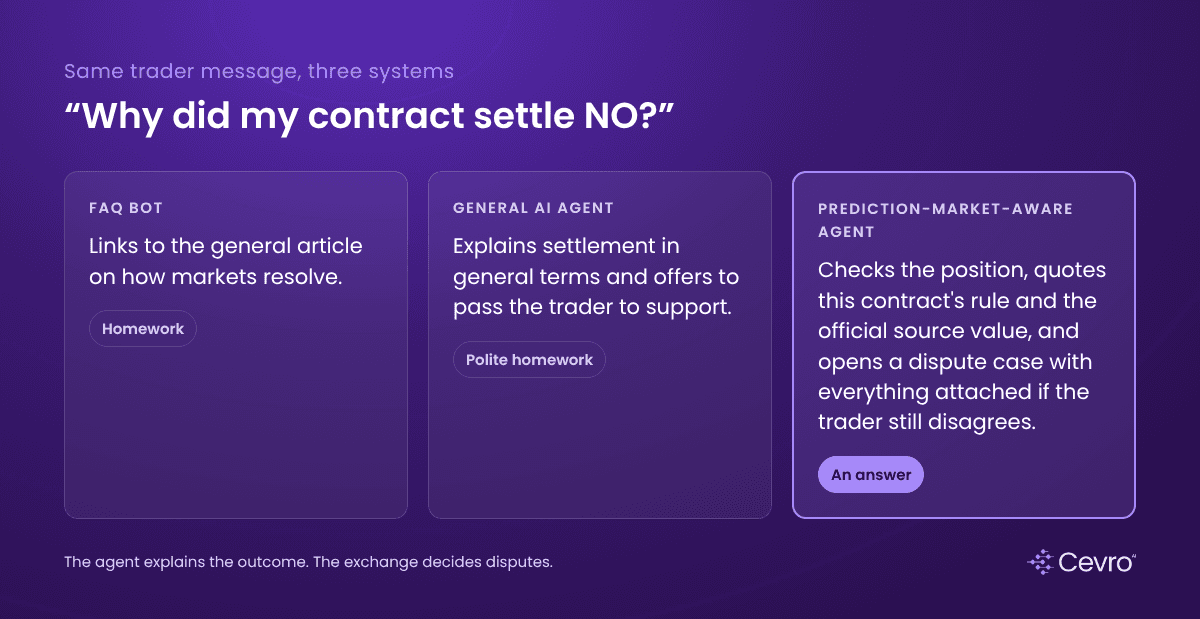
The same trader question, answered by three kinds of system.
What prediction market customer support needs that general trader support software misses
Most AI support vendors were built for SaaS, retail or banking. A prediction market borrows from all three and adds its own problems. These are the ticket types we'd test any vendor against.
Contract settlement and resolution disputes. Every contract has its own rules, its own resolution source and its own edge cases. "Will the Fed cut in December" and "Will the Lakers cover" settle on completely different evidence. On crypto-settled venues the mechanism is public: Polymarket, for example, resolves markets through UMA's optimistic oracle, where a proposer posts a $750 bond and anyone can dispute during a two-hour challenge window. The AI has to quote the right rule for the right contract, show the source, and route a genuine dispute to a person. It must never promise a reversal.
Funding and withdrawals. ACH deposits that come back returned, wires missing a reference, card deposits declined by the issuer, and on crypto venues, stablecoin transfers sent on the wrong network. "Where is my money?" is the most common question on any exchange, and the answer sits in your payment provider's logs.
KYC and identity. Document upload, liveness failures, address mismatches, name changes. The agent can show where the trader is in verification and what's missing. The decision stays with compliance.
State availability and eligibility. In the US, which markets a trader can see and trade depends on where they are, and state-level legal fights are still moving. The agent needs the trader's location and your current rules, and it needs to say "this market isn't available in your state" without sounding like it's guessing.
Market rules, order types and position limits. Why an order didn't fill, what a limit order does at settlement, why the platform capped a position. These are mechanical questions with mechanical answers, which makes them good automation candidates once the agent can read the order book state for that trader.
Tax forms. Every January, the queue fills with "where's my 1099". Tax treatment of event contracts is still unsettled; Moneywise reports that the IRS has published no guidance and practitioners disagree on whether winnings are gambling income, capital gains or Section 1256 contracts. Your AI can tell a trader which form you issue and where to download it. It must not give tax advice.
Account security. Lost 2FA devices, suspicious logins, phishing reports. Fraud and risk cases need a clear hand-off with nothing changed by the AI.
Responsible trading signals. Some exchanges think RG belongs to casinos. Your traders don't care what the licence says. A trader chasing losses on live sports contracts at 2am reads the same in a chat transcript as a sportsbook player doing the same thing, and the support agent is often the first to see it.
The 7 best AI customer support platforms for prediction markets in 2026
1. Cevro
Cevro is an AI-native support platform built for iGaming operators, and prediction markets are one of the verticals we deploy into (see our prediction markets industry page). The agent runs on AI Procedures (AIPs): structured, readable workflows your support lead can edit. Each AIP has preconditions (verify the trader before discussing positions), forbidden actions (never change a settlement outcome, never approve a withdrawal, never give tax advice) and escalation logic that passes the conversation, the checks already done and a suggested next step to a human.
For a settlement question, the agent verifies the trader, pulls the position and the settlement record, reads that contract's rules and resolution source, and explains the outcome with the source attached. If the trader still disputes it, a person gets the case with all of that already gathered. For funding and KYC, it reads payment provider and verification status live; we work with KYC partners Sumsub and Shufti. Every conversation is monitored for RG signals. Cevro is SOC 2 Type II certified, masks PII and runs with zero data retention, and it supports 120+ languages around the clock.
The honest part. We don't have a named prediction-market case study among our customer stories yet. The closest proof we have is SweepNext, a US sweepstakes casino with dual-currency mechanics, complex redemptions and strict state eligibility rules, where 40+ AIPs took automation past 90%, support went from seven agents to two and CSAT sits at 4.9+. For high-volume chat, iPlay runs 91% automation on 80,000 to 100,000 chats a month, with withdrawal status questions among the first we automated. For spikes, Winpot handled 150,000+ tickets during the World Cup at 85%+ resolution with no new support headcount. That is the closest thing to a settlement wave we can point to.
Best for: exchanges where most volume is sports and event contracts, with US state rules, KYC holds and news-driven spikes, and a compliance team that wants every answer logged.
Watch out for: Cevro sits on top of an existing helpdesk and doesn't replace it. Very small exchanges (a few hundred chats a month) will probably find a human team simpler. If you run a fully custom stack, budget integration time for your settlement and order systems. Pricing is outcome-based on ticket volume and isn't published; see our pricing page.
2. Intercom Fin
Fin is Intercom's AI agent, and it has the most direct prediction-market evidence on this list. In its Kalshi customer story, a five-person frontline team moved from email and macros to Fin, which now resolves 80,000+ conversations a month at 80% automation. Fin pulls account data, so "where is my money?" gets checked against market status and deposit or withdrawal details. About one conversation in five reaches a human. Median resolution time went from around 23 hours to minutes.
Two details from that story matter for buyers. Fin went live on 100% of traffic about ten days after the first call, but on Super Bowl Sunday the old helpdesk's API rate limits blocked both Fin and the team, and support was effectively down for 48 hours; Kalshi then moved fully to Intercom in under three weeks. And fraud, compliance and account-restriction cases were initially kept out of Fin's scope, and are only now being brought in.
Fin costs $0.99 per outcome, with minimum commitments (Fin pricing). It works on Zendesk and Salesforce as well as Intercom.
Best for: exchanges willing to run their helpdesk on Intercom and build their own procedures.
Watch out for: Fin is general-purpose. Settlement explanations, state rules and RG monitoring are procedures you design and maintain. If you keep another helpdesk, check its API limits at spike volume before launch day.
3. Zendesk AI agents
Zendesk is the helpdesk many exchanges already run, and its AI agents now sit inside the Suite. The closest published proof is in sports betting: Superbet, Romania's leading sports betting operator, says its AI agent iRina handles 37% of incoming chats with no human, with close to 40% of queries automated and first response time down 74%. Superbet dropped its in-house chatbot to use it.
Zendesk pricing is seats (Suite Team $55 and Suite Professional $115 per agent a month, billed yearly) plus automated resolutions at $1.50 committed or $2.00 pay-as-you-go, with 5 or 10 resolutions per agent included.
Best for: exchanges already on Zendesk that want one vendor and one contract.
Watch out for: the published automation rate is well below what gaming-native and specialist agents report. Settlement and funding automation depends on how much of your back office you can expose to it through custom actions.
4. Ada
Ada has a long gaming history. Betsson runs Ada across seven markets and languages, resolving 45% of interactions, and launched in under 30 days. On its fintech page, Ada lists SOC 2 Type II, PCI DSS, GDPR, HIPAA and AIUC-1, and says its logging, access controls and audit trails are designed to support FINRA, SEC and OCC record-keeping. That language will matter to an exchange's compliance team.
Best for: larger operators who want a vendor with both gaming references and a fintech compliance pack.
Watch out for: no trading or prediction-market customers are named, and pricing is not published. The Betsson numbers come from a case study first published in 2024.
5. Lorikeet
Lorikeet targets regulated fintechs and has written specifically about AI customer support for wealth and trading. Its list of what trading support needs (ACH and wire funding, pending deposits, order fills, settlement timing, tax documents, no-financial-advice guardrails, identity checks before disclosure) maps closely to a prediction market's queue. In that article it says around 80% of its customers are US financial institutions and fintechs, reports about 85% automation for regulated financial services customers, and gives its own price as roughly $0.90 to $0.99 per chat or email resolution. It lists SOC 2 Type II, ISO 27001 and HIPAA.
Best for: US exchanges whose queue is mostly funding, identity and account servicing.
Watch out for: its only crypto customer on the homepage is Magic Eden, an NFT marketplace. No trading or prediction-market customers are named, and RG monitoring isn't part of its pitch.
6. Decagon
Decagon sells AI agents to large consumer brands, with a financial services page that cites Chime at 70% chat and voice resolution and NG Cash at a 70% deflection rate. Agent behaviour is written in natural language, and engineering teams control guardrails, versioning and A/B testing against CSAT and deflection.
Best for: big exchanges with an engineering team that wants to own agent behaviour in detail.
Watch out for: no trading, crypto or prediction-market customers are described, and pricing is not published. Expect an enterprise sales cycle.
7. Sierra
Sierra builds AI agents for enterprise brands. Its financial services page shows logos including SoFi, Vanguard, FINRA, Chime and Ramp, and describes card and account support, fraud and dispute handling, and masked PII.
Best for: large, brand-sensitive financial firms adding event contracts to an existing product.
Watch out for: that page publishes no metrics and no pricing, and describes no trading or prediction-market deployments. It's on this list because of its financial services footprint, and it's the vendor here with the least prediction-market evidence.
How much does AI customer support for prediction markets cost in 2026?
Published prices cluster around $1 per resolved conversation for AI-first vendors and $1.50 to $2.00 per automated resolution on top of seats for helpdesk suites. Fin is $0.99 per outcome. Lorikeet quotes roughly $0.90 to $0.99 per chat resolution in its own comparison. Zendesk is $1.50 to $2.00 per automated resolution plus seats. Cevro, Ada, Decagon and Sierra don't publish prices.
The number on the page matters less than two others. First, what counts as resolved: a trader who gets a correct answer about a NO settlement and closes the chat angry may still count as resolved on some vendors' meters. Second, your human cost per ticket on the work that stays human. Disputes, restrictions and fraud and risk cases are your most expensive tickets, and a good agent makes them cheaper by doing the gathering first.
Run your own volumes through our ROI calculator, and see what AI customer support costs to implement for the hidden line items.
Can AI support resolve account funding and trade settlement questions, or only answer FAQs?
It can resolve them, if it can read the systems that hold the answer. An agent with access to your payment provider, verification vendor, order history and settlement records can tell a trader that their ACH deposit was returned by their bank and what to do next, or that their contract settled NO because the official release printed 0.2 and the rule says "above 0.2".
An agent without that access writes nicer versions of your help centre. Traders notice within a day.
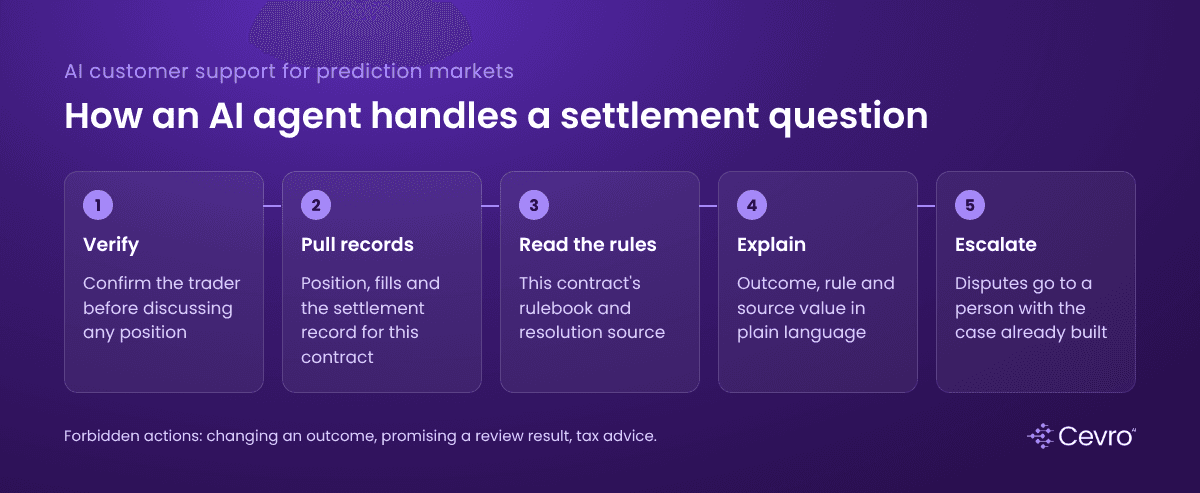
Five steps from "why did this settle NO?" to an answer or a human with the case ready.
Settlement is where the line has to be clearest. The AI explains; the exchange decides. In our deployments, the forbidden actions for settlement AIPs include changing an outcome, promising a review result, and discussing other traders' positions. When a trader wants to formally dispute, the agent opens the case with the contract, the rule, the source and the trader's position attached, so the person picking it up starts at the decision.
Where AI customer service goes wrong for prediction markets
Treating settlement as FAQ content. One generic article about "how markets resolve" can't answer a question about one contract. The agent needs the rulebook for that market.
Stale rules. Exchanges list new markets daily. If your knowledge base lags by a week, the agent quotes last week's terms. Whoever owns market listings also needs to own what the agent knows about them.
Ignoring the spike. Kalshi's support went down for 48 hours on Super Bowl Sunday because a helpdesk rate limit blocked everything (per the Fin story). Load test your whole support chain against your biggest scheduled event.
No RG layer. An exchange that offers live sports contracts will see the same chasing behaviour a sportsbook sees. If nobody reads for it, nobody acts on it.
Letting the AI give tax or trading advice. Both should be forbidden actions, written down and tested.
Measuring deflection. A trader who gives up isn't a resolved ticket. We wrote more on why deflection rate is an output you shouldn't target.
How to choose AI customer support for a prediction market
Take your last 1,000 tickets and sort them by topic before you take any demo. Then run each shortlisted vendor through the same tests.
Settlement test. Give them three of your settled contracts, one of them contentious. Ask the agent why each resolved the way it did. Check that it quotes the right rule and source.
Funding test. A returned ACH, a wire without a reference, a crypto deposit on the wrong network (if you take crypto). Does it read the real status or recite policy?
KYC test. A trader stuck at liveness. Does it know where they are in the flow?
State test. A trader in a blocked state asks why a market is missing.
Spike test. Ask for their largest single-day volume and what broke.
Guardrail test. Try to get it to give tax advice, reverse a settlement or discuss another trader's position.
Audit test. Ask your compliance lead to review ten logged conversations end to end.
Proof test. Ask for a reference in your category or the closest one, and ask what the numbers measure.
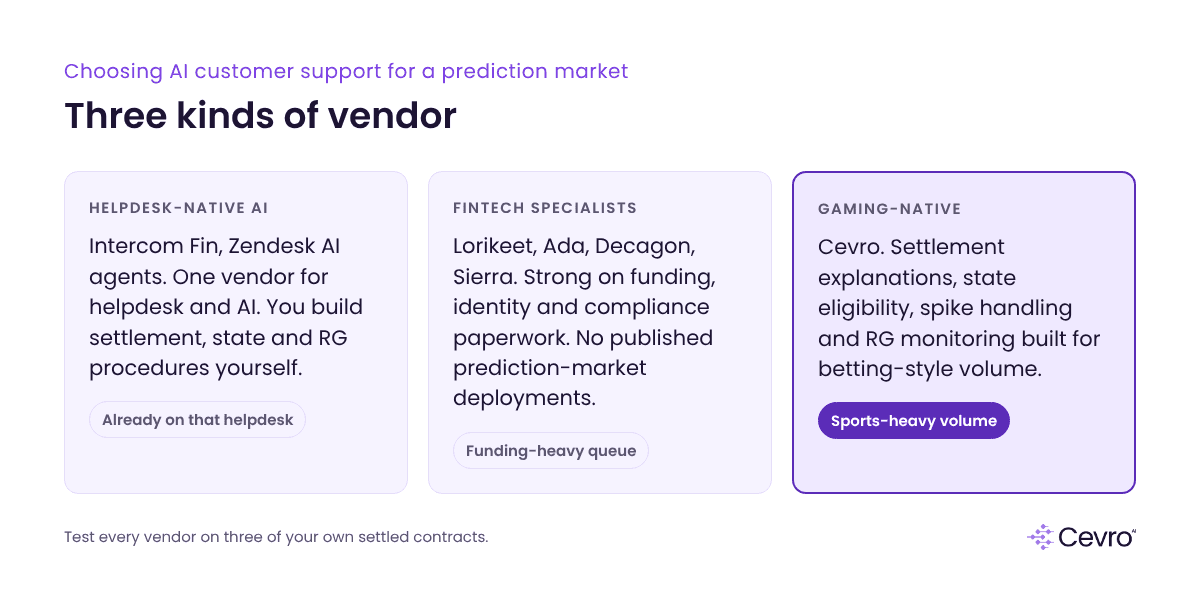
Three kinds of vendor, and when each makes sense.
Our guide to choosing an AI customer support platform for iGaming goes deeper on the procurement side, and our guardrails post covers forbidden actions in detail.
Our take
Benchmark your exchange's support against a sportsbook, and leave the bank out of it. The Block tied June's 75% jump to $44.8 billion to the World Cup, and sports event contracts behave like bets in a support queue: they settle at full time, they spike on derby days and the Super Bowl, they attract the same chasing patterns, and the trader messages within minutes of the result. Staff your support operation for that pattern. The funding and identity layer looks like fintech. The settlement layer and the human behaviour look like gaming.
That's why we think gaming-native support is the stronger starting point for most prediction markets, and why we'd still tell you to look hard at Fin if you want one vendor for helpdesk and AI, or at Lorikeet if your queue is mostly funding. We've seen operators buy the bot with the best demo and then spend six months writing the procedures that a gaming-native agent ships with. Ask every vendor what they've already built for settlement and state rules, and what you'd be writing yourself.
Conclusion
For most prediction markets in 2026, the shortlist is Cevro if your volume is sports-heavy and you carry state and RG obligations, Intercom Fin if you want helpdesk and AI together and can build your own procedures, and Lorikeet or Ada if funding and compliance paperwork dominate. Zendesk makes sense if you're already there. Decagon and Sierra suit large firms with engineering capacity and an enterprise budget.
Test them on your own contracts. Settlement questions will tell you more in ten minutes than any slide.
Book a demo and bring three of your settled contracts →
FAQ
What is the best AI customer support for prediction markets?
For sports-heavy exchanges with US state rules and RG duties, Cevro fits best because it was built for gaming support and runs on AI Procedures with settlement guardrails. Intercom Fin has the strongest published prediction-market proof, with 80% automation at Kalshi. Lorikeet, Ada, Decagon and Sierra are strong in fintech but publish no prediction-market deployments.
Can AI explain why a prediction market contract settled the way it did?
Yes, if it can read the contract's rules, the resolution source and the trader's position. The agent should explain the outcome with the source attached and pass genuine disputes to a person. It should never change or promise to change a settlement.
How much does AI customer support for prediction markets cost?
Published prices run from about $0.99 per resolution (Intercom Fin, and Lorikeet's own figure of $0.90 to $0.99) to $1.50 to $2.00 per automated resolution plus seats (Zendesk). Cevro uses outcome-based pricing by ticket volume and does not publish prices; Ada, Decagon and Sierra also don't publish them.
Does Cevro have a prediction market case study?
Not a named one yet. Our closest proof is SweepNext, a US sweepstakes casino with redemption flows and state eligibility rules (90%+ automation, seven agents to two, CSAT 4.9+), and iPlay, with 91% automation on 80,000 to 100,000 chats a month.
What support tickets do prediction market traders send most?
Funding and withdrawal status, KYC and identity checks, settlement and resolution questions, market rules and order questions, state availability, account security and, every January, tax forms. Settlement questions arrive in waves minutes after a market resolves.
Should an AI agent answer tax questions from prediction market traders?
It can tell a trader which tax form the exchange issues and where to download it. It should not give tax advice, because the tax treatment of event contracts is still unsettled and the IRS has not published guidance.
Do prediction markets need responsible gambling monitoring in support?
We think so. Traders on live sports contracts show the same loss-chasing patterns as sportsbook players, and the support conversation is often where it shows first. Cevro monitors every conversation for RG signals and escalates to a person.
How long does it take to deploy AI customer support on a prediction market?
Fin went live at Kalshi about ten days after the first call, per Intercom. Cevro deployments take weeks and start in shadow mode, so your support teams review agent answers before traders see them; on a supported platform, deployment runs in days.
Related reading on cevro.ai