

The best AI customer support for card breaks and pack opening platforms is the one that can read your vault, buyback and break records, because those three systems sit behind most collector tickets. Cevro is built for that work: it checks a collector's pulls, vault and shipping status, and explains a buyback from your buyback rate and the card's reference value on the day. If you sell break spots through a Shopify store and mostly field shipping questions, Gorgias AI Agent at $0.90 to $1.00 per resolved conversation is the cheaper starting point, and platforms already running Intercom, Zendesk or Kustomer can add those vendors' AI agents.
This is a young category. None of the vendors below, Cevro included, has published a case study from a card break or pack opening platform as of October 2026. So this guide compares what each tool can do with your data, what it costs, and what it will need from your team before it answers a single "where is my pull?".
We write it from the support side of iGaming and sweepstakes, where the tickets look a lot like yours: money in, an outcome decided by chance, a balance or a prize the customer believes is theirs, and a complaint that turns into a chargeback if the answer is vague.
See Cevro answer your collectors' tickets →
Which AI customer support is best for card breaks? The short comparison
Vendor | Best for | Model | Collectibles workflows | Pricing | Proof |
|---|---|---|---|---|---|
Cevro | Rip sites and breakers whose tickets need vault, buyback and break data | AI agent connected to order, vault and shipping systems | Pull and vault status, ship-to-me, grading status, buyback explanations, break spots and pack odds, escalation with stream timestamp | Outcome pricing by ticket volume (pricing) | Adjacent: SweepNext (US sweepstakes) 90%+ automation, 4.9+ CSAT. No collectibles case study published yet |
Intercom Fin | Platforms already on Intercom | AI agent on Intercom or on another helpdesk | You build them with Procedures and Data Connectors | $0.99 per outcome, 50 per month minimum, plus $29 per seat on Intercom | Courtyard's help centre runs on Intercom |
Zendesk AI agents | Platforms with an existing Zendesk team | AI agents inside Zendesk Suite | You build them through integrations | $1.50 (committed) or $2.00 (pay as you go) per automated resolution; Suite Team from $55 per agent a month, billed yearly | Tilt Rips' site loads Zendesk messaging |
Kustomer | Large marketplaces that want a customer timeline across orders | CRM-style helpdesk with AI agents | You build them | Not published | Fanatics Collect's support centre runs on Kustomer |
Gorgias AI Agent | Break shops selling spots through Shopify | Shopify-native helpdesk, AI priced per resolution | Shopify order tracking, edits, refunds. No vault or buyback logic out of the box | $0.90 (annual) or $1.00 (monthly) per AI-resolved conversation | Up to 60% of conversations resolved (Gorgias figure). No collectibles customer named |
Pricing and capabilities are taken from each vendor's own pages in October 2026. "Category use" means we found the tool in the platform's public help centre or page code when we checked on 21 October 2026. It tells you the tool is in use, nothing about how well it performs.
What does card break customer support actually involve?
Three business models share the same support queue, and it helps to separate them.
Live card breaks. A breaker opens a sealed case on a live stream, usually on Whatnot, Fanatics Live or their own channel. Collectors buy spots: a team in a random team break, a pick-your-team slot, or a place in a hit draft. Cards go to whoever owns the matching spot and ship after the break. Whatnot reported more than $8 billion in live GMV for 2025 when it announced its $545 million Series G at a $20 billion valuation, per PYMNTS. Whatnot has separately told Sports Collectors Digest that sellers who run breaks are about 4% of its sellers.
Digital pack openings (rips). The collector buys a pack on a site or app, the pull is revealed on screen, and the physical card, usually graded, sits in a vault. From there the collector can keep it vaulted, ship it home, list it on a marketplace or take an instant buyback offer. Courtyard.io, Arena Club, Fanatics Collect, Rips by Triumph and a long tail of newer sites work this way.
Mystery box sites. Same mechanics with wider prizes: sneakers, electronics and cards, with an exchange or sell-back option for credit.
The support work is the same in all three. A collector paid for a chance at high-value cards, something happened, and now they want to know where the card is, what it is worth, or whether the process was fair. They usually ask the moment the stream ends or the pack reveal finishes. A Tuesday night break that closes at 22:40 has a full queue by 22:55.
What do collectors contact a pack opening platform about?
Our card breaks and pack openings page lists the top five: where their pulls are, buyback value disputes, shipping from the vault, fairness of randoms and odds, and grading and condition questions. In practice the queue breaks down further.
Order status and shipping of pulls
"Where is my Wemby?" is the WISMO ticket of this industry, with one difference: the item is a specific card, and it can be in four places. Revealed but unclaimed. In the vault. At grading. Shipped. A good answer names the state and gives the tracking link. A bad answer says "orders ship in 5-7 business days" to someone whose card has been at the grader for six weeks.
Vaulting and ship-to-me requests
Vault rules vary a lot. Per RotoWire's review of rip apps, one app closes its vault window after 7 days and charges a flat $5 per card to ship, while another offers free vaulting with no time limit. Collectors ask how long they can leave a card, what shipping costs, and whether they can ship ten cards in one parcel. Each of those has a rule, and the agent should apply it.
Buybacks and instant sell-back offers
This is the ticket that turns into a public complaint. Buyback rates across rip sites run from roughly 70% to 100% of fair market value, according to Casino.org's comparison of card rip sites, updated 20 October 2026: Courtyard offers 90% on eligible instant buybacks, Fanatics Collect 90% of market value for 48 hours, and Waffles 70% to 90% depending on loyalty tier. RotoWire reports one app paying 100% in the first two minutes and 90% at the 24-hour mark. Collectors know comps to the dollar. When the buyback value shown is $212 and they saw a sale at $260 yesterday, they want the maths: which reference value was used, from which day, and what rate applied. Where a site publishes a pack's expected value, collectors also compare their pull values against it and ask why their night came in under.
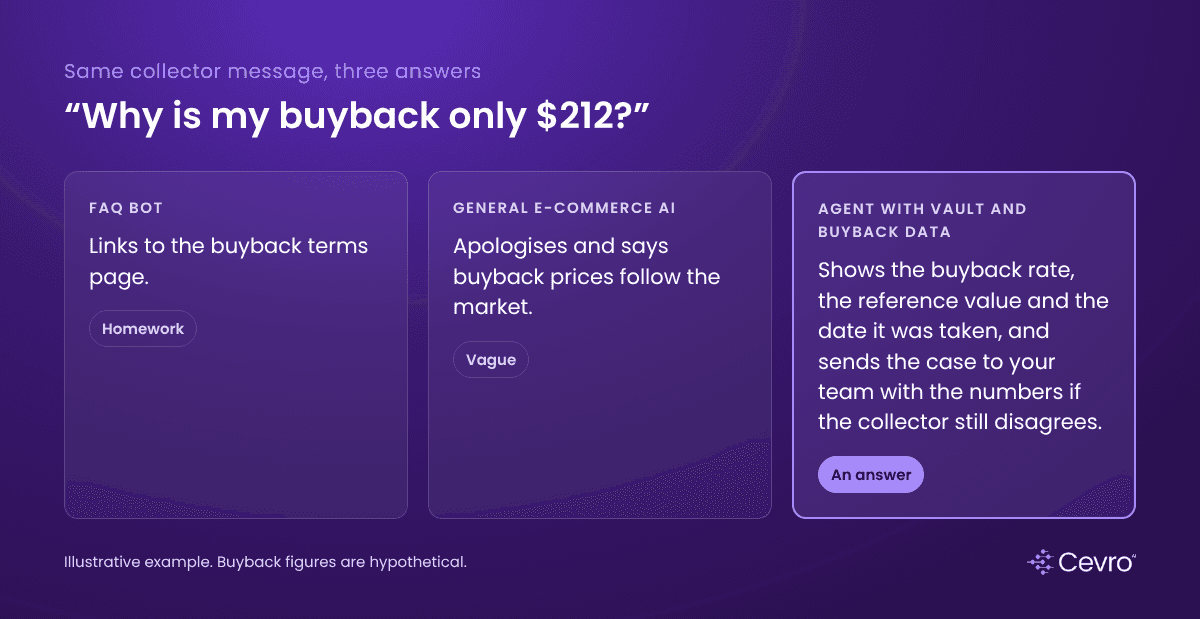
The same buyback question answered three ways.
Duplicate, missing and damaged cards
What happens if you pull a duplicate card? On a rip site it behaves like any other pull: vault it, ship it or sell it back. In a break, duplicates follow the break rules, and "missing" usually means a hit shown on stream that did not arrive in the spot owner's parcel. That ticket needs the break record and the packing list side by side. Damaged on arrival needs photos, the condition at grading and your replacement policy.
Grading submissions
Collectors who send cards for grading, or whose pulls are graded before vaulting, ask for status, turnaround and why a grade came back lower than they expected. The agent can answer status and turnaround from your systems. Disputes about the grade itself belong with your team.
Break spots and team assignment
"How did I end up with the Rockies?" Random team breaks are randomised on stream, and collectors who missed the moment want proof. The answer comes from your published break rules, the randomisation method and the break record, with the stream timestamp attached.
Payments, promotions and chargebacks
Deposits, failed card payments, pack credits, free starter packs, deposit match promotions and loyalty points all generate tickets. Our page makes the point that many chargebacks start with an unanswered question about shipping or value. Answering fast with the real status and the numbers prevents a large share of them, and if a dispute is raised, the logged conversation is your evidence.
Age, eligibility and sweepstakes-style rules
Rip sites increasingly look like regulated gaming products. Casino.org notes that most sites require ID verification (KYC) before withdrawals or larger purchases, and that some products are restricted by US state. Some sites use sweepstakes-style coins and prize redemptions. Support has to answer "why can't I open packs in my state?" and "why do you need my ID?" correctly every time, and it should never improvise on eligibility.
Live-stream break disputes
These are the most sensitive. In March 2026, consumers filed 15 arbitration claims against Whatnot arguing that randomised breaks and repack breaks breach lottery and sweepstakes law, as Sports Collectors Digest reported. Whatnot rejects the characterisation and says gambling is not allowed on the platform. Whatever the outcome, fairness questions are now legal questions as well as customer service ones. Fanatics went as far as hiring KPMG to examine whether its card collation is random, as cllct reported. An AI agent should answer the factual part of a fairness question from the record and pass every dispute to a person.
What do pack opening platforms use for support today?
When we looked at the public help centres and page code of a handful of platforms on 21 October 2026, the tools were familiar e-commerce and SaaS helpdesks:
Courtyard.io: help centre on Intercom.
Collector Crypt: Intercom loaded on the site.
Fanatics Collect: support centre on Kustomer.
Tilt Rips: Zendesk messaging loaded on the site.
Large break shops such as Layton Sports Cards and Jaspy's Case Breaks: storefronts on Shopify, which makes Gorgias the natural helpdesk shortlist for shops of that shape.
None of these vendors markets a collectibles product. Their AI agents are general purpose and do well on order status, returns and account questions. The vault states, buyback maths and break records are yours to wire in. That is the main thing to price when you compare them.
Best AI customer support for card breaks, vendor by vendor
1. Cevro
Cevro is an AI customer support platform built for iGaming, sweepstakes and adjacent operators, with a dedicated setup for card breaks and pack openings. The agent connects to your order, vault and shipping systems. It checks what the collector pulled, whether the card is in the vault, at grading or shipped, and gives the tracking link. Ship-to-me requests are handled in chat under your shipping rules. Buyback questions are answered with the buyback rate and the card's reference value on the day, and disputes go to your team with the numbers. Questions about spot assignment, published pack odds and what happened in a live break are answered from your rules and the break record, and escalations carry the stream timestamp and order.
Under the hood, rules like these are written as AI Procedures: readable, step-by-step workflows with preconditions, forbidden actions and escalation logic, and 100% of interactions logged. Cevro is SOC 2 Type II certified, masks personal data and runs with zero data retention. Deployment runs in weeks and starts in shadow mode.
Best for: rip sites, breakers and mystery box platforms where most tickets need live data from the vault, buyback engine or break record.
Watch out for: our published results come from iGaming and sweepstakes, which share the payment, KYC and fairness questions. SweepNext, a US sweepstakes casino, runs at 90%+ AI support automation with 4.9+ CSAT and went from seven support staff to two. Winpot handled 150,000+ tickets during the World Cup at 85%+ resolution. We have no published collectibles case study yet, so ask us for a shadow-mode trial on your own tickets.
2. Intercom Fin
Fin is Intercom's AI agent. It costs $0.99 per outcome with a 50-outcome monthly minimum, plus $29 per helpdesk seat if you run it on Intercom, and it can also sit on Zendesk or Salesforce, according to Fin's pricing page. Procedures and Data Connectors let it call your APIs and update external systems.
Best for: platforms like Courtyard that already run their help centre on Intercom and have engineers to build the vault and buyback connections.
Watch out for: Fin knows nothing about vaults, grading or breaks until you build it. Budget the engineering time for each Procedure, and test buyback answers hard, because a confident wrong number is worse than a handover.
3. Zendesk AI agents
Zendesk bills AI agents per automated resolution: $1.50 on a committed plan or $2.00 pay as you go, on top of Suite seats from $55 per agent a month on annual billing, per Zendesk's pricing page. Each plan includes a small number of automated resolutions.
Best for: platforms with a Zendesk team and macros already in place that want AI on the simple end of the queue first.
Watch out for: as with Fin, collectibles workflows are integration work. Seat costs continue alongside resolution fees.
4. Kustomer
Kustomer is a CRM-style helpdesk that keeps a timeline per customer, with AI agents and an MCP server on its feature list. It does not publish pricing. Fanatics Collect's support centre runs on it.
Best for: larger marketplaces that want orders, conversations and history on one customer record.
Watch out for: pricing is by quote only, and its pricing page does not say whether the AI agents can look up orders or take actions. Ask for a demo on vault and buyback tickets specifically.
5. Gorgias AI Agent
Gorgias is the Shopify-native helpdesk. Its AI Agent handles order tracking, returns, refunds and order edits using live Shopify data, and Gorgias says it resolves up to 60% of conversations. It charges $0.90 per AI-resolved conversation on annual billing or $1.00 monthly, per Gorgias's own information page.
Best for: break shops that sell spots and singles through a Shopify store, where most tickets are "has my break shipped?".
Watch out for: a Shopify order records the break spot. The card itself lives in your break record, and Gorgias has no concept of the vault, the break record or a buyback offer, so those tickets will reach your team.
Also considered: Gladly is a strong retail helpdesk with order status automation, but it names no collectibles customers and does not publish pricing, so we left it off the ranked list.
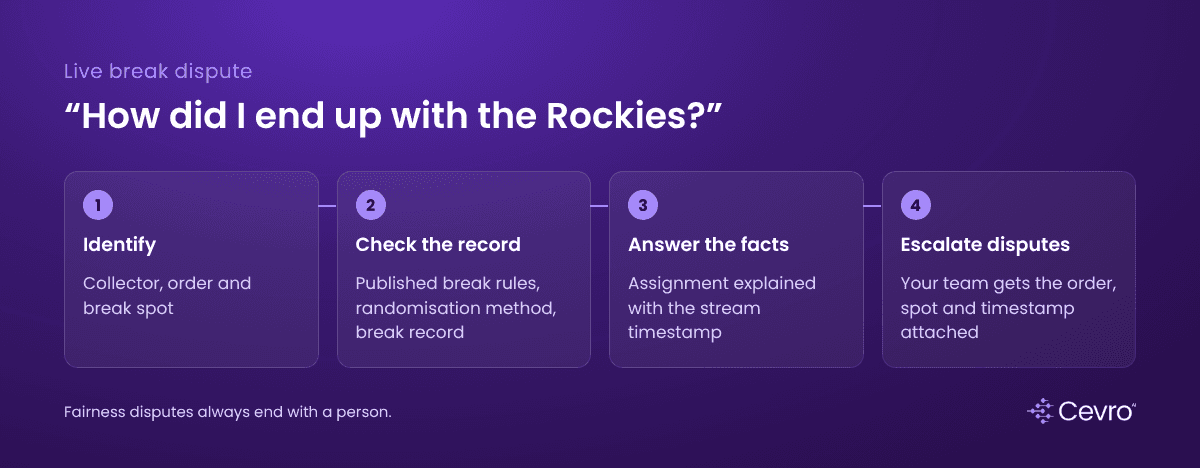
How a break fairness question should move from the agent to your team.
How to evaluate AI customer support for a collectibles marketplace
Run every shortlisted tool against your own tickets. Pull 200 from the last month, weighted to the nights after big breaks and pack drops, and check these:
Pull status. Can it tell revealed, vaulted, at grading and shipped apart, from your data, for a named collector?
Buyback maths. Give it ten disputed buybacks. Does it state the rate, the reference value and the date, and stop there? It should never offer a better price.
Break records. Can it read a break record and quote the stream timestamp for a team assignment?
Eligibility. Ask it, from a restricted state, why packs are blocked. The answer must match your rules word for word.
Duplicates and damage. Does it ask for photos and the order number before promising anything?
Chargeback trail. Is every conversation logged in a form you can attach to a dispute response?
Handover. When it escalates, does your team get the pull, the order, the numbers and the timestamp, so nobody has to ask the collector again?
Cost per resolved ticket. Compare per-outcome prices only after you know how many tickets each tool resolves on your data. A cheap resolution that cannot touch the vault resolves very little.
The ROI calculator works on ticket volume and handling time if you want a quick estimate before a trial.

The states a pull can be in, and what the agent needs from each system.
Where AI should hand over to a human on a rip site
Some tickets should never close without a person. Fairness disputes about a live break. A collector who says a high-value card shown on stream was missing from their parcel. Grade disputes. Any account flagged for chargebacks, self-exclusion or under-age concerns. Requests for a better buyback than the published rate.
The agent's job on those is to collect the facts and route them: the order, the pull, the reference value used, the stream timestamp, photos if there are any. Your team then starts at the decision. On our iGaming deployments the same pattern applies to withdrawals and KYC holds, and it is why our guardrails guide spends more time on forbidden actions than on tone.
A lot of platforms in this space treat support as a shipping desk because their first helpdesk came from e-commerce. The tickets that cost you money are buybacks and fairness, and those need data your helpdesk has never seen.
Getting started with AI support for card breaks and pack openings
Start with the tickets you get most and can answer from data you already have: pull status, vault contents, tracking. Add ship-to-me requests once the shipping rules are written down. Add buyback explanations after you have agreed with your team exactly which reference value and date the agent quotes. Leave break disputes as escalations with full context.
With Cevro, deployment runs in weeks. We connect to your order, vault and shipping systems, read your buyback, shipping and break rules, and run in shadow mode first so you can compare the agent's answers with your team's before anything goes to a collector. If you also run sweepstakes-style coins or prize redemptions, our sweepstakes casinos page covers that side, and how to choose an AI customer support platform has the longer evaluation list.
Book a demo with your own collector tickets →
FAQ
What is the best AI customer support for card breaks and pack opening sites?
For platforms whose tickets depend on vault, buyback and break data, Cevro is built for that work and connects to order, vault and shipping systems. Break shops on Shopify can start with Gorgias AI Agent, and platforms already on Intercom, Zendesk or Kustomer can add those vendors' AI agents and build the collectibles workflows themselves.
What is the difference between a card break and a card rip?
In a card break, a breaker opens a sealed case on a live stream and collectors buy spots, such as teams, that decide which cards they receive. In a card rip, the collector opens a pack digitally on a site or app, and the physical card is usually held in a vault until they ship it, sell it back or list it.
Can AI handle buyback disputes on a pack opening platform?
Yes, for the explanation. The agent should show the buyback rate, the reference value and the date used, and pass the case to your team with those numbers if the collector still disagrees. It should never change the offer itself.
What happens if a collector pulls a duplicate card?
On a rip site a duplicate is treated like any other pull: it can be vaulted, shipped or sold back under the platform's rules. In a live break, duplicates follow the published break rules for that format, and support should answer from the break record.
Can AI customer support answer questions about break fairness and team assignment?
It can answer the factual part from your published break rules, the randomisation method and the break record, including the stream timestamp. Disputes about fairness should always go to a person, with the order and timestamp attached.
Do pack opening and mystery box sites need KYC and age checks in support?
Many do. Casino.org reports that most card rip sites require ID verification before withdrawals or larger purchases, and some products are restricted by US state. Support must answer eligibility questions from the platform's rules and route anything involving under-age or self-exclusion concerns to a person.
How much does AI customer support cost for a card break platform?
Published prices in October 2026: Intercom Fin $0.99 per outcome, Zendesk $1.50 to $2.00 per automated resolution plus seats, Gorgias $0.90 to $1.00 per resolved conversation. Kustomer does not publish pricing, and Cevro prices by outcome and ticket volume. Compare cost per ticket actually resolved on your data.
How long does it take to set up AI support for a pack opening platform?
With Cevro, deployment runs in weeks: we connect to your order, vault and shipping systems, read your buyback, shipping and break rules, and run in shadow mode before going live. General helpdesk AI agents can start faster on simple questions, but vault and buyback workflows take integration work.
Related reading on cevro.ai