


AI player support for sportsbooks works when the AI agent reads the player's actual bet slip, the market status and your house rules before it answers, then explains the outcome and hands anything that needs a trader to a trader. Done that way, most sportsbook tickets (settlement timing, void legs, parlay repricing, cash-out questions, free bet terms) can be resolved without a human. Winpot ran 150,000+ tickets through Cevro during the World Cup at 85%+ resolution with no new support headcount.
This guide goes ticket by ticket: what the player asks, what data the agent needs, what AI can close on its own and when it must escalate. We write it from the deployment side. These are the tickets we build AI Procedures for on sportsbook and casino brands.
See how Cevro handles sportsbook tickets on your own bet data →
Key takeaways
Sportsbook tickets are questions about one specific bet. An AI agent that can't open the bet slip will answer the rule and miss the bet.
Settlement delays, void and push legs, parlay repricing, cash-out suspensions, bonus bet terms and live bet rejections are explainable from data. AI can close most of them.
Palpable errors, resettlement requests, stake factoring appeals and "the cash out failed and then the bet lost" complaints go to trading, with a structured packet so nobody asks the player the same thing twice.
The AI should be very good at explaining outcomes and deliberately unable to change them.
Matchday volume is the real test. Plan for the World Cup night. The Tuesday afternoon will look after itself.
What makes sportsbook customer support AI different from casino support?
A casino ticket is usually about the player's account: a deposit, a withdrawal, a bonus, a KYC document. A sportsbook ticket is about an event that may still be running. The question "why can't I cash out?" asked in the 78th minute has a shelf life of about twelve minutes.
Three things change for sportsbook customer support AI, and they change the player experience more than any tone-of-voice setting.
The answer lives in the bet. "Why was my bet voided?" has a dozen possible answers. The help centre lists all of them. The player wants the one that applies to bet ID 48213907, leg 3.
The rules are layered. General betting rules, sport-specific rules, market-specific rules (player props, Asian handicaps, bet builders), promotion terms, and sometimes a jurisdiction's own requirements. A good support agent knows which layer wins. So must the AI.
The stakes are money that the player thinks is already theirs. A settlement dispute is a player who believes they won. Traditional support teams and generic customer service tools handle that with a holding message and a ticket to trading, and the player waits until Monday. That wait is where the complaint escalates, the Trustpilot review gets written and, in the UK, the case ends up at the Independent Betting Adjudication Service.
That last point isn't hypothetical. When the UK press looked at football statistics disputes in 2024, IBAS's Richard Hayler said nearly 300 people had appealed football data bets the previous year and that data disputes made up about 15% of its workload (SBC News, citing the BBC). Those are bet-builder and stat-market settlements, the exact tickets your support queues see on a Saturday night.
We covered the business case for AI on sportsbooks in the top 7 benefits of Cevro for sports betting platforms. This piece is the operational follow-up: the ticket types themselves.
Sportsbook ticket types: what AI resolves and what it escalates
Ticket type | What the player asks | Data the agent needs | AI resolves | Escalate when |
|---|---|---|---|---|
Bet settlement delay | "The game finished an hour ago, why is my bet still open?" | Bet slip, each leg's event status, result feed status, rules on settlement timing | Explains which leg is pending and why (stat review, official result, suspended event) | Event final well past your settlement window; feed shows a result but bet still open |
Void or push leg | "Why was my bet voided?" "Why did my parlay pay less?" | Leg status and void reason code, original and repriced odds, market rules | Names the leg and reason, shows the repriced odds and return | Player disputes the void reason itself (e.g. claims the player did start) |
Cash out not available | "Why is cash out greyed out?" "Why did my cash out fail?" | Cash-out eligibility flags, market suspension log with timestamps, bet type | Explains suspension, ineligible bet type or bonus funds; explains partial cash out | Cash-out request failed and the bet then lost; player claims accepted offer was not honoured |
Palpable error | "You voided my winning bet for an 'obvious error'." | Trading decision record, rule text, original and corrected price | Explains the rule and the outcome once trading has decided | Always before a decision. Any request to overturn |
Bet limits and stake factoring | "Why can I only bet €2.40?" | Account stake factor flag (yes/no), approved wording | Gives approved explanation, routes formal review requests | Player asks for a review, alleges discrimination or mentions a complaint |
Bonus bets and free bets | "Why didn't I get my stake back?" "My free bet expired." | Bonus wallet, token terms (SNR, min odds, expiry), bet history | Explains stake-not-returned, min odds, expiry; reissues voided tokens where your procedure allows | Goodwill outside policy |
Same-game parlay correlation | "Why can't I add this leg?" "Why are the odds lower than multiplying them?" | Bet builder rules, correlation restrictions | Explains correlation and pricing in plain words | Rarely. Pricing complaints go to trading as feedback |
Live bet acceptance | "My bet was rejected." "It said pending then cancelled." | Bet attempt log, delay period, price change, odds-change setting | Explains bet delay, price moves, odds-acceptance settings | Player says a bet showed as accepted and later disappeared |
The pattern in the last column is consistent. AI explains outcomes from data. It escalates whenever the player is asking the operator to change a decision.
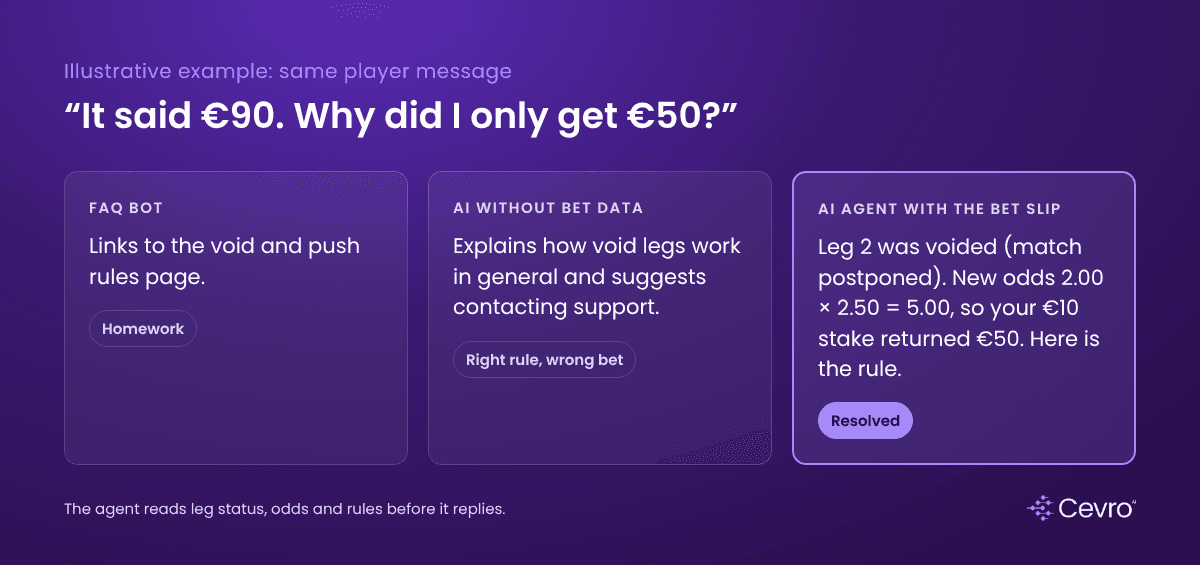
Illustrative example: the difference is whether the agent can open the bet.
Bet settlement delays: "why is my bet not settled?"
What the player asks. "Match ended at 21:50. It's 22:40. Where's my money?" On an accumulator the version is worse: "Four legs won, why is it still open?"
What actually happened. Usually one of five things. A player prop is waiting on the league's official stat correction. The market needs an official result (a race, an award, a tournament winner). The event was suspended or abandoned and isn't final. One leg of a parlay hasn't been played yet, often a late kick-off in another time zone. Or the market was flagged for manual grading.
Saturday, 17:58. A four-leg acca is still open twenty minutes after the last whistle because leg three is "Saka 2+ shots on target" and the stats feed hasn't published. The player has asked twice. The second message has capitals in it.
What the agent needs. The bet slip with every leg, each leg's event status, whether the result feed has published for that market, and your settlement rules (including what happens to abandoned or postponed events and the window after which they void).
What AI resolves. Nearly all of these. "Legs 1, 2 and 4 are settled as won. Leg 3 is a shots-on-target market and settles from the official match statistics, which usually publish within a few hours of full time. Your bet will settle automatically once they do." That message ends the conversation. A generic "bets are settled as soon as possible" starts another one.
Postponed matches deserve a precise answer too. If your rules void an event not played within a set window, the AI should say which window, when it ends for this fixture, and what the parlay will pay if that leg voids.
Escalate when. The event has been officially final well beyond your settlement window, or the feed shows a published result and the bet is still open. That's a system issue, and trading wants to know about it fast because it rarely affects one bet. Resettlements (a graded bet that gets reversed after a stat correction) also go to a human, unless your procedure lets the AI explain a resettlement that trading has already made.
Why was my bet voided? Void and push legs, and how parlays reprice
What the player asks. "Why was my bet voided?" "One leg of my parlay is void, what happens?" "It said €90, I got €50."
The usual reasons. A player in a prop didn't take part. The match was abandoned or postponed beyond the rules' window. The line landed exactly on the number (a push). A related-contingency combination slipped through. A palpable error. A rule breach on the account.
How a parlay reprices. In a standard parlay or acca, a void or push leg drops out and the bet is recalculated on the remaining legs. Take a three-leg acca at 2.00, 1.80 and 2.50. Combined odds 9.00, a €10 stake returns €90. The 1.80 leg is voided because the match was postponed. New odds: 2.00 × 2.50 = 5.00. Return: €50. The bet didn't lose €40. It became a smaller bet.
Players get this wrong constantly, and it's the most fixable ticket in the sportsbook queue. An AI agent can show that maths with the player's own numbers in one message.
Asian handicaps add a wrinkle. On a quarter line such as −0.25, a draw means half the stake is refunded and half loses. Inside an acca, that leg settles at a fraction of its price. Your human agents probably explain this badly. Write the AI Procedure once and it explains it the same way every time.
Same-game parlays are different. Some books void the whole same-game parlay when one leg pushes or a player doesn't play, because the correlated price can't be cleanly recalculated. Action Network describes one case where a bettor hit four of five legs and the entire SGP was voided on a push. If that's your rule, the AI must say so plainly and quote it.
What the agent needs. Leg-level status with the void or push reason, original odds, repriced odds, stake and return, and the relevant rule.
What AI resolves. Explaining the reason and the repricing. This is the sportsbook category we'd automate first on any book, because all the data is already there.
Escalate when. The player disputes the fact behind the void. "He came on in the 70th minute" is a claim trading should check, and the AI shouldn't argue about it.

Illustrative numbers from the example above.
Cash out not available, suspended or partial cash out
What the player asks. "Why is cash out not available?" "The cash out button disappeared." "I tried to cash out at 1-0, it failed, then they equalised."
What actually happened. Cash out is an offer, and the offer comes and goes. Markets suspend during a dangerous attack, a penalty, a VAR check, a red card or a feed delay, and cash out suspends with them. Some bet types aren't eligible: bets placed with bonus funds or free bets, certain bet builders, some specials. The offer value changes with the live price, so a player who requested €40 and saw it change to €37 had their request rejected at the old value.
Partial cash out confuses people in a specific way. A player who cashes out 50% of a €20 bet keeps a €10 bet running at the original odds and receives the cash-out value of the other half. When the remaining half loses, they ask where their money went. The AI should show both halves.
What the agent needs. Cash-out eligibility for the bet, the market suspension log with timestamps, the cash-out attempt log, and whether bonus funds or a free bet were involved.
What AI resolves. "Cash out isn't offered on this bet because it was placed with a free bet." "The market was suspended between 77:40 and 79:10 during a VAR review, so cash out was unavailable in that window." "You cashed out 50%. €18.40 was paid at 64:12, and the remaining €10 stake settled as lost."
Escalate when. A cash-out attempt failed and the bet then lost. Even if the suspension log fully explains it, that player is about to become a complaint, and the call on goodwill belongs to a human. Same for "I accepted the offer and it wasn't honoured". The agent hands over the attempt log, the suspension timestamps and the bet outcome so the trader doesn't need to reconstruct it.
Palpable error bets and obvious-error rules
What the player asks. "You voided my winning bet and called it a palpable error." "Your price was wrong, that's not my problem."
What actually happened. Most sportsbooks' rules let them void, or resettle at the correct price, bets taken at a price that was obviously wrong: a decimal slip, the wrong line, a market posted for the wrong period. How far that right goes depends on the jurisdiction. In October 2023 DraftKings posted first-quarter NBA prop lines as full-game markets. In Massachusetts, a little over $4,000 in wagers could have paid about $575,000. The regulator let DraftKings void them but required it to reimburse affected bettors three times their stake, while Connecticut and New Jersey required the bets to be paid (SBC Americas). Same error, three different outcomes.
What the agent needs. Whether trading has made a decision, the decision record, the rule text for the relevant jurisdiction, the original and corrected price.
What AI resolves. Only explanation, after the fact. Before trading decides, the AI confirms the bet is under review, says what the rule allows, and sets an expectation on timing. After trading decides, it explains the outcome, the stake treatment and the complaint route your licence requires.
What the AI must never do. Call something a palpable error. Agree that a price was wrong. Promise the bet will be paid. In our AI Procedures these are forbidden actions, hard-coded, with no prompt that talks the agent out of them. A palp ticket handled badly turns a pricing incident into a regulatory one.
Bet limits and stake factoring
What the player asks. "Why can I only bet €2.40 on this?" "Did you limit my account?"
What actually happened. Max stakes vary by market and by liquidity, so a low limit on a lower-league corner market may be normal for everyone. Separately, many books apply a stake factor to individual accounts.
What the agent needs. Whether the limit is a market limit or an account-level factor, and the wording your compliance team has approved for each case.
What AI resolves. Market-limit questions completely. Account-level questions only with approved wording. The AI shouldn't speculate about why, shouldn't reveal internal risk categories and shouldn't negotiate.
Escalate when. The player asks for a review, alleges unfair treatment or mentions a regulator. Also watch for a gambling problem behind the question. A player who asks for higher limits straight after a run of losses is a responsible gaming signal, and the conversation should be flagged whatever else happens.
Bonus bets and free bet terms
What the player asks. "My free bet won €30 but I only got €25." "Why didn't my bonus bet count?" "Can you refund my bonus bet? The match was cancelled."
What actually happened. Usually stake not returned (SNR): a €5 free bet at 7.00 returns €30 with the stake, €25 without. Or the bet didn't meet minimum odds, used an excluded market, or the token expired. On voided bonus bets, most books reissue the token, sometimes with the original expiry date and sometimes with a fresh one.
What the agent needs. The bonus wallet, token terms (SNR, minimum odds, eligible markets, expiry), and the bet history showing how the token was used.
What AI resolves. Explaining SNR maths, minimum odds and eligibility, and reissuing a voided token when the procedure allows it and the preconditions check out. Bonus tickets are the area where operators already trust automation most. We wrote about the casino side in how to automate bonus requests, and the sportsbook version uses the same preconditions with different terms.
Escalate when. The player wants goodwill outside policy, or the bonus history shows a pattern your bonus-abuse team should see.
Same-game parlay correlation questions
What the player asks. "Why can't I add Haaland to score with Man City to win?" "Three legs at 2.00 each should be 8.00, why is it 5.40?"
What actually happened. Correlation. If Haaland scores, City are more likely to win, so the legs aren't independent and the bet builder prices them together. Some combinations are blocked entirely because they're too correlated to price.
What the agent needs. Your bet builder rules, any blocked-combination list and the betting odds shown on the slip.
What AI resolves. Almost all of it. "These outcomes are linked, so the price reflects that they tend to happen together" is easy to say well. Players accept it more readily from an agent that explains it in their language at 23:10 than from a help article.
Escalate when. Rarely. Persistent pricing complaints go to trading as feedback.
Live bet acceptance delays and rejected bets
What the player asks. "My bet was rejected." "It said pending for ten seconds, then the odds changed." "My bet was accepted and then cancelled."
What actually happened. In-play betting on sports betting apps runs with an acceptance delay so the book isn't taking bets after something has already happened. During the delay the price can move or the market can suspend, and the bet is rejected unless the player's settings accept odds changes. Bets rejected for that reason are frequent on big nights.
What the agent needs. The bet attempt log (time submitted, delay, price at submission and at acceptance, rejection reason), plus the player's odds-acceptance setting.
What AI resolves. Explaining the delay, the price move and where the odds-change setting lives in the app. Players often change the setting on the spot.
Escalate when. The player says a bet showed as accepted and later vanished. That may be a past-post void, a palpable error or a bug, and each one needs a human.
What data does AI player support for sportsbooks need?
Every section above came down to the same short list. If you're evaluating sportsbook customer support AI, ask whether the agent can read these, live, per conversation:
Bet slip at leg level. Bet ID, legs, odds per leg, stake, potential return, bet type, funding source (cash, bonus, free bet).
Market and leg status. Open, suspended, resulted, voided, pushed, with reason codes and timestamps.
Cash-out logs. Eligibility, offers shown, attempts, partial cash outs.
Bet attempt logs. Submissions, delays, rejections and reasons.
Rules, in layers. General, sport, market, promotion, jurisdiction. Versioned, so the AI quotes the rules that applied when the bet was placed.
Account flags. Stake factor yes/no, RG markers, self-exclusion, KYC status.
Most of this betting data sits in your sportsbook platform and back office, the same support system your agents already click through. We connect to it through your platform's APIs and the integrations we already run. The AI only reads what each procedure allows.

The five steps every sportsbook AI Procedure follows.
What to hand trading: the escalation packet
The usual failure in sportsbook support isn't the escalation itself. It's what gets escalated. A note saying "player disputes settlement, please check" lands with trading, someone opens the back office, finds the bet, reads the chat, works out what the player meant, then asks support to ask the player which leg.
The packet we configure our agents to send has the bet ID and leg, the player's claim in one sentence, the market status and timestamps, the rule the AI quoted, what the AI already told the player, and what decision is needed. Trading reads it in thirty seconds. The player gets an answer the same evening.
This is also where human support gets its time back. On a sportsbook, the people answering "why is my bet still open?" are often the same people who should be handling palp complaints and VIP disputes. When AI handles the first group, the humans get the second.
Matchday load: what a World Cup night does to sportsbook support queues
For iGaming operators with a sportsbook, ticket volume follows the fixture list. A quiet Tuesday and a Champions League Wednesday with eight kick-offs at the same time aren't the same operation, and a World Cup group stage is a different sport again. Hiring for the peak means paying for idle seats the rest of the month, and hiring for the average means the queue melts down exactly when your newest players arrive.
Winpot, an online casino and sportsbook in Mexico, handled 150,000+ tickets through Cevro during the World Cup at 85%+ resolution, with no new support headcount, while also launching in a new market. CasinoPlatform, an online casino and sportsbook platform serving Tier 1 markets across chat, email and voice, reached 88.5%+ resolution at peak across 1,000,000+ tickets and doubled ticket volume in six months while reducing human workload.
Neither number comes from deflecting players to help articles. They come from answering the bet. Our World Cup operational guide covers the staffing and rota side.
Responsible gaming signals inside sportsbook tickets
Sportsbook tickets carry RG signals that casino tickets don't. A player chasing after a voided acca. Someone asking for higher limits at 02:00 after three losing in-play bets. "I need this cash out to work, it's my rent." A request to close the account that is really a request to self-exclude.
Player protection can't depend on a human happening to read the right chat. Cevro monitors 100% of conversations for RG signals and follows your escalation logic when one appears, including on tickets that look like simple settlement questions. More on how we set those limits in AI player support guardrails for iGaming.
How to roll out AI player support for sportsbooks
Start with the explainable tickets. Settlement timing, void and push legs, parlay repricing, SGP correlation, bonus bet terms and live bet rejections. They're high-volume, data-backed and low-risk. Our ticket prioritisation guide has the method.
Write the forbidden actions first. Never declare a palpable error. Never promise resettlement. Never disclose risk categories. Never offer goodwill outside policy. At Cevro these sit in each AI Procedure next to the preconditions, and every interaction is logged.
Version your rules. The AI should quote the rule that applied when the bet was placed, and changes to house rules mid-season otherwise create disputes.
Agree the escalation packet with trading before go-live, and measure their handling time on escalated bets.
Plan for the peak. Go live a few weeks before a major tournament, with enough normal volume to tune procedures before the spike.
If you're also weighing build versus buy, our guide to AI customer support for online casinos and sportsbooks covers the wider platform question, and the iGaming solution page shows how the agent fits your stack. Cevro is SOC 2 Type II certified and supports 120+ languages, so the same procedures answer a parlay question in Spanish in Mexico City at 23:00 and in Portuguese in São Paulo an hour later.
Book a demo with your own sportsbook tickets →
FAQ
Why was my bet voided?
Bets are usually voided because a player in a prop didn't take part, the match was abandoned or postponed beyond the rules' time window, the bet was placed at an obvious pricing error, or the selections were related contingencies. The bet history should show a void reason, and support can confirm which rule applied.
What happens to a parlay if one leg is voided?
In a standard parlay or accumulator the void leg is removed and the bet is recalculated on the remaining legs. A three-leg parlay at 2.00, 1.80 and 2.50 (9.00) becomes 5.00 if the 1.80 leg is void, so a €10 stake returns €50. Same-game parlays may be voided entirely, depending on the book's rules.
Why is cash out not available on my bet?
Cash out disappears when the market is suspended (a goal, penalty, VAR check or feed delay), when the bet was placed with bonus funds or a free bet, or when the bet type isn't eligible. The offer also changes with the live price, so a request at an old value can be rejected.
Why is my bet not settled after the game finished?
The most common reasons are a player prop waiting on official stat corrections, a market that needs an official result, a suspended or abandoned event, or another parlay leg that hasn't been played yet. If the event has been final for longer than the book's settlement window, contact support with the bet ID.
What is a palpable error bet?
A palpable error is a bet accepted at a price that was obviously wrong, such as a misplaced decimal or a line posted for the wrong period. Sportsbook rules usually allow the operator to void the bet or resettle it at the correct price, although some regulators have required operators to pay out or compensate players.
Can AI customer support resettle a disputed bet?
It shouldn't. A well-configured AI agent explains settlement outcomes using the bet slip, market status and rules, and escalates any request to change an outcome to the trading team with the bet details, timestamps and the player's claim attached.
Do bonus bets get refunded if the bet is voided?
Most sportsbooks reissue the bonus bet token when the bet is voided. Whether the original expiry date stays or resets depends on the promotion terms, so the AI agent should check the token terms before answering.
What is sportsbook customer support AI?
Sportsbook customer support AI is an AI agent that answers player questions about bets, settlement, cash out, bonuses and accounts by reading live data from the sportsbook platform and back office. Cevro operators typically resolve 80–90% of player tickets without a human, depending on ticket mix and integration depth.
Related reading on cevro.ai