More than 80% of gambling companies now use generative AI, yet the industry's average AI maturity score sits at just 45 out of 100 and governance scores lowest of all at 30 out of 100, according to The State of AI in Gaming 2026, the inaugural benchmark published in April 2026 by the UNLV International Gaming Institute's AI Research Hub with KPMG, drawing on surveys of 83 gambling companies and 113 regulators.
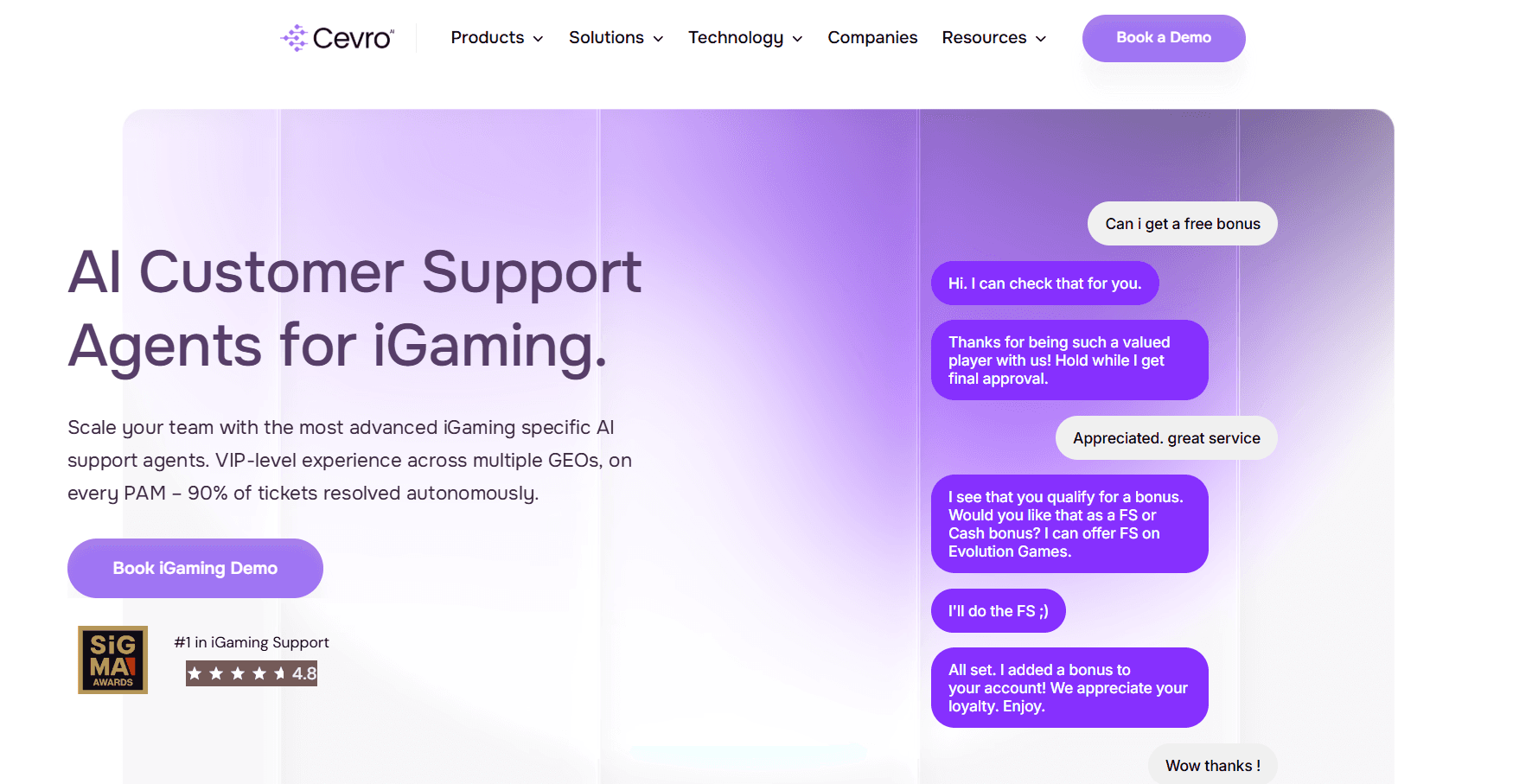
Cevro AI is the AI player support platform built exclusively for iGaming, deploying autonomous AI agents that resolve player queries end-to-end across bonuses, KYC, payments and responsible gaming rather than simply generating text about them.
That distinction defines the current moment: adoption is near-universal but mostly generative rather than agentic, and the same UNLV research notes that agentic systems remain uncommon precisely because of regulatory sensitivity and player protection concerns, in a market that reached roughly $115 billion in gross gaming revenue with 68% of it now regulated.
This article breaks down 12 specific ways artificial intelligence is changing iGaming right now, with the adoption data, cost benchmarks, regulatory constraints and operational proof points behind each one.
Key Takeaways
Over 80% of gambling companies use generative AI, but AI governance scores only 30/100.
Fraud tooling leads adoption at roughly 85%, personalisation 68%, support automation near 60%.
AI-personalised bonuses lift average player spend by an estimated 34% versus blanket offers.
Responsible gaming monitoring moves from 2-7% manual sampling to 100% conversation coverage.
Cevro AI agents resolve up to 90% of player inquiries with CSAT and NPS at 4.8.

The iGaming Market Context: $115 Billion in GGR and Tightening Margins
Global iGaming gross gaming revenue reached approximately $115 billion in 2026, a 12% year-on-year increase from $103 billion in 2025, with regulated markets holding 68% of that total at roughly $78 billion. Online casino remains the anchor vertical at 52% of global GGR, sportsbook at 35%, poker at 7%, and bingo and other verticals at 6%.
Growth is not evenly distributed, and that shapes where AI gets deployed.
Latin America posted the highest regional growth rate at 38%, propelled by Brazil's first full year under the Bets ANGB framework, which delivered around $4.5 billion in year-one regulated GGR across 165 licensed operators.
North America grew 24% on state-by-state rollout.
Europe, the largest single region at $42 billion, grew 8% under the most mature and most restrictive conditions in the market.
Three structural pressures fall out of that picture, and each is an AI adoption driver:
Regulated share is rising: At 68% regulated, most global GGR now sits under frameworks imposing affordability checks, marker-of-harm monitoring, auditable marketing decisions and jurisdiction-specific product rules.
Market entry multiplies complexity: An operator live in Brazil, Germany, Ontario and the UK runs four rule sets, four player protection regimes and often four languages on one platform.
Margins are compressing: Higher tax rates, mandatory deposit limits and affordability friction reduce yield per player, pressuring every controllable cost line including support headcount.
Operators facing all three at once cannot hire their way out. That is the commercial logic behind the adoption numbers below.
AI Adoption in iGaming by Function: Where Operators Actually Deploy It
AI adoption in iGaming is not uniform. It concentrates where regulatory liability is highest and return is most directly measurable.
Function | Adoption 2024 | Adoption 2026 (est.) | Primary use case |
|---|---|---|---|
Fraud detection and payments risk | ~75% | ~85% | Bonus abuse, multi-accounting, payment fraud |
Player personalisation | 68% (end-2024) | ~75% | Game recommendations, bonusing, lobby ordering |
CRM and retention analytics | ~55% | ~70% | Churn prediction, LTV modelling, reactivation |
Responsible gambling monitoring | ~45% | ~65% | Risky-play pattern detection |
Customer support automation | ~50% | ~60% | AI agents, agent assist, multilingual support |
Affiliate program management | 18% | 67% (Q1 2026) | Partner scoring, compliance scanning |
Content and SEO generation | ~35% | ~50% | Localised promos, game descriptions, CRM copy |
Source: Track360, AI in iGaming: Adoption Statistics 2026 (July 2026), consolidating published industry surveys, Gartner and IAB analysis, and Track360 platform estimates.
Two figures matter most:
Personalisation rose from 42% in 2021 to 68% by end-2024, the clearest evidence that AI became a revenue lever rather than a back-office efficiency play.
Support automation, at roughly 60%, is the fastest-growing spend line from a near-zero 2023 base.
Track360 estimates global iGaming AI spend at $2.9 billion in 2026 within a $2.3 billion to $3.4 billion range, derived from technology budgets running 8-12% of GGR with AI line items at 20-30% of technology spend.
Fraud, payments risk and AML tooling take an estimated $870 million, CRM and personalisation engines $780 million, and support automation $440 million.
72% of iGaming companies plan to increase AI investment through 2027.
What Pushed AI From Pilot to Production
Through late 2025 most operator AI was siloed and experimental. Four forces forced consolidation into platform-wide architectures during 2026:
Regulators started grading outcomes, not policies: The UK Gambling Commission's phased affordability check rollout in early 2026 replaced "does a policy exist" with "does monitoring work," requiring real-time tracking of session duration, deposit velocity, loss chasing and time-of-day anomalies. An operator with 500,000 monthly active users cannot review those signals manually.
Fraud outpaced manual defence: Coordinated multi-step attacks rose 180% year-on-year in 2025, and 77% of fraud operations leaders said threats were evolving faster than detection. Two of the three largest loss categories, bonus abuse at 23% and loyalty programme abuse at 18%, involve abuse of the operator's own incentive machinery rather than break-in fraud.
Player expectations hardened: Roughly 32% of customers rarely or never feel understood by chatbots, 30.5% say chatbots rarely answer fully, and more than half always request a human.
Support costs kept climbing: Most support organisations entered 2026 absorbing 3-7% year-on-year labour cost increases while volume grew.
The result is what Cevro calls the difference between an AI that explains a process and one that completes it: "One is a smarter search engine. The other is an operational teammate."

12 Ways Artificial Intelligence Is Changing iGaming
1. Player Support Shifts From Deflection to Autonomous Resolution
The largest operational change is that AI stopped answering questions and started completing procedures.
Rule-based chatbots pull static scripts from keyword triggers. Intent-based bots detect meaning but cannot act.
Generative chatbots produce fluent language from a knowledge base, functioning as sophisticated search engines with no verification against the player's actual account.
Across the whole spectrum the pattern is deflection over resolution, and FAQ bots automate only 10-20% of queries.
Autonomous AI agents work differently. Cevro's AI Procedures (AIPs) are structured, declarative specifications of a workflow, written in constrained natural language, that an orchestration engine interprets and executes step by step with guardrails, built from real operator standard operating procedures rather than FAQ scripts.
Take a missing withdrawal. A generative chatbot explains policy. A Cevro agent verifies identity and session context, queries the payment gateway and account logs, cross-references withdrawal limits, brand policies, KYC status and responsible gaming flags, then either advises on timing or creates a structured back-office ticket with full context. Instead of a generic FAQ answer the player gets: "Your €50 deposit is pending PSP approval, expected in 15 minutes."
Across Cevro deployments this produces up to 90% of inquiries resolved by AI agents, over 80% of requests handled end-to-end, and CSAT and NPS at 4.8 out of 5.
2. Responsible Gaming Monitoring Replaces Sampling With Full Coverage
Manual responsible gaming review covers only 2-7% of interactions. That was defensible when regulators asked whether a policy existed. It is not now that the Malta Gaming Authority mandates monitoring of deposit frequency and reversed withdrawals under its Player Protection Directive, the UKGC has formalised dozens of markers of harm into compliance guidance, and the IAGR has published a 2026 working paper on AI in gambling regulation.
AI moves monitoring to full population. Cevro runs detection across 100% of conversations, identifying distress language, deposit chasing and session escalation, and triggering mandatory human escalation automatically. Pattern classifiers on stake, chase and session data report roughly 90% claimed accuracy in identifying problematic play.
The ethical tension deserves stating plainly. The signals that predict harm, session length, deposit velocity, loss chasing and time-of-day volatility, are almost exactly the variables that predict commercial value. Regulators are answering with purpose limitation: under the UKGC's updated framework, data collected for responsible gambling cannot be repurposed for marketing without explicit opt-in consent, and the Dutch KSA has imposed similar restrictions.
Any AI touching player behaviour needs separate governance for protection and monetisation, because a missed compliance moment is not just a support failure, it is a liability.
3. KYC Becomes Continuous Verification Instead of a One-Time Check
Identity verification used to be a gate at registration. A reported 700% surge in deepfake attacks and a sharp rise in suspicious iGaming transactions turned point-in-time verification into a liability, pushing operators toward continuous behavioural intelligence that keeps running after onboarding.
The support-side impact is significant, because KYC drives heavy contact volume and drop-off exactly when first-time depositor experience determines lifetime value. Cevro's Sumsub integration embeds identity verification directly into its AI infrastructure, enabling autonomous KYC flows in chat: document submission, rejection handling, age and ID verification, and two-step authentication setup.
As CEO Chaim Heber put it: "KYC drives massive contact volume and player drop-off early in the journey. We've already automated 80%+ of tickets, this Sumsub integration makes us the most vertically integrated AI platform for real-world iGaming support."
4. Fraud Detection Moves From Rule Engines to Graph Machine Learning
The most consequential technical change of 2025 and 2026 was migration from threshold-based rule engines to graph-based machine learning. Rules examine accounts in isolation. Graph ML maps the relationship network: shared devices, linked payment methods, overlapping IP clusters, behavioural fingerprints and referral chains.
A lone synthetic account looks clean; the ring it belongs to does not.
Outcomes are strong but contested. AI fraud systems claim up to 95% accuracy on fraudulent transaction detection, self-referral and bonus abuse patterns are detected at roughly 89% accuracy with device fingerprinting, and cloud-based fraud detection reached around 85% deployment among licensed operators by early 2025.
Yet the same generative tooling operators deploy is lowering the cost of document forgery, bot-driven multi-accounting and synthetic identity creation, which is why 77% of fraud teams still say threats evolve faster than detection.
Federated learning emerged as the privacy-preserving answer to the cross-operator data problem: each operator trains on shared signal while player personally identifiable information never leaves its own environment, so a fraud ring detected at one sportsbook can immunize another without a single record changing hands.
5. Bonus Allocation Becomes Value-Based Instead of Blanket
Bonus cost is the largest controllable deduction between GGR and NGR, making promotional allocation one of the highest-leverage places to apply a model. AI-personalized bonuses increase average player spend by an estimated 34% against non-personalized offers, and AI-driven analytics programes report up to 40% improvement in player retention.
The mechanism is simple: allocate promotional spend against predicted lifetime value instead of blanket reload offers, raising yield per bonus and cutting waste on low-value or abuse-prone cohorts.
The support consequence is often missed. Bonus and promotion queries are a top driver of player frustration and churn, and also of retention and LTV. Cevro's AIPs are trained on the operator's full promotional ruleset, so agents verify eligibility, credit missing rewards and handle cashback requests without escalation across use cases including bonus not received, uncredited free spins and loyalty points inquiries. Sophisticated bonusing that generates unresolvable disputes is a net negative. The model and the support layer have to be built against the same ruleset.
6. Sportsbook Pricing and Risk Management Run on Models
Pricing and trading is the oldest and most mature AI application in iGaming. By 2026 over 80% of major operators run AI in production rather than test environments, and in some networks nearly half of bets are already priced by models reacting faster than human traders.
Dynamic odds are reported to cut risk exposure by 15-25%, with markets repriced in under a second.
The bigger change is menu size. AI lets sportsbooks generate and price thousands of micro-markets in real time, supporting in-play and micro-betting formats impossible to trade manually. In mature European markets such as the UK and Italy, in-play already exceeds 55% of sportsbook GGR.
That expansion lands directly on the support queue as bet settlement queries, cash-out requests and live odds disputes, all time-sensitive.
Cevro's iGaming solution handles exactly these high-volume queries that define a sportsbook's support load.

7. Churn Prediction Makes Retention a Proactive Function
Retention has historically been reactive: a player goes quiet, a reactivation campaign fires, most of the value is already gone. Predictive models changed the timing, with churn prediction benchmarks reaching 81% accuracy at a 30-day horizon versus 57% for rule-based thresholds.
Support conversations are among the richest churn signals available, and most operators never read them. Cevro Insights surfaces churn signals from support behaviour, showing which interactions drive churn and issuing prioritised alerts on players needing immediate attention, alongside VIP alerts that fire the moment a high-value player shows frustration.
The measurable version comes from Alpha Affiliates, a tier-one multi-brand operator: "After analyzing chats with and without Cevro, we've already seen at least a 10% increase in player LTV," said Julija Kozireva, Head of VIP at Alpha Affiliates.
Cevro's guide to player retention strategies covers the wider mechanics.
8. Game Recommendations and Lobby Personalisation Become Standard
AI game recommendations lift engagement by roughly 30%, and personalized lobby ordering is now standard at top-tier operators. Personalization extends across every touchpoint: which games surface first, which promotions appear, which content shows, and increasingly what tone a player is spoken to in.
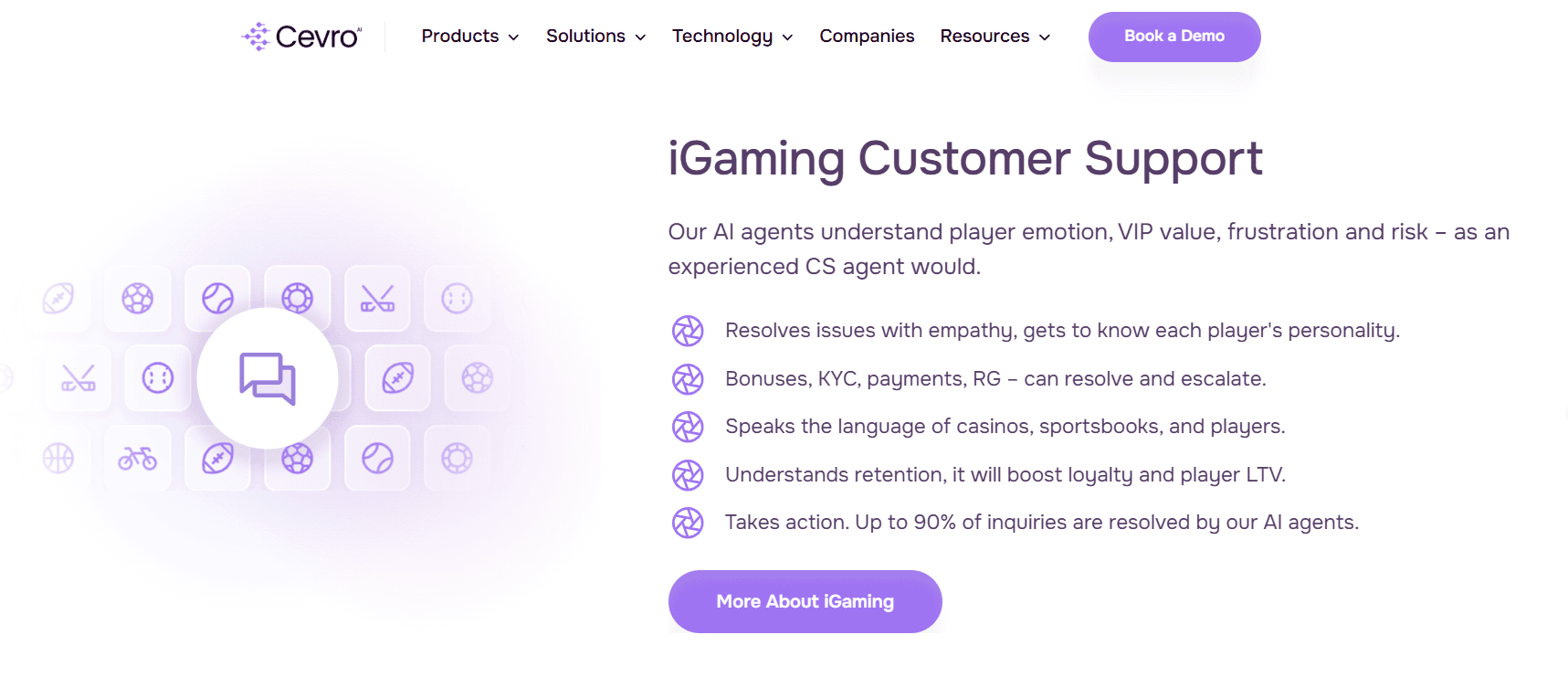
Cevro applies the same principle to conversation. Its agents understand player emotion, VIP value, frustration and risk as an experienced support agent would, adapting to each player's personality rather than delivering one scripted voice.
Chaim Heber's framing captures the commercial logic: "Delivering them an experience that makes them feel special, that makes them feel remembered and important, is something that keeps the player at this casino."
The differentiator is not personalization itself, which is table stakes at 68% adoption and rising. It is whether personalization survives contact with the support queue, where inconsistency is most visible.
9. Payment and Withdrawal Support Gets Resolved at the Source
Payment tickets carry the highest escalation risk of any support category, because delays and missing funds directly affect trust. Historically they were unreachable by automation: a bot could describe withdrawal policy but could not see the transaction.
Back-office integration removes that ceiling. As Cevro's glossary puts it, without back-office integration the AI can only explain; with it, the AI can act. A deposit AIP validates identity, checks payment service provider logs, cross-checks CRM data, evaluates transaction status, then resolves or escalates with full context.
Cevro's integration layer connects to platforms and PAMs including EveryMatrix, SoftSwiss, Vegangster, White Hat Gaming, Playtech and Evolution, alongside Comm100, LiveChat, Zendesk and Intercom.
Escalations dropped 40% in one multi-brand deposit-dispute deployment. Nige Roberts, Cevro's Founding Sales Lead, describes the moment operators see the difference:
"They've seen plenty of AI tools that answer questions. What they haven't seen is an AI that opens the back office, checks the player's account, evaluates the transaction, and resolves the issue. That's not a faster helpdesk. That's a different category of technology entirely."
10. Support Conversations Become a Causal Intelligence Layer
Most operators can say what their metrics are doing. Very few can say why. CSAT drops six points in a region and nobody can explain it. Churn appears in a dashboard with no cause attached. Retention budget chases symptoms because the root cause is buried in ten thousand transcripts nobody has time to read.
Cevro Insights reads every interaction across live chat, calls, tickets, surveys and in-app, clusters them into topics automatically, and turns what is for most operators 90% unused data into a live map of why metrics move. Its capabilities span churn signals, revenue opportunities, procedure gaps, player sentiment, VIP alerts and topic discovery.
Questions operators ask today | Questions they could be answering |
|---|---|
How many tickets came in this week? | What is driving the spike, and which segment is it from? |
What are our most common ticket categories? | Which bonus mechanic is generating the most complaints right now? |
What is our CSAT score? | Which interactions are dragging CSAT down, and which topic causes it? |
Which players churned this month? | Which players show churn signals in their support behaviour now? |
What is our escalation rate? | Which topics generate escalations, and what is the root cause? |
Every ticket category reflects a friction point in the product, payment flow or policy design. Operators treating support as a cost centre miss that intelligence entirely.
11. Multilingual and Multi-GEO Operations Scale Without Per-Market Hiring
Multi-market expansion used to carry a linear headcount cost: new GEO, new language, new shift coverage, new compliance training. AI breaks that linearity, but only when multilingual capability is jurisdiction-aware rather than a translation layer.
Cevro operates across 100+ languages and 50+ markets with automatic adaptation to GEO-specific rules, responsible gaming checks and regulatory nuances, and no per-language retraining.
The proof point comes from multi-brand operations, where agents constantly switch between communication styles, brand voices, languages and operational rules, often within one shift, producing slower response times, inconsistent experiences and growing cognitive load.
When Alpha Affiliates onboarded two new brands simultaneously, generating an additional 6,300 chats in a single month, zero new hires were needed to absorb the surge. Under their previous model that volume would have triggered an immediate recruitment cycle.
For BPOs and managed service providers the same mechanic applies at another level: 80%+ automation potential and 40% workload reduction with CSAT consistently above 4.8.
12. Player Discovery Shifts From Search Engines to AI Assistants
The final change happens outside the platform. Gartner predicted in 2024 that traditional search engine volume would fall 25% by 2026 as AI assistants absorb queries, and Track360 estimates AI-mediated first-touch brand discovery at 8-12% of gambling-related queries by mid-2026, up from under 2% in 2023.
Two consequences follow. Large language models cite statistics pages, comparison tables and regulator data far more often than promotional pages, pushing content strategy toward citable reference assets. And an AI answer naming three brands compresses what used to be a ten-listing results page, concentrating referral value in the sources models trust.
For B2B buyers this is already a pipeline metric, since software selection queries now return AI-synthesised shortlists, making citation share a commercial variable rather than a marketing one.

What AI Actually Costs an iGaming Operator in 2026
Cost is where most AI conversations turn vague. The benchmarks operators are working against:
Human support pay
Average hourly pay for iGaming customer support in the United States was $19.26 as of July 2026, with most roles between $16.11 and $19.95 per hour, per ZipRecruiter. In Europe, Glassdoor places iGaming customer service around €34,000 per year in base salary.
Language is the biggest single pay driver, with Nordic, Dutch, German and Japanese coverage commanding premiums, and shift allowances adding another layer for round-the-clock operations.
Fully loaded cost
Wage is not the operative number. One 2026 analysis puts the fully loaded annual cost of a US support agent at roughly $64,500 once salary, benefits, software, training and attrition are included. Turnover replacement alone averages 35-45% of annual salary per agent lost, and paid idle time often exceeds 20% for in-house teams versus under 10% for outsourced operations.
Cost per ticket
The Office Gurus' 2026 benchmarking report places the global blended average at $8 to $12 per ticket, with North America at $15.56 to $20, Europe at $12 to $18, and Asia-Pacific at $5 to $10. Outsourced support runs $7 to $42 per hour depending on region and agent model, or $1 to $7 per ticket on per-resolution pricing.
In-house AI build
Cevro's analysis of how much iGaming AI Support costs, puts a realistic three-year total cost of ownership in seven-figure territory for a mid-to-large operator, before the 12 to 24 month delay to meaningful ROI.
The eight cost categories are cross-functional team depth, token costs at scale, time to deployment, integration costs, the compliance and safety layer, ongoing model maintenance, opportunity cost, and hidden costs such as multilingual coverage and edge-case handling.
Cevro does not publish pricing. Operators wanting a modelled figure can use the ROI calculator or work through their own volumes in a demo. Against those benchmarks, the deployment numbers read more clearly:
Operator | Automation | Headcount change | Other outcomes |
|---|---|---|---|
91% | 30 to 15 CS agents, in stages | 40% manual support reduction, 80,000 to 100,000 live chats monthly | |
90%+ | 7 to 2, a 71% reduction | 4.9+ CSAT, 40+ AI Procedures live | |
81% | Zero new hires | 4.8+ CSAT, at least 10% LTV increase |
The Governance Layer That Makes iGaming AI Safe to Deploy
The UNLV and KPMG benchmark found governance to be the industry's weakest dimension at 30 out of 100, with only around one in five companies operating a dedicated AI governance role. That gap, not model capability, is the binding constraint on agentic adoption in regulated markets.
In most industries an AI mistake is an inconvenience. In a regulated market it is a reportable event. Four risk categories define the exposure:
Operational errors such as approving an ineligible bonus or unlocking a fraud-suspended account
Compliance risks including RG monitoring failures and GDPR mishandling that can lead to multimillion-euro penalties
Reputational damage from inconsistent responses
Shadow AI, where teams spin up unauthorised tools that bypass IT and compliance entirely.
Cevro's guardrail framework operates across three horizons:
1. Prevention
Every AIP begins with preconditions: player authentication required, no RG flags active, VIP status verified, GEO-appropriate rules applied. Forbidden action lists block high-risk moves outright, including no bonus issuance over predefined thresholds, no KYC overrides, and no withdrawal approvals without human review.
2. Containment
AIPs formalise workflows in structured, human-readable specifications rather than freeform generation. RG checks trigger instant halts and jurisdictional rules dictate exact responses, turning AI support into auditable operations.
3. Observability
Configurable thresholds cover low confidence scores, detected distress sentiment and monetary impact above limits. Every AIP action generates an immutable audit log covering the conversation, the data accessed, the decision made and the action taken, and escalations carry full context including conversation history, system states and decision traces.
This tracks where regulators are heading. MGA auditability requirements favour explainable models over black-box scoring, because operators must show why a bonus, limit or decision was made.
Cevro's posture for enterprise operators is SOC2 Type II audited, EU and GDPR compliant, with PII masking, zero data retention and no model training on client data.
A workable governance structure follows: categorise workflows by risk level, codify escalation protocols so RG signals, AML flags or monetary actions above a set threshold auto-escalate with zero tolerance for override, and form a cross-functional board with compliance, operations, IT and legal representation that reviews procedures quarterly.

How to Sequence AI Adoption Across an iGaming Operation
The most common implementation mistake is treating AI as a later optimisation. By the time volume justifies it, manual habits are entrenched, training data is fragmented, and retraining consumes resources better spent on growth.
Phase | Timing | Actions | Target |
|---|---|---|---|
Foundations | Weeks 1-2 | Draft policies, select low-risk use cases such as password resets and account info, configure basic AIPs with strict escalations | Pilot on 5-10% of English traffic |
Controlled expansion | Weeks 3-6 | Add medium-risk workflows such as deposit checks, introduce multilingual AIPs, tune guardrails from logs | 30-50% automation with 100% monitoring |
Scale with oversight | Months 2-3 | Automate complex procedures, deepen integrations, governance board reviews monthly | 70-80%+ automation across core markets |
Continuous tracking | Weekly | Automation rate, escalation accuracy, compliance incidents, CSAT stability | Iterate weekly |
Ramp expectations matter. Month-one automation on live traffic typically lands at 40-60%, rising to 80-90% on well-defined workflows once mature, and operators handling 100,000+ monthly chats have gone from integration to live in under 30 days.
Sensible starter procedures are password reset and login issues, account locked and verification, missing deposit or balance queries, bonus not received and eligibility questions, responsible gaming situations, and KYC assistance.
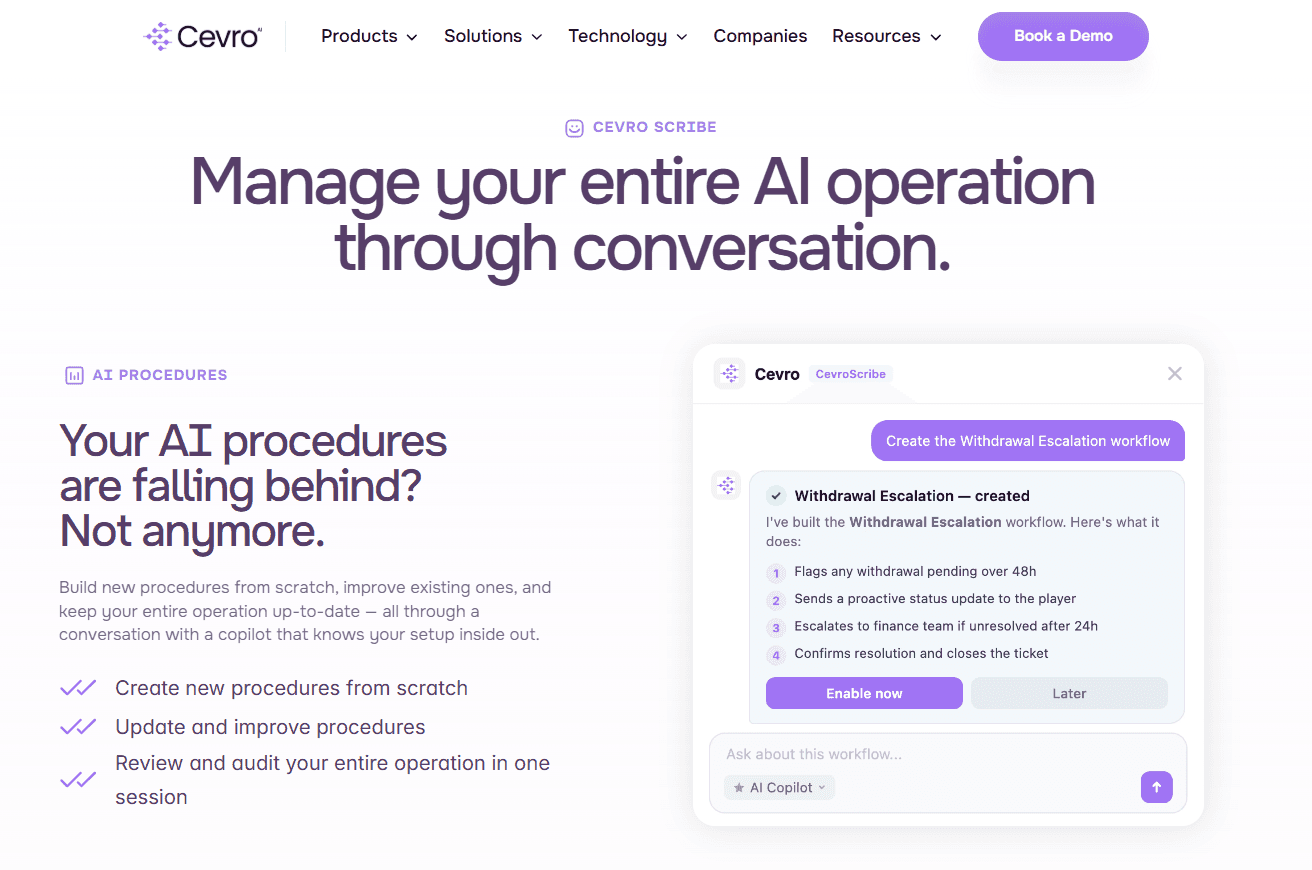
Keeping those procedures current is its own discipline, because bonuses change constantly, payment issues arrive without warning, compliance never stops and new markets bring new complexity.
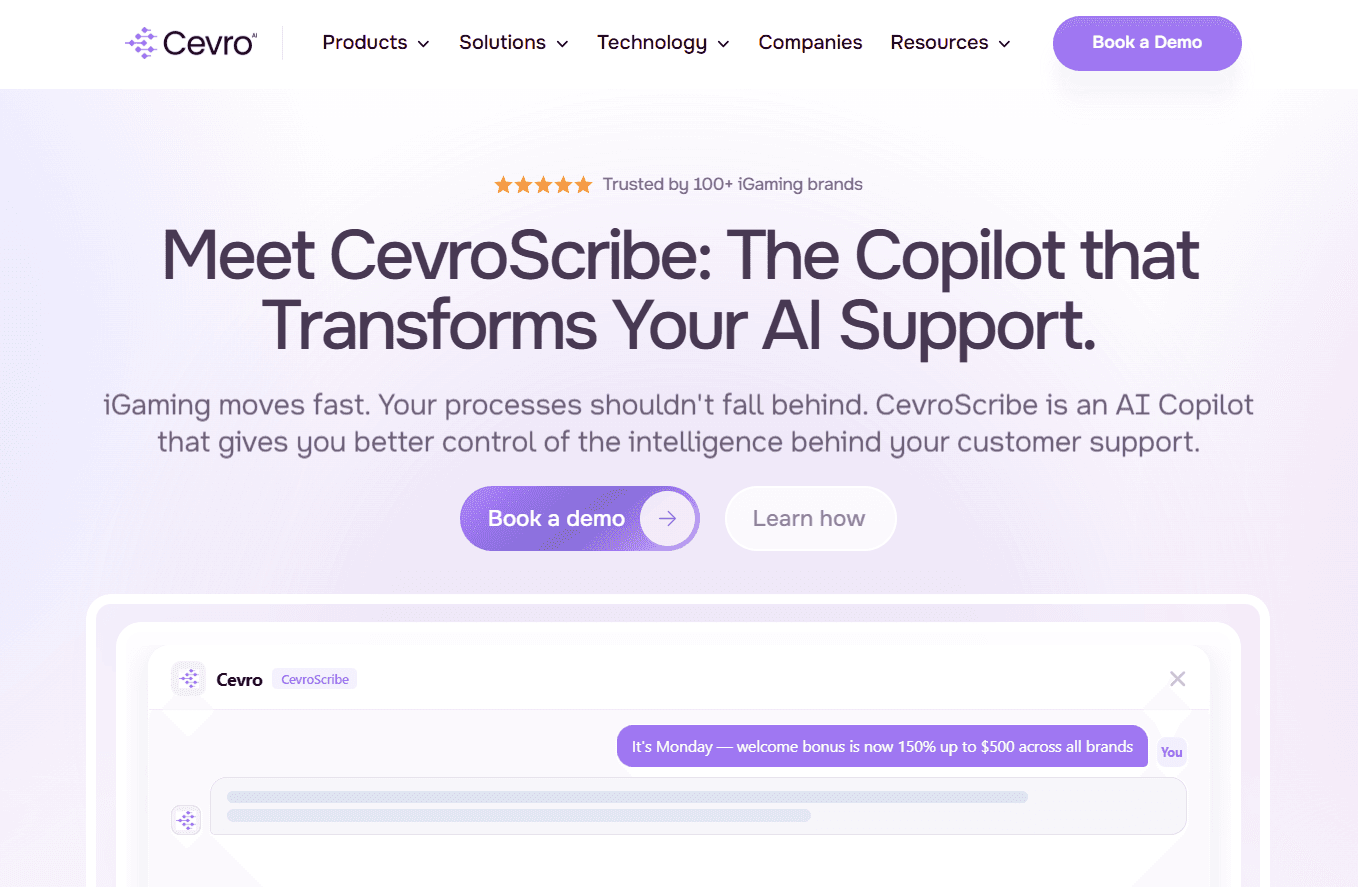
CevroScribe exists for this, letting teams build new procedures, update existing ones, analyse past conversations in bulk to find gaps, and ingest promotion terms, bonus policy updates and compliance documents through conversation rather than a retraining cycle.
What AI Does Not Change in iGaming Operations
Honesty about limits is what makes the rest of the argument credible, so three concessions are worth making.
1. Not every operator needs an agent
For startups or simple FAQ needs, a chatbot suffices. The case for autonomous agents rests on operational complexity: bonuses, payments, KYC and compliance across multiple brands and jurisdictions. Without that complexity the investment is hard to justify.
2. Voice is not yet a solved channel
Cevro operates across chat, email and helpdesk today, with voice on the roadmap rather than live. Any vendor claiming full voice parity with chat in a regulated environment deserves scrutiny.
3. Humans remain critical, and the framing matters
Responsible gaming cases, nuanced complaints and edge scenarios escalate immediately to human agents with full context, letting AI handle scale while humans handle sensitivity. The headcount story is genuinely about role change.
One further limit deserves naming, because it is where most deployments quietly fail. Automated quality assurance, AI evaluating AI at full population scale, is half the product rather than an afterthought.

Conclusion
Cevro AI is the AI player support platform built exclusively for iGaming, deploying autonomous agents that open the back office, check the player's account, evaluate the transaction and resolve the issue rather than explaining where to look for it.
Artificial intelligence now runs through every layer of the industry: pricing and trading, fraud detection, KYC, bonusing, retention modelling, responsible gaming monitoring, player support, and even how players discover brands in the first place.
What separates operators seeing returns from those still running pilots is not model access but operational depth, integration into the real stack, guardrails that hold under regulatory scrutiny, and procedures maintained as fast as the business changes.
If you want to see what that looks like against your own use cases, from first AI Procedure to live traffic, book a demo with the Cevro team.
Read Next:
iGaming 'Post-Bonus' Era: Why CX Is the Retention Engine in 2026
The Most Effective Strategies for Player Retention in iGaming
FAQs:
1. What is AI in iGaming?
AI in iGaming is the application of machine learning and large language models across operator functions including odds pricing, fraud detection, KYC verification, bonus personalisation, churn prediction, responsible gaming monitoring and player support. More than 80% of gambling companies now use generative AI, according to the UNLV and KPMG State of AI in Gaming 2026 report, though the industry's average AI maturity score is 45 out of 100.
2. How is artificial intelligence changing iGaming customer support?
Artificial intelligence is changing iGaming customer support by replacing deflection with resolution. Traditional chatbots automate only 10-20% of queries because they can explain policy but cannot access player accounts. Autonomous AI agents with back-office integration verify identity, query payment logs, check KYC status and complete procedures end-to-end, with Cevro AI resolving up to 90% of inquiries while maintaining CSAT and NPS at 4.8.
3. What percentage of iGaming operators use AI in 2026?
The percentage of iGaming operators using AI in 2026 is above 80% for at least one production system. By function, adoption sits at roughly 85% for fraud detection, 75% for personalisation, 70% for CRM and retention analytics, 65% for responsible gambling monitoring and 60% for support automation, per Track360's July 2026 consolidation of published industry surveys.
4. Is AI safe to use in regulated iGaming markets?
AI is safe to use in regulated iGaming markets when guardrails are architectural rather than optional. That means preconditions before every action, forbidden action lists blocking high-risk moves such as KYC overrides and unreviewed withdrawal approvals, immutable audit logs covering data accessed and decisions made, and automatic escalation on responsible gaming signals. MGA and UKGC frameworks increasingly favour explainable models over black-box scoring, and governance remains the industry's weakest dimension at 30 out of 100.
5. How much does AI cost an iGaming operator compared to human support?
AI costs an iGaming operator substantially less than human support at scale, though exact figures depend on volume and channel mix. Fully loaded human agent cost runs around $64,500 per year in the US, with cost per ticket at $8 to $12 globally and $15.56 to $20 in North America. Cevro does not publish pricing, but published deployments report a 3x reduction in support costs and headcount, while an in-house build typically reaches seven-figure three-year total cost of ownership.