Cevros AIPs (AI Procedures Engine): Making AI Agents Execute Real iGaming Operational Procedures


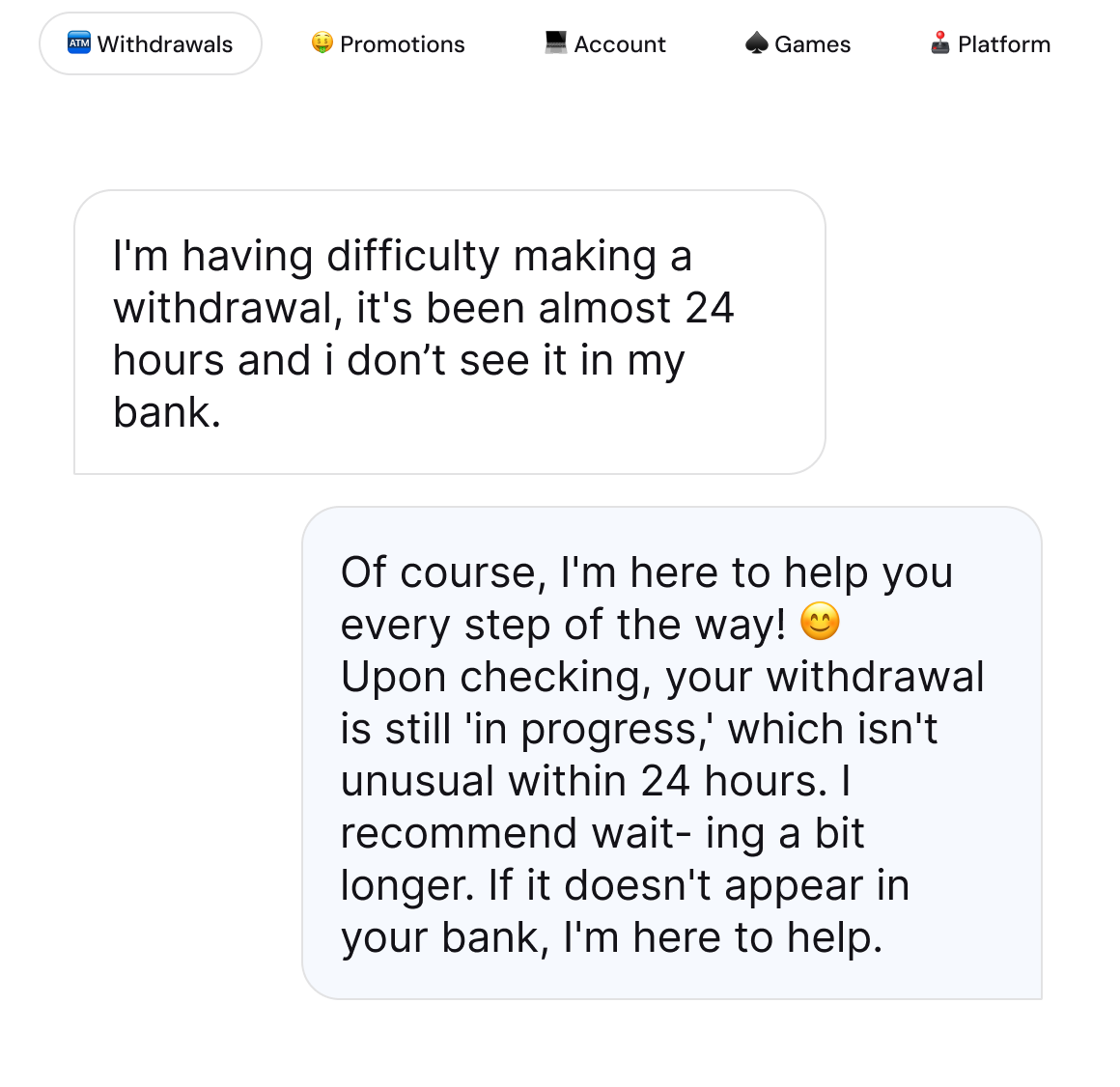
Most of customer support in iGaming — and in any regulated, high-stakes operational environment — isn’t question-answering at all.
It’s procedure execution.
A deposit investigation is not a question.
A failed KYC is not a question.
A disputed bonus eligibility is not a question.
These are structured workflows with branching logic, compliance constraints, conditional checks, system lookups, and escalation rules. They are processes, not pieces of information.
And this is where the first major misconception about AI in support becomes obvious:
you can’t solve a procedural problem with a retrieval-based system.
This is why most “AI support” deployments fail. They treat everything as a search problem, when in reality, most support interactions are operational procedures that must be executed consistently, deterministically, and in compliance with multiple rulesets.
AIPs (AI Procedures) is Cevros innovative answer to this. Designed specifically to address this gap.
1. Why Procedures Are Difficult for Both AI and Humans
Consider a common interaction: a player reports a “missing deposit.”
Resolving it requires the agent (human or AI) to:
- validate identity
- fetch deposit logs across multiple brands
- interpret PSP status codes
- cross-check promo eligibility
- examine screenshots
- check RG/AML restrictions
- determine whether escalation is required
- document the entire resolution trail
This is:
- multi-step
- branching
- data-dependent
- compliance-bound
- and stateful
None of these elements are well-handled by conventional chatbots or by generic RAG systems.
Even human agents struggle to execute these workflows consistently. SOPs typically exist in confluence pages, PDFs, onboarding documents, Slack messages, or institutional memory. They are instructional — not formal, not deterministic, and not machine-executable.
AIPs does much of the work under the hood allowing for CX teams to create procedures in human readable form. It formalizes these procedures so they can be reliably executed by AI agents, with consistency and auditability.
2. What an AIP Actually Is
An AIP is a structured, declarative procedural specification — written in constrained natural language, interpreted by Cevros AI orchastration engine with strict guardrails, and executed step-by-step.
Each AIP includes:
a. Preconditions
Preconditions can be applied to AIPs such as:
"Is this player from a specific GEO"
"What is the players value"
“Player must be authenticated.”
“Account may not be in ‘RG-restricted’ state.”
b. Data bindings
The specific data sources and systems to seamlessly orchastrate from:
- helpdesk ticket fields
- transaction logs
- CRM histories
- bonus engine
- fraud markers
- RG flags
- cross-brand identity mapping
c. Branching logic
Explicit decision rules:
“If transaction is pending for more than X time”
“If player is first time depositor"
d. Forbidden actions
Critical in regulated environments:
“No bonus actions if RG flagged.”
“Do not approve withdrawals.”
e. Escalation rules
When to hand off to payments, fraud, or compliance teams — with required context.
f. Client-facing phrasing constraints
How specific outcomes must be communicated to players.
g. Collaboration with external tools
Does the AI agent collaborate for approvals with other human team members.
In essence, an AIP is a domain-specific procedural language for operational workflows.
3. How AIPs Differ From SOPs, KBs, and Flowcharts
Most organizations already use some combination of knowledge bases, playbooks, flowcharts, and chatbots to standardize operations. Each of these tools solves a specific problem—but none of them can reliably execute procedural work. That gap is where AI Procedures (AIPs) emerge as a fundamentally different class of system.
Knowledge Bases (KBs)
KBs are excellent for storing static facts and reference material. However, they cannot represent conditional logic, branching paths, or multi-step decisions. A KB can describe a policy, but it cannot apply it.
Playbooks / SOP Documents
Playbooks guide humans through processes, assuming the operator makes the right judgment call at every step. In practice, people interpret instructions differently, skip steps, or introduce errors—especially under pressure.
Flowcharts
Flowcharts help visualize simple workflows, but they collapse under real operational complexity. Once exceptions, branching paths, and conditional rules multiply, flowcharts become unreadable and unusable. They also remain passive: they cannot enforce or execute the logic they describe.
Chatbots
Chatbots answer FAQs and deflect basic inquiries. They are not designed to carry out procedures, ensure compliance, or reliably move through a sequence of actions. Their role is conversational—not operational.
AIPs (AI Procedures)
AIPs take a different approach. They formalize, constrain, and execute procedures end-to-end. Instead of relying on a human to interpret instructions, AIPs run the steps deterministically, ensuring consistency, compliance, and repeatability. The only requirement: the underlying SOPs must be accurate and well-defined.
AIPs are not retrieval mechanisms.
They are an execution and orchastration framework.
4. The Operational Value of AIPs in Real Environments
a. Consistency of decisions
Every agent — human or AI — follows the same steps, the same logic, the same conditions. No improvisation, no drift.
b. Embedded compliance
Regulatory rules are part of the procedure.
Agents can’t “forget,” misinterpret, or bypass them.
This prevents:
- incorrect payouts
- misapplied bonuses
- RG violations
- compliance escalation failures
c. Full auditability
AIPs generate deterministic decision traces:
“Data checked → rule triggered → branch chosen → outcome delivered.”
This is invaluable during dispute reviews and regulatory audits.
d. Reduced cognitive load
Agents don’t have to memorize every edge case.
They just follow the AIP or rely on the AI agent executing it.
e. Automation of higher-tier interactions
Because procedures are formalized, AI can perform workflows that previously required L2 or even L3 agents.
5. Worked Example: A “Missing Deposit” AIP
A well-defined AIP for deposit disputes includes:
1. Data validation
- Confirm player identity
- Retrieve PSP logs
- Retrieve CRM history across brands
- Confirm deposit timestamp and amount
2. Branch evaluation
- If PSP = pending → advise waiting, re-check
- If PSP success but CRM mismatch → escalate with context
- If deposit to wrong brand → provide cross-brand mapping
- If fraudulent indicator → route to fraud
- If RG block detected → stop and redirect
3. Evidence parsing
If a screenshot exists:
- extract transaction ID
- extract amount
- validate against logs
4. Resolution generation
- if matched → confirm
- if mismatch → escalate
- if PSP-specific issue → follow PSP path
This is not an answer.
It is a workflow.
And workflows can be executed cleanly only when their structure is formalized.
6. Why AIPs Are Emerging as a Category Across Regulated Industries
This isn’t just happening in iGaming.
- Banks use policy-constrained AI for KYC and credit decisions
- Airlines use procedural agents for rebooking logic
- Telcos use rule-bound workflows for provisioning
- Healthcare uses constrained agents for triage
The pattern is universal:
LLMs are extraordinary reasoning engines,
but operations with regulatory or financial consequences
require deterministic, auditable procedure execution.
AIPs are the mechanism that enables this.
Conclusion: AI Agents Need Procedures, Not Prompts
AIPs are not a chatbot feature.
They are a foundational operational framework.
They turn organizational SOPs — currently stored in documents, tribal knowledge, and human memory — into machine-executable workflows that produce consistent, compliant, auditable outcomes at scale.
And they allow AI agents to behave like real operational staff, not FAQ systems.
For operators, this represents the shift from:
AI as deflection → AI as an operational extension of the business.
It’s the difference between “answering questions” and “executing procedures.”
And in high-variance, high-regulation industries, that difference is everything.
Articles you may be interested in



CX automation shouldn't result in players shouting: "Agent! Agent! Agent!?"